
In an increasingly interconnected digital world, accessing information freely can sometimes feel like navigating a maze. Whether you’re encountering content filters at school, corporate firewalls at work, or nationwide censorship in restrictive countries, the desire to bypass these barriers is common. Many users often stumble upon solutions like Proxyium, a widely recognized free web proxy service, promising a quick and straightforward way to unlock the internet. Its popularity stems from its apparent simplicity and ease of use, making it a go-to for those seeking immediate access without the hassle of software installations.
However, beneath its user-friendly surface lie crucial questions: How does Proxyium truly operate? Is it a genuinely secure option for your online activities? And, perhaps most importantly, what are the superior alternatives available when Proxyium inevitably falls short of more demanding requirements? Understanding these aspects is vital for making informed decisions about your online privacy and accessibility.
This comprehensive guide aims to demystify Proxyium, offering an in-depth review for 2025. We will meticulously break down its operational mechanics, delineate its capabilities and limitations, and conduct a thorough comparison with more robust and secure proxy solutions. Specifically, we’ll contrast its performance and features against advanced options like residential and datacenter proxies, which are designed for serious users and businesses. By the end of this article, you’ll have a clear understanding of when Proxyium is an adequate tool and when it’s imperative to consider more sophisticated alternatives for reliable and secure online navigation.

What Exactly Is Proxyium and How Does It Function?
Proxyium stands out as a prominent free online proxy service, specifically engineered to empower users to navigate around blocked websites without the necessity of installing any specialized software or browser extensions. In essence, it serves as an intermediary, or a “middleman,” positioning itself between your personal device (be it a laptop, smartphone, or tablet) and the target website you wish to access. When you connect through Proxyium, your actual IP address – which typically reveals your geographical location and internet service provider – is effectively masked, presenting the website with Proxyium’s server IP instead.
This fundamental mechanism allows users to bypass various forms of digital censorship and geo-restrictions. When your network administrator or ISP attempts to block a specific website, they typically do so by identifying and blocking its IP address or domain name. By routing your request through Proxyium, your local network only sees a connection to Proxyium’s servers, not the ultimate destination. This simple redirection can often trick the blocking system into granting access to content that would otherwise be inaccessible. It’s a convenient, browser-based solution, making it incredibly accessible for quick, one-off usage scenarios.
Proxyium’s appeal is further amplified by several key attributes:
- Uncomplicated User Interface: Its design prioritizes simplicity. To begin browsing, users merely need to input the desired website’s URL into a designated field on Proxyium’s homepage.
- Encrypted (SSL) Connection: For enhanced security, Proxyium typically employs an SSL connection, aiming to encrypt the data transferred between your device and its proxy server. This basic encryption helps protect your browsing activity from casual snooping.
- Access to Popular Platforms: It is designed with the capability to unblock a broad spectrum of popular websites, including major social media platforms like Facebook, video-sharing giants like YouTube, and popular forums such as Reddit, among others.
- No Account or Login Required: One of its most attractive features is the complete absence of any registration process or login credentials, ensuring instantaneous access without any personal data commitment.
This makes Proxyium an ideal tool for spontaneous, temporary use when you need to quickly check a piece of information or access content without leaving a direct trace of your IP address on the destination server. However, it’s crucial to understand that while it offers a layer of anonymity, this is often rudimentary compared to more advanced solutions.
How Proxyium Works in Detail: The Mechanics of a Web Proxy
At its operational core, Proxyium functions in a manner consistent with most web-based proxy services. When you decide to visit a particular URL using Proxyium, you don’t directly connect to that website. Instead, your browser sends its request to Proxyium’s servers. Proxyium then acts on your behalf: it fetches the content from the target website, processes it, and subsequently relays that information back to your browser. From the perspective of your local network or Internet Service Provider (ISP), the only connection visible is the one between your device and Proxyium’s servers, effectively concealing your actual browsing destination.
This process of intermediation achieves several critical functions, making it a valuable tool for certain use cases:
Key Operational Features and Their Implications:
- IP Masking and Anonymity: One of Proxyium’s primary functions is to obscure your true IP address. By routing your traffic through its own servers, Proxyium ensures that your real IP remains hidden behind its proxy IP. This provides a basic level of anonymity, which can be sufficient for casual browsing or avoiding direct IP tracking by websites. However, it’s important to distinguish this from complete anonymity, as Proxyium itself may log your activity, and its shared IPs can sometimes be identified as proxy traffic.
- Bypassing Geo-Restrictions and Content Filters: This is arguably Proxyium’s most utilized feature. In environments such as school networks, corporate office firewalls, or heavily censored regions, certain websites are blocked based on IP addresses or domain names. By using Proxyium, you leverage its server’s IP address, which may not be subject to the same restrictions. This allows you to circumvent these digital barriers and access a wider range of online content.
- No Downloads or Installations Required: A significant convenience of Proxyium is its entirely browser-based operation. There’s no need to download or install any specific software applications, browser extensions, or configure complex settings. This “plug-and-play” simplicity makes it incredibly accessible for immediate use on any device with a web browser, regardless of administrative permissions or available storage.
While these features offer immediate benefits, the shared and free nature of Proxyium also introduces inherent limitations. Users frequently report inconsistent connection speeds, often experiencing significant slowdowns due to server overload and bandwidth sharing among numerous users. Furthermore, advanced functionalities such as seamless high-definition video streaming, secure login-based applications, or interactive web elements may not function smoothly, or at all. The limited resources and basic infrastructure mean that while simple web pages load, more complex web applications often encounter compatibility issues or performance bottlenecks, diminishing the overall user experience.
Is Proxyium Safe to Use? Assessing the Risks and Benefits
For individuals seeking quick access to basic blocked websites or engaging in light, non-sensitive browsing, Proxyium can be considered relatively safe in the short term. It offers a convenient solution for immediate content access without requiring any personal commitment. However, it’s crucial for users to understand that “safe” is a subjective term when it comes to free online services, and Proxyium comes with a distinct set of limitations and potential risks that warrant careful consideration.
Advantages of Using Proxyium:
- No Signup Needed: The immediate access without any registration process is a major draw, saving time and preserving a degree of privacy by not requiring personal information.
- Quick and Easy to Use: Its intuitive interface means anyone can start using it within seconds, making it perfect for urgent, temporary needs.
- Effective for Basic Access: For simply viewing static web pages or accessing general information on blocked sites, Proxyium performs adequately.
Significant Drawbacks and Risks:
- Limited Privacy and Potential Data Logging: Despite masking your IP address from the target website, Proxyium itself acts as your connection point. As a free service, it likely has financial incentives that might include logging your browsing activity, collecting data, or even injecting advertisements. While it may offer an SSL connection, this only encrypts the traffic between you and the proxy server, not necessarily the data stored or processed by Proxyium. This means your activities might not be as private as you assume.
- No IP Rotation and Shared IP Issues: Proxyium typically uses a limited pool of shared IP addresses. These IPs are used by numerous users, making them easily identifiable as proxy traffic by sophisticated websites and firewalls. Shared IPs are also prone to being flagged, rate-limited, or outright blocked, diminishing their effectiveness for consistent access. Furthermore, if another user abuses the shared IP, it could negatively impact your ability to access sites.
- Unreliable for Sensitive Tasks: Due to the potential for data logging, lack of strong encryption guarantees, and the inherent insecurity of shared, free services, Proxyium is highly unsuitable for any task involving personal or financial data. This includes logging into banking websites, email accounts, social media profiles, or conducting online purchases. The risk of credential interception or exposure is elevated, making it a critical security vulnerability.
- Not Suitable for Automation or High-Volume Use: The unpredictable performance, limited bandwidth, and vulnerability to IP bans make Proxyium entirely impractical for automated tasks like web scraping, SEO monitoring, brand protection, or managing multiple online accounts. Its infrastructure simply isn’t built to handle the demands of consistent, high-volume requests.
In summary, while Proxyium offers a convenient entry point for circumventing basic web restrictions, its inherent limitations in terms of privacy, reliability, and security mean it cannot be trusted for anything beyond casual, non-sensitive browsing. If your needs extend to accessing geo-restricted content consistently, engaging in data scraping operations, managing multiple online accounts, conducting ad verification, or ensuring robust online anonymity, you will unequivocally require a more secure, private, and scalable proxy solution.
Proxyium vs. Other Proxy Types: A Critical Comparison
Understanding the fundamental differences between various proxy solutions is paramount for choosing the right tool for your specific online needs. While Proxyium offers a basic, free entry point, its capabilities pale in comparison to more advanced, dedicated proxy services. Let’s compare Proxyium against residential and datacenter proxies, which represent the industry standards for reliable and secure proxy use. This comparison highlights why investing in a specialized proxy service is often a necessity for serious online activities.
| Feature | Proxyium (Free Web Proxy) | Residential Proxy (e.g., IPFLY) | Datacenter Proxy |
| Free to use | ✅ Yes | ❌ No (paid service) | ❌ No (paid service) |
| Source of IPs | Dedicated proxy servers | Real user devices (ISPs) | Commercial data centers |
| Shared IPs | ✅ Yes (always shared) | ❌ No (unique or rotating per user) | ✅ Often shared (can be dedicated) |
| Speed & Performance | ⚠️ Variable, often slow | ✅ Fast & highly reliable | ✅ Very fast & consistent |
| Anonymity Level | ⚠️ Medium (IP masked, but activity logged by proxy) | ✅ High (real IPs, difficult to detect) | ✅ High (dedicated servers, distinct IPs) |
| Bypass Detection | ❌ Often blocked by sophisticated sites | ✅ Excellent (appears as organic user traffic) | ⚠️ Mixed (easier to detect than residential) |
| Use for Web Scraping | ❌ Not recommended (unreliable, bans) | ✅ Yes (ideal for large-scale, stealthy scraping) | ✅ Yes (good for high-volume, less sensitive scraping) |
| Geo-targeting Capabilities | ❌ No (limited server locations) | ✅ Yes (extensive, 190+ countries) | ⚠️ Limited (major regions/cities) |
| Security & Privacy | ⚠️ Low (potential logging, weak encryption) | ✅ High (private IPs, secure protocols) | ✅ High (private IPs, secure protocols) |
| Stability & Uptime | ❌ Poor, unpredictable | ✅ Excellent, reliable connections | ✅ Excellent, consistent uptime |
As the table clearly illustrates, while Proxyium offers the immediate benefit of being free, this comes at a significant cost in terms of reliability, security, and advanced functionality. Residential proxies, sourced from real user devices, are virtually indistinguishable from organic traffic, making them superior for tasks requiring high anonymity and robust bypass capabilities. Datacenter proxies, on the other hand, offer unparalleled speed and cost-effectiveness for bulk operations where the highest level of IP authenticity isn’t the primary concern. The choice between these options depends heavily on the specific requirements and sensitivity of your online activities.
When to Use Proxyium: Best and Worst Case Scenarios
Understanding the appropriate application of Proxyium is key to leveraging its limited benefits while avoiding its significant drawbacks. It’s a tool with a narrow, specific utility, and attempting to use it for purposes beyond its design can lead to frustration or, more importantly, compromise your online security.
Proxyium is best suited for the following scenarios:
- Bypassing Basic Firewalls at School or Work: For those instances where an institution has implemented simple content filters preventing access to social media, news sites, or certain educational resources, Proxyium can often provide a quick and temporary workaround.
- Quickly Checking a Blocked Website: If you need to access a specific piece of information on a site that is temporarily geo-restricted or blocked in your region for a very brief period, Proxyium can be a convenient solution for a one-off look.
- Accessing Content in Emergencies When No Other Tools Are Installed: In situations where you are on a public computer, a borrowed device, or an environment where you cannot install VPNs or other proxy software, Proxyium offers a browser-based, no-installation alternative.
- Testing Basic Geo-Restrictions: For developers or marketers who need to quickly verify if a website is blocked in a specific region (assuming Proxyium’s server is in that region), it can offer a superficial check.
However, it is equally important to be acutely aware of when Proxyium is demonstrably not ideal and should be actively avoided:
- Logging into Personal or Sensitive Accounts: This is arguably the most critical “don’t.” Any attempt to log into email, banking, social media, or e-commerce accounts via Proxyium carries a substantial risk of your credentials being intercepted, logged, or compromised due to the service’s unknown security practices and shared infrastructure.
- Streaming HD Content or Bandwidth-Intensive Activities: Due to shared bandwidth and often congested servers, Proxyium is incapable of providing the stable, high-speed connection required for smooth high-definition video streaming, online gaming, or large file downloads.
- Scraping Data, Running Bots, or Automation Tasks: Its unreliability, slow speeds, and high susceptibility to IP bans make it entirely unsuitable for any form of automated web interaction, data collection, or bot operation. These tasks demand stable, rotating, and undetectable IPs, which Proxyium cannot provide.
- Business or Enterprise Use Cases: For professional applications such as market research, SEO monitoring, ad verification, competitive intelligence, or brand protection, Proxyium lacks the required reliability, security, scalability, and geo-targeting capabilities. Such tasks necessitate dedicated, high-performance proxy networks.
- Maintaining True Online Anonymity and Privacy: If your primary goal is to ensure robust anonymity and prevent any third party from tracking your online activities, Proxyium’s potential data logging practices and transparent proxy nature make it an insufficient and potentially risky choice.
In essence, Proxyium is a quick fix, not a robust solution. Use it with caution and only for the most basic, non-sensitive tasks.
Better Alternatives to Proxyium: Enhanced Security and Performance
When your online needs extend beyond the rudimentary capabilities of a free web proxy like Proxyium – especially for long-term projects, high-volume operations, or tasks demanding superior privacy and reliability – upgrading to a more sophisticated proxy solution becomes not just recommended, but essential. These advanced proxy types offer unparalleled performance, security, and anonymity, making them indispensable for both individuals and businesses.
1. Residential Proxies from IPFLY: The Gold Standard for Anonymity
Residential proxies are widely regarded as the most powerful and effective type of proxy available, primarily because they route your internet traffic through real IP addresses assigned by Internet Service Providers (ISPs) to genuine residential users. This makes your online requests appear completely organic and legitimate, making it exceedingly difficult for websites to detect that you are using a proxy. Unlike web-based proxies, which are easily flagged, residential IPs blend seamlessly with regular user traffic, effectively bypassing the most stringent bot detection systems, geo-restrictions, and anti-scraping measures. This makes them an ideal choice for a vast array of demanding online tasks.
For individuals and businesses serious about their online operations, residential proxies from a reputable provider like IPFLY offer a significant upgrade. They are perfect for:
- Advanced Web Scraping: Collect vast amounts of data from any website without being blocked or flagged.
- Market Research and Competitive Analysis: Gain unbiased insights into competitor pricing, product data, and advertising strategies from various locations.
- Ad Verification: Ensure your advertising campaigns are displayed correctly and are not fraudulent, by viewing them from different geographic regions.
- SEO Monitoring: Track search engine rankings and local search results accurately from any target location.
- Account Management: Create and manage multiple social media, e-commerce, or online gaming accounts without triggering suspicion.
- Accessing Geo-Locked Content: Reliably bypass geo-restrictions to access streaming services, region-specific content, or restricted websites from anywhere in the world.
Why choose IPFLY for Residential Proxies:
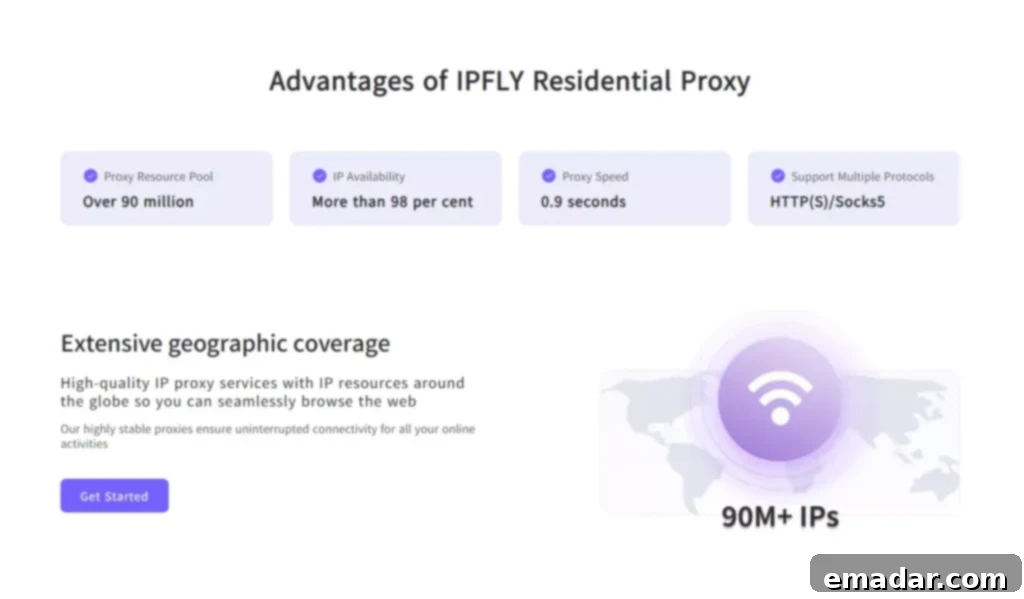
- Extensive IP Pool: IPFLY boasts a colossal network of over 90 million residential IPs, ensuring a virtually limitless supply of fresh, clean IPs to avoid detection and maintain continuous access.
- Dynamic & Static Options: Users can choose between dynamic (rotating) IPs for high-volume scraping and static (sticky) IPs for tasks requiring consistent IP addresses, like account management.
- Precision Geo-targeting: With support for over 190 countries, IPFLY allows granular targeting down to the city level, providing unparalleled control over your virtual location.
- Exceptional Reliability and Uptime: Engineered for performance, IPFLY’s residential proxies offer high uptime and stable connections, crucial for uninterrupted operations.
- Seamless Integration with Automation Tools: Designed to be compatible with a wide range of popular web scraping tools, bots, and automation software, making implementation straightforward for technical users.
For more detailed information and to explore plans tailored to your specific needs, we highly recommend you Learn more about IPFLY Residential Proxies.
2. Datacenter Proxies: Speed and Affordability for Bulk Tasks
Datacenter proxies, unlike residential proxies, do not originate from real residential ISPs. Instead, they are IPs housed in commercial data centers, often provided by large cloud hosting providers. They are known for their exceptional speed and affordability, especially when purchased in bulk. This makes them an attractive option for specific use cases where sheer speed and cost-efficiency are prioritized over the ultra-high anonymity offered by residential IPs.
While generally faster and cheaper than residential proxies, datacenter proxies are also inherently easier to detect by sophisticated anti-bot systems. Websites can often identify that an IP address belongs to a datacenter and may consequently block or challenge the traffic. However, they remain highly effective for:
- High-Volume, Less Sensitive Web Scraping: Ideal for scraping publicly available data from websites that have less aggressive anti-bot measures.
- Bulk Account Creation: Useful for creating a large number of accounts on platforms that don’t have stringent IP reputation checks.
- Content Delivery Networks (CDNs): Enhancing website performance and security by distributing traffic.
- Website Testing: Quickly testing website functionality from various locations.
Datacenter proxies offer a compelling balance of speed and cost, but users must be mindful of their limitations in bypassing advanced detection systems. For tasks where IP reputation is critical, residential proxies remain the superior choice.
How to Stay Safe When Using Proxyium: Essential Best Practices
If, despite the acknowledged limitations and risks, you still find yourself needing to use Proxyium for very specific, non-sensitive tasks, it is imperative to adopt a set of best practices to mitigate potential security vulnerabilities. While these measures won’t offer the comprehensive protection of a premium proxy service, they can help reduce your exposure to common threats associated with free web proxies:
- Utilize a Secure and Privacy-Focused Browser: Browsers like Brave, Firefox (with enhanced tracking protection), or even Google Chrome with robust privacy extensions can offer an additional layer of defense. These browsers often include built-in ad blockers, tracker blockers, and other security features that can prevent some forms of monitoring.
- Always Enable HTTPS Whenever Possible: Ensure that the websites you visit through Proxyium are using HTTPS (Hypertext Transfer Protocol Secure). This encrypts the connection between Proxyium’s server and the destination website, adding another layer of security beyond what Proxyium might provide for the initial connection. Look for the padlock icon in the browser’s address bar.
- Never Log into Personal or Sensitive Accounts via Proxyium: This is a golden rule that cannot be stressed enough. Avoid logging into your email, banking, social media, e-commerce, or any other account containing personal or financial information. Free proxies are notorious for potential data logging and interception, making them unsafe conduits for sensitive credentials.
- Avoid Downloading Files Through the Proxy: Downloading files via an untrusted proxy can be risky. The proxy service could potentially inject malware into the downloaded files or monitor what you are downloading. It’s always safer to download files directly or through a trusted VPN/proxy service.
- Clear Cookies and Cache After Each Session: To minimize tracking and remove any potentially malicious scripts or persistent cookies, make it a habit to clear your browser’s cookies, cache, and browsing history immediately after you finish using Proxyium. This helps in maintaining a cleaner digital footprint.
- Do Not Share Personal Information: Refrain from filling out forms, providing personal details, or engaging in any activity that requires you to input sensitive information while connected through Proxyium.
- Be Wary of Pop-ups and Advertisements: Free proxy services often rely on advertising to cover costs. Be extremely cautious of any unusual pop-ups, redirects, or advertisements that appear while using Proxyium, as these could potentially lead to malicious sites.
By adhering to these guidelines, you can significantly reduce the inherent risks associated with using a free web proxy. However, for true security, privacy, and performance, dedicated and paid proxy solutions remain the superior choice.
Final Thoughts: When to Upgrade Beyond Free Proxies

In conclusion, Proxyium serves a niche purpose as a convenient, free tool for instantly unblocking basic websites and bypassing rudimentary content filters. Its simplicity and accessibility make it an attractive option for quick, non-sensitive tasks in restrictive environments like schools or workplaces. However, it is fundamentally a basic solution, not designed for robust online privacy, consistent performance, or the scalability required for more demanding digital operations. The potential for data logging, the unreliability of shared IPs, and the inherent security vulnerabilities render it unsuitable for any activity involving personal data, secure logins, or high-volume usage.
If your goals extend beyond casual browsing—if you are serious about maintaining genuine anonymity, preventing frustrating IP bans, executing effective web scraping campaigns, managing multiple online accounts securely, or conducting precise geo-targeted market research—then a basic web proxy like Proxyium will quickly prove inadequate. These advanced use cases necessitate a more secure, flexible, and high-performance proxy solution.
It’s time to upgrade your online toolkit. For unparalleled performance, stringent privacy, and broad geographical coverage, consider investing in industry-leading proxy solutions. IPFLY stands out as a premier provider, offering a comprehensive suite of residential and datacenter proxies explicitly engineered for superior performance and robust privacy. With access to an expansive network spanning over 190 countries, IPFLY empowers users to navigate the digital landscape with confidence, efficiency, and complete control over their online identity. Make the smart choice for your online endeavors and step up to a professional-grade proxy experience.