
Introduction: The Gap Between Buying and Real Value
Between 2025 and 2026 the residential proxy market expanded rapidly, with more than fifty new providers entering the space in just one year. For newcomers this growth looks like boundless opportunity. For those who have purchased residential proxy packages only to find them fail in production, it feels more like a minefield. The uncomfortable truth: most first-time buyers make at least one costly mistake—not because they intentionally chose a malicious provider, but because the critical signals that separate usable residential proxies from expensive dead ends are not printed on the pricing page. Those signals are embedded in IP quality metrics, rotation configuration, and geographic consistency checks, and no introductory guide typically explains them.
This guide addresses that gap directly. It explains the common mistakes that cause residential proxy purchases to fail, the verification steps that prevent such failures, and a practical, step-by-step walkthrough of buying and configuring residential proxies on the IPFLY platform. The purpose is not to sell proxy subscriptions but to ensure that purchased IP addresses actually meet buyers’ expectations in production environments.
Why Beginners Fail When Buying Residential Proxies
False “Connection Successful” Signals
A residential proxy may pass a basic connectivity check yet be useless in production. When an IP address responds to a request, a buyer sees a “green light” and assumes the product works. That assumption confuses connectivity with reputation. An IP can be reachable and geo-locate correctly in a test query while simultaneously being flagged in multiple anti-abuse databases as a source of suspicious traffic. Although the connection succeeds, the target server may quietly degrade response quality—returning stale prices, placeholder content, or rate-limited access instead of the data you expect.
That is why buyers must evaluate IP quality before purchasing a residential proxy, and why IPFLY’s guide to identifying high-quality residential IPs emphasizes purity and historical reputation rather than simple connectivity.
Confusing Pool Size with Pool Quality
A provider claiming ninety million IP addresses does not necessarily sell ninety million “clean” IPs. Pool size only matters if it translates into low reuse rates and high purity. Smaller pools force providers to assign the same addresses to different users more frequently; that reuse quickly damages IP reputation. A well-maintained smaller pool can outperform a very large pool that is overloaded and overused.
Misreading Pricing Models
Residential proxy pricing is based on bandwidth, not on the number of IP addresses. If a buyer chooses the lowest per-GB price without estimating actual traffic, they risk exhausting bandwidth mid-project or paying for unused data. Pricing models must match the workload. Bandwidth consumption for request-rotating crawlers is far higher than for account-management tasks that use sticky sessions.
Five Major Pitfalls to Avoid When Buying Residential Proxies
Pitfall 1: Paying Residential Prices for Datacenter IPs
The most expensive mistake in the residential proxy market is paying residential rates for datacenter IP space. Providers may label IP blocks sourced from cloud infrastructure as “residential,” and invoices can look legitimate—but an ASN lookup reveals the truth. When traffic routed through what you believe is a home broadband connection actually originates from a hosting provider’s IP block, target sites treat it like any datacenter request and apply strict scrutiny.
Verification is simple: an ASN lookup should map to a consumer ISP (for example, Comcast, AT&T, Deutsche Telekom or a local equivalent) rather than Amazon, Google Cloud, or OVH. If the ASN points to a hosting provider, the IP is not residential regardless of how the vendor markets it.
Pitfall 2: Ignoring Geographic Consistency
A proxy that is in the correct country but the wrong city is often insufficient. Pricing, search results, and product availability vary across metropolitan areas. If a request appears to come from an IP range in the correct country but is routed from a city with no real user base for that platform, it can trigger the same suspicion as a datacenter IP. IPFLY’s residential infrastructure supports city-level targeting rather than approximate country-level location, which is the precision required for localized data collection.
Pitfall 3: Rotating IPs Mid-Session
The most common configuration error for new users is rotating IP addresses during sessions that require continuity. A user logs in via one residential IP, then subsequent requests (for pages behind the login) come from another IP. From the platform’s perspective, the authenticated session appears to jump to a new network address. This triggers alarms that cannot be offset by high IP quality.
Multi-step workflows require sticky sessions—keeping the same IP throughout the entire flow. Per-request rotation only suits independent, stateless requests. Mixing these modes is the main reason buyers report “my residential proxy was detected.”
Pitfall 4: Overloading a Single Sticky IP
The inverse error is anchoring a large number of requests to one fixed IP in a short time. Real home users do not load thousands of pages per minute. Even a clean IP looks automated if request volume exceeds human capability. The purpose of a large residential IP pool is to distribute load so no single address shows suspicious patterns. Concentrating traffic on one IP defeats that distribution and nullifies the pool’s benefits.
Pitfall 5: Conflicting Geographic Signals
Routing traffic through a German residential IP while sending Accept-Language: en-US, setting the browser time zone to America/New_York and locale to the United States creates a clear mismatch between network identity and application signals. This contradiction is a textbook detection flag and is entirely within the buyer’s control. When targeting a country, all related signals—language headers, time zone, locale, and currency—must align with the IP address location.
What to Verify Before Buying Residential Proxies
ASN and ISP Validation
Start by checking the Autonomous System Number (ASN) associated with the IP addresses. Legitimate residential IPs belong to consumer ISPs’ ASNs. If the ASN points to cloud providers, hosting companies, or CDNs, the IP is not residential. Perform this verification using sample IPs or trial traffic provided by reputable vendors before purchasing.
Blacklist and Reputation Checks
IPs that pass connectivity checks can still appear in spam and abuse databases. Check addresses against public blacklists such as Spamhaus or AbuseIPDB to see if they have a history of abuse. Residential proxy packages built from addresses listed on these services will cause frequent verification challenges and degrade data quality regardless of the provider’s marketing claims.
Pool Reuse Evaluation
Pool size alone does not tell you how often individual IPs are reassigned. The relevant metric is the ratio of active users to available IPs. Providers with large pools but high reuse rates are often worse than smaller pools with lower user-to-IP ratios. Ask vendors about their IP reuse policies or inspect trial traffic for signs of overuse—recurring CAPTCHA challenges, inconsistent geolocation, or abnormal response delays are strong indicators.
Protocol and Authentication Compatibility
Not all residential proxy plans support the protocols or authentication methods your stack requires. Some providers restrict access to HTTP/HTTPS; others support SOCKS5 for lower-level TCP routing. Authentication may be credential-based, IP whitelist-based, or both. If you plan to route non-HTTP traffic or integrate with cloud-hosted applications, confirm protocol and authentication compatibility before purchase.
IPFLY Residential Proxy Purchase Walkthrough
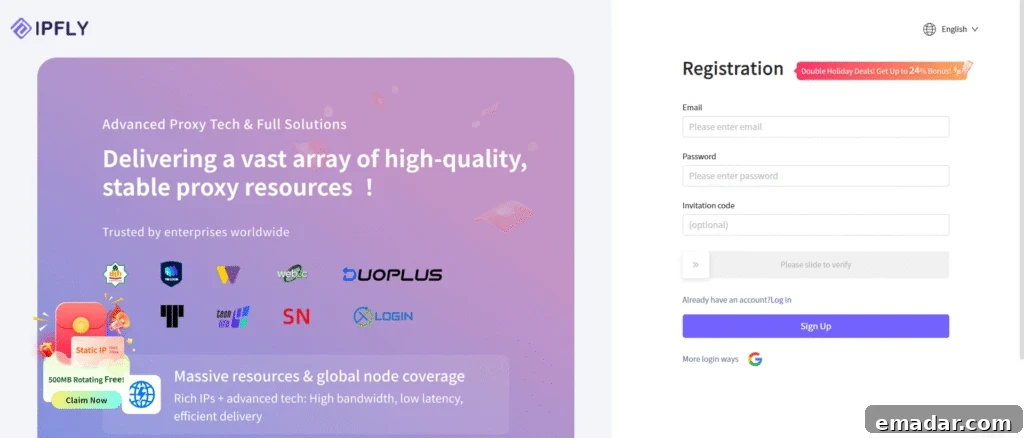
Step 1: Create an Account
Start at the IPFLY homepage and register an account.
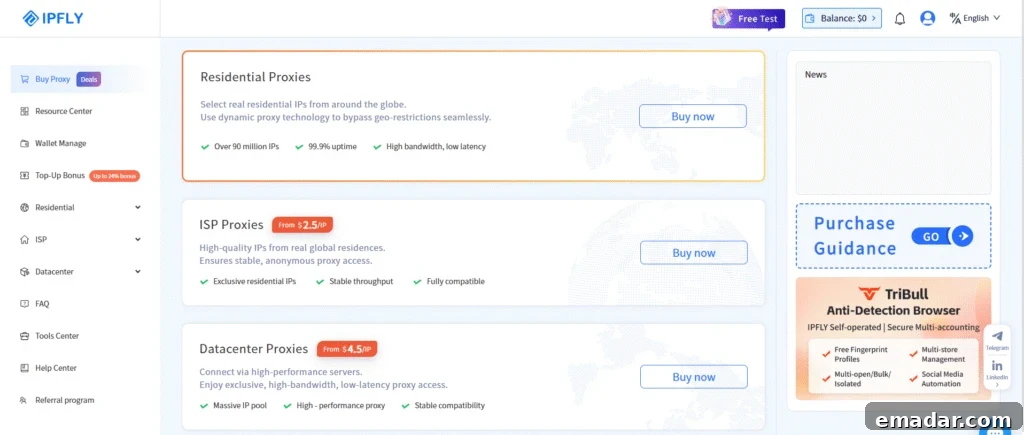
Step 2: Open the “Residential Proxy” Product Page
Choose the IP type that matches your needs.
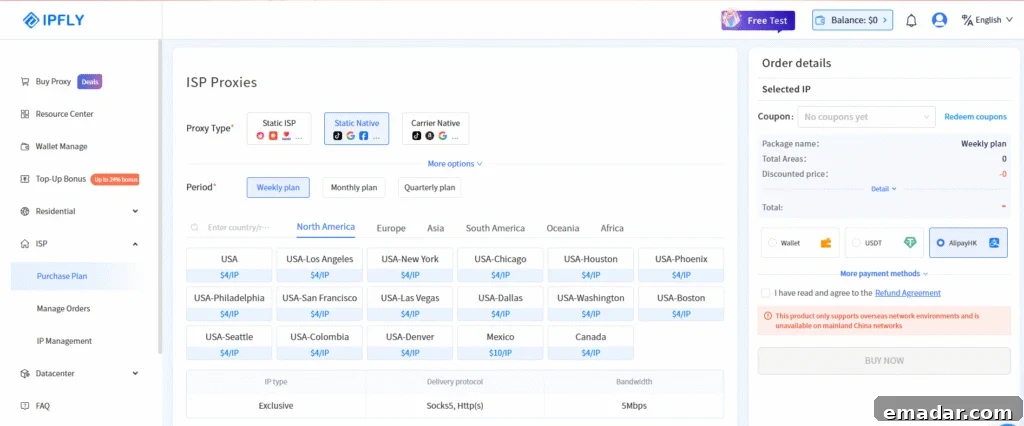
Step 3: Configure Plan Parameters
Select the destination country and city for the IP addresses you need. Pay for the order to receive access to the allocated IP addresses.
Step 4: Complete Purchase and Retrieve Credentials
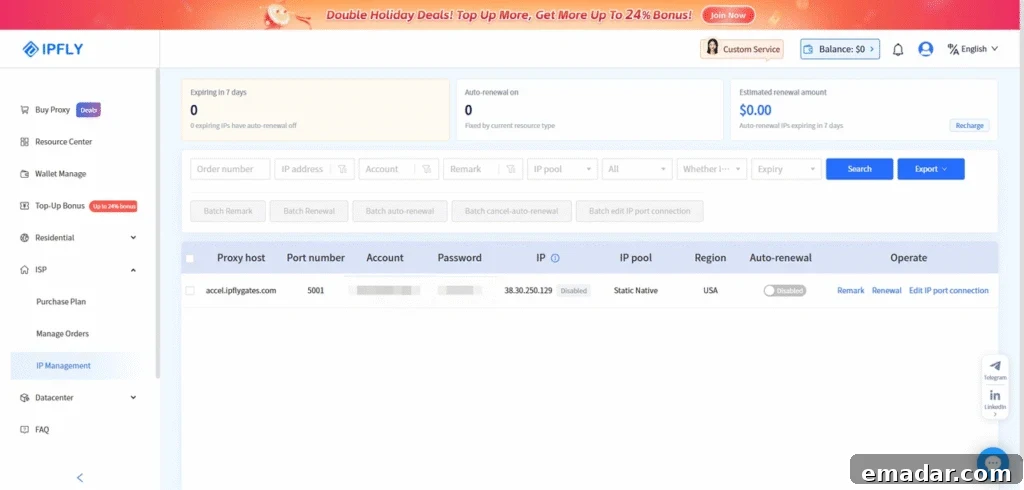
After checkout, login credentials for the purchased proxies appear in the platform’s IP management area. For dynamic residential proxies, credentials are generated via an account-authenticated extraction API. The platform provides host, port, username, and password as a linked set of parameters.
Step 5: Integrate with Your Application
Insert the retrieved credentials into your target application’s proxy configuration. For browser-based workflows, input host, port, username, and password into the browser proxy settings or a profile manager. For programmatic access, pass the same parameters to your HTTP client library. IPFLY supports HTTP, HTTPS and SOCKS5 protocols and provides API-based rotation control for workflows that require dynamic IP switching.
How to Configure Rotation Correctly After Purchase
Choose Rotation Mode Based on Workflow Type
The most important post-purchase decision is choosing a rotation mode. Independent, stateless requests are suited to per-request rotation: each request uses a different residential IP, distributing load across the pool and preventing suspicious patterns on any single address. Serialized workflows—login, browsing, form submission, checkout—require sticky sessions that maintain the same IP throughout the series.
Session Duration and Request Distribution
Set sticky session length to the minimum time required to complete the workflow. If sessions last longer than needed, an IP remains unavailable for rotation and risks overload. Once a workflow completes, the session should expire and the IP return to the pool. This preserves pool capacity while keeping per-IP request rates within human-like patterns.
Align Geographic Signals
When targeting a specific country or city, configure application-layer signals accordingly. Language headers should match the target region. Browser time zone must reflect the IP’s location. Currency and locale settings should align with the target market. Mismatches between IP location and application signals produce obvious, machine-detectable contradictions.
Summary: Verify Before You Buy, Configure with Discipline
Buying residential proxies is not a one-time checkout event. A purchase grants access to a set of IP addresses; whether those addresses yield usable data depends on pool quality and careful configuration. Failure in first purchases typically stems from two categories: procurement errors—buying non-residential or contaminated IPs at residential prices—and configuration errors—routing patterns that trigger detection mechanisms even when IP quality is good.
Verification steps to avoid procurement mistakes include ASN checks, blacklist screening, and assessing pool reuse. Configuration rules to avoid detection include selecting the correct rotation mode, controlling session durations, and aligning geographic signals. IPFLY’s residential proxy platform provides the pool diversity, city-level targeting, and session management controls needed to apply these best practices; its purchase and credential extraction flow is designed to take you from account registration to tested proxy credentials without unnecessary steps.
Start Setting Up Your Residential Proxies with IPFLY
If you are ready to move from learning about residential proxies to configuring a system that actually works, the IPFLY platform offers the infrastructure and controls you need. Registration takes only a few minutes, credentials are generated immediately after purchase, and rotation and session settings let you tune IP behavior to match your workflows rather than forcing your workflows to adapt to the proxy.
Create your IPFLY account → Then visit the “Dynamic Residential Proxies” product page to view rotation-ready pools that support per-request and sticky-session controls. For workflows that require dedicated, persistent ISP-registered IPs, review the “Static Residential Proxies” offering that provides unlimited bandwidth on fixed IPs. If you prioritize speed and concurrency and the target sites do not enforce strict residential verification, datacenter proxies can deliver large-scale, low-latency performance.