
In the dynamic world of online business, where activities span cross-border e-commerce, social media management, account nurturing, and targeted advertising, you’ve likely encountered a few key terms: “Native IP,” “Residential IP,” and “Data Center IP.” Among these, the Native IP is frequently celebrated as the “golden shield” for unparalleled account security and operational integrity, often considered the most trustworthy digital identity.
But what exactly does “Native IP” signify? How does it differ from a standard Residential IP, and, more importantly, which type is the optimal choice for your specific business objectives? If these questions leave you pondering, fret not. This comprehensive guide is designed to provide you with a crystal-clear understanding of each IP type and empower you to make informed decisions for maximizing your online success.
✅ Understanding the Foundation: Why IP Addresses Matter in Online Business
Before we delve into the specifics, it’s essential to grasp why the type of IP address you use holds such significance. An Internet Protocol (IP) address is a unique numerical label assigned to every device connected to a computer network. It serves as your device’s identifier and location on the internet. However, not all IP addresses are created equal. Online platforms, security systems, and anti-fraud mechanisms heavily analyze IP addresses to determine the legitimacy and intent of user activities. Using the wrong IP type can lead to frustrating challenges like account suspensions, geo-restrictions, CAPTCHAs, or even permanent bans, making the choice of IP crucial for sensitive online operations.
✅ What Exactly is a Native IP (Local Native IP)? The Benchmark for Digital Trust
A Native IP, also known as a **Local Native IP** or sometimes referred to as a ‘Pure Residential IP,’ represents the pinnacle of authenticity and trust in the realm of IP addresses. Its definition is anchored in two fundamental characteristics:
- It is **originally and directly assigned to an end-user by a local Internet Service Provider (ISP)**. This implies that the IP originates directly from a legitimate telecommunications company that provides internet services to homes and businesses within a specific geographical area.
- Critically, **this particular IP has never been utilized previously by cloud servers, data centers, or commercial VPN service providers.** This “pristine” and unblemished history is the defining factor that elevates a Native IP above other types.
To put it simply, a Native IP functions as a brand-new, untainted digital identity. It’s clean, pure, and devoid of any prior “online history” that could potentially trigger red flags or detection by sophisticated security systems. It meticulously simulates the genuine network environment of a local user, offering an unparalleled degree of authenticity and anonymity. This makes it exceptionally difficult for websites and platforms to distinguish your activity from that of a real, local internet subscriber.
The distinctive characteristics that underscore the immense value of a Native IP include:
- Genuine Residential Network Origin: While it is part of a residential network, its “native” designation implies a superior level of originality and direct allocation from an ISP, bypassing any intermediate proxy infrastructure.
- Untainted and Undetectable History: Guaranteed to be completely free from any past associations with illicit activities, bot networks, or commercial proxy services. This spotless reputation is critical for maintaining high trust scores with target platforms.
- Exceptional Trust and Anonymity: Online platforms and services accord Native IPs the highest level of trust. This significantly reduces the likelihood of encountering CAPTCHAs, temporary blocks, or outright bans, ensuring your online actions appear genuinely local and human.
- Ideal for Highly Sensitive Operations: Native IPs are indispensable in scenarios where environmental integrity and absolute trust are paramount. This includes critical tasks such as registering and nurturing high-value social media accounts, establishing and scaling cross-border e-commerce storefronts, or managing high-stakes advertising campaigns where detection means immediate failure.

✅ What is a Residential IP? A More Common but Less Pure Alternative
A Residential IP address is an IP that has been legitimately assigned to a home internet subscriber by an Internet Service Provider (ISP). Because these IPs are associated with real physical addresses and human users, they are generally perceived as significantly more trustworthy than Data Center IPs by most online services.
Residential IPs typically find their origin from several sources:
- Standard household internet connections managed by official, regulated network operators.
- User devices that participate in peer-to-peer (P2P) networks, where their internet connection is used to route traffic for others, usually with explicit user consent. These are often referred to as dynamic residential IPs.
- Or, they might be acquired and distributed to users through various technical means, including direct agreements with smaller ISPs or by integrating existing home connections into a proxy network.
While Residential IPs do represent “local networks” and offer a substantial upgrade in trustworthiness compared to Data Center IPs, they come with potential caveats that differentiate them from the superior Native IP. These aspects can impact their effectiveness for the most sensitive tasks:
- Potential for Shared Usage: Many residential proxy networks share IPs among multiple users. This means the specific IP you are using might have been previously utilized by numerous other individuals for a wide range of activities, some of which could be considered “spammy,” automated, or abusive by target websites.
- Risk of “Pollution” or Compromised Purity: A residential IP might not have a perfectly pristine history. If it was previously employed for activities such as bulk account registrations, aggressive web scraping, or any actions that could have triggered flags on target platforms, it could carry a “taint” that makes it less effective or even risky for critical operations. You might inherit a compromised reputation.
- Less Direct Control Over History: When you acquire a residential IP from a proxy provider, you often have limited insight into its complete usage history. This makes it challenging to guarantee its absolute cleanliness or predict how it might be perceived by advanced detection systems.
Therefore, it’s accurate to state that **a Native IP is best understood as a “premium” or “higher-tier” version of a Residential IP.** It offers an unparalleled degree of purity and security, primarily due to its guaranteed direct ISP origin and a rigorously verified unblemished usage history.
✅ Native IP vs. Residential IP vs. Data Center IP: Deciphering the Core Distinctions
To empower your business with the ability to choose the most appropriate IP solution, it’s vital to clearly understand the fundamental differences between these three primary categories of IP addresses. While Native IPs and Residential IPs often share some characteristics, their distinct nuances significantly impact their reliability and trustworthiness for critical online tasks. Data Center IPs, conversely, operate on an entirely different level of detectability and purpose.
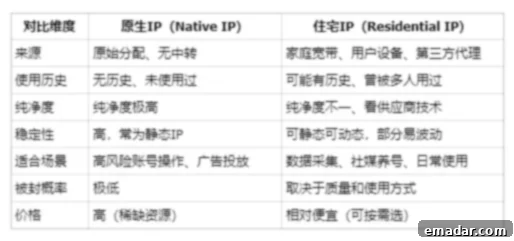
1. Origin and Assignment: Where Do They Truly Come From?
- Native IP: Directly assigned by a local Internet Service Provider (ISP) to an actual individual end-user. It has never been resold, reassigned, or utilized by any commercial proxy service, VPN provider, or data center. It is genuinely “fresh” from the ISP.
- Residential IP: Also assigned by an ISP to a home user, but these IPs are then typically integrated into a proxy network. This can occur via P2P networks (with user consent) or through contractual agreements with ISPs for proxy reselling. Its path to you often involves an intermediary.
- Data Center IP: Assigned to servers physically located in data centers. These IPs have no association with individual homes or residential ISPs; they belong to cloud providers, hosting companies, or large enterprises. They are designed for server-to-server communication, not for mimicking human browsing.
2. Purity and Usage History: The “Digital Reputation”
- Native IP: Guaranteed to be **untainted**, meaning it has no prior history of use by other proxy users, spammers, automated bots, or any activities that could trigger flags. This pristine history ensures platforms have no inherent “reason” to distrust it based on past actions.
- Residential IP: Possesses a more varied history. While generally “cleaner” than Data Center IPs, they may have been used by multiple individuals within a proxy network for activities that could have led to flags, blocks, or a degraded reputation on certain websites. The purity cannot always be definitively guaranteed.
- Data Center IP: Almost universally recognized by major websites and online services as belonging to commercial entities. Their history is often associated with automated tasks, bulk operations, and bots, making them highly susceptible to immediate detection and blocking by anti-bot systems.
3. Trust Level and Detection Risk: How Platforms Perceive Your IP
- Native IP: Offers the **highest trust level**. It perfectly simulates a genuine local user, making it exceedingly difficult for even the most sophisticated platforms to detect it as a proxy or as suspicious activity. This results in minimal CAPTCHAs, bans, or restrictions, allowing for seamless operations.
- Residential IP: Generally offers a **high trust level** compared to Data Center IPs. However, due to potential shared usage or a less-than-perfect past, they can still trigger some detection mechanisms, leading to occasional CAPTCHAs, soft blocks, or increased scrutiny.
- Data Center IP: Possesses the **lowest trust level**. Easily detected by virtually all advanced anti-bot, fraud detection, and security systems. Using them for sensitive tasks often leads to immediate blocking, extensive CAPTCHAs, or outright account suspension.
4. Cost and Scarcity: Market Availability and Pricing
- Native IP: Due to their inherent rarity, guaranteed purity, and extremely high demand for critical tasks, Native IPs are typically the **most expensive** option. The technical infrastructure and ethical sourcing required to provide truly native IPs are complex and costly.
- Residential IP: Generally **more affordable** than Native IPs, especially for dynamic or shared residential options. They are more abundant in the market, though high-quality, unpolluted, and static residential IPs can still command a significant premium.
- Data Center IP: The **cheapest and most abundant** IP type. They are easily provisioned from cloud providers and mass-produced, reflecting their limited utility for sensitive, human-like online tasks.
5. Best Use Cases: Tailoring IP Types to Your Operational Needs
- Native IP: Indispensable for scenarios demanding the absolute highest level of trust and anti-detection. This includes critical account registrations (e.g., social media, e-commerce platforms), sensitive ad campaign management, advanced web scraping of highly protected sites, and any activity requiring a completely undetectable and authentic user footprint.
- Residential IP: Suitable for tasks that require a human-like IP but can tolerate some level of detection risk. Examples include general web scraping, localized brand monitoring, or accessing geo-restricted content where the target site’s anti-bot measures are not overly aggressive.
- Data Center IP: Best for high-volume, less sensitive tasks like general web scraping of non-protected public sites, basic SEO monitoring, or accessing publicly available data where anonymity, human-like behavior, or anti-detection capabilities are not primary concerns.
✅ Who Needs a Native IP? Essential Use Cases for Optimal Security and Success
For businesses and individuals operating in highly sensitive online environments, leveraging Native IPs is not merely an advantage; it’s often a fundamental requirement for success. Their unparalleled ability to flawlessly simulate genuine local user behavior drastically enhances operational stability and security, significantly reducing the risk of bans, flags, or limitations. Here are the key scenarios where Native IPs prove to be invaluable:
1. Social Media Account Management: Registration, Nurturing, and Scaling
Platforms like **TikTok, Facebook, Instagram, X (formerly Twitter), and LinkedIn** employ extremely sophisticated algorithms to detect suspicious activity, especially during account creation, mass management, and rapid scaling. Using a Native IP is critical for:
- Successful and Sustainable Registrations: New accounts are far less likely to be flagged as bot-generated or fraudulent from the outset, leading to higher success rates.
- Effective Account Warming & Nurturing: By mimicking authentic user behavior, Native IPs allow accounts to build trust and authority naturally over time, effectively circumventing shadow-bans or immediate suspensions.
- Building Multi-Account Matrices: Managing multiple accounts from different geo-locations becomes possible without cross-contamination or mass detection, essential for large-scale social media strategies.
- Content Posting and Engagement: Ensures posts and interactions appear genuine, increasing reach and reducing the risk of content suppression.
Native IPs provide the most convincing and trustworthy digital footprint, which is absolutely crucial for establishing and maintaining a robust, scalable social media presence.
2. Cross-Border E-commerce Operations: Store Setup and Management
For sellers on major platforms like **Amazon, eBay, Shopee, Etsy, and Shopify**, maintaining a secure and trusted online presence across different regions is paramount. Native IPs are vital for:
- New Store and Seller Account Registrations: Many platforms have stringent geo-restrictions and anti-fraud measures for new seller accounts. A Native IP helps pass these rigorous checks seamlessly, reducing the chance of initial rejection.
- Multi-Account Management: Operating multiple seller accounts from different regions, or even within the same region, without triggering platform fraud detection systems that link accounts.
- Avoiding Geo-Restrictions & Localizing Operations: Accessing region-specific features, product listings, or conducting competitor analysis without being flagged or blocked. This is crucial for accurate market research and localized strategies.
- Enhanced Security & Compliance: Protecting sensitive business data and payment information by operating from an IP that carries the highest level of platform trust, ensuring compliance with platform terms of service.
3. Advertising Account Management: Google, Facebook, and Other Ad Platforms
Managing advertising campaigns on platforms like **Google Ads, Facebook Ads, TikTok Ads, and Bing Ads** demands an immense level of trust to prevent costly account suspensions. Native IPs significantly mitigate risks by:
- Secure and Stable Account Logins: Accessing ad accounts from various desired locations without triggering security alerts, suspicious activity flags, or incessant two-factor authentication loops due to perceived unusual IP changes.
- Preventing Account Flags & Suspensions: Ad platforms are notorious for aggressive fraud detection. A Native IP minimizes the risk of your valuable ad accounts being frozen, suspended, or banned due to perceived suspicious access patterns or location discrepancies.
- Accurate Geo-Targeting & Ad Verification: Ensuring your ad campaigns appear to originate from the precise intended geographical location, which is crucial for localized ad delivery, competitive ad verification, and accurate campaign analytics.
4. Automated Testing and Advanced Anti-Fingerprint Detection Bypass
For developers, QA teams conducting sophisticated automated tests, or for users employing anti-detect browsers, Native IPs provide the most authentic and reliable testing ground:
- Realistic User Simulation: Ensures automated tests accurately reflect how genuine users in specific target regions experience a website or application, leading to more reliable test results.
- Bypassing Advanced Detection: When paired with cutting-edge tools designed to thwart sophisticated bot detection and browser fingerprinting, Native IPs dramatically increase success rates and significantly reduce the likelihood of detection, making operations truly stealthy.
- Web Scraping and Data Collection: For extracting data from highly protected websites with aggressive anti-bot measures, Native IPs allow for sustainable and undetectable data extraction without IP blocks.
5. High Anti-Blocking & Anti-Detection Requirements
Any work scenario that demands extreme resilience against blocking, throttling, or detection benefits immensely from the use of Native IPs. This broad category includes:
- Sensitive Data Scraping: When targeting websites with very aggressive anti-bot measures and CAPTCHA challenges, Native IPs are crucial for sustainable and undetectable data extraction, especially for competitive intelligence.
- Competitive Intelligence & Market Research: Monitoring competitor pricing, strategies, product launches, and market trends across different regions without revealing your identity or getting blocked.
- Brand Protection & Copyright Monitoring: Detecting counterfeit products, unauthorized usage of your brand, or intellectual property infringement on various global platforms and marketplaces.
- Circumventing Geo-Restrictions: Reliably and securely accessing region-locked content, streaming services, or business services without triggering VPN/proxy detection and ensuring stable access.
- Cybersecurity Research & Penetration Testing: For ethical hackers and security researchers who need to simulate real-user traffic from specific locations without being flagged.
In essence, Native IPs empower you to simulate the actions and digital footprint of a true local user, which is by far the most effective strategy to gain platform trust and proactively avoid critical issues such as account bans, stringent risk controls, and debilitating traffic limitations from the very outset of your online operations.
✅ Where to Find Reliable Native IPs? Introducing IPFLY: Your Partner for Pure IP Solutions
While the profound benefits of Native IPs are unequivocally clear, sourcing genuinely pure, high-quality, and ethically obtained Native IPs can present a significant challenge. The inherent scarcity of these premium IPs, coupled with the complex technical infrastructure and rigorous vetting processes required to acquire and manage them, means that not all IP providers can truly deliver on their promises. Therefore, it is absolutely crucial to partner with a reputable provider that specializes in ethical sourcing and maintains the pristine integrity of their IP network.
📌 For those seeking top-tier Native Proxy IPs that meet the highest standards of purity and performance, we wholeheartedly recommend considering: IPFLY Native Proxy IPs
IPFLY has established itself as a leading provider in the market, offering a robust, highly reliable, and meticulously sourced solution for businesses and individuals who demand the utmost in IP authenticity and performance. Their unwavering commitment to IP purity and extensive global reach makes them an ideal choice for even the most sensitive and critical online operations.
Key advantages and compelling features of IPFLY’s Native Proxy IPs include:
- Extensive Global Coverage: With an impressive network spanning over **190+ countries and regions** worldwide, including crucial markets like the United States, Japan, Hong Kong, Singapore, and Germany, IPFLY offers unparalleled geographical flexibility to perfectly align with your diverse business needs and target markets.
- Guaranteed Purity and Verifiable Sources: Every single IPFLY IP originates from clear, legitimate, and ethical sources. They are meticulously vetted to ensure they are untainted by any prior misuse or association with undesirable activities. IPFLY even allows for **verifiable purity**, providing you with complete transparency and peace of mind regarding the integrity of your connection.
- Static Dedicated IPs for Unwavering Stability: IPFLY provides **static dedicated IPs**, meaning you receive exclusive access to a single, consistent IP address that remains constant over an extended period. This unparalleled stability is absolutely critical for maintaining account consistency, building long-term trust with platforms, and drastically reducing detection risks, especially for long-term account nurturing strategies.
- Seamless Integration with Anti-Detect Browsers: Designed to work synergistically and flawlessly with advanced anti-fingerprint browsers and multi-login browser solutions, IPFLY’s Native IPs significantly enhance your overall stealth and anonymity, making your online operations virtually undetectable by even the most sophisticated systems.
- High Concurrency and Exceptional Success Rates: Built from the ground up to support high volumes of simultaneous connections, IPFLY offers highly concurrent access solutions with exceptional success rates. This ensures that your operations run smoothly, efficiently, and without interruption, even under the most demanding loads and complex scenarios.
- Tailored for Cross-Border Business Excellence: IPFLY’s entire infrastructure and comprehensive service offerings are specifically adapted and optimized to cater to the unique and intricate requirements of various cross-border business models, ranging from global e-commerce ventures to sophisticated social media marketing campaigns and beyond.
Ultimately, choosing the right IP type for your business is akin to selecting the perfect pair of shoes for a long journey – the right fit is not just important, it’s absolutely paramount for comfort and success. For critical online operations that demand the highest levels of trust, security, and an authentic online footprint, a Native IP is not merely a good choice; it is the essential “first step” and the foundational element that ensures your business walks on solid, secure ground in the competitive digital landscape.
By thoroughly understanding the profound differences and unique advantages offered by Native, Residential, and Data Center IPs, you empower your business with the crucial knowledge to make intelligent, informed decisions. This strategic approach will safeguard your valuable online assets, minimize risks, and pave the way for sustainable growth and unparalleled success in the ever-evolving digital realm.