

A common misconception must be corrected up front: platforms do not primarily judge risk by whether a proxy is used, but by whether the identity signals are internally consistent.
An account using a U.S. residential IP, set to New York time zone, resolving DNS through U.S. servers, and showing normal browsing habits will be treated as a legitimate user by a platform’s risk system. Conversely, an IP that appears to be in the U.S. but whose DNS queries originate from a domestic network and whose system time zone is Beijing—even if each individual signal seems harmless—creates internal contradictions when combined.
IP Fraud Score is the quantitative result of evaluating that kind of consistency. Understanding how this metric is calculated, what factors influence it, and how to optimize it is essential for cross-border e-commerce, social media operators, ad verification teams, and data collection projects that need to maintain operational continuity.
How the IP Fraud Score Is Calculated and Risk Tiers
0 to 100: a quantitative assessment of network identity
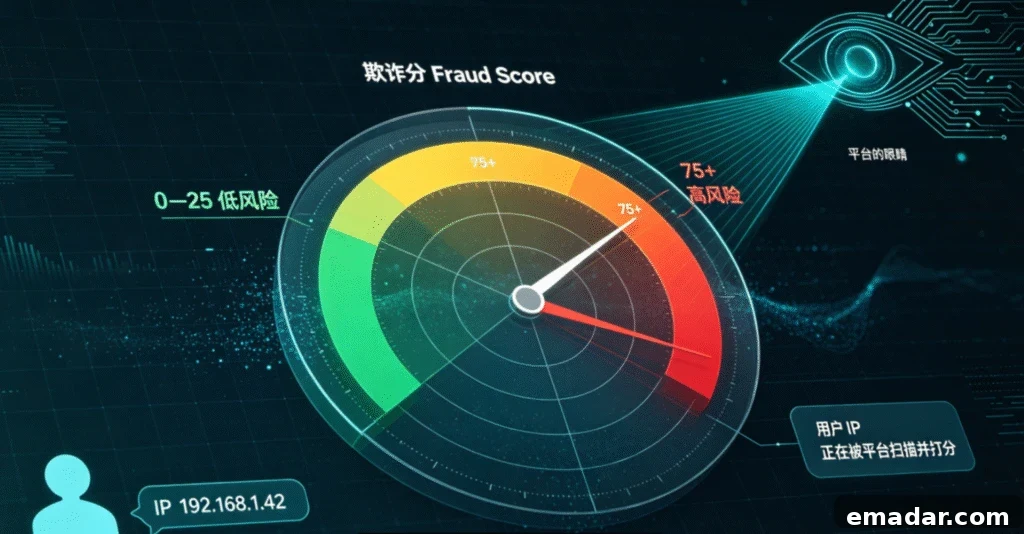
The IP fraud score is a numeric indicator used to assess the likelihood that an IP address is associated with fraudulent activity. It typically ranges from 0 to 100, with higher scores indicating that the traffic source looks less like a normal user. Crucially, this score does not label a user guilty; it measures suspicion. Platforms use the score to determine actions — low scores allow access, mid-range scores trigger additional verification, and high scores can result in blocking.
Major fraud scoring systems aggregate multiple data dimensions. IP-related signals typically account for roughly 20%–30% of the total weight and include IP type, geographic consistency, IP reputation, and historical fraud records for the IP range.
What risk tiers mean in practice
Different scoring providers may define thresholds slightly differently, but the overall framework is consistent. A common recommendation is: 0–30 indicates low risk—usually ISP-assigned residential or mobile IPs with clean histories and permitted access; 31–75 indicates medium risk—may involve cloud-hosted IPs or residential IPs with minor anomalies and should trigger secondary checks; 76–100 indicates high risk—often known exit nodes or IPs linked to attacks and should be blocked.
From operational experience, IP quality scores can be interpreted in four ranges: 0–30 often corresponds to data center IPs or heavily shared addresses and may be blocked outright; 30–60 is typical for low-cost proxy IPs and usually prompts verification during login; 60–80 is common for residential IPs or high-quality proxies and typically functions normally; 80–100 represents top-tier native residential IPs with the best account stability and ad performance.
These ranges explain why many operators feel they were blocked “for no reason” — actions may be legitimate, but the network environment carries many features that “don’t look human,” causing the system to block first and ask questions later.
Five core factors that raise the IP Fraud Score
IP type: the gap between data center and residential
Risk systems first check what type of network the IP belongs to: residential broadband, mobile cellular, business lines, or cloud data centers. Data center IPs carry a high base score because normal household users rarely access services from server racks. This factor alone can push an account into medium or high risk.
Data center IPs are issued by cloud providers and have clear ASN identifiers; historically they have been used by automated tools and malicious actors and generally have lower trust. Residential IPs come from actual home ISPs, naturally mimic regular user behavior, and are the hardest to detect as anomalous.
The score difference between residential and data center IPs can be dozens of points. That base-level gap is difficult to offset later by changing browser or device settings.
Proxy fingerprinting: whether the IP is flagged
Risk databases continually record IP ranges identified as exit nodes or proxies. If an IP has already been placed on such lists, its baseline score will be higher regardless of device or browser changes. These flags are persistent and do not vanish simply because usage patterns change. Scoring typically combines blacklist records, abnormal traffic history, proxy behavior signatures, data center attributes, and spam request frequency.
Abuse history: shared IPs inherit prior records
This is often overlooked. When you use a shared IP, you inherit all prior users’ behavior tied to that address. If a previous user performed violations from that IP, the record remains and the new user starts from an elevated score.
IP addresses get reused, and past abuses leave marks. After a sufficient cooling period some IPs can recover reputation, but abuse history has a long-term impact on fraud scores and explains why shared IPs are inherently unpredictable.
Geographic consistency: whether IP location matches other signals
Platforms cross-check multiple signals: IP geolocation, DNS resolver location, system time zone, browser language, and historical login locations for the account. Any mismatch among these items is flagged as an “inconsistent environment,” an assessment with significant weight.
ASN reputation: differences between ISPs and cloud providers
ASN records indicate the network owner. ASNs belonging to consumer ISPs are naturally more trusted; those belonging to cloud providers or data centers are scrutinized more closely. When both ASN and operator name point to a regular ISP, the residential attribute is more authentic and less likely to be classified as suspicious.
DNS leaks: the most subtle geographic inconsistency
Among the five factors above, IP type, proxy flags, abuse history, and ASN reputation can be addressed by switching to a clean IP. Geographic consistency, however, often breaks down due to an easily overlooked component: DNS.
How DNS leakage works
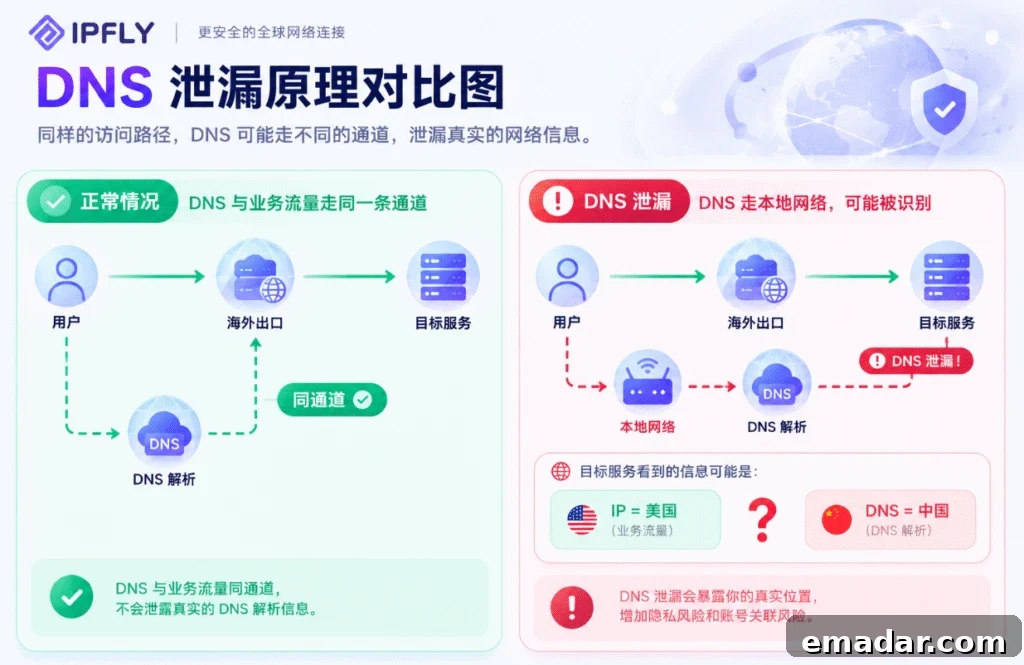
Traffic to a site may be routed overseas, while the DNS queries still use a local DNS resolver. The platform then sees a U.S. IP accessing the site but observes DNS resolution originating from a local DNS server. Those two signals conflict and are recorded as a discrepancy.
DNS resolution does not travel in the same direct path as the HTTP request; it follows a separate channel determined by network configuration, not the outbound traffic route. As a result, outbound traffic may exit through an overseas path, but name resolution queries might still query the local router’s DNS. That single difference can reveal the true geographic origin and ISP.
Two-path comparison
| Comparison | Correct configuration | DNS leak |
| Outbound request | Goes through overseas channel | Goes through overseas channel |
| DNS resolution | Uses the same overseas channel | Uses local network |
| Result | Exit locations match; environment is consistent | Exit locations conflict; true location is exposed |
An analogy: you change your phone number to an overseas one, but before each call you still use your home landline to look up the recipient’s number. The call records show an overseas number, while the lookup records stay local — the two records don’t match.
This explains why many operators see an IP check showing a U.S. residential IP yet still face frequent verification: the detection page may display only IP geolocation and not reveal where the DNS resolution originated.
How to test for DNS leaks
Common methods to detect DNS leaks include using online DNS leak test tools or browser extensions. After starting a test, these tools send probe requests to multiple DNS resolvers and compare results against the expected configuration, highlighting mismatches.
A practical rule is: if the ASN of the DNS resolver matches the ASN of the network connection, there is no leak; if they differ, a DNS leak exists. It is advisable to run a DNS leak test whenever a new network environment is configured before putting it into production.
Leaks are not limited to DNS: three signal types to verify
DNS leakage
DNS queries that do not follow the same path expose the real network location and ISP. This is the most subtle of the three and stems from network configuration rather than user behavior.
WebRTC leakage
When a browser establishes peer-to-peer communications, it can reveal local network interface addresses that differ from the exit IP. WebRTC is built into browsers for real-time communication; its exposure mechanisms differ from standard HTTP and require separate checks.
Environment inconsistency
Mismatches among time zone, language, date format, currency symbol, and IP geolocation are also contradictory signals. These are not leaks per se, but they produce the same effect — the platform detects inconsistent environment signals and raises the fraud score.
Among these three, DNS leakage is often the most unfair: many teams pay to obtain clean residential IPs but see reduced effectiveness because they overlooked aligning DNS.
Five self-check items for environment consistency
Use this checklist to verify your environment. The goal is not merely to check boxes, but to identify any mismatch that signals an inconsistent environment.
| No. | Check | Criterion |
| 1 | IP type and ownership | Is it residential or data center? Does the ASN belong to a consumer ISP or a cloud provider? If it appears as an IDC, the base score is already elevated. |
| 2 | DNS resolver location | Does the place where DNS queries originate match the IP geolocation? An IP in the U.S. but DNS in the local country is a classic leak signal. |
| 3 | WebRTC exposure | Does the browser expose local network interface addresses that conflict with the exit IP? A mismatch indicates an inconsistency. |
| 4 | Environment consistency | Are system time zone, browser language, and date/time formats aligned with the IP’s region? |
| 5 | IP usage history | Is the IP dedicated or shared? Does it carry prior flags? Shared IPs inherit previous reputations. |
These indicators can be verified via IP reputation checkers and DNS leak test pages. It is recommended to perform a full self-check after configuring any new network environment before using it in production.
Five practical directions to lower IP Fraud Scores
Once the scoring logic is understood, optimization becomes clear: do not try to hide signals; remove features that “don’t look human.”
Start with the right IP type
For account-driven operations, use residential IPs as the foundational element. Data center IPs are fundamentally disadvantaged regardless of how you configure the environment. Choosing authentic ISP-assigned residential addresses is the baseline for lowering scores.
Keep IPs stable over time
Trust accumulates. Frequently changing IPs means having to rebuild trust each time. Configuring a stable, long-term IP is the simplest path. Platforms track risk at the IP level over time — an IP that logs into the same account regularly and shows predictable behavior will increasingly be classified as normal, reducing verification prompts and raising account trust.
Align IP, DNS and time zone
When these three are consistent, geographic mismatch issues largely disappear. DNS is especially important because it determines where name resolution originates. Ensuring that DNS resolvers and the exit IP are geographically aligned directly improves trust scores.
Avoid shared IP addresses
A dedicated IP’s history is written only by its user. Shared IPs inherit unknown behavior and therefore carry uncontrollable risk. A one-account-one-IP principle prevents cross-account correlation and reduces the chance of cascading bans.
Let time and behavior build trust
Consistent login patterns, regular activity windows, and normal usage behaviors are the true long-term factors that reduce scores. Risk systems reward long-term stability more than short-term technical tweaks.
From scoring logic to product selection
To apply these principles when choosing a product, focus on three key questions.
Is the IP type genuine? Can the IP be verified as a true residential endpoint and can the ASN ownership be independently confirmed? A residential IP from a real ISP should show verifiable ownership data.
Is the IP dedicated? Does the IP’s reputation begin accumulating from your own usage? A dedicated static residential IP starts building trust when you start using it instead of inheriting past records.
Does the IP type match your use case? Account-driven long-term operations should use static residential IPs; large-scale distributed tasks may require dynamic residential IPs. Mixing these approaches is not advisable.
Conclusion: fraud scores and DNS tests point to the same issue
IP fraud scores and DNS leak tests reveal the same central truth: platforms do not care which tools you used; they care whether all the source signals can be assembled into a coherent, normal user profile.
The IP is the network “address”; DNS is the network “call record.” Addresses can change, but call records will reveal inconsistencies. Aligning them is often more effective than frequently rotating IPs.
Practically, lowering an IP fraud score involves choosing residential proxy resources as the foundation, keeping IPs stable to accumulate trust, aligning IP/DNS/time zone, avoiding shared IPs that inherit unknown histories, and maintaining steady behavior so the score improves over time. This approach does not attempt to deceive systems; it removes the features that appear non-human.
When cross-border store management, social account operation, or ad verification tasks repeatedly trigger verification due to high fraud scores, the core solution is to select residential proxies sourced from real ISP networks and ensure DNS resolution and system time zone match the exit IP location.
Residential proxy offerings include both static and dynamic options. Static residential IPs suit scenarios that require a stable, long-term network identity; dynamic residential IPs are useful for flexible multi-region tasks. After establishing an account with a provider, select resources by country or city to create a consistent and trustworthy network exit environment for your team’s deployments.
Learn more about proxy product options and validate choices with independent IP reputation and DNS leakage checks before deployment.