
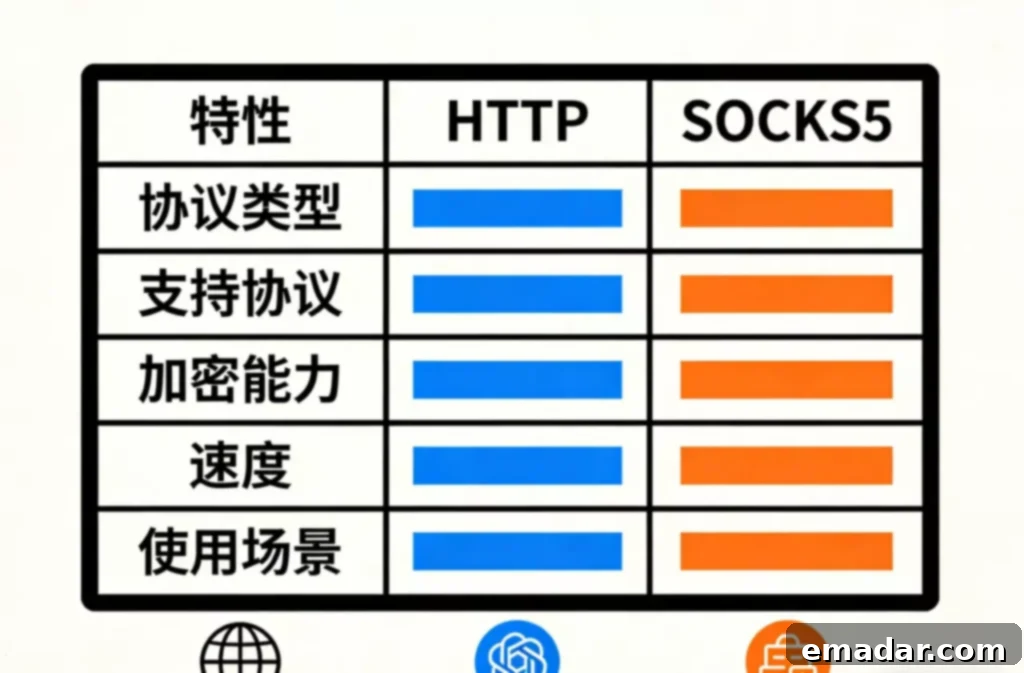
HTTP Proxy IP vs. SOCKS5: Understanding the Key Differences and Choosing the Right Protocol
When selecting a proxy, many individuals face the same dilemma: What are the differences between HTTP Proxy IP and SOCKS5, and which one should I choose?
Online explanations often delve into technical jargon or provide overly simplistic answers, leading to incorrect protocol selections. This can result in account issues, failed access attempts, and the mistaken belief that the proxy itself is inadequate.
In this article, we’ll steer clear of brand endorsements and abstract concepts, focusing solely on the practical implications of using HTTP Proxy IP and SOCKS5. We’ll clarify their differences, appropriate use cases, and common misconceptions.
HTTP Proxy IP and SOCKS5: Neither is Inherently Superior
A common misconception among newcomers is:
SOCKS5 appears more “low-level,” so it must be better than HTTP Proxy IP, right?
The answer is: Not necessarily, and in many scenarios, it’s actually unsuitable.
The core difference between HTTP Proxy IP and SOCKS5 isn’t about “good” or “bad,” but rather about:
- The type of traffic you’re handling
- Whether you prioritize stability or versatility
- Whether you’re performing account-related actions
What is HTTP Proxy IP? What Problems Does It Solve?
HTTP Proxy IP, as the name suggests, is a proxy protocol specifically designed for handling HTTP/HTTPS requests.
It operates in a straightforward manner:
- It proxies only web page access and API requests.
- It understands HTTP header information.
- It allows for more precise control over requests.
Key Characteristics of HTTP Proxy IP
- Simple to configure
- Natively supported by browsers
- User-friendly for web pages, APIs, and web scraping
- Easily recognized by most programs
Consequently, you’ll find that most:
- Web page visits
- Account logins
- API requests
- Data scraping activities
Use HTTP Proxy IP by default.
What is SOCKS5? What Are Its Advantages?
SOCKS5 is a lower-level proxy protocol.
Its characteristics include:
- Not concerned with specific application protocols
- Doesn’t parse HTTP content
- Capable of proxying almost any type of traffic
Sounds powerful, right?
But that’s precisely where the problem lies.
Real-World Characteristics of SOCKS5
- High flexibility
- Suitable for complex network environments
- More of a “channel-type” proxy
SOCKS5 is more commonly used in:
- Specific client programs
- Gaming and P2P applications
- Specialized network forwarding needs
However, it’s not designed for “account environments” or “simulating web behavior.”
Key Differences Between HTTP Proxy IP and SOCKS5: A Detailed Comparison
Instead of presenting a table, let’s focus on the key points.
Protocol Recognition Capabilities
- HTTP Proxy IP: Understands HTTP behavior, closely mimicking genuine user access patterns.
- SOCKS5: Only forwards traffic, without understanding the nature of the data.
👉 In account and web page scenarios, understanding behavior is advantageous.
Browser and Tool Compatibility
- HTTP Proxy IP: Supported by nearly all browsers and automation tools.
- SOCKS5: Requires additional configuration, with incomplete support in some environments.
Friendliness to Risk Control Systems
This is a point that many tutorials fail to explicitly mention.
In account-based platforms:
- HTTP Proxy IP behavior more closely resembles that of a “normal user.”
- SOCKS5 is more easily identified as “bot traffic.”
This explains why account logins, social media management, and e-commerce backends more frequently utilize HTTP Proxy IP.
When is HTTP Proxy IP More Suitable?
If you’re engaged in the following activities, prioritize HTTP Proxy IP:
- Social media account login and daily use
- E-commerce store backend management
- Web page data collection
- Search result scraping
- API requests and automated tasks
The common thread among these scenarios is: 👉 HTTP behavior dominates, and high stability is essential.
Many users employ HTTP Proxy IP in these operations to:
- Reduce IP association risks
- Distribute access frequency
- Improve request success rates
Some proxy services (such as residential and datacenter proxies) employ multi-layered IP filtering mechanisms to enhance the availability of HTTP Proxy IP in these scenarios.
When is SOCKS5 More Appropriate?
SOCKS5 isn’t useless, but using it in the wrong context can cause significant issues.
Scenarios where SOCKS5 is better suited include:
- Non-HTTP protocol communication
- Specific client software
- Gaming or specialized network forwarding
- Custom network programs
If you are:
- A typical web user
- Performing account operations
- A beginner in web scraping
Forcing the use of SOCKS5 can introduce instability.
Why Do Many Users Still Struggle Even After Selecting the Right Protocol?
The problem often lies not in the protocol itself, but in the way it’s used.
Common causes of failure include:
- Sharing a single proxy across multiple accounts
- IP and browser environment inconsistencies
- Excessively high request frequency
- Frequent and erratic IP switching
Whether it’s HTTP Proxy IP or SOCKS5, the protocol is merely a tool; the behavioral logic is paramount.
Even with high-quality proxy resources, if the usage logic is flawed, the results will be compromised.
A Simple Rule of Thumb for Beginners
If you only want to remember one criterion, remember this:
- Web pages, accounts, APIs → HTTP Proxy IP
- Specialized programs, non-HTTP → SOCKS5
Avoid selecting a protocol that doesn’t suit your needs simply to “look professional.”
Choosing a Protocol Means Choosing a Use Case
HTTP Proxy IP and SOCKS5 are not inherently superior or inferior. The real determining factor is what you use them for.
Most people searching for these keywords don’t actually need complex network solutions. Instead, they need:
- Stability
- Controllability
- Reliability
In these situations, HTTP Proxy IP is often the more practical choice.
Specifically for cross-border account maintenance, focusing on the proxy IP market, providing:
- ✅ 90 million+ residential IPs worldwide, covering 190+ countries
- ✅ Support for static residential IP exclusivity + dynamic residential IP rotation
- ✅ High purity, ISP native + datacenter optional
- ✅ Multi-protocol support: HTTP/SOCKS5/HTTPS, strong platform adaptation
- ✅ API integration, fingerprint browser compatibility, fast onboarding
👉Register now, quickly build a highly trusted cross-border environment!