
The Proxy Revolution: How Proxies Became Essential Internet Tools
When you hear the word “proxy,” what comes to mind?
Many people envision a relic from the early 2000s, primarily used for bypassing school web filters to play games or, for the more technically inclined, accessing websites in other countries. For decades, proxies were simple, one-dimensional tools – the digital equivalent of a cheap disguise, easily detectable and used for trivial purposes.
However, the world of proxies has undergone a dramatic transformation. We are now in the midst of The Proxy Revolution, a silent but significant shift that has transformed proxies from basic tools into vital and powerful technologies underpinning the modern digital economy.
This is no longer just about circumventing website blocks. It’s about data, trust, and digital identity. Let’s delve into this revolution and understand its importance.
The “Old World”: The Traditional Proxy
To fully appreciate the revolution, we need to revisit the “old world.” Traditionally, a proxy server was a simple gatekeeper.
As a School Filter: It acted as an intermediary between students and the internet, blocking access to specific websites deemed inappropriate or distracting.
As a Caching Tool: In office environments, it saved (or “cached”) copies of frequently visited websites. When another employee accessed the same website, the page loaded faster, conserving the company’s bandwidth.
In both scenarios, the proxy was a static, known, and relatively simple intermediary. It was a visible checkpoint, and its presence was obvious. The IP addresses used were typically from data centers – large server farms easily identifiable.
The Catalysts: Igniting the Proxy Revolution
What factors triggered this profound change? Three significant shifts in internet usage rendered the “old world” proxy obsolete and sparked the revolution.
1. The Rise of Big Data
The global economy became increasingly reliant on data. Businesses could no longer rely on guesswork; they needed precise, real-time information.
Consider these questions:
- What are my competitors’ prices, in real-time, across 100 different cities?
- What are people saying about my brand on social media platforms?
- What is the real-time price of a flight or a hotel room?
This generated an immense demand for web scraping and data collection. However, businesses quickly realized that sending thousands of requests from a single data center IP address resulted in immediate blacklisting.
2. The Age of Geolocation
The internet became increasingly localized. The content displayed on a website to one user is often different from what another user sees. Websites began tailoring prices, products, and advertisements based on the user’s physical location, determined by their IP address. This made obtaining “true” data incredibly difficult without employing a new tool.
3. The Trust Economy
Online services, ranging from social media platforms to e-commerce sites, became adept at detecting “fake” or untrustworthy behavior. They developed sophisticated security systems based on IP reputation. A single, easily identifiable data center IP was no longer an effective disguise; it became a significant red flag.
The “New World”: The Modern Proxy Landscape
The proxy revolution is the direct response to these challenges. The technology didn’t simply receive an update; it evolved into entirely new forms. The basic data center IP was superseded by two new, potent types of proxies.
From Datacenter to Residential: Building Trust
The most significant innovation was the residential proxy. This proxy utilizes a real, verified IP address assigned by an Internet Service Provider (ISP) to a legitimate home.
Why it’s revolutionary: To a website’s security system, a residential IP address is indistinguishable from that of a genuine human customer. It’s not a flimsy disguise; it’s a flawless imitation. It possesses an inherent “trust” that data center IPs lack. A business can now examine prices as a “real user” in Chicago, and then as another “real user” in Miami, without triggering any alarms.
The Power of Mobile IPs
The revolution extended even further with mobile proxies. These are IP addresses assigned by mobile carriers (such as T-Mobile or Verizon) to individual smartphones. These represent the most trusted and highest-quality IPs available, making them ideal for interacting with mobile-first apps like Instagram or TikTok.
Who is Leading This Revolution? (The Emerging Use Cases)
The proxy is no longer a tool reserved for bored students. It’s a strategic asset for:
E-commerce Brands: Monitoring competitor pricing, managing online stores efficiently, and even acquiring limited-edition products before they sell out.
Ad-Tech Companies: Verifying that their advertisements are being displayed correctly to users in specific geographic locations, ensuring accurate targeting and campaign performance.
Social Media Managers: Securely managing numerous different brand accounts from a single dashboard without risking flagging or account bans, maintaining consistent brand presence.
Market Researchers: Gathering accurate, localized data from search engines and websites worldwide, gaining insights into consumer behavior and market trends.
Harnessing the Revolution: The Rise of Specialized Networks
The proxy revolution wasn’t simply a technological advancement; it generated a substantial demand for specialized, reliable, and clean networks. The focus shifted from merely finding “a” proxy to identifying the right proxy – a residential IP with a high purity score, originating from the appropriate country.
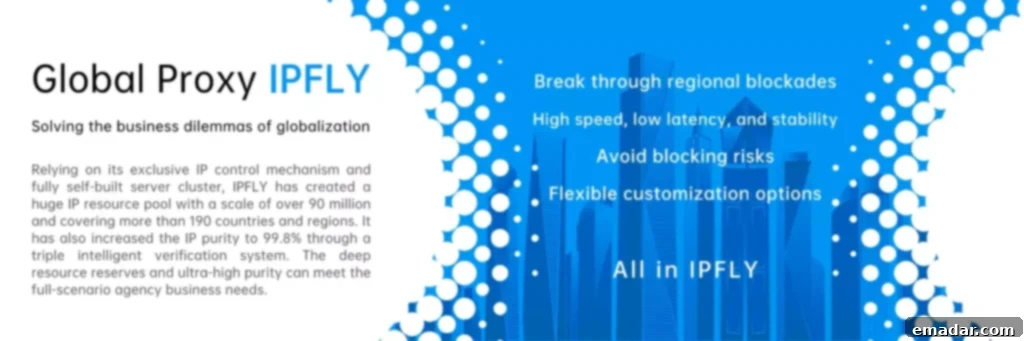
This is where professional networks have evolved into the new infrastructure of the web. Services like IPFLY are no longer just “proxy sellers”; they are managers of extensive, high-purity IP pools. They provide the crucial service of sourcing, verifying, and delivering the residential and mobile IPs that the revolution requires. This empowers businesses to tap into this new power grid, ensuring their operations rely on clean, trusted, and authentic IP addresses.
If you’re new to cross-border proxies and uncertain about setup, potential errors, or choosing the right types, beginner-friendly resources are available! Visit IPFLY.net for “newbie-friendly proxy plans” that include setup tutorials. Additionally, join the IPFLY Telegram newbie group for “step-by-step proxy setup from scratch” and “real-time FAQ answers.” Learn from experienced users and quickly master cross-border proxies!
Conclusion: The Revolution Will Be Proxied
So, the next time you encounter the word “proxy,” don’t envision a cumbersome web filter. Instead, think of the invisible, revolutionary technology that’s powering the new digital economy.
The proxy has evolved from a simple gatekeeper into a sophisticated key. It’s the technology that enables a truly global, verifiable, and data-driven internet. The revolution is subtle and technical, but it’s already here – and it’s transforming everything.