

What Is a Bing Rank Tracker?
Bing rank tracking refers to tools or workflows used to monitor a website’s position in Bing search results for specific keywords.
The basic idea is simple: enter a keyword, collect Bing search results, identify the target site, and record its ranking position.
The challenge appears when you need to track hundreds or thousands of keywords across different markets.
A useful Bing rank tracker should associate ranking data with the search conditions used to collect it, including: keyword, ranked URL, search location, language, device, SERP features, timestamp, and historical positions.
Context matters because a ranking is not always universal. A page that ranks first in New York might rank differently in London. Desktop and mobile search results can also vary. Without consistent search conditions, historical rank comparisons become unreliable.
Accurate Bing rank tracking is therefore less about capturing individual numbers and more about establishing a consistent monitoring environment.
How Does a Bing Rank Tracking Tool Work?
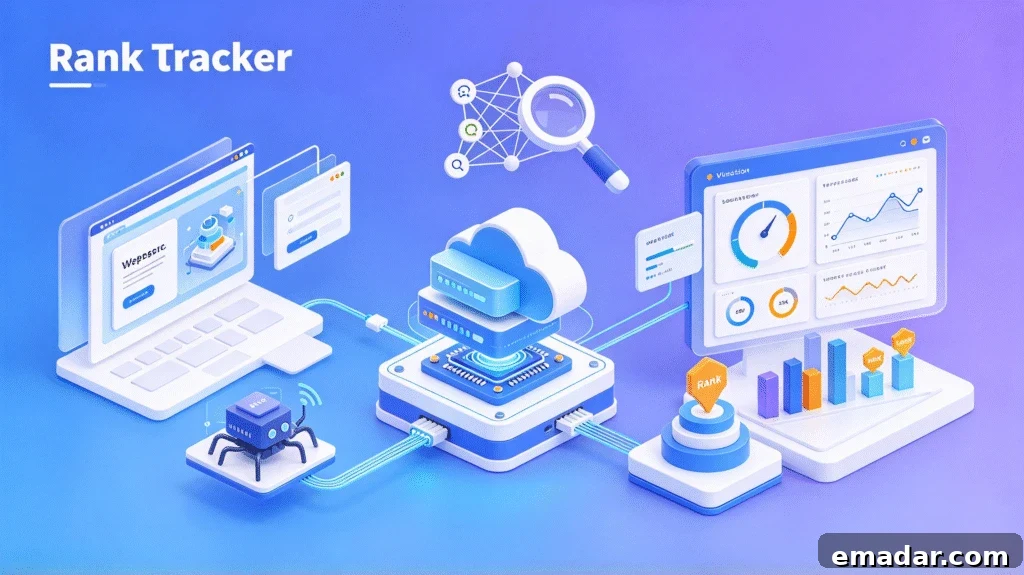
Most Bing rank tracking workflows follow four fundamental stages.
Keyword and Location Setup
The process begins with a predefined set of keywords and a defined search environment.
For example:
Keyword: project management software Market: United States Location: New York Language: English Device: Desktop
The more precisely these conditions are defined, the easier it is to compare results over time.
Collecting Bing SERPs
Next, the system collects Bing search results for each query.
Depending on the solution used, the output might be processed ranking positions or structured SERP data containing URLs, titles, snippets, and other elements.
Microsoft announced the deprecation of its Bing Search API on August 11, 2025, which means teams that programmatically gather Bing search data now need alternative data collection or ranking-tracking solutions.
Rank Extraction
The system identifies the target domain or URL within the returned results and records its position.
For example:
Keyword: running shoes

1. competitor-a.com
2. competitor-b.com
3. example.com
The target site is recorded in third place.
Historical Tracking
The final step is to store the results. A single rank check provides only a snapshot; historical records show whether rankings are rising, falling, or fluctuating.
Because of this, historical tracking is one of the most important features of any Bing rank tracker.
What Makes Bing Rank Tracking Accurate?
Rank numbers are meaningful only when the conditions under which they were collected remain consistent.
Several factors deserve special attention.
Location
Geographic location has a major impact on search results. This is especially important for international and local SEO. If a company targets U.S. users but collects ranking data from a different market, the results may not reflect the target audience.
Therefore, a geographically aligned network environment is a key component of any Bing rank-tracking workflow.
Core principle:
The measurement environment should match the market being measured.
Device
Desktop and mobile results can differ. If you track both, store them separately rather than merging them into one history. Mixing device types can create the illusion of ranking fluctuations even when SEO performance hasn’t changed.
Language
Language settings must remain consistent. Keywords tracked in English should not be compared with results gathered under a different language setting. For international SEO, country/region, geographic location, language, and device should be treated as independent tracking dimensions.
SERP Context
Search results are more than a list of organic links. Depending on the query, the SERP may include different result formats and enhanced features. A practical Bing rank tracker should retain enough SERP information to explain a position, not just record a number.
Why Geography Matters in Bing Rank Tracking
Geography is one of the most overlooked yet critical factors in international SEO.
Imagine a company tracking the same keyword across four markets:
| Market | Position | Ranked URL |
| United States | 4 | /product-a |
| United Kingdom | 7 | /product-b |
| Germany | 11 | /product-a |
| Japan | 15 | /product-c |
A single global ranking number would hide these differences. Market-level datasets surface them and are particularly useful for:
- International SEO
- Local SEO
- Regional content analysis
- Competitor monitoring
- Market research
- Search visibility reporting
For geographically distributed tracking, network resources that correspond to the target country or city are essential. Aligning IP resources with ranking workflows improves the relevance of collected data.
How to Choose a Bing Rank Tracking Tool
Not every Bing rank tracker is designed for the same SEO workflow. Before selecting a solution, consider five aspects.
Geographic Coverage
Verify whether the system supports the markets critical to your SEO plan. For international projects, country-level coverage may be enough for some keywords; for local search, city-level targeting can be essential.
Historical Data
The tool should make it easy to compare current rankings with past observations. Historical data helps identify:
- Ranking trends
- Sudden changes
- Landing page updates
- Market differences
- Competitor movements
Tracking Frequency
Daily checks are typically sufficient for ongoing SEO monitoring. Higher frequency may help investigate specific events, while established sites may not require continuous collection. Frequency should be driven by business needs, not the desire to gather the most data possible.
SERP Data Depth
If a site often ranks beyond the first page, tracking only top results can give an incomplete picture. Define the required depth of results before choosing a data source.
API or Dashboard
There are generally two approaches:
Integrated platforms provide dashboards, historical reports, and keyword management with little development effort.
Data APIs give teams full control over how search data is collected, processed, and integrated with internal systems. The right choice depends on technical resources and reporting needs.
Rank Tracker vs SERP Data API
These concepts are related but distinct. A SERP data API delivers raw search result data. A Bing rank tracker turns that data into a continuous ranking monitoring system.
A SERP-driven workflow typically requires handling:
- Keyword scheduling
- Result parsing
- Domain matching
- Position calculation
- Historical storage
- Reporting
- Error handling
A professional rank tracker usually provides these features through a polished interface. The trade-off is:
Choose a rank-tracking platform for convenience and built-in reporting.
Choose a data API when you need fine-grained control over the data workflow.
For enterprise SEO teams, both approaches can coexist.
Which IP Types Suit a Bing Rank-Tracking Workflow?
IP infrastructure is not the same as a tracking tool, but it influences the network environment from which measurement data is collected.
Dynamic Residential IPs
Dynamic residential IPs are suitable for multi-market SEO research that needs flexible geographic coverage. They are especially useful for:
- Regional SERP research
- International keyword monitoring
- Market research
- Large-scale search data collection
Static Residential IPs
Static residential IPs are better when a tracking workflow requires the same residential network endpoint over an extended period. They support scenarios where endpoint consistency matters for measurement.
Datacenter IPs
For high-volume workflows, network performance and throughput may be more important than residential network characteristics. Datacenter IPs are designed for dedicated IP resources, low latency, and high concurrency.
Choose the IP type based on data collection requirements rather than assuming one type fits all Bing SEO workflows.
Common Mistakes in Bing Rank Tracking
Tracking All Markets From a Single Location
This can produce rankings that do not represent the target audience.
Mixing Desktop and Mobile Rankings
Different devices can generate different results, so these datasets should remain separate.
Recording Only the Rank Number
Without location, device, timestamp, and ranked URL, the rank data lacks analytical context.
Comparing Inconsistent Search Conditions
If the monitoring environment changes, rank shifts may reflect those condition changes rather than actual SEO performance.
Treating Rank Change as an Explanation
Rank trackers tell you what changed, not why. Changes can stem from competitors, SERP feature updates, content modifications, landing page changes, or differences in the search environment. Ranking data should be the basis for further SEO analysis, not a standalone explanation.
A Practical Bing Rank-Tracking Checklist
Before starting a Bing SEO monitoring workflow, confirm it can answer these questions:
- Are target keywords clearly defined?
- Are target countries and cities specified?
- Is language tracking consistent?
- Are desktop and mobile results tracked separately?
- Are ranked URLs recorded?
- Will historical data be retained?
- Is the desired SERP depth sufficient?
- Does the network environment match the target market?
- Is the tracking frequency appropriate?
- Can the data be exported or integrated into existing SEO reports?
When these conditions are met, the resulting dataset is far more useful than a collection of isolated rank numbers.
Conclusion: Accurate Bing Tracking Starts With Consistent Data
Bing rank tracking is not just a tool that places a number next to a keyword. Reliable tracking depends on collecting comparable search data under clearly defined conditions.
The most important variables are:
Keyword → Location → Language → Device → SERP → Time
Once these factors are controlled, rank changes become easier to interpret and historical SEO analysis becomes more reliable.
Since Microsoft deprecated the Bing Search API in August 2025, organizations building programmatic Bing tracking workflows must pay closer attention to their data collection architecture.
For geographically distributed SEO monitoring, network location is a key part of that architecture. Different IP resources—dynamic residential, static residential, and datacenter IPs—serve different data collection needs.
The goal is not to collect as many rank numbers as possible. The goal is to collect consistent, relevant, and geographically aligned data to support effective SEO analysis.
Building More Precise Bing Rank-Tracking Workflows
When Bing SEO monitoring requires location-specific network resources, choose IP options that match your data collection needs. Evaluate available IP resources and align them with your tracking workflow to improve the accuracy and relevance of your search data collection.