
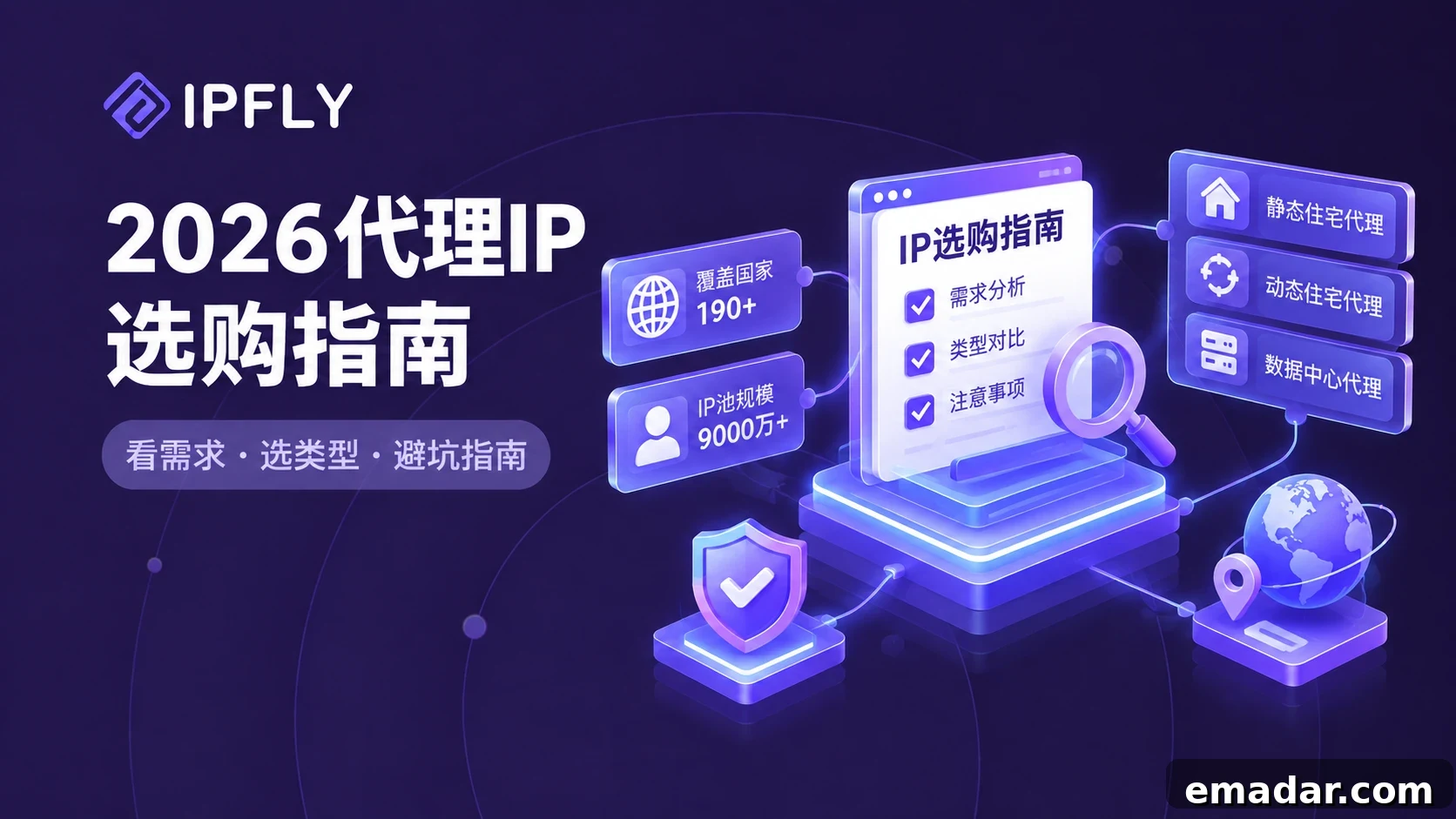
Purchasing proxy IPs may seem like a technical choice, but in business practice it is closer to a strategic resource selection decision.
Different use cases have different IP requirements.
Market research prioritizes geographical coverage and representative data; SEO monitoring emphasizes regional granularity and stable access; ad verification focuses on the network environment of the target region; long-term cross-border e-commerce operations care about fixed network exits and sustained usage; and large-scale data tasks typically value response speed, concurrency and resource scale. Therefore, asking “which proxy IP is best” is not an effective selection question.
A more accurate question is: what IP attributes does the current business need?
Only by clearly breaking down business requirements and matching them to different IP types—residential, static residential or datacenter—can you avoid the situation where “the IP itself is fine, but the product is not suitable for the business.”
Why selecting proxy IPs cannot rely only on IP count
When companies choose proxy IPs for the first time they often focus on three numbers:
IP count, number of covered countries, price.
These metrics matter, but they do not fully represent actual utility.
For example, an SEO monitoring task targeting only the United States does not become more suitable simply because the provider covers more countries. Likewise, a business that needs a long-term fixed network exit should not choose a dynamic residential pool solely because it has a larger dynamic IP supply.
The factors that truly influence selection results are the following dimensions:
- IP source
- IP persistence (fixed or not)
- Target region
- Access frequency
- Task scale
- Network stability
- IP resource quality
- Access and management methods
These dimensions form the basic framework enterprises should use when evaluating proxy IPs.
Step one: determine what the business actually needs
IP selection should start from business requirements, not product pages.
Begin by answering several questions.
Does the business need to maintain the same IP long-term?
If so, IP persistence becomes more important. Long-running cross-border e-commerce, region-specific access, and long-term monitoring tasks often require relatively stable network exits.
Such scenarios should prioritize static residential proxies.
If the business does not require a fixed IP and instead needs to access different regions or collect data from varied network contexts, consider dynamic residential proxies.
Does the business rely on residential network attributes?
This is another key judgment. The difference between residential proxies and datacenter proxies is not just “where the IP comes from.” They represent different network properties.
Residential proxies are better suited for use cases that require residential network origins, such as:
- Market research
- SEO monitoring
- Ad verification
- Regional data collection
- Cross-border functional testing
Datacenter proxies are more suitable when network performance, concurrency and processing efficiency are priorities.
Thus, enterprises should not simplistically conclude “residential proxies are always better” or “datacenter proxies are always faster.” The correct approach is: match the resource to the business need.
Core choice: static or dynamic?
The static vs. dynamic question is one of the most common in procurement. There is no absolute superiority between them; each addresses different requirements.
Static residential proxies: continuity is key
Static residential proxies maintain the same IP during the usage period.
This trait is especially valuable for scenarios requiring a consistent network exit, for example:
- Long-term cross-border store operations
- Region-specific business access
- Extended market monitoring
- Ongoing testing efforts
- Applications that require continuous session persistence
In these use cases, frequent IP changes can introduce unwanted variables. Stability is itself a business asset: the real value of a static residential IP lies not just in an unchanging address, but in the trust and certainty it builds over time.
Dynamic residential proxies: flexibility is key
Dynamic residential proxies deliver flexibility in resource scheduling. For market research, SEO monitoring, ad verification and public data collection, tasks often span multiple regions and broad target sets.
In such cases businesses care less about a single IP staying constant and more about whether they can obtain residential IPs that match target areas.
Dynamic residential pools are typically a better fit for these multi-region tasks.
Avoid confusing two separate dimensions
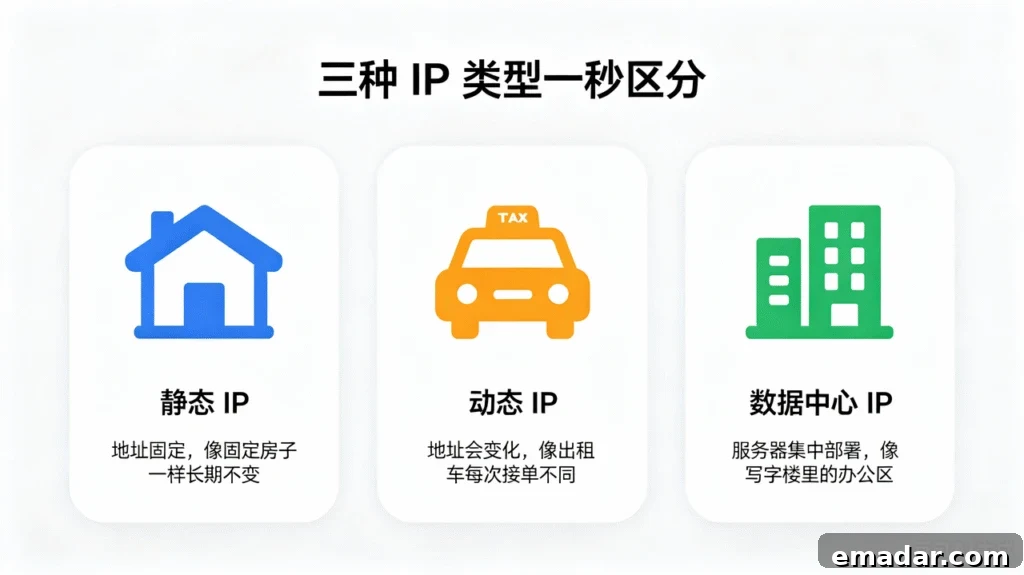
It is easy to misunderstand that static/dynamic and residential/datacenter are the same. In fact they are orthogonal dimensions.
Think of it as a two-dimensional grid:
| Dimension | What it determines |
| Residential / Datacenter | IP network origin |
| Static / Dynamic | IP usage mode |
Thus:
- Static residential = residential origin + fixed IP
- Dynamic residential = residential origin + dynamic allocation
- Static datacenter = datacenter origin + fixed IP
Do not interpret the word “static” as indicating a single product type. Source and change behavior must be assessed independently.
Selection logic for common business scenarios
A practical guide should return to real business needs rather than product definitions.
Market research: prioritize geographic coverage
Market research usually requires collection from multiple regions rather than a single persistent IP. For a company studying the US, UK, Germany and Japan, focus on:
- Whether the target countries are covered
- Support for fine-grained regional selection
- Sufficient residential IP resources
- Stable data access
Dynamic residential proxies often align better with these requirements.
SEO monitoring: focus on region and stability
Search results vary by region, so SEO monitoring for overseas markets must consider the network environment of each target country. Evaluate IP resources specific to the market rather than merely seeking the largest pool.
Ad verification: focus on the target region
Ad verification answers the practical question: do users in the target area see the expected content? Therefore, regional coverage and residential attributes usually matter more than raw speed. Verify:
- Availability of IPs in the target area
- Accuracy of geographic attribution
- Connection stability
- Ability to complete verification tasks continuously
Dynamic residential proxies are commonly evaluated for these needs.
Cross-border e-commerce: prioritize long-term stability
E-commerce store operations differ from one-off data collection: they are ongoing. Companies should pay attention to:
- Consistent network exits over time
- Fixed regional presence
- High IP resource quality
- Persistent connectivity
Static residential proxies often suit these use cases better.
Large-scale data tasks: prioritize performance and concurrency
As task scale grows, evaluation criteria change. For low-volume daily requests, a single IP’s performance may not be decisive. But when request volume rises, response time, concurrency and network stability affect overall efficiency. Datacenter proxies are often preferred for high-throughput, low-latency needs.
Consider the target region carefully
After deciding IP type, regional choice is the next critical layer. “Coverage of 190+ countries” indicates broad reach, but for a specific business you should ask:
Does the provider have strong resources in the target country? If your focus is the US market, the quality of US-based resources matters far more than the total number of countries covered.
Country-level coverage
Suitable for businesses conducting country-specific market research, SEO or ad verification.
City-level coverage
If you need finer regional data, city-level resources are more valuable. For example, the Los Angeles market in California differs from New York City in many practical ways, so city granularity can be critical.
Evaluate IP resource quality
Pool size does not equal usable quality. Key evaluation metrics include:
IP availability
Whether resources can reliably complete business requests.
Geographical accuracy
Whether country, region and city attributes match requirements, especially important for SEO, ad verification and market research.
Stability
For long-term tasks, stable network connections directly affect continuity.
Resource vetting and maintenance
Assess the provider’s mechanisms for screening, managing and maintaining IP quality rather than focusing only on pool size.
Don’t compare proxy IPs by a single metric
Turn the selection into an actionable procurement checklist by evaluating dimensions such as:
| Selection dimension | Questions to answer |
| IP source | Residential or datacenter? |
| IP persistence | Is a long-term fixed IP required? |
| Geographic coverage | Are target countries and cities covered? |
| Resource scale | Can it support the business volume? |
| Network performance | Does it meet response time needs? |
| Concurrency | Can it sustain required request volumes? |
| IP quality | Is there a reliable vetting mechanism? |
| Access method | Does it integrate with existing systems? |
| Service capability | Can it support long-term operations? |
This checklist transforms “which IP to buy” into a repeatable procurement process.
Common misconceptions in proxy IP selection
Focusing only on IP count
Large country counts do not automatically make a product right for a business that targets a single market.
Chasing only speed
High speed does not suit every use case. For region-centric work, IP origin and coverage often outrank raw throughput.
Assuming dynamic IPs are always best for large-scale tasks
Dynamic residential proxies suit many data collection and research tasks, but if your business requires a fixed network exit, static residential proxies may be a better match.
Confusing residential with static
Residential answers “where the IP comes from.” Static answers “is the IP fixed.” They are distinct concepts and cannot substitute for each other.
Comparing only single-IP cost
Enterprise procurement should evaluate total cost of ownership. A cheaper IP that causes frequent reconfiguration, retesting or many failed requests can produce higher overall time and business costs. Assess cost per effective task rather than price per IP.
How enterprises can build an internal IP selection standard
For long-term use, establish internal criteria rather than re-evaluating from scratch for each purchase. A practical framework can follow these layers:
Business layer
Clarify:
- What the business is
- Which markets are targeted
- Expected usage cycle
- Whether fixed IPs are required
- Data volume
Network layer
Decide:
- Residential or datacenter
- Static or dynamic
- Country or city-level resources
- Required stability
Resource layer
Evaluate:
- Pool size
- IP quality
- Geographic coverage
- Availability
- Concurrency capability
Service layer
Assess:
- Access methods
- Account management
- API capabilities
- Technical support
- Long-term resource stability
A standard built this way is more reliable than a simple comparison of vendors’ promotional specs.
How to match IP types to different procurement needs
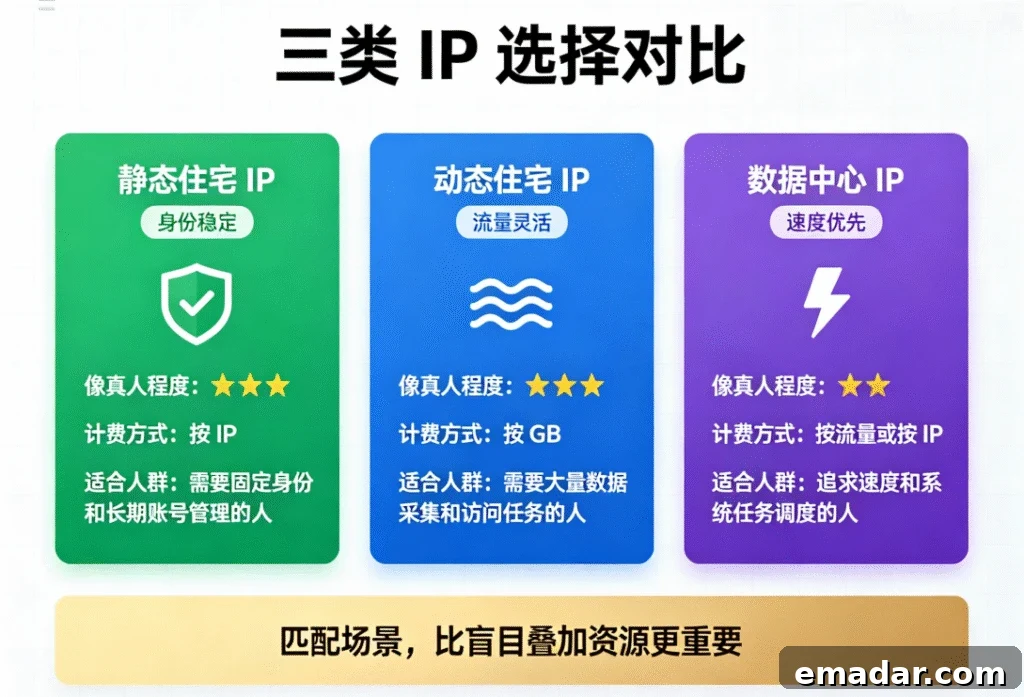
There is no one-size-fits-all proxy IP. Choose the class of resource according to stability, geography and performance requirements:
- When you need multi-region residential IPs, choose dynamic residential pools.
- When you need long-term fixed residential IPs, choose static residential resources.
- When you need high-speed, low-latency and high concurrency, consider datacenter proxies.
Conclusion: selection is matching business to resources
There is no universal “best” proxy IP outside the business context. The real decisions are whether the business needs fixed or flexible IPs, residential or datacenter origins, country- or city-level coverage, long-term stability or large-scale processing, and a narrow or broad resource pool.
Answering these questions turns IP procurement from “examining product specs” into a clear decision process. In short: persistence determines static vs. dynamic, source determines residential vs. datacenter, business scale determines resource and performance needs, and target markets determine geographic selection.
For companies, the important question is not “which proxy IP is best” but which IP resources best match the current access patterns of the business.
Choose the IP resources that fit your business needs.
If you are currently evaluating proxy IPs, first determine the IP type based on business requirements, then test for target countries, stability and task scale.
Register to learn more about dynamic residential, static residential and datacenter proxy resources, and choose the IP type that suits your business scenario.