
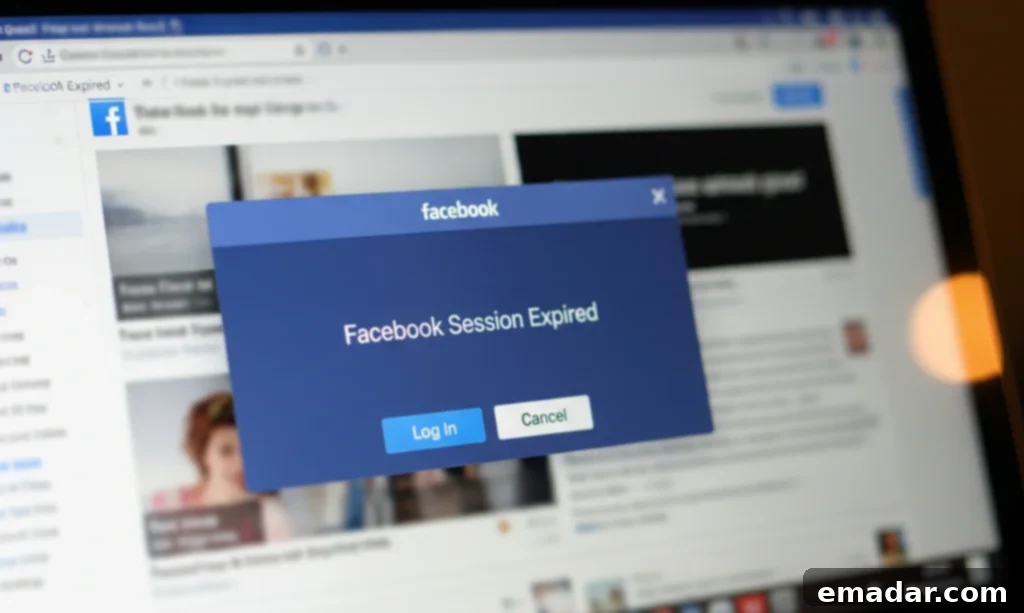
Have you ever been engrossed in scrolling through your Facebook feed or connecting with friends, only to be abruptly interrupted by a message stating, “Your session has expired”? This frustrating pop-up is a remarkably common experience for millions of Facebook users worldwide, particularly when juggling multiple devices, interacting with the app intermittently, or encountering unexpected disruptions in background processes. But what precisely does this message signify, and more importantly, what are the most effective strategies to resolve it swiftly and prevent its recurrence?
This comprehensive guide delves deep into the intricacies of Facebook session expirations. We will meticulously explain the underlying causes that trigger this message, provide detailed, step-by-step solutions to help you regain access to your account quickly, and offer proactive tips to significantly reduce the likelihood of encountering this annoyance in the future. Understanding this security feature is key to a smoother, uninterrupted Facebook experience.
Understanding “Facebook Session Expired”: What It Really Means
When you successfully log into Facebook, whether through its dedicated mobile application or via a web browser on your computer, you initiate what is technically known as a session. This session is essentially a temporary, secure connection that Facebook establishes with your device. It allows the platform to authenticate your identity, remember that you are logged in, and grant you access to your account without requiring you to re-enter your credentials for every single action or page load.
However, for paramount privacy and security reasons, these sessions are not indefinite. Facebook is designed to automatically terminate sessions under specific circumstances, such as after a prolonged period of inactivity or when its sophisticated security systems detect anything out of the ordinary. When your session expires, Facebook effectively logs you out as a protective measure to safeguard your account from unauthorized access. You’ll typically encounter a pop-up alert, a notification, or be redirected to the login page, clearly indicating that your session has ended and prompting you to log back in to resume your activity.
Think of it like a library card that needs to be renewed after a certain period, or a temporary pass that grants you access to a secure building. For online platforms, especially one as widely used as Facebook, managing these sessions is crucial for maintaining both user convenience and robust security against potential threats like hacking or data breaches. While an expired session can be inconvenient, it’s a vital part of Facebook’s defense mechanism against unauthorized account access.
Common Reasons Why Your Facebook Session Might Expire
The “Facebook session expired” message isn’t arbitrary; it’s usually triggered by specific events or system behaviors. Understanding these common culprits can help you not only troubleshoot the problem more effectively but also adopt habits that minimize its occurrence. Here are the primary reasons why your Facebook session might abruptly end:
1. Prolonged Inactivity
One of the most frequent reasons for a session timeout is simply not using Facebook for an extended period. If you leave your browser tab open with Facebook active but don’t interact with it for hours, or if you haven’t opened the app for days, Facebook’s security protocols will automatically terminate your session. This is a standard security practice across most online platforms to prevent unauthorized access if you step away from an open, logged-in device.
2. App or Browser Updates
Software updates are essential for performance and security, but they can sometimes disrupt active sessions. When the Facebook app on your phone or your web browser (like Chrome, Firefox, or Safari) receives a significant update, it might clear temporary data, including session tokens. This often happens because the new version of the software might handle session data differently, or the update process itself acts as a soft reset, prompting a fresh login.
3. Multiple Simultaneous Logins
Accessing your Facebook account from numerous devices at the exact same time – for instance, being logged in on your desktop computer, smartphone, and tablet simultaneously – can sometimes confuse Facebook’s session management system. While Facebook generally supports multiple logins, certain actions or conflicts in session data across different devices can trigger an automatic logout on one or more of them as a protective measure against potential misuse.
4. Corrupted or Expired Cookies and Cache
Your browser stores small pieces of data called cookies, which are crucial for remembering your login status, preferences, and session information. Similarly, cached data helps websites load faster. If these cookies become corrupted, are manually deleted, or simply expire after a set period, your browser loses the stored session information, resulting in an immediate logout. A cluttered or corrupted cache can also interfere with proper session management, leading to unexpected expirations.
5. Enhanced Security Measures and Suspicious Activity Detection
Facebook employs sophisticated algorithms to monitor for unusual or suspicious login patterns. If it detects a login attempt from a new or unfamiliar location, an unrecognized device, or an IP address that deviates significantly from your typical access points, it might interpret this as a potential security threat. In such scenarios, Facebook often automatically expires active sessions on other devices as a precautionary measure to prevent unauthorized access and protect your account from compromise.
6. Network Instability or Changes
A sudden drop in your internet connection, switching between different Wi-Fi networks, or moving from Wi-Fi to mobile data can sometimes disrupt the ongoing session. While not always a direct cause, an unstable network can lead to incomplete data transfers or authentication failures, prompting Facebook to assume the session is no longer valid or secure.
How to Swiftly Fix “Facebook Session Expired” Errors
The good news is that resolving a Facebook session expiration is usually a straightforward process. The specific steps you’ll need to take might vary slightly depending on whether you’re using the Facebook mobile app or a desktop browser. Here’s a comprehensive breakdown of solutions:
On Mobile Devices (Facebook App):
For smartphone and tablet users, tackling session issues often involves addressing the app itself or your device’s settings.
- Simply Reopen and Log In: Often, the simplest solution is the most effective. Close the Facebook app completely (ensure it’s not just running in the background) and then reopen it. You will almost certainly be presented with the login screen. Carefully enter your username (or email/phone number) and password. Make sure to double-check your credentials to avoid further login issues.
- Update the Facebook App: An outdated version of the Facebook app is a common culprit for various glitches, including session errors.
- For iOS Users (iPhone/iPad): Go to the App Store, tap on your profile icon, and scroll down to see pending updates. Find Facebook and tap “Update” if available.
- For Android Users: Open the Google Play Store app, tap your profile icon, then select “Manage apps & device.” Look for Facebook under “Updates available” and tap “Update.” Regularly updating your apps ensures optimal performance and security.
- Clear App Cache and Data: Over time, the app accumulates cached data that can sometimes become corrupted and interfere with normal operations, including session management.
- Android: This is relatively easy on Android. Navigate to your device’s Settings > Apps (or “Apps & notifications”) > Find and tap on “Facebook” > Select “Storage” > Tap “Clear Cache” first. If the problem persists, go back and tap “Clear Data” (or “Clear Storage”). Be aware that clearing data will essentially reset the app to its initial state, requiring you to log in again.
- iOS: Apple’s iOS ecosystem doesn’t provide a direct “Clear Cache” option for individual apps like Android does. The most effective way to clear an app’s cache and data on iOS is to delete and then reinstall the application. To do this, press and hold the Facebook app icon until a menu appears, then tap “Remove App” > “Delete App.” Afterward, go to the App Store and reinstall Facebook. This process typically resolves deep-seated app-related issues.
- Reboot Your Device: A classic IT solution, but often surprisingly effective. A simple restart of your smartphone or tablet can clear temporary system glitches, refresh background processes, and resolve minor conflicts that might be impacting your Facebook session.
- Check Network Connection: Ensure you have a stable internet connection. Try switching between Wi-Fi and mobile data to see if the issue is network-related. A weak or intermittent connection can sometimes prematurely end a session.
On Desktop Browsers:
If you’re accessing Facebook via a web browser on your laptop or desktop computer, the solutions will focus on browser settings and data.
- Refresh the Page: Before trying more involved steps, simply refreshing the browser page (F5 or the refresh icon) can sometimes resolve a minor glitch where the session is actually still active but the display isn’t updated.
- Clear Browser Cookies and Cache: This is arguably the most crucial step for browser-based session issues. Corrupted or expired cookies are a primary cause of logouts.
- Google Chrome: Click the three-dot menu in the top-right corner > Settings > Privacy and Security > Clear Browsing Data. Select a time range (e.g., “All time”), ensure “Cookies and other site data” and “Cached images and files” are checked, then click “Clear data.”
- Mozilla Firefox: Click the three-line menu > Settings > Privacy & Security > Scroll down to “Cookies and Site Data” > Click “Clear Data…” > Check both options and click “Clear.”
- Microsoft Edge: Click the three-dot menu > Settings > Privacy, search, and services > Under “Clear browsing data,” click “Choose what to clear” > Select time range, check “Cookies and other site data” and “Cached images and files,” then click “Clear now.”
- Apple Safari: Go to Safari menu > Preferences > Privacy > Click “Manage Website Data…” > Search for “Facebook” and remove it, or click “Remove All.” Then go to History > Clear History.
After clearing, close and reopen your browser before trying to log in again.
- Log In Again: After clearing your browser data, you’ll typically be redirected to the Facebook login page. Re-enter your username and password carefully. This fresh login establishes a brand new, clean session.
- Disable Browser Extensions: Certain browser extensions, particularly those related to privacy, ad-blocking, or security, can sometimes interfere with how websites store session data or cookies. Try disabling your extensions one by one, or try logging into Facebook in an “Incognito” or “Private” browsing window (which runs without extensions by default) to see if an extension is the culprit.
- Try a Different Browser: If all else fails, attempt to log into Facebook using a completely different web browser (e.g., if you use Chrome, try Firefox or Edge). This can help determine if the issue is specific to your primary browser’s configuration or a broader account problem.
Proactive Strategies to Prevent Future Session Expirations

While some session expirations are unavoidable due to inherent security protocols, adopting a few best practices can significantly reduce how often you encounter the “Facebook session expired” message. These habits not only promote a smoother Facebook experience but also enhance your overall account security.
✅ Enable “Keep Me Logged In” or “Stay Logged In”
Whenever you log into Facebook on a web browser, look for a checkbox labeled “Keep me signed in” or “Remember me.” Ticking this box tells Facebook to remember your credentials for a longer period, reducing the frequency of logouts due to inactivity. On mobile, actively closing the app (force-quitting) instead of just letting it run in the background can sometimes mimic a logout, so try to avoid force-closing unless necessary. Note that this feature doesn’t override security-triggered logouts.
✅ Minimize Frequent Device Switching
While convenient, constantly switching between different devices (e.g., logging in on your phone, then immediately on your laptop, then on a friend’s tablet) can sometimes trigger Facebook’s security algorithms. The system might interpret these rapid changes in access points as suspicious activity, leading it to expire sessions on older devices for your protection. Try to use the same primary device regularly when accessing Facebook to maintain session stability.
✅ Keep Your Software and Apps Updated
Regularly updating the Facebook app, your web browser, and even your device’s operating system (iOS, Android, Windows, macOS) is crucial. Updates often include bug fixes, security patches, and compatibility improvements that ensure smooth interaction between Facebook and your device. Outdated software can lead to unexpected glitches, including issues with session management.
✅ Use Trusted and Secure Networks
Exercise caution when logging into Facebook from public or unsecured Wi-Fi networks (like those in cafes, airports, or hotels). These networks are often less secure and can be vulnerable to snooping. Facebook’s security systems are designed to flag logins from potentially compromised or unusual network environments, which might lead to an automatic session expiration as a preventative measure. Stick to private, password-protected networks whenever possible.
✅ Turn On Two-Factor Authentication (2FA)
While Two-Factor Authentication (also known as two-step verification) won’t directly prevent session expirations, it provides an indispensable layer of security for when you *are* asked to log in again. With 2FA enabled, even if someone obtains your password, they cannot access your account without the second verification code sent to your phone or generated by an authenticator app. This ensures that even after a session expires and you need to re-authenticate, your account remains secure.
✅ Regularly Monitor Your “Where You’re Logged In” Section
Proactively checking your Facebook security settings can prevent future issues. Navigate to Settings > Security and Login. Here, you can review all active sessions and devices. If you spot any unrecognized logins, end them immediately. This helps clear potentially conflicting sessions and signals Facebook that your account is secure, reducing the likelihood of forced logouts.
What If You’re Being Logged Out Repeatedly and Persistently?
If you find that your Facebook session is expiring almost immediately after you log in, or if you’re experiencing constant, inexplicable logouts despite trying the basic troubleshooting steps, it might indicate a more persistent or serious underlying issue. This requires a more thorough investigation.
Check for Suspicious Activity on Your Account
This is paramount. Persistent logouts can be a strong indicator that someone else might be trying to access your account, or has already gained unauthorized access.
- Go to your Facebook Settings > Security and Login.
- Look for the section titled “Where You’re Logged In.” This provides a list of all devices, locations, and times your account has been accessed.
- Carefully review this list. If you see any unknown devices, locations that you didn’t visit, or login times that don’t match your activity, this is a red flag.
- Immediately click on the three dots next to any suspicious entry and select “Log Out.”
- After logging out of suspicious sessions, proceed to change your password without delay. Choose a strong, unique password that you haven’t used before.
Reinstall the Facebook App (Mobile)
For mobile users facing persistent issues, simply clearing cache might not be enough. A full reinstall of the Facebook app often resolves deep-seated bugs, corrupted application files, or persistent data conflicts that accumulate over time. Delete the app completely from your device, restart your device (optional but recommended), and then download a fresh copy from your respective app store.
Reset Your Facebook Password
Even if you don’t find explicit suspicious activity, a persistent logout loop could sometimes be related to account compromise. As a preventative and diagnostic measure, resetting your password can help. This forces all active sessions to log out, ensuring that only you can establish a new session with the new credentials. Choose a robust, unique password that combines uppercase and lowercase letters, numbers, and symbols.
Scan Your Device for Malware
Malware (malicious software) on your computer or phone can sometimes interfere with your browsing experience, including stealing session cookies or login credentials, leading to forced logouts. Run a full scan with reputable antivirus or anti-malware software on any device you use to access Facebook. Ensure your security software is up-to-date.
Review Browser Settings and Extensions
If the issue is primarily on desktop, revisit your browser’s settings. Ensure that Facebook.com is not blocked by any privacy settings or scripts. Temporarily disable all browser extensions, especially those related to VPNs, ad-blockers, or privacy, and try logging in. If the problem disappears, re-enable extensions one by one to identify the culprit.
Facebook Session Expiration with Business Suite or Meta Accounts
The challenge of session expiration extends beyond personal profiles, significantly impacting users who manage professional pages, ad accounts, or integrated services through Meta Business Suite (formerly Facebook Business Manager), Facebook Pages Manager, or accounts linked with Instagram and WhatsApp. When you’re dealing with multiple profiles, roles, and permissions, session management can become even more intricate.
If you’re experiencing session expirations while managing business assets, consider these additional factors:
- Multiple Business Accounts: If you manage several Meta Business Suite accounts or Facebook Pages, ensure you are logged into the correct personal Facebook profile that has the necessary administrative access. Switching between different business accounts or personal profiles without proper session handling can trigger logouts.
- Permission Conflicts: Verify that your user permissions for specific pages or ad accounts are correctly configured and haven’t been revoked or altered. Changes in permissions can sometimes lead to session instability, especially when attempting actions you no longer have access to.
- Integrated Services: If your Facebook account is heavily integrated with Instagram, WhatsApp Business, or other third-party tools, ensure that these integrations are stable. A problem with one linked service can sometimes impact your primary Facebook session.
- Business Suite Specific Cache: For Meta Business Suite users, clearing your browser’s cache and cookies is even more critical, as Business Suite relies heavily on client-side data for seamless operation.
- Dedicated Browser Profiles: Consider using dedicated browser profiles (e.g., in Chrome or Firefox) for different business logins. This keeps cookies and session data separate, minimizing conflicts.
The fundamental solutions (clearing cache, updating apps, checking security settings) still apply, but the complexity increases with the number of interconnected accounts and tools you manage under the Meta ecosystem.
When It’s Time to Contact Facebook Support
While the vast majority of “Facebook session expired” issues can be resolved with the troubleshooting steps outlined above, there are instances where the problem persists, indicating a more complex underlying issue that requires direct intervention. If you’ve diligently tried all the recommended solutions – clearing cache, updating apps, changing passwords, checking for suspicious activity – and you’re still being logged out repeatedly, it’s time to reach out to Facebook’s official Help Center.
To ensure you get the most effective assistance, be prepared to provide detailed information when submitting your report:
- Your Device and Operating System Version: Specify whether you’re using an iPhone (e.g., iPhone 13, iOS 17.0), an Android phone (e.g., Samsung Galaxy S23, Android 14), or a computer (e.g., Windows 11, macOS Sonoma).
- Where the Issue Occurs: Clearly state whether the problem happens exclusively on the mobile app, only on a specific web browser (e.g., Chrome), or on both platforms.
- Screenshots or Screen Recordings: If possible, provide screenshots of the exact error message you receive. A short screen recording of the logout process can also be immensely helpful for technical support to diagnose the issue.
- Steps You’ve Already Taken: List all the troubleshooting steps you’ve already attempted (e.g., “I’ve cleared browser cache, reinstalled the app, and changed my password”). This prevents support from suggesting solutions you’ve already tried.
- Frequency and Timing: Explain how often the issue occurs (e.g., “every 5 minutes,” “once a day”) and if there are any specific triggers (e.g., “only when I try to post a photo”).
While Facebook’s response times can vary and direct human support may sometimes be challenging to access, formally documenting your issue through their Help Center is the official channel. This ensures your problem is logged and increases the chances of a resolution, especially for persistent or unusual account issues.
Facebook Session Expired vs. Logged Out: Understanding the Nuance
Although both “Facebook session expired” and simply being “logged out” ultimately lead you back to the login screen, there’s a subtle but important distinction between the two. Understanding this difference can help you better pinpoint the root cause of your access issues.
- Session Expired: This message typically indicates a security-driven or technical timeout. It means the temporary, secure connection (the “session”) that Facebook established with your device has been explicitly terminated by the system. This often happens due to:
- Inactivity: You haven’t used Facebook for a long time.
- Security Protocols: Facebook detected unusual activity (new device/location, suspicious behavior).
- Corrupted/Expired Session Data: Browser cookies or app data that held the session information became invalid.
- System Updates: An app or browser update reset the session token.
In essence, “session expired” implies that Facebook itself initiated the logout as part of its designed functionality, often for your protection or due to a technical handshake failure.
- Logged Out: This usually refers to a more direct or manual termination of your access. It can be a result of:
- Manual Action: You or someone with access to your device deliberately clicked the “Log Out” button.
- App Crash: A severe bug or crash in the Facebook app or your browser caused an abrupt closure, which implicitly logs you out.
- Remote Sign-Out: You used Facebook’s “Where You’re Logged In” feature (in Settings > Security and Login) to remotely log out of another device.
- Account Compromise (in some cases): If a hacker gains access and changes your password, it will log out all other active sessions, effectively logging you out.
“Logged out” suggests a more immediate or explicit action (either by you, your device, or an authorized third party) causing the termination of access, rather than an automatic system timeout.
While both outcomes require you to re-enter your credentials, “session expired” points towards a more passive, system-managed security or maintenance event, whereas “logged out” often suggests a more active, immediate termination.
Conclusion

The “Facebook session expired” message, while undoubtedly an annoyance, is fundamentally a built-in safety mechanism meticulously designed to protect your account from unauthorized access and maintain your online privacy. Whether it’s triggered by a simple period of inactivity, a software glitch, or a more serious security concern like unusual login patterns, the primary fix remains consistent: a simple login, often coupled with clearing old cookies or cached data, and ensuring your application is up-to-date.
By understanding the common causes and implementing the straightforward troubleshooting and preventative measures discussed in this guide, you can significantly minimize the frequency of these interruptions. Regular updates, judicious use of trusted networks, enabling two-factor authentication, and routinely checking your active login sessions are all crucial steps towards a more secure and seamless Facebook experience.
For individuals and teams managing multiple Facebook logins for business or intricate personal use, aiming for a consistently smoother session experience is paramount. In such scenarios, advanced tools like dedicated proxy services can offer considerable advantages. For example, reputable providers like IPFLY offer dedicated proxy solutions that are specifically engineered to maintain stable session data across various devices and geographical locations. This can be exceptionally beneficial for digital marketers, social media managers, and remote teams who need to manage numerous accounts efficiently without the constant disruption of frequent logouts due to IP changes or conflicting session data.
If you’re seeking to gain more robust control over your Facebook sessions, especially when juggling multiple accounts or operating across different devices and locations, exploring how secure proxy services can help stabilize connections and enhance your privacy is a wise investment. These services can provide a consistent and dedicated IP address, which Facebook’s security systems are less likely to flag as suspicious, thus reducing the likelihood of session expirations.
Visit trusted providers like IPFLY to learn more about how to streamline your browsing experience, manage multiple accounts effectively, and significantly reduce the hassle of frequent Facebook logouts. Take control of your online presence with enhanced stability and security.