
Best Residential Proxy Providers in 2025: A Comprehensive Guide
In the landscape of globalized online activities, including cross-border e-commerce, social media matrix management, advertising, and data scraping, residential proxies have become a critical foundational element. Unlike traditional datacenter IPs, residential IPs originate from genuine home networks, possessing more natural network characteristics. This reduces the likelihood of triggering platform risk controls, making them ideal for sensitive operations like account management, advertising backend access, and regional content verification.
As we move into 2025, the residential proxy market is expanding rapidly. Different providers exhibit significant variations in aspects such as IP pool size, connection speed, stability, anonymity, pricing strategies, and tool ecosystems. This article provides an objective evaluation and comparison of prominent providers in the market, assisting various teams in identifying the most suitable solutions for their unique requirements.

Top Residential Proxy Providers: An Overview
The following five providers have been selected based on their industry coverage, user base, and publicly available performance data (in no particular order):
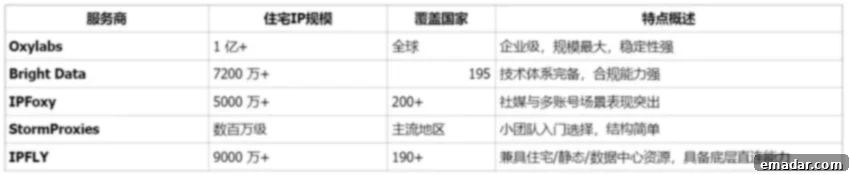
Each provider has a distinct focus, impacting its suitability for various scenarios.
In-Depth Comparison of Five Major Providers
- Oxylabs: The Enterprise-Grade Standard for Scale and Stability
- Residential IP Count: 100 Million+ (One of the largest publicly available)
- Success Rate: 99.5%
- Technical Capabilities: Powerful API, Web Unlocking tools, Automation support
- Compliance: Provides long-term audit trails (365-day traceability)
Advantages: Well-suited for high-frequency, large-scale web scraping and enterprise-level data acquisition projects. Limitations: Higher price point, better suited for large enterprises or institutions.
- IPFoxy: The Go-To Solution for Matrix Operations and Social Media Activities
- IP Pool Size: 50 Million
- Countries Covered: 200+
- Key Features:
- High anonymity, preventing exposure of real IP addresses.
- Low IP sharing ratio, reducing social media association risks.
- Stable performance on platforms like Twitter/X and Instagram.
Ideal For: Social media matrix teams, multi-account environments, and lightweight data scraping.
- Bright Data: A Comprehensive Service Provider with a Robust Technical Ecosystem
- Residential IP Count: 72 Million
- Countries Covered: 195
- Key Strengths:
- Complete data collection tool suite (Web Unlocker, Crawler, etc.)
- Strict compliance policies, ideal for industries with high data compliance requirements.
Ideal For: Financial research, price monitoring, academic/enterprise-level data acquisition. Considerations: Higher prices, more engineering-focused interface, potentially less user-friendly for small teams.
- StormProxies: A Lightweight Option for Small to Medium-Sized Teams
- IP Pool Size: Millions (Significantly smaller than leading brands)
- Key Characteristics:
- Fast IP rotation speed.
- Simple structure, rapid deployment.
- Lower cost.
Ideal For: Beginner users and small-scale scraping tasks.
- IPFLY: A Comprehensive Solution Covering Residential, Static, and Datacenter IPs
- Residential IP Pool: 90 Million+
- Regions Covered: 190+
- Distinctive Features:
- Offers both static residential IPs and dynamic residential IPs.
- Network directly connected by global carriers, resulting in lower fraud scores.
- Suitable for cross-border advertising, social media management, and scenarios requiring high account stability.
Suitable For: Teams that need to flexibly switch between residential, static, and datacenter resources.
Key Metrics: A Comparative Analysis
- IP Pool Size and Geographic Coverage
Significant differences exist among providers in terms of resource pool size:
- Oxylabs: Approximately 102 Million
- IPFLY: Approximately 90 Million+
- Bright Data: Approximately 72 Million+
- IPFoxy: Approximately 50 Million+
- StormProxies: Millions
Insights: A larger IP pool provides more exit options, but doesn’t necessarily guarantee higher access quality. In scenarios requiring fine-grained regional segmentation, such as *multi-region A/B testing, advertising verification, and global data acquisition*, a large IP pool offers a clear advantage.
- Connection Speed and Success Rate
Based on publicly available data and industry assessments:
- Fastest Response Time (Around 0.5 seconds): Oxylabs
- High Success Rate (99.5%+): Oxylabs, IPFLY
- Medium Performance: Bright Data, IPFoxy
- Suitable for Lightweight Scenarios: StormProxies
Trends: In 2025, the stability of residential proxies relies primarily on underlying carrier resources and IP reuse rate control. In account-sensitive activities, success rate is often more critical than response speed.
- Privacy Protection and Identity Trustworthiness
Evaluation criteria include:
- Whether the IP originates from a genuine home network.
- Whether there are issues related to leakage or excessive sharing.
- Whether it supports integration with anti-fingerprinting tools.
Providers performing well include:
- IPFLY (Native home network resources + low fraud score)
- Bright Data, Oxylabs (Comprehensive compliance systems)
- IPFoxy (Low sharing ratio, high social media compatibility)
- Pricing Structures
- Flexible Pay-as-You-Go: IPFLY, IPFoxy
- Enterprise-Level Fixed Monthly Fees: Oxylabs, Bright Data
- Low-Budget Entry-Level: StormProxies
Insights: Business volume dictates the affordability of different pricing models:
- Enterprise-level scraping → Oxylabs / Bright Data are more suitable.
- Social media matrix / cross-border e-commerce → IPFLY / IPFoxy are more common.
- Entry-level scraping → StormProxies.
Residential Proxy Market Trends in 2025: Key Insights
Based on recent technological advancements and market dynamics, the following changes are evident:
Trend 1: Static Residential IPs are the Fastest-Growing Category
Suitable for sensitive scenarios such as long-term stable account logins and advertising backends.
Trend 2: IP Pool Size Shifting from “Expansion” to “Quality Control”
More and more providers are starting to reduce IP reuse rates and improve regional authenticity.
Trend 3: Increased Emphasis on Privacy Protection Mechanisms
Balancing compliance and anonymity has become a priority.
Trend 4: Hybrid Structures Combining Residential + Datacenter + Mobile are Becoming Mainstream
Providers such as IPFLY are offering multiple resource types to meet diverse task requirements.
Conclusion: How to Choose the Right Residential Proxy Provider
Establish a decision-making framework based on the following factors:
- Business Type
- Social Media Matrix: IPFoxy / IPFLY
- Large-Scale Data Collection: Oxylabs / Bright Data
- Ad Verification / Multi-Regional Viewing: IPFLY
- Entry-Level Scraping: StormProxies
- Budget and Team Size
- Large Enterprises: Oxylabs / Bright Data
- Small to Medium-Sized Teams: IPFoxy / IPFLY
- Requirements for Stability and Anonymity
- Sensitive Operations: Static Residential IPs are more appropriate
- Regional Tasks: Consider country coverage and IP pool size
IPFLY Proxy:
- Stable across all nodes, supporting 190+ countries and regions globally.
- Second-level connection, unobstructed operation, simulating real home broadband scenarios.