
Unveiling the Internet Protocol (IP): The Invisible Bridge Connecting the World
Every day, we seamlessly browse web pages, send messages, and stream videos, all powered by a silent, underlying set of rules – the Internet Protocol, or IP. For many, “IP Protocol” is a familiar yet somewhat mysterious term. We hear about it often, but its specific function and operation often remain unclear.
In essence, the IP Protocol acts as the “traffic rules” of the internet. Envision the internet as a vast, global transportation network. Each device connected to the internet is a “vehicle,” data represents “cargo,” and the IP Protocol provides the core regulations that govern how these “vehicles” move and how this “cargo” is transported. Without the IP Protocol, global network devices couldn’t communicate, and the internet as we know it would cease to exist.
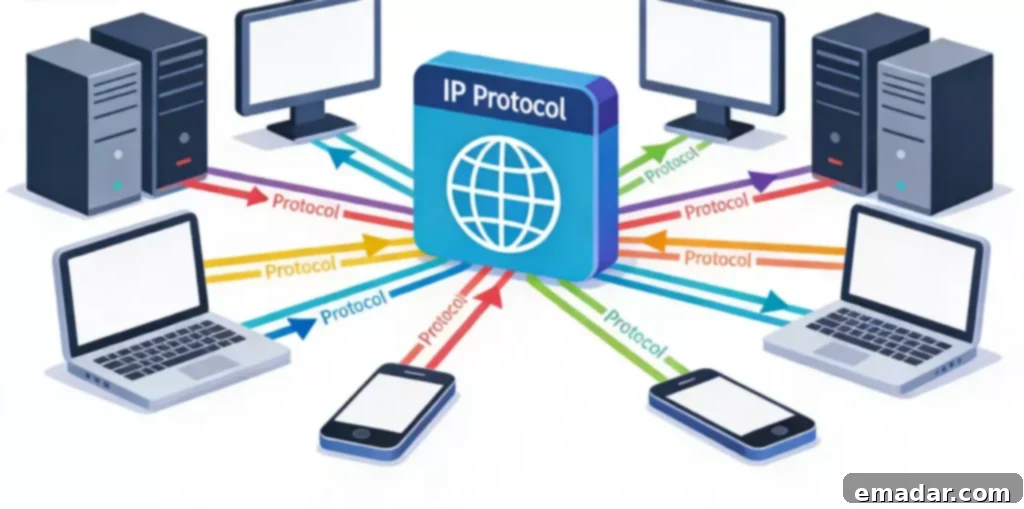
What is the IP Protocol?
1. Definition: The Universal Language of Internet Communication
The IP Protocol, short for Internet Protocol, is a fundamental component of the TCP/IP protocol suite. It defines the standards and rules for data transmission across the internet, acting as a “universal language” that enables seamless communication between different network devices. Simply put, the IP Protocol’s main role is to “label and route” data, ensuring its accurate delivery from the sender to the recipient.
It’s crucial to understand that the IP Protocol primarily focuses on data “addressing” and “routing.” It determines the path data should take and delivers it to the target device. However, it doesn’t guarantee reliable data transmission, such as ensuring data integrity or the order of arrival. The responsibility of ensuring data transmission reliability usually falls on other protocols like TCP. The IP Protocol collaborates with these protocols to form the foundation of internet communication.
2. Key Versions: IPv4 and IPv6
The two main versions of the IP Protocol currently in use are IPv4 and IPv6.
IPv4, the fourth version of the Internet Protocol, is the most widely used version globally. IPv6, the sixth version, was introduced to address the depletion of IPv4 addresses. The core difference lies in the address format and capacity:
(1) IPv4: Uses a 32-bit address format represented in “dotted decimal” notation (e.g., 192.168.1.1). It provides approximately 4.3 billion addresses. With the explosive growth of internet-connected devices, IPv4 address resources have become scarce, leading to the development of IPv6.
(2) IPv6: Employs a 128-bit address format expressed in “colon-hexadecimal” notation (e.g., 2001:0db8:85a3:0000:0000:8a2e:0370:7334). This provides a virtually limitless number of addresses, capable of meeting the networking demands of future global devices. However, due to technical upgrades and compatibility issues, IPv6 is still in the process of being deployed and hasn’t fully replaced IPv4.
How Does the IP Protocol Achieve Precise Data Transmission?
The IP Protocol achieves precise data transmission through “addressing and routing.” This process involves four key steps, akin to sending a package:
1. Data Packaging: Labeling Data with “Address Tags”
When a device needs to send data, it first divides the data into “IP datagrams” (data transmission units defined by the IP Protocol). Each IP datagram includes two essential pieces of information: the sender’s IP address (source IP) and the recipient’s IP address (destination IP). This is similar to writing the sender’s and recipient’s addresses on a package.
Besides the source and destination IPs, IP datagrams also contain control information like data length, protocol type, and Time To Live (TTL). This information ensures smooth and orderly data transmission. For example, the “Time To Live (TTL)” specifies the maximum number of routers a datagram can pass through, preventing it from looping endlessly due to routing errors.
2. Route Addressing: Determining the Data’s Transmission Path
After packaging, the datagram is sent from the sender’s device to the nearest router. Routers act as “traffic hubs” on the internet. They consult their “routing tables” based on the destination IP address in the datagram to determine the next transmission node (i.e., the next router).
A routing table is a vital piece of information stored in a router. It contains the transmission paths for different IP address ranges. By comparing the destination IP address with the address ranges in the routing table, the router can quickly find the optimal transmission path. This is like a package sorting center determining the next stop based on the address on the package.
3. Data Forwarding: Transmitting Data Along the Optimal Path
Once the router identifies the next transmission node, it forwards the datagram. The datagram is relayed through multiple routers. Each router re-queries its routing table and adjusts the transmission path (if a better path is available) while decrementing the datagram’s “Time To Live (TTL)” by 1. When the TTL value reaches 0, the datagram is discarded by the router to prevent infinite looping.
During forwarding, the IP Protocol uses a “connectionless” transmission method. This means the sender and recipient don’t need to establish a dedicated connection before data transmission. Datagrams can be transmitted independently. This method offers high transmission efficiency and is suitable for transmitting large amounts of data. However, it doesn’t guarantee data transmission reliability, which can result in data loss or out-of-order delivery.
4. Data Reception: Receiving and Parsing Data by the Target Device
After multiple hops, the datagram eventually reaches the target device corresponding to the destination IP address. The target device receives the datagram and verifies that the destination IP address matches its own IP address. If there’s a match, the device removes the control information and reassembles the fragmented data into the original data, completing the entire data transmission process.
The Critical Role of the IP Protocol in the Internet
As the underlying rule for internet communication, the IP Protocol performs several crucial functions, ensuring the internet’s smooth operation:
1. Address Allocation and Identification: Assigning a Unique “Network ID” to Devices
The IP Protocol defines the format and allocation rules for IP addresses, assigning a unique IP address to each device connected to the internet. This IP address acts as the device’s “network ID,” uniquely identifying it on the internet. With IP addresses, network devices can accurately identify senders and recipients, preventing data from being “misdelivered.”
For instance, when we use our phones to access a website, the phone’s IP address is the sender’s ID, and the website server’s IP address is the recipient’s ID. The IP Protocol uses these two IDs to ensure that the website data is accurately delivered to our phones.
2. Route Selection: Planning the Optimal Data Transmission Path
The IP Protocol uses routing tables and routing algorithms to plan the optimal data transmission path. Multiple paths may exist between different devices. The IP Protocol can select the smoothest and most efficient transmission path based on factors like network congestion, transmission distance, and link quality, improving data transmission efficiency.
For example, when sending data from Beijing to Shanghai, multiple network links might exist. The IP Protocol will automatically select the link with the lowest congestion and fastest transmission speed, ensuring rapid data delivery.
3. Cross-Network Interconnection: Enabling Interoperability Between Different Network Types
The internet consists of countless local area networks (LANs) and wide area networks (WANs) of different types. These networks may have different hardware and transmission protocols. As a universal underlying protocol, the IP Protocol masks the differences between networks, enabling interconnection and communication between different types of networks.
For example, home Wi-Fi networks (LANs), company Ethernet networks (LANs), and mobile carrier networks (WANs) are all different types of networks. However, through the IP Protocol, they can all access the internet and enable cross-network communication between devices.
4. Supporting Proxy Network Services: Breaking Down Network Geographical Restrictions
In scenarios requiring cross-border access to internet resources, proxy network services leverage the IP Protocol’s address identification and routing capabilities to assign users dedicated IP addresses, helping devices overcome geographical restrictions. For example, a proxy service might allocate users independent overseas IP addresses according to the IP Protocol’s rules, allowing user devices to be recognized as local devices by overseas networks. Optimizing routing paths also ensures stable and secure data transmission, meeting various cross-border internet needs.
Common Misconceptions About the IP Protocol
1. “The IP Protocol Guarantees Reliable Data Transmission”
Many people believe that the IP Protocol ensures accurate and complete data transmission, but this isn’t the case. The IP Protocol employs a “connectionless” and “unreliable” transmission method. It focuses on transmitting datagrams to the target device without guaranteeing data transmission reliability. If datagrams are lost, damaged, or delivered out of order during transmission, the IP Protocol doesn’t automatically retransmit or correct them. Ensuring data transmission reliability is the responsibility of upper-layer protocols like TCP. TCP uses mechanisms like retransmission, verification, and sorting to ensure reliable data transmission.
2. “The IP Address is the Device’s Physical Address”
This is incorrect. The IP address is the device’s “logical address” on the internet, used to identify the device’s location on the network and is allocated based on the IP Protocol. The device’s physical address is the “MAC address,” which is the hardware address of the device’s network card. It identifies the device’s physical identity and is permanently embedded in the hardware at the factory. Their functions and allocation methods are completely different. IP addresses are used for cross-network routing and addressing, while MAC addresses are used for device identification within a local area network.
3. “IPv6 Has Completely Replaced IPv4”
While IPv6 is the next-generation IP Protocol and addresses the depletion of IPv4 addresses, it hasn’t completely replaced IPv4 yet. Existing network devices and software systems are mostly based on IPv4, and upgrading to IPv6 requires significant cost and time. Therefore, the current internet is still primarily based on IPv4, and IPv6 is in a gradual promotion and transition phase. Many network devices and services support both IPv4 and IPv6 to ensure compatibility.
4. “The IP Protocol Only Handles Data Transmission and is Unrelated to Network Security”
Although the IP Protocol doesn’t have built-in strong security mechanisms, it’s closely related to network security. For example, IP addresses are important targets for network attacks. Attackers can initiate attacks by forging IP addresses (IP spoofing). Also, attackers can exploit the control information in IP datagrams (such as TTL and protocol type) to carry out network attacks. Therefore, network security protection requires measures like firewall filtering, IP address binding, and intrusion detection to address the characteristics of the IP Protocol.
The IP Protocol: The “Underlying Cornerstone” of the Internet
In conclusion, the IP Protocol acts as the underlying rule for internet communication. Its core function is to achieve precise data transmission through “addressing and routing,” providing a core guarantee for the interconnection of global network devices. Understanding the principles and functions of the IP Protocol helps us understand the basic logic of internet access and allows us to quickly identify the root cause of network problems (such as inability to access the internet or slow data transmission).
In daily use, we don’t need to deeply master the technical details of the IP Protocol. However, understanding its basic concepts and core functions can make the internet experience smoother. With the gradual promotion of IPv6, the IP Protocol will continue to be upgraded and optimized, providing support for a larger and more complex internet ecosystem.