
In our daily lives, we interact with “reverse proxies” constantly, yet a vast majority of people are unaware of their existence.
When you open TikTok on your phone, shop internationally on Amazon, or search for information on Google, do you think you are directly connecting to these giants’ servers?
The answer is: no.
Almost 100% of the time, you are connecting to the “super receptionist” set up at the forefront – the Reverse Proxy.
This “receptionist” is one of the most important, yet most unsung heroes of the internet. It supports the massive traffic surges of events like “Singles’ Day,” withstands constant hacker attacks, and allows you to open web pages in the blink of an eye. Reverse proxies are essential for maintaining a seamless and secure online experience.
Understanding Reverse Proxies
To understand reverse proxies, let’s set aside complex code and servers for a moment and imagine a very large, upscale restaurant.
- You (Client/User): A diner coming to eat.
- Restaurant Servers (Backend Servers): Dozens of talented chefs, busy in the kitchen.
- Reverse Proxy: The restaurant’s “head maitre d’,” standing at the entrance, and the only person you directly interact with.
Your dining process goes like this:
- You walk into the restaurant. You don’t need to know or care which chef is cooking your meal today. You only deal with the “maitre d’.”
- You tell the “maitre d'” your needs (“I want to order a signature dish”).
- The “maitre d'” (reverse proxy) takes your menu (request) and does several things:
- Security Check: He first assesses you to make sure you are not there to cause trouble (security protection).
- Traffic Distribution: He looks at the kitchen and sees that “Chef Wang” is busy, while “Chef Li” is relatively free. To get your food to you as quickly as possible, he hands the menu to “Chef Li” (load balancing).
- Specialized Tasks: If you want “a dessert” and “a steak,” he will give the dessert order to the “pastry chef” and the steak order to the “head chef” (path routing).
- Efficient Response: If you ask “What is today’s soup?” and 100 people have already asked that question, he will tell you the answer directly (“It’s borscht”) without having to run back to the kitchen to ask (caching).
- Finally, the “maitre d'” brings the food (web page data) prepared by “Chef Li” to your table.
In this process, the reverse proxy (maitre d’) fulfills its core mission: It hides the complexity, chaos, and fragility of the kitchen (backend servers), providing diners (users) with a unified, efficient, and secure service.
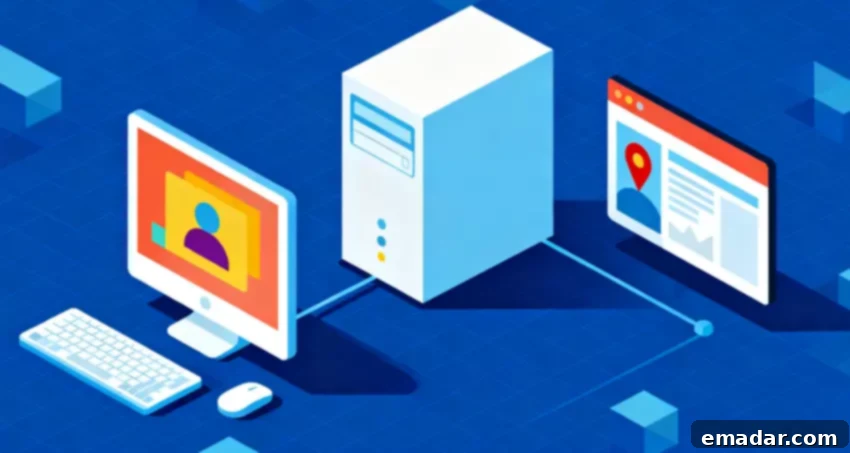
Reverse Proxy vs. Forward Proxy
This is the most searched and most easily confused knowledge point under the “reverse proxy” keyword. Many people struggle to differentiate between these two important concepts.
“Forward Proxy” and “Reverse Proxy”, although both called “proxies,” have completely opposite directions, purposes, and service objects.
- Forward Proxy: Serving “You”
- Service Object: Client, i.e., “you” yourself.
- Purpose: Hide “your” real identity, helping you access “others.”
- Analogy: You want to buy a limited-edition bag but don’t want to reveal your identity. So you hire a “personal shopper” (forward proxy) to buy it for you.
- Workflow: You -> Forward Proxy -> Internet
- Platform Determination: The store (target website) only knows that the “shopper” (proxy IP) came to buy something, but doesn’t know that you are the buyer behind the scenes.
- Use Cases:
- Circumventing geographical restrictions (accessing content not available in your region).
- Bypassing internet censorship.
- Protecting your privacy by masking your IP address.
- Reverse Proxy: Serving the “Server”
- Service Object: Server, i.e., the “website” itself.
- Purpose: Hide the “server’s” real identity, to “greet you” on behalf of the server.
- Analogy: The “head maitre d'” (reverse proxy) hired by the upscale restaurant owner to greet “you.”
- Workflow: You -> Reverse Proxy -> Website’s Internal Servers
- Platform Determination: You (the user) only know the address of the “maitre d'” (reverse proxy), but don’t know where the kitchen (real server) is located or how many servers there are.
- Use Cases:
- Load Balancing: (Detailed below).
- Security Protection: (Detailed below).
- Large Website Architecture: Almost all large websites you’ve heard of (Google, Alibaba, Tencent) are using it.
The Five Core Benefits of Reverse Proxies
Why can’t all large websites live without reverse proxies? Because they provide five “superpowers” that are the cornerstone of modern network architecture. These benefits ensure optimal performance, security, and scalability for any online platform.
- Load Balancing
This is the most core and most important function of a reverse proxy. Without effective load balancing, websites would struggle to handle the immense traffic they receive daily.
- Problem: Modern websites (like TikTok) have hundreds of millions of visitors per second. One server (chef) will definitely be exhausted (crash).
- Solution: The website will prepare thousands upon thousands of identical servers (chefs) in the “kitchen.”
- Reverse Proxy’s Job: When the “head maitre d'” (reverse proxy) receives 1000 menus (requests), it won’t foolishly give them all to “Chef Wang.” It will use algorithms (such as round robin, least connections, IP hashing) to distribute these 1000 menus evenly to 100 free chefs.
- Result: The pressure on each backend server is very small, user requests are responded to instantly, and the website never crashes. This ensures a consistently smooth user experience, even during peak traffic periods.
- Security & Anonymity
Reverse proxies play a vital role in protecting backend servers from various online threats.
- Problem: If hackers know the real IP address of your backend server, they can bypass all firewalls and directly “DDoS attack” your core data, hitting it accurately every time.
- Reverse Proxy’s Job: It hides the real identities and locations of all “chefs.”
- Result: Hackers can only attack the “head maitre d'” (reverse proxy) standing at the forefront. And this “maitre d'” is usually Nginx or Cloudflare, a battle-hardened “martial arts master” who is extremely resistant to attacks. The website can deploy a WAF (Web Application Firewall) on the reverse proxy, blocking all “suspicious elements” (such as SQL injection, XSS attacks) at the “gate.” This proactive security measure significantly reduces the risk of successful cyberattacks.
- Caching
Caching is a crucial optimization technique that dramatically improves website loading speed and reduces server load.
- Problem: 90% of the content on a website is “static” (such as logo images, CSS/JS files, company profiles). If 1 million people visit, the backend server has to repeatedly “package” this logo 1 million times, which is extremely wasteful.
- Reverse Proxy’s Job: When the first person requests the logo, the “maitre d'” gets a copy from the kitchen, but he makes a copy for himself and puts it at the front desk (cache).
- Result: When the next 999,999 people ask for the logo, the “maitre d'” directly hands it to them from the front desk. The pressure on the backend server (chef) instantly drops to zero, and users’ web page loading speeds become incredibly fast. This significantly improves the user experience and reduces server costs.
- SSL/TLS Termination
SSL/TLS termination offloads the computationally intensive task of encryption and decryption from backend servers, improving overall performance.
- Problem: We now access websites using HTTPS (with a lock), and this “encryption” and “decryption” process (SSL/TLS handshake) consumes a lot of CPU resources. If each “chef” is responsible for “verifying their identity” (decrypting) while cooking, efficiency is too low.
- Reverse Proxy’s Job: The “maitre d'” says, “I’ll do the hard work of encryption and decryption!”
- Result: The “maitre d'” (reverse proxy) is responsible for HTTPS encrypted communication with all diners (users). But he turns around and hands the “decrypted” plaintext menu (ordinary HTTP) to the kitchen.
- Advantage: Secure externally (encrypted), efficient internally (unencrypted). The backend server can offload the burden of “encryption” and focus on processing business logic. This results in significant performance gains and reduced server resource utilization.
- Unified Entry Point & Microservices Routing
Reverse proxies provide a single entry point for clients, simplifying complex microservices architectures and improving maintainability.
- Problem: Modern large websites use a “microservices” architecture. Your “shopping cart” is one server, “user center” is another server, and “blog” is a third server. They may be deployed in different locations.
- Reverse Proxy’s Job: The “maitre d'” acts as a “unified address.” The reverse proxy routes requests to the appropriate backend service based on the URL path or other criteria.
- Users (clients) are completely unaware of the complex architecture behind the scenes, resulting in an extremely smooth experience. This abstraction simplifies development and deployment, allowing teams to focus on individual services.
Conclusion: We Live in a World of “Proxies”
Let’s go back to the original question: “What does reverse proxy mean?”
A reverse proxy is the server’s “umbrella” and “dispatcher,” making the internet safe, fast, and scalable. They are fundamental to the operation and security of modern web applications.
A forward proxy is the client’s “invisibility cloak” and “pass,” making you anonymous, free, and disguiseable.
As an operator of cross-border e-commerce or TikTok live streaming, you may never need to personally “deploy” a reverse proxy (your website service provider such as Shopify or Amazon has already taken care of it for you).
However, you need to use “forward proxies” every day.
You must clearly realize that when you need IP isolation, anti-association, or data collection, you are looking for a “personal shopper” (forward proxy). In multi-account operations, protecting your “client” identity is the top priority, and this is exactly the core problem solved by services such as IPFLY’s Static Residential Proxies.
Understanding the fundamental difference between these two, you can truly understand the “attack” and “defense” of the internet and build the most solid and secure network “moat” for your cross-border business. This knowledge is essential for protecting your online assets and ensuring business continuity.
Why recommend IPFLY’s solution?
IPFLY helps users efficiently configure proxy IPs through the following technical advantages:
1. Self-built server network: covering major cities around the world, with high IP resource purity, avoiding “blacklist” problems. This ensures reliable and consistent proxy performance.
2. Dynamic IP allocation mechanism: automatically rotates IPs, reducing the risk of long-term use of the same address. This helps prevent detection and blocking by target websites.
3. Multi-level IP filtering: uses big data algorithms to eliminate low-quality IPs, ensuring proxy link success rate. This results in faster and more reliable data transfer.
👉Choose IPFLY for greater peace of mind, claim your discount now and get high-quality IPs