
Understanding Russian Search Engines: Yandex and Beyond
In the Russian digital landscape, Yandex reigns supreme as the most widely used and comprehensive search platform for native Russian speakers. While Google holds significant sway globally, it’s crucial to understand that it’s not always the primary or even the preferred choice in Russia and other Russian-speaking regions. For businesses targeting this market, a deep dive into Yandex is essential for effective SEO and online marketing.
What is a Russian Search Engine?
A Russian search engine is designed specifically for users in Russia and those who speak the Russian language. These platforms cater to the local language nuances, map integration, content ecosystem, and regulatory environment of the region. Yandex holds the lion’s share of this market, acting as the central hub for online information and services.
Major Search Engines in Russia

-
Yandex (Most Popular)
Yandex is Russia’s leading search engine and a critical piece of the country’s internet infrastructure.
Key Features:
- Superior understanding of Russian language semantics.
- Deep integration of local news, maps, and services.
- Highly localized search results.
- Extensive use in e-commerce, transportation, and advertising platforms.
Within the Russian market, Yandex functions as a powerful combination of Google, Baidu, and a comprehensive mapping service like Google Maps or similar.

-
Google Russia (Still Used, but Not Mainstream)
Google maintains a presence in Russia, primarily among specific user groups:
- Technical professionals.
- Employees of international corporations.
- Users who require English or cross-lingual search capabilities.
For searches related to pure Russian language content and local life, Google’s results often lack the relevance and accuracy of Yandex.
-
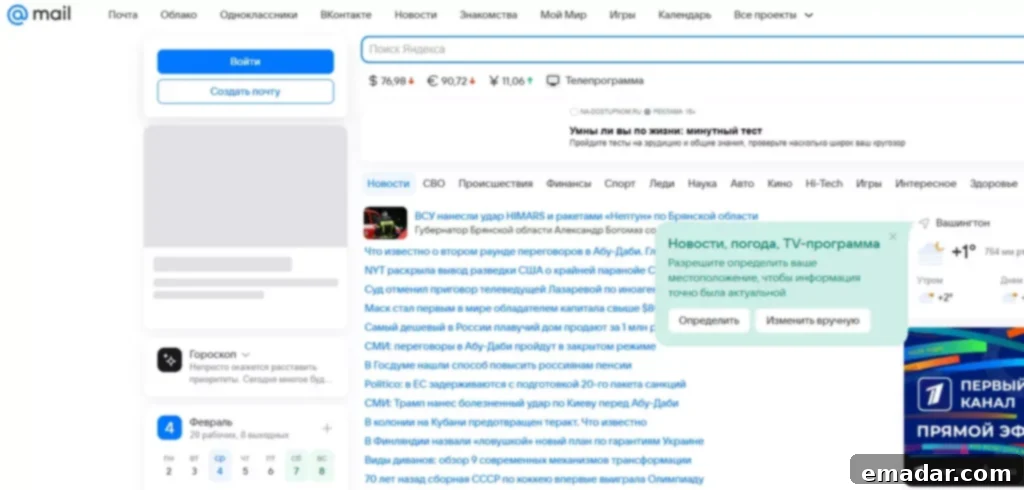
Mail.ru Search (Used Within its Ecosystem)
Mail.ru is not exclusively a search engine; it’s more of an integrated platform offering:
- Email services.
- News aggregation.
- Social networking.
- A comprehensive portal.
Its search functionality primarily caters to users within its own ecosystem and represents a smaller share of independent search activity.
Why is Yandex More Important in Russia?
This is a critical question for international businesses and SEO professionals. The reason Yandex holds such a prominent position is that its search logic prioritizes local user behavior over globally uniform algorithms. This localized approach is key to understanding how to effectively optimize for the Russian market.
Key aspects of Yandex’s localized approach:
- Strong emphasis on local IP addresses and regional matching.
- High sensitivity to the nuances of the Russian language.
- Significant weighting of user behavior signals.
- Prioritization of content “usefulness” over brand authority.
This explains why websites that perform well on Google may struggle to rank on Yandex. The algorithms are fundamentally different, requiring a tailored approach.
Core Differences Between Russian Search Engines and Google
Here’s a simplified comparison to help understand the distinctions:
- Google emphasizes links and domain authority.
- Yandex emphasizes user behavior and local relevance.
- Google relies on a unified global algorithm.
- Yandex adapts to regional variations.
For businesses targeting the Russian market, failing to optimize for Yandex is essentially equivalent to neglecting local SEO altogether. Understanding the nuances of Yandex’s algorithm is paramount for success.
What Signals Do Search Engines Consider in the Russian Market?
Within the Yandex ecosystem, several factors influence search rankings:
- Whether the traffic originates from genuine Russian users.
- The naturalness and authenticity of the page’s Russian language.
- The content’s effectiveness in addressing specific user needs.
- User engagement metrics, such as time on page and interactions.
- The stability and reliability of the network access path.
Therefore, maintaining a stable network environment that closely mimics the characteristics of local Russian users is critical when testing, gathering data, or managing Russian content long-term. Some teams employ solutions that replicate residential network characteristics (such as residential IPs) to mitigate issues stemming from anomalous traffic and regional mismatches.
Suitable Scenarios for Using Russian Search Engines
Common use cases include:
- Russian SEO and content research.
- Market analysis for local brands or e-commerce businesses.
- Sentiment analysis and user feedback collection.
- Verification of real search intent for keywords.
- Data gathering for informing Russian advertising campaigns.
Common Mistakes for Beginners
Many newcomers to the Russian market stumble on these common pitfalls:
- Relying solely on Google for keyword research.
- Directly translating English content without considering cultural context.
- Ignoring the unique search habits of Russian users.
- Overlooking the importance of a consistent and localized browsing environment.
The result is often content that is created but unrecognized by the search engines, leading to wasted effort and poor results.
Frequently Asked Questions (FAQ)
What is the most popular search engine in Russia?
Yandex is the dominant search engine in the Russian market, holding the largest market share.
Can you optimize for both Yandex and Google simultaneously?
Yes, but it requires distinct strategies. You cannot fully replicate the same optimization approach for both engines.
Does Yandex support English searches?
Yes, it does. However, its primary strength lies in Russian-language content and local search.
Is it necessary to study Yandex for the Russian market?
Absolutely. Without understanding Yandex, it’s challenging to achieve significant organic traffic.
Is Yandex sensitive to IP addresses and geographic regions?
Yes, it is relatively sensitive, particularly for localized searches and service-related content.
Conclusion: A Word of Summary
If your target audience is Russian-speaking, then Yandex is not merely an “option,” but rather an “essential element” of your strategy. It’s the fundamental infrastructure upon which your online success in Russia depends.
By understanding the nuances of Yandex, tailoring your content to the preferences of Russian users, and employing appropriate SEO techniques, you can significantly improve your visibility and reach in this important market.