
In the highly competitive arenas of cross-border e-commerce, sophisticated TikTok operations, targeted Google ad campaigns, and large-scale data harvesting, the quality of your IP address is often the single most critical factor determining success or failure. Among all types of proxy solutions, the US Native Residential IP stands out. It’s far more than just “an American IP address”; it represents a distinct and superior class, offering advantages that ordinary proxies or datacenter IPs simply cannot match. This comprehensive guide will delve into real-world business scenarios to illuminate the unparalleled benefits, diverse applications, precise setup methods, and crucial pitfalls to avoid when leveraging US native residential IPs.

Understanding US Native Residential IPs: The Unrivaled Gold Standard for Online Operations
The term “US Native Residential IP” is frequently mentioned but often misunderstood. To truly appreciate its value, it’s essential to grasp its core components and how it differs from other proxy types.
1. A Clear Definition of Superiority
- Native IP Designation: An IP address is considered “native” when it is directly allocated by an internet service provider (ISP) within the United States. This means its registration history is pristine, untainted by previous use as a proxy, VPN, or association with illicit online activities. Such IPs carry inherent trust and credibility.
- Residential Attribute: Beyond being native, these IPs originate from genuine residential broadband networks. They mimic the online behavior of a typical home user, making them incredibly difficult for sophisticated anti-bot systems and platform algorithms to detect as anything other than a legitimate connection.
2. Distinguishing True Native Residential IPs from the Rest
The market is flooded with various IP types, but none offer the same level of anonymity and trust as a genuinely native residential IP. Understanding these distinctions is paramount:
- Standard “Residential IP” Proxies: Many providers offer “residential proxies,” but these can sometimes be repurposed, overused, or even derived from compromised devices (botnets), leading to a higher risk of detection and blacklisting. These “second-hand” resources lack the clean history and direct ISP allocation of native IPs.
- Datacenter IP Proxies: While incredibly fast and cost-effective, datacenter IPs are easily identifiable. They are provisioned in large blocks within commercial server farms and are immediately flagged by most advanced detection systems used by social media platforms, e-commerce sites, and advertising networks. Their primary use is for general web browsing or simple tasks where anonymity is not a major concern.
- The Native Residential IP Advantage: A truly native residential IP operates virtually indistinguishable from a real person browsing from their home. This high level of authenticity and anonymity makes it the preferred choice for sensitive online tasks, ensuring maximum trust and minimizing the risk of triggering security protocols.
3. Why IP Quality is Absolutely Crucial
In today’s digital landscape, major platforms like Facebook, TikTok, Google Ads, Amazon, and eBay employ sophisticated multi-layered detection systems. These systems analyze numerous data points, including device fingerprints, IP reputation, geographical location consistency, and behavioral patterns. Utilizing low-quality or easily detectable IPs can lead to severe consequences:
- Advertising Account Restrictions: Ad platforms are particularly vigilant against fraudulent activity. A compromised or non-native IP can trigger immediate account suspensions, ad disapprovals, shadow-banning (where ads run but receive no impressions), or even permanent bans, leading to significant financial losses and wasted advertising spend.
- E-commerce Account Anomalies: Cross-border sellers often face “account abnormal” notifications, “identity verification failed” messages, or even account lockouts when logging in with non-native IPs. This directly impacts their ability to manage listings, process orders, and communicate with customers.
- Data Collection Blocks: Automated scraping attempts from datacenter IPs are quickly identified and blocked, often resulting in CAPTCHAs, temporary IP bans, or permanent blacklisting of entire IP subnets, hindering vital market research and competitive intelligence efforts.
Real-World Business Scenarios: Unleashing the Power of Native Residential IPs
The strategic application of US native residential IPs can dramatically enhance the success rates of various demanding online operations. Let’s explore some critical use cases.
Scenario A: Optimizing Cross-Border E-commerce Ad Campaigns
Imagine you’re launching an independent e-commerce store targeting the American market. To maximize your ad campaign’s effectiveness on platforms like Facebook Ads or Google Ads, your operational environment needs to mirror that of a genuine US user. By using a local US credit card and logging into your ad account via a US native residential IP, you significantly boost the stability and performance of your campaigns. Unlike datacenter IPs, which can lead to erratic ad delivery, lower click-through rates (CTR), and fluctuating conversion rates due to platform skepticism, a native residential IP ensures your ad impressions are delivered to the right audience without triggering algorithms that might flag your activity as suspicious. This leads to more consistent results, better ad spend efficiency, and a reduced risk of account flags or suspensions.
Scenario B: Secure TikTok Multi-Account Management and Growth
TikTok’s robust anti-spam and anti-bot systems are notoriously sensitive to unusual IP activity. Attempting to manage multiple TikTok accounts from a single non-native or shared IP is a surefire way to get all linked accounts simultaneously flagged and potentially banned. A strategic approach is crucial for successful multi-account management:
- One Account, One Native IP: Assign a dedicated, unique US native residential IP to each TikTok account. This ensures that each account appears to be operated by a distinct individual from a different location within the US, creating a highly credible digital footprint.
- Fingerprint Browser Integration: Complement your native IP strategy with advanced fingerprint browsers (e.g., Dcloak, GoLogin, Multilogin, Incogniton). These tools create unique browser environments for each account, preventing platform detection based on consistent browser fingerprints, device types, or operating system characteristics.
- Dynamic IP Rotation and Sticky Sessions: Leveraging an API from a reliable provider like IPFLY allows for flexible IP management. You can implement IP rotation for tasks requiring high anonymity across many requests (like initial account setup or mass following) or utilize sticky sessions for sustained, consistent interaction with a single account over a longer period, ensuring seamless and natural-looking operations. This combination is vital for platforms like Instagram, Twitter (X), and YouTube as well.
Scenario C: E-commerce Platform Review Management & Large-Scale Data Collection
E-commerce giants like Amazon, eBay, and Walmart have advanced systems to detect and prevent automated activities such as price scraping, review manipulation, or mass product listing from suspicious sources. Datacenter IPs are often blocked after just a few hundred requests when attempting to gather competitive pricing data or product information.
- Mimicking Real User Behavior: By utilizing a distributed network of US native residential IPs, your data collection efforts can effectively simulate genuine user browsing. This significantly reduces the likelihood of being detected, allowing you to execute hundreds of thousands, or even millions, of requests without triggering anti-bot measures.
- Enhanced Data Accuracy and Completeness: With native residential IPs, you can access region-specific content and pricing, ensuring the accuracy and completeness of your collected data. IPFLY’s dynamic distribution technology, for example, allows you to precisely control the frequency of IP switching per minute, greatly boosting data collection success rates for tasks like competitive analysis, market trend identification, and inventory monitoring. This capability is indispensable for businesses relying on real-time market intelligence.
Choosing and Setting Up Your US Native Residential IP Correctly
The effectiveness of your native residential IP strategy hinges on making the right choices and configuring them properly. Here’s a detailed guide:
A. Key Indicators for Selecting a Premium Provider
- Authenticity of ISP Allocation: This is paramount. Always verify that the IP addresses are genuinely sourced directly from reputable US ISPs and not resold or repurposed from questionable origins. A transparent provider will offer details on their IP sources.
- Consistent Bandwidth and Stability: While “native” implies authenticity, it doesn’t automatically mean high speed. A top-tier service provider, such as IPFLY, invests in vetting and selecting high-speed broadband sources to ensure optimal performance for your tasks, whether it’s rapid data scraping or smooth ad account management.
- Support for Multiple Protocols: Your chosen provider should offer support for both Socks5 and HTTP/HTTPS protocols. This versatility is crucial, as different tools and applications may require specific proxy types. HTTP/HTTPS is common for web browsing and simple requests, while Socks5 offers a lower-level, more secure, and often faster connection for certain applications.
- Extensive IP Pool Coverage: A diverse and geographically dispersed IP pool, covering multiple US states and major cities, is vital. This allows you to select IPs that precisely match your target market or account registration location, preventing geo-location inconsistencies that can trigger platform security alerts.
- Reliable Customer Support & API Integration: Look for providers offering robust customer support and comprehensive API documentation for seamless integration into your automated workflows and custom applications.
B. Step-by-Step Setup Guide (Illustrated with IPFLY)
Setting up your US native residential IP can be straightforward with a reliable provider. Here’s how:
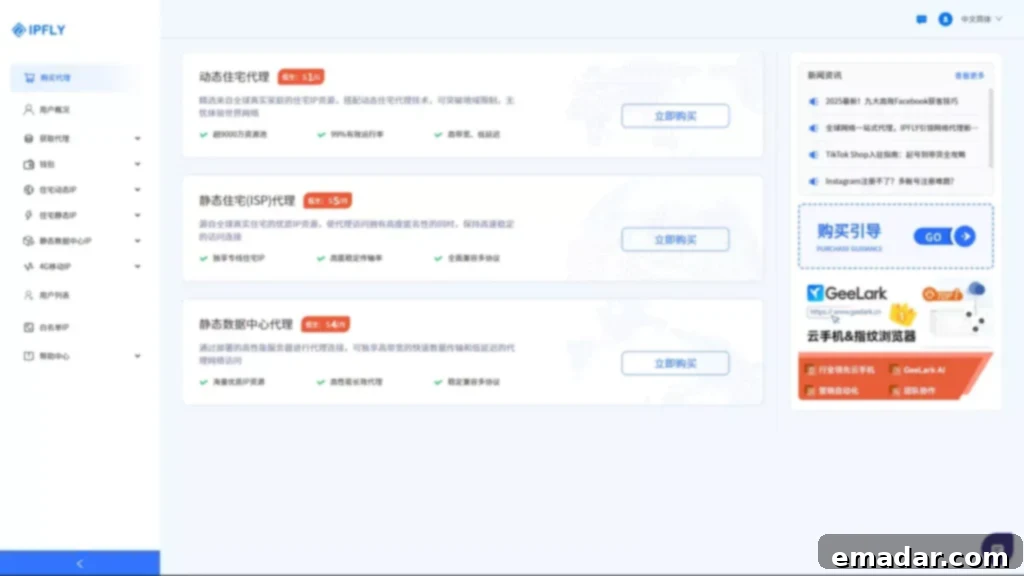
1. Registration and Package Selection
- Navigate to the IPFLY official website and choose the “US Native Residential IP” package that best suits your operational needs.
- Carefully select your desired US state or city to align with your target demographic or account location, then choose the appropriate bandwidth specifications to ensure optimal performance for your intended tasks.
2. Retrieving Your IP and Port Details
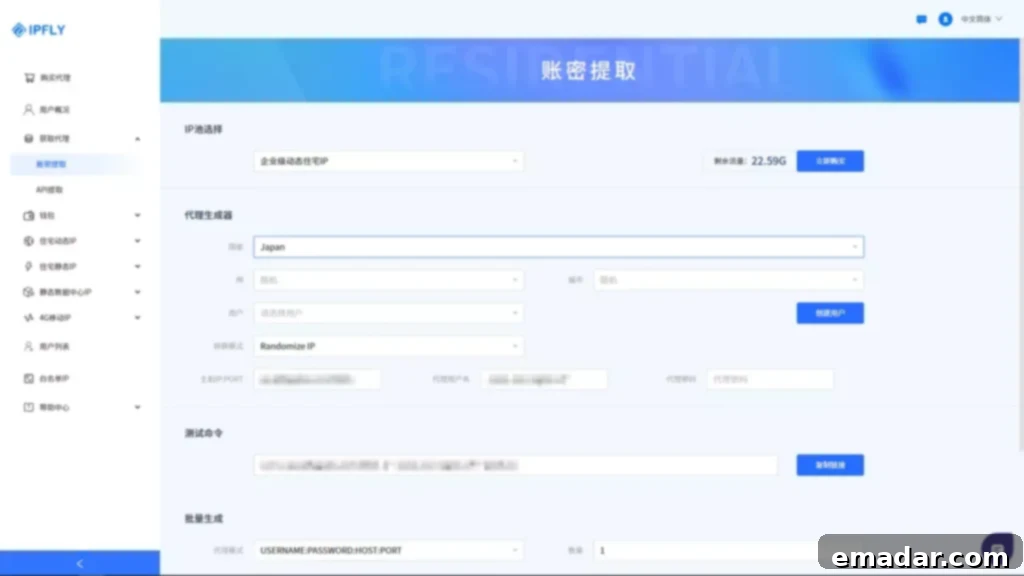
- Once logged into your IPFLY dashboard, go to the “My IPs” section. Here, you will find and copy your allocated native residential IP address and its corresponding port number.
- Simultaneously, retrieve your authentication credentials – this typically includes a username and password, or you may configure IP whitelisting to allow specific server IPs to access the proxy without explicit credentials.
3. Configuring Your Operating Environment
- For Browser-Based Operations & Ad Platforms:
- If using a fingerprint browser (e.g., Dcloak, GoLogin, Multilogin), create a new browser profile or environment. Navigate to the proxy settings within that profile.
- Input the IP address, port, and authentication details (username/password or ensure your IP is whitelisted) provided by IPFLY.
- Always perform a connection test within the browser to verify that the proxy is active, stable, and delivering the expected speed.
- For Web Crawling & Data Collection Tools:
Integrate the proxy into your scraping scripts. Here’s a common example using Python’s `requests` library:
import requests

proxies = {
    'http': 'http://user:pass@ipfly_ip:port',
    'https': 'http://user:pass@ipfly_ip:port'
}

# Replace 'user:pass' with your actual username and password
# Replace 'ipfly_ip:port' with the IP and port obtained from IPFLY
# Ensure the URL is correctly defined for your target site.
try:
    r = requests.get('https://www.amazon.com', proxies=proxies, timeout=10)
    print(f"Status Code: {r.status_code}")
    # print(r.text) # Uncomment to see the page content
except requests.exceptions.RequestException as e:
    print(f"An error occurred: {e}")
This code snippet demonstrates how to configure proxies for HTTP and HTTPS requests, routing your traffic through the specified IPFLY native residential IP. Remember to replace placeholder values with your actual credentials and IP details.
Best Practice: It is highly recommended to allocate separate, dedicated native residential IPs for different critical tasks or distinct accounts. This strategic isolation minimizes cross-contamination risks and significantly reduces the chances of multiple accounts being compromised if one IP inadvertently triggers a security alert.
Avoiding Common Pitfalls: Mastering Native Residential IP Usage
While US native residential IPs offer immense advantages, misusing them can undermine their effectiveness. Be aware of these common mistakes:
- Pitfall One: Using a Single IP for Multiple Accounts
- Risk Explained: Platforms are adept at linking accounts through common IP addresses, browser fingerprints, and even behavioral patterns. Using one IP for several social media profiles, ad accounts, or e-commerce seller accounts will inevitably flag them as suspicious, leading to mass account suspensions or bans.
- Solution: Strict adherence to a “one account, one IP” policy is crucial. This, combined with a robust fingerprint browser, creates a genuinely isolated and unique digital identity for each online entity you manage. Invest in a sufficient pool of IPs to support your operational scale.
- Pitfall Two: Falling for Cheap “Native” IPs
- Risk Explained: The market contains many providers offering “cheap” proxies labeled as “native” or “residential.” These often turn out to be overused, previously blacklisted, or even compromised IPs from botnets. Such IPs will be quickly detected, rendering your efforts futile and potentially damaging your account reputation.
- Solution: Prioritize quality and reputation over price. Choose providers that explicitly state their IP sourcing methods, ideally those with self-built infrastructure and rigorous IP vetting processes. A premium service ensures clean, dedicated, and high-reputation IPs that genuinely offer the promised benefits.
- Pitfall Three: Disregarding Geo-location Matching
- Risk Explained: Inconsistencies between your IP’s geographical location and other account details (e.g., account registration country, target market, billing address, or local time zones) are red flags for platform algorithms. For instance, registering an ad account in New York but operating it from an IP in California without logical justification can trigger immediate scrutiny and account holds.
- Solution: Always align your IP’s geographical location with your specific operational needs. If your target audience is in Florida, use a native residential IP from Florida. If your ad account is registered in Texas, use a Texas IP. This consistency builds trust and significantly reduces the risk of triggering geo-based security checks.
Conclusion: The Strategic Imperative of US Native Residential IPs
The US native residential IP is not just a tool; it’s a strategic imperative for anyone operating at scale in the digital realm. It serves as an invisible weapon, fortifying your operations in cross-border e-commerce, sophisticated ad placements, and critical data collection endeavors. By providing authentic ISP allocation and an unparalleled level of trust and anonymity, these IPs ensure your advertising accounts remain stable, your data scraping efforts proceed unhindered, and your independent e-commerce promotions achieve maximum efficiency and reach.
If you’ve been grappling with persistent account bans, underwhelming ad conversions, or frustrating blocks on your web crawlers, it’s time to elevate your strategy. Adopting US native residential IPs can be the pivotal shift that allows your business operations to flourish seamlessly in an increasingly complex online environment.
IPFLY stands as a dedicated and professional proxy service provider, specializing in solutions tailored for the demanding cross-border industry:
- ✔ Offers extensive global coverage, spanning over 190 countries and regions.
- ✔ Supports a diverse range of proxy types, including static and dynamic residential proxies, dedicated native IPs, and high-performance datacenter proxies.
- ✔ Provides exclusive, pure IPs, ensuring dedicated use for each account or task, minimizing shared risks.
- ✔ Guarantees a strict no-log policy and high anonymity, with seamless integration capabilities for advanced fingerprint browsers.
- ✔ Facilitates effortless bulk configuration and management through robust API integration.
👉 Unlock exclusive offers and secure premium IPs today to empower your online ventures!