
What exactly is an ISP? Tracing the answer through the historical tapestry of internet development reveals a concept rich with evolving characteristics. The very definition and operational scope of an Internet Service Provider have continuously transformed with each iteration of access technology. This evolution has profoundly reshaped their business models, service capabilities, and market dynamics. Understanding this journey is crucial for grasping the fundamental nature of today’s network infrastructure and for comprehending the technical underpinnings of modern services like proxy IPs.
The ISPs of the internet’s early commercialization era bore little resemblance to their contemporary counterparts. In the mid-1990s, ISPs primarily offered dial-up internet services. Users would connect to an ISP’s server via a modem, dialing a specific telephone number, and thus establishing an internet connection through a standard phone line. During this period, an ISP’s core competitive advantage lay in the density of its access points and the capacity of its dial-up lines. Services were rudimentary, and bandwidth was an extremely scarce and precious resource.
The advent of the broadband era marked a monumental leap in ISP service capabilities. Technologies like DSL (Digital Subscriber Line) leveraged the higher frequency bands of existing telephone lines for data transmission, with standards such as ADSL and VDSL progressively introduced. This allowed home users to experience unprecedented speeds, often in the range of several Mbps, for the first time. Simultaneously, cable television operators entered the market, utilizing the inherent bandwidth advantages of coaxial cables to offer Cable Modem services, creating a competitive landscape with the traditional telecommunications-based ISPs. In this phase, ISPs began to differentiate between basic access services and value-added offerings, establishing broadband access as a fundamental utility for digital living.
The arrival of the fiber optic era fundamentally reshaped the technological foundation of the ISP industry. FTTH (Fiber-to-the-Home) architecture extended optical fiber directly to individual homes, completely eliminating the bandwidth bottlenecks associated with copper cables. Gigabit-speed internet access became a tangible reality. ISP network architectures evolved from asynchronous transfer modes to fully IP-based networks, expanding service capabilities from mere “pipe providers” to comprehensive digital service platforms. To truly understand “what is an ISP” in today’s context, one must consider this complete technological evolution.
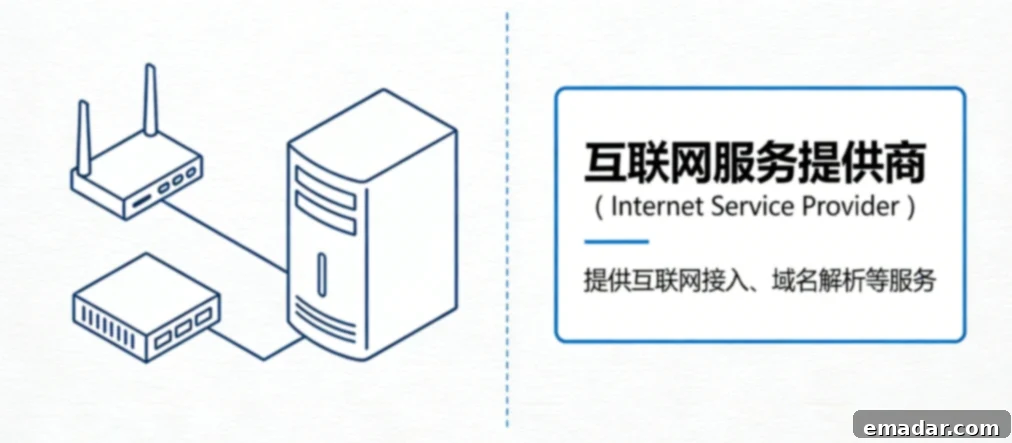
Access Technology Evolution: From Analog Signals to All-Optical Networks
The technical foundation of ISP services has undergone a profound transformation, shifting from analog to digital and from electrical signals to optical signals. Each generation of technological advancement has been accompanied by a significant leap in service capability and user experience.
The Dial-Up Era: Maximizing Analog Signal Utilization
Early dial-up ISPs utilized the voice channels of the PSTN (Public Switched Telephone Network) to transmit data. This method offered a theoretical maximum bandwidth of just 56 Kbps. Modems played a crucial role, modulating digital signals into analog audio tones for transmission over telephone lines, and then demodulating them back into digital signals at the receiving end. The inherent physical limitations of this technology meant its eventual obsolescence: extremely low bandwidth, unstable connections, the inability to use the phone line simultaneously for voice calls, and high per-minute or per-hour billing costs.
Despite its limitations, the dial-up era laid the foundational framework for the ISP business model: users paid for internet access services, ISPs were responsible for maintaining the access network and securing upstream bandwidth, and billing was often based on data usage or connection time. This fundamental framework persists to this day, albeit with continuous upgrades in technical implementation and service offerings.
The DSL Era: Deepening the Potential of Copper Cables
Digital Subscriber Line (DSL) technology represented a concerted effort to maximize the potential of existing copper cable infrastructure. Through frequency division multiplexing, DSL divided the telephone line’s frequency spectrum into separate channels for voice and data, enabling simultaneous internet access and phone calls. Standards like ADSL2+ pushed downstream speeds up to 24 Mbps, while VDSL2 even broke the 100 Mbps barrier, significantly extending the lifespan of copper networks.
The widespread adoption of DSL allowed ISPs to rapidly provide broadband services leveraging their extensive telephone network infrastructure. This played a critical role in bridging the “digital divide” before the widespread deployment of fiber optics. However, the physical attenuation characteristics of copper cables meant that DSL speeds significantly degraded with distance from the central office, leading to considerable variations in actual user experience.
The Fiber Optic Era: Eliminating Bandwidth Bottlenecks Entirely
The FTTH (Fiber-to-the-Home) architecture extended optical fiber directly to the user’s premises, completely eliminating the bandwidth limitations of copper cabling. Passive optical network technologies such as GPON (Gigabit Passive Optical Network) and XGS-PON support gigabit or even multi-gigabit access speeds, transforming ISP service capabilities from “best-effort” to “quality-assured.” Fiber’s low attenuation characteristics enable high-speed transmission over long distances, resulting in flatter and more efficient ISP network architectures.
Key technical characteristics of ISPs in the fiber optic era include: an all-IP network architecture, large-scale IPv6 deployment, intelligent operations and maintenance systems, and advanced cloud-network convergence capabilities. Network access has evolved from a simple conduit service into a comprehensive digital ecosystem gateway, integrating cloud, network, and end-user devices.
Evolution and Diversification of ISP Business Models
Technological iteration has continuously driven innovation in ISP business models, transforming the industry landscape from one of monopoly to fierce competition, and from homogenization to differentiation.
The “Pipe Provider” Stage
In their early stages, ISPs’ core value proposition was simply providing the internet access “pipe.” Users paid primarily for bandwidth resources. During this phase, differentiation among ISPs was mainly based on access speed, coverage area, and pricing, leading to a high degree of service commoditization and competition largely centered on price wars. The focus was on delivering raw connectivity.
The “Platform Service” Stage
With the widespread adoption of broadband, ISPs began to integrate content resources, offering value-added services such as video streaming, music, and online gaming. The rise of IPTV (Internet Protocol Television) marked a significant shift, transforming ISPs from mere pipe providers into content distribution platforms. Bundling broadband access with content services became a prevalent business model. In this stage, the competitive landscape for ISPs expanded to include content breadth, user experience, and the richness of their service ecosystem.
The “Cloud-Network Convergence” Stage
The current trajectory of ISP development is characterized by the deep integration of cloud computing capabilities with network infrastructure. Innovative services like edge computing, cloud storage, smart home solutions, and enterprise cloud networks are positioning ISPs as essential infrastructure providers for digital transformation. Network access is no longer a standalone product but a fundamental component of integrated, comprehensive services.
This ongoing evolution provides critical insights into what “ISP” means today: contemporary ISPs are far more than just “Internet Access Providers.” They are operators of sophisticated, integrated digital service platforms, whose technical capabilities and service ecosystems vastly surpass their early forms. They are enablers of the modern digital economy.
Technological Evolution Fuels New Forms of Proxy IP Services
The continuous advancement of ISP technology, particularly the abundance of access bandwidth and the increasingly sophisticated management of IP addresses, has created both the technical conditions and market opportunities for the proliferation of proxy IP services.
Bandwidth Abundance and Edge Node Deployment
The significant drop in bandwidth costs brought about by widespread fiber optic deployment has made it economically viable to deploy proxy nodes in residential or small office environments. While early proxy services primarily relied on dedicated servers within large data centers, modern residential proxy networks can now effectively leverage the ample fiber bandwidth available in ordinary homes, aggregating a vast pool of geographically dispersed residential IPs. The feasibility of this model is fundamentally rooted in the high-bandwidth, low-cost internet access services provided by contemporary ISPs.
Refined IP Address Management
ISPs’ increasingly refined management of IP address allocation has significantly enhanced the quality and trustworthiness of proxy IP services. Modern ISPs commonly implement stringent user real-name authentication, maintain detailed dynamic IP allocation logs, and deploy sophisticated abnormal traffic monitoring mechanisms. These measures collectively contribute to a higher reputation score for IP addresses. Residential IPs acquired through legitimate ISP channels, therefore, possess significantly higher commercial service value compared to historical “gray market” or illicit IPs.
IPv6 Deployment and Address Resource Expansion
The gradual deployment of IPv6 fundamentally alleviates the long-standing pressure of IP address scarcity, providing a far more abundant resource base for proxy IP services. The IPv6 address space is virtually limitless, enabling ISPs to assign fixed prefixes or even static addresses to individual users. This simplifies the complex address management tasks associated with proxy IP services. Furthermore, the improved end-to-end reachability of IPv6 networks enhances the efficiency and stability of proxy connections, offering a more robust and scalable foundation.
Technical Implementation Paths for ISP-Level Proxy IPs
By understanding the technical evolution of “what is an ISP,” we can gain deeper insight into how contemporary proxy IP services leverage ISP resources to construct their advanced technical solutions.
Static Residential Proxies: The ISP Partnership Model
The implementation of static residential proxies relies heavily on direct cooperative relationships with ISPs. Service providers acquire ISP-level IP resources through several primary avenues:
- Carrier Partnerships: Engaging in commercial agreements with regional ISPs to obtain bulk allocations of residential IP address ranges.
- User Sharing Networks: Building platforms where individual users voluntarily contribute their home bandwidth resources in exchange for incentives or compensation.
- IoT Integration: Consolidating network resources from various IoT devices, smart home gateways, and other connected terminals.
For instance, IPFLY’s static residential proxies are provisioned directly by ISPs, offering active, static IPs that authentically replicate real residential network environments. These genuine ISP residential proxy IP addresses remain permanent, provide unlimited data usage, support HTTP/HTTPS/Socks5 protocols, and ensure exclusive access to pure resources, effectively preventing misuse. The success of this product form is squarely built upon the modern ISP technical architecture and business model, guaranteeing unparalleled authenticity and stability for critical online operations.
Dynamic Residential Proxies: Scaled Operations
Dynamic residential proxies demand an even larger scale of ISP resource support. The availability of a vast pool of over 90 million high-quality, real residential proxy IPs, covering more than 190 countries and regions, is achieved through:
- Global ISP Partnerships: Establishing extensive collaborations with major ISPs and regional carriers across all continents.
- Distributed Node Architecture: Deploying a global network of proxy nodes, leveraging the widespread broadband access provided by ISPs worldwide.
- Intelligent Scheduling Systems: Employing big data algorithms to dynamically optimize IP allocation strategies in real-time, precisely matching diverse business requirements for seamless operation.
Achieving millisecond-level response speeds depends critically on the quality assurance provided by ISP networks and the routing optimization implemented by the proxy service provider. The commitment to uninterrupted service is predicated on the inherent stability of ISP-grade networks and the robust failover capabilities of the proxy system, ensuring consistent performance for data-intensive tasks.
Static Datacenter Proxies: Infrastructure Advantages
While static data center proxies do not directly utilize ISP residential resources, their underlying infrastructure significantly benefits from advances in ISP technology. Direct connections between data centers and ISP backbone networks, BGP (Border Gateway Protocol) multi-line access, and intelligent routing optimization are all technologies that enable data center proxies to deliver high-speed, low-latency service experiences essential for many enterprise applications.
The market’s largest proxy pools and the flexibility to choose from numerous global locations are the direct result of deep collaborations with global ISPs and data center operators. The exceptional anonymity and superior cost-effectiveness offered by these services are a combined outcome of continuous technical optimization and the inherent efficiencies of scale.
ISP Evolution Trends and the Future of Proxy Services
The ongoing evolution of ISP technology will undoubtedly continue to shape the development trajectory of IP proxy services, opening up new possibilities and challenges.
5G and Fixed Wireless Access (FWA)
The maturation of 5G technology presents new access methods for ISP services. Fixed Wireless Access (FWA) leverages 5G networks to replace traditional fiber for the “last mile,” allowing ISPs to cover remote areas with lower deployment costs. For proxy IP services, the high bandwidth, low latency, and inherent mobility characteristics of 5G networks will undoubtedly foster new forms of proxy nodes and innovative IP rotation models, especially for mobile-centric use cases.
Network Slicing and Quality of Service (QoS) Assurance
5G and next-generation fixed-line network technologies introduce advanced network slicing capabilities, enabling ISPs to provide differentiated Quality of Service (QoS) guarantees for specific applications. This means proxy IP services could potentially gain more granular network resource scheduling capabilities, allowing for optimized network paths tailored to various business scenarios, such as real-time video streaming, high-frequency trading, or critical data synchronization, ensuring predictable performance.
Edge Computing and Distributed Proxies
The integration of ISP-deployed edge computing nodes with proxy IP services is set to create even lower-latency, higher-efficiency proxy solutions. By distributing computing power closer to the network edge, proxy nodes will be endowed with local data processing capabilities. This significantly reduces backhaul latency, improves real-time response, and ultimately enhances the overall user experience for geographically dispersed operations.
Grasping the Essence of ISP in Technological Evolution
So, what exactly does “ISP” mean? From a historical perspective, an ISP is a product of continuous technological innovation, its definition constantly enriched by transformations in access technology, network architecture, and business models. From the dawn of dial-up to the current fiber era, and from being mere “pipe providers” to sophisticated “platform operators,” ISPs have consistently remained at the core of the internet’s foundational infrastructure.
Understanding the technological evolution of ISPs is fundamental to recognizing the technical roots and developmental logic behind contemporary proxy IP services. Product categories such as static residential proxies, dynamic residential proxies, and static data center proxies are all direct outcomes of the synergy between ISP technological advancements and evolving market demands. Enterprise users, when selecting proxy services, should critically evaluate the service provider’s depth of collaboration with ISP resources, the sophistication of its technical architecture, and its demonstrated ability to adapt to future network evolutions. This ensures a robust and future-proof proxy solution.
Partner with IPFLY: Harnessing ISP Technology Evolution
The continuous evolution of ISP technology is actively reshaping the landscape of network infrastructure and simultaneously creating unprecedented growth opportunities for proxy IP services. IPFLY stays at the forefront of ISP technological advancements, establishing deep partnerships with ISPs across more than 190 countries and regions worldwide, thereby transforming the benefits of this technological evolution directly into tangible client value.
IPFLY’s static residential proxies directly interface with core ISP resources, providing authentic, fixed, and exclusively dedicated residential IP identities. Our dynamic residential proxies integrate a massive pool of over 90 million ISP-allocated IPs, supporting intelligent global rotation for unparalleled flexibility. Furthermore, our static data center proxies leverage ISP-grade backbone networks to deliver high-speed, low-latency, and high-volume concurrent processing capabilities. With a commitment to 99.9% uptime, millisecond-level response times, and 24/7 professional technical support, we ensure your operations consistently run on the most optimal and reliable network infrastructure available.
Register for an IPFLY account today and select the proxy product that perfectly aligns with your business requirements. Whether you need ISP-level residential IPs to safeguard account security or require extensive global IP resources to support large-scale data collection, IPFLY offers technologically advanced, resource-rich, and professionally supported solutions. Let the benefits of ISP technological evolution become the accelerator for your business growth, ensuring that every network connection embodies cutting-edge technical quality and reliability.