
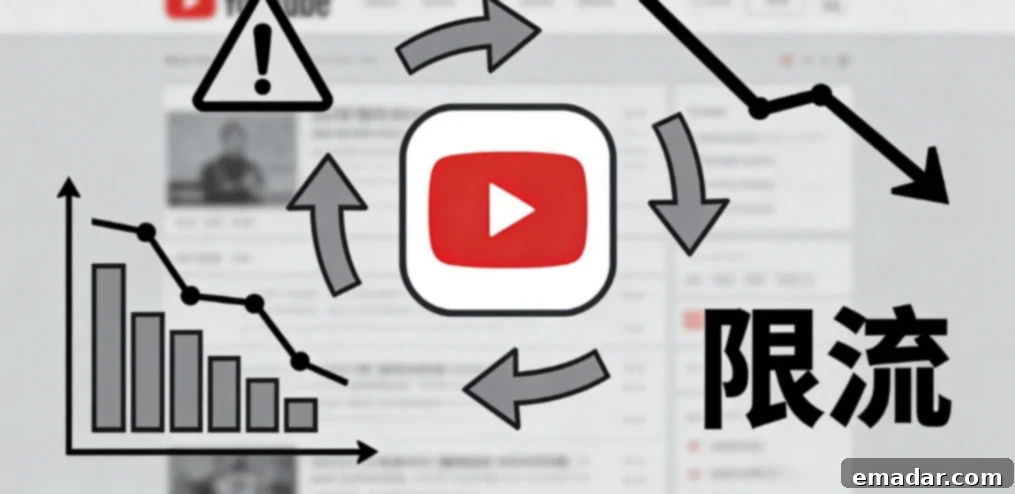
Every YouTube creator faces a unique set of challenges, but few are as disheartening or perplexing as the phenomenon of “YouTube channel throttling,” often referred to as a shadowban. Imagine this scenario: after pouring hours into meticulously planning, filming, and editing a video, you finally hit ‘publish.’ You refresh the page, eager to see your hard work reach your audience, only to find the view counter stubbornly stuck at zero. This isn’t an isolated incident; perhaps you’ve noticed a sudden, drastic drop in recommended traffic across multiple videos, with your audience source analysis showing an alarming reliance solely on direct visits. Or, even more critically, the “Browse features” section – a cornerstone of YouTube’s organic discovery – completely vanishes from your channel analytics. These are tell-tale signs of throttling, an invisible force that can instantly drag creators from the exhilaration of content creation into the abyss of data anxiety and self-doubt.
The ramifications of channel throttling extend far beyond the performance of a single video. This algorithmic suppression can trigger a cascade of negative effects: your overall channel weight diminishes, leading to a synchronous decline in traffic for your entire historical video library. Subscriber growth stagnates, severely impacting your negotiation leverage for potential business collaborations and sponsorships. The continuous algorithmic de-ranking creates a detrimental feedback loop, making even the most dedicated creators question their capabilities and content strategy. What makes this predicament even more frustrating is YouTube’s notorious silence; the platform rarely provides explicit reasons for throttling, leaving creators to grope in the dark, desperately searching for a path to recovery.
This comprehensive guide is meticulously crafted for YouTube creators who are either currently grappling with channel throttling or proactively seeking to prevent it. We present a full-spectrum, practical strategy that encompasses diagnosis, recovery, and long-term prevention. Our approach goes beyond conventional content optimization, delving into a critical yet often overlooked factor: your network environment. By integrating advanced proxy IP technology, we offer a systematic and robust solution to navigate the complexities of YouTube’s algorithmic scrutiny.
Decoding Throttling: Differentiating Content vs. Network Issues
When your YouTube channel is hit by throttling, your immediate and most crucial task is to accurately pinpoint the root cause. Without a precise diagnosis, any attempts at optimization, whether focused solely on content or on haphazard network changes, are likely to be inefficient and frustrating. Identifying the specific type of throttling is the first step towards formulating a truly effective recovery strategy.
Identifying Content-Related Throttling
If the throttling originates from issues within your content, YouTube’s platform usually provides discernible signals. These indicators often point directly to specific videos or aspects of your content that violate platform policies or fall outside recommended guidelines. Key characteristics include:
- Receiving explicit copyright claim notifications or Community Guidelines warnings directly within your YouTube Studio dashboard. These are often clear signals that specific elements of your content (e.g., music, footage) or the content itself (e.g., hate speech, misinformation) are in violation.
- Individual videos being age-restricted or geo-restricted, preventing them from being viewed by certain demographics or in particular regions. This indicates that YouTube’s automated or manual review flagged the content as inappropriate for a general audience or specific locales.
- A consistent pattern where videos on a particular theme or topic underperform drastically, while other content themes on your channel continue to perform normally. This suggests that the problematic theme might be sensitive or controversial, triggering stricter algorithmic review.
- Receiving a direct response from a human reviewer after you submit an appeal via YouTube Studio for a flagged video or warning. This confirms that YouTube’s moderation team has specifically reviewed your content.
Resolving content-level throttling typically involves a clear course of action: addressing and rectifying copyright claims (e.g., replacing copyrighted music, editing out problematic clips), appealing any community guideline warnings that you believe were issued in error, proactively adjusting your content direction to steer clear of sensitive or high-risk topics, and patiently waiting for any imposed penalty periods to conclude.
Identifying Network-Related Throttling
Throttling that stems from issues with your network identity is often far more insidious and challenging to detect, as it lacks the overt notifications associated with content violations. These are the “silent killers” of channel growth. Typical signals indicating a network-level problem include:
- A pervasive problem where all your videos, regardless of their intrinsic quality, consistently receive zero or extremely low views. This suggests a systemic issue unrelated to the content itself.
- Experiencing throttling from the very first video uploaded on a brand new account, effectively ruling out any historical content factors or past performance metrics.
- A sudden and noticeable recovery in traffic or views after you switch your network environment, such as moving from a corporate network to your personal home broadband, or even using a different mobile data connection.
- Observing vastly different performance outcomes for the exact same content when uploaded or managed under different network environments.
- Encountering throttling immediately after you begin using a Virtual Private Network (VPN) or any generic proxy service.
At its core, network-level throttling is triggered by YouTube’s sophisticated system developing a sense of distrust towards the creator’s network identity. This distrust can arise from various factors, including: the IP address you’re using having a history of being associated with policy violations, the IP type being incorrectly identified as a data center or generic proxy server rather than a genuine residential connection, a significant discrepancy between your IP’s geographic location and your account’s declared information or target audience, or even excessively frequent and erratic changes in your IP address. Understanding these subtle cues is paramount to effective diagnosis.
Complex Scenarios: Mixed Content and Network Factors
In practice, the majority of throttling cases are not neatly compartmentalized into either purely content-based or purely network-based issues. Instead, they often represent a complex interplay of both. A creator might, for instance, have borderline content violations—perhaps a slightly clickbait title, a subtly misleading thumbnail, or content that skirts close to community guidelines. Simultaneously, their network environment might exhibit high-risk characteristics, such as using an IP address flagged for previous abuse or one that appears to be a data center connection. When these two sets of factors converge, they can trigger an even more stringent algorithmic throttle, making recovery efforts significantly more challenging.
In such mixed situations, a holistic approach is indispensable. Creators must concurrently optimize both their content strategy and their network environment. Addressing only one aspect will likely yield limited or temporary improvements, as the underlying dual triggers will continue to suppress the channel’s reach.
Network Environment Self-Audit: Your IP Health Check
Before considering professional proxy services, it’s essential for every creator to conduct a thorough self-audit of their current network environment. This initial IP health check will provide invaluable insights into your current IP status and help confirm if network factors are indeed contributing to your throttling issues.
Basic IP Information Retrieval
To begin, visit reputable IP detection websites such as ipinfo.io or whatismyipaddress.com. These tools will reveal critical information about your current internet connection. Carefully record the following details:
- IP Address: This is the specific numerical identifier of your current outbound IP. Note the exact sequence of numbers.
- ISP Attribution: Identify the name of the organization to which your IP is registered. This could be a major telecommunications provider like “Comcast Cable” or “China Telecom,” but critically, it could also show cloud service providers like “Amazon.com,” “Google Cloud,” or “OVH SAS.”
- IP Type Classification: Most detection websites categorize the nature of your IP. Look for labels such as “Residential” (indicating a home internet connection), “Datacenter” (indicating a server farm or cloud service), or “Mobile” (indicating a cellular data connection). This classification is particularly important for YouTube’s algorithm.
- Geographic Location: Record the city, state/province, and country where your IP address is registered. This helps determine if your IP’s perceived location aligns with your channel’s target audience or your actual physical location.
Recognizing Key Risk Signals
Once you have gathered your IP information, analyze the results for any indicators that might signal a high-risk network environment for YouTube. Understanding these signals is crucial for effective diagnosis:
| Risk Signal | Specific Manifestation | Impact on YouTube Trust and Throttling |
| Data Center IP | Your ISP attribution is listed as a cloud service provider (e.g., AWS, Azure, Google Cloud) or a web hosting facility. | YouTube’s algorithms are designed to identify human users operating from genuine residential or mobile connections. Data center IPs are immediately flagged as originating from servers, leading to suspicion of bot activity, automated operations, or bulk account management, regardless of your actual intentions. This severely reduces algorithmic trust. |
| High-Risk ISP / ASN | The Autonomous System Number (ASN) or ISP associated with your IP has a documented history of widespread abuse, spamming, or fraudulent activity. | YouTube’s reputation systems maintain lists of IP ranges and ISPs with low overall trust scores due to past malicious behavior. Even if you are a legitimate user, an IP from a tainted segment can inherit this poor reputation, making your channel highly susceptible to throttling as a precautionary measure by the algorithm. |
| Geolocation Mismatch | Your IP’s registered geographic location differs significantly from your channel’s target audience region, or your actual physical location where you manage the channel. | Major discrepancies can negatively impact your channel’s local recommendation weight, as YouTube struggles to ascertain the authenticity of your audience connection. More severely, a sudden, frequent, or illogical jump in perceived geographic location can trigger “suspicious activity” alerts, prompting security reviews or outright throttling to prevent unauthorized access. |
| Shared Proxy Characteristics | Your IP address is identified as being used by a large number of diverse users concurrently, often a characteristic of public or low-quality shared proxy services. | The actions of other users sharing the same IP address can directly implicate your account. If another user engages in spamming, policy violations, or other malicious activities while on that shared IP, your YouTube channel can suffer collateral damage, leading to throttling or de-ranking even if your own actions are entirely legitimate. |
Network Environment Switching Test
If your self-audit reveals any of the high-risk signals discussed above, conduct a comparative network switching test. This will help confirm if network factors are indeed the primary cause of your throttling:
Publish a test video (it can be a short, unlisted video) using your current, potentially problematic network environment. Then, switch to an entirely different, ideally “clean” network—such as your mobile data connection, a friend’s home broadband, or a completely distinct Wi-Fi network that you trust. Publish another similar test video from this new environment. Over the next 24-48 hours, closely observe the traffic and view performance differences between these test videos. If you notice a significant and immediate recovery in views or organic reach for the video published on the new network, it strongly confirms that network factors are the main contributors to your channel’s throttling.
Static Residential Proxies: Rebuilding Trust with YouTube’s Algorithm
Once you’ve definitively identified that network factors are contributing to your YouTube channel throttling, implementing a professional solution becomes paramount. Static residential proxies offer an unparalleled solution for meticulously rebuilding a trustworthy and legitimate network identity in the eyes of YouTube’s sophisticated algorithms.
The Imperative of Residential IPs for YouTube Trust
YouTube’s immensely powerful algorithms are trained on an enormous dataset of real user behavior. This training has equipped them with a precise understanding and expectation of what a “real creator’s” network identity looks like. Their model anticipates that genuine creators operate from stable home broadband connections, exhibit consistent IP geographic locations, and are serviced by mainstream local Internet Service Providers (ISPs). Data center IPs, cloud server IPs, or even generic VPN IPs severely deviate from this deeply ingrained expectation. Even if your content is of the highest quality and completely original, operating from such a non-residential IP will almost inevitably trigger algorithmic scrutiny and de-ranking, as it signals potential automation, bot activity, or an attempt to circumvent platform rules.
The core, undeniable value of static residential proxies lies in their ability to furnish a network identity that is virtually indistinguishable from a genuine home broadband connection. These IPs are not merely “proxy servers”; they are legitimate IP addresses directly assigned by real Internet Service Providers to actual residential users. They are categorized as residential by IP databases, possess complete ISP metadata, and accurately reflect real geographic locations. From YouTube’s perspective, a static residential proxy presents as a stable, authentic home internet connection, allowing creators to operate within an optimized and trusted network environment, thereby systematically rebuilding their account’s credibility and reputation.
To effectively leverage static residential proxies for recovery, consistent operation is key. Once configured, you should operate your YouTube channel exclusively through this fixed IP address, maintaining its stability. It is highly recommended to sustain this stable network environment for a minimum of 4 to 8 weeks. This duration allows YouTube’s algorithms sufficient time to re-learn your account’s revised, trustworthy network identity. Throughout this critical period, ensure you maintain a regular and consistent content publishing schedule, and crucially, avoid any operations or behaviors that could be perceived as high-risk or suspicious. This patient and disciplined approach is vital for long-term algorithmic trust recovery.
Dynamic Residential Proxies: Empowering Multi-Channel Management
For prolific content creators, digital marketing agencies, or small Multi-Channel Networks (MCNs) that manage and operate multiple YouTube channels simultaneously, the demands on network identity management become significantly more complex. Dynamic residential proxies emerge as an indispensable and highly efficient solution, providing the necessary tools for scalable and secure multi-channel operations.
The Critical Need for Network Isolation in Multi-Channel Operations
Operating several YouTube channels from the same underlying network infrastructure carries substantial and often underestimated risks of network-level correlation. If multiple distinct channels frequently log in, upload content, and interact with the platform from an identical IP address or a narrow range of closely related IPs, YouTube’s sophisticated fraud detection systems may flag this activity. The algorithm might interpret such patterns as indicative of a “channel farm,” a “content network” designed for artificial manipulation, or even an attempt to bypass monetization policies. This can trigger a cascade of negative consequences, including associated channel reviews, blanket de-monetization, or even widespread throttling across all linked accounts.
The ideal, albeit impractical, solution would be to provide each individual YouTube channel with its own dedicated, physically separate internet connection and static IP address. This is clearly unfeasible for most creators or MCNs due to the immense cost and logistical complexity. This is precisely where dynamic residential proxies provide an elegant and virtualized solution. By leveraging a vast pool of authentic residential IPs, dynamic proxies can effectively assign a unique, independent residential IP identity to each channel, creating the perception of distinct users operating from different genuine home connections.
Strategic Dynamic Residential Proxy Configuration
IPFLY, with its expansive pool of over 90 million high-quality, ethically sourced residential proxy IPs spanning more than 190 countries, empowers creators to construct highly flexible and robust multi-channel operational architectures. Here are strategic approaches for configuring dynamic residential proxies:
Strategy One: Fixed Channel-IP Mapping (Session Persistence)
For channels requiring maximum stability and mimicking a dedicated connection, assign a specific dynamic residential IP to each channel using session persistence functionality. This feature ensures that for a set duration (e.g., 10 minutes, 30 minutes, up to hours), the same IP address is maintained for all requests originating from a particular session. This creates a strict, stable correspondence: Channel A consistently uses a specific US California IP (IP-A), while Channel B reliably uses a distinct US Texas IP (IP-B). This strategy ensures each channel’s network identity remains stable, unique, and insulated from others.
Strategy Two: Geo-Targeted Regionalized Operations
Optimize your content’s local relevance and reach by aligning your IP’s geographic location with your target audience. For channels primarily aimed at audiences in Southeast Asia, utilize dynamic residential IPs specifically sourced from that region. Similarly, channels targeting a European demographic should operate using European residential IPs. This geo-targeting enhances the local relevance signals perceived by YouTube’s algorithm, potentially boosting discoverability and recommendation rates within those specific markets.
Strategy Three: Risk Isolation and Rotation for Testing
For new or experimental channels, or when conducting high-risk operations such as in-depth competitor analysis, extensive keyword research, or testing new content formats, employ a dynamic IP rotation mode. In this setup, the proxy assigns a new IP address with each new request or after a very short interval. This transient IP usage ensures that any potential risks or flags associated with exploratory or aggressive behaviors are immediately isolated and do not propagate to your established, core channels. Once a specific task is completed, the IP is automatically rotated, providing an additional layer of security and anonymity.
MCN Startup Team Application Architecture
For nascent MCNs or small creator teams (e.g., 3-5 individuals) managing a portfolio of channels, a tiered proxy architecture can provide optimal balance between stability, flexibility, and risk management:
- Core IP Pool (Static Residential): Allocate 3-5 dedicated static residential proxy IPs to your primary, high-value, and revenue-generating channels. These IPs should be used long-term for maximum stability and trust building, becoming integral “network assets” for your most critical content.
- Test IP Pool (Dynamic Residential – Rotating Sessions): Utilize dynamic residential proxies with rapid rotation for new channel experimentation, testing novel content directions, or exploring niche markets. The rotational nature minimizes risk and allows for agile testing without impacting core channels.
- Tool IP Pool (Independent Dynamic Residential): Establish a separate pool of dynamic residential proxies, distinct from your core operational IPs, for all auxiliary activities. This includes comprehensive market research, competitor deep dives, advanced keyword research, and audience trend analysis. This complete isolation ensures that intense data gathering activities do not inadvertently trigger flags on your primary content creation IPs.
Content Strategy Synergy: Operational Essentials Post-Network Optimization
While resolving network identity issues creates the foundational conditions for traffic recovery on YouTube, the quality and strategic execution of your content remain paramount. Network environment optimization opens the door; compelling content determines how quickly that door swings open and how high your channel’s growth can ultimately reach.
Adjusting Your Publishing Rhythm
In the initial phase of recovering from throttling, a strategic adjustment to your content publishing frequency is highly advisable. Rather than maintaining a high volume, prioritize quality over quantity. Consider reducing your output from multiple videos per week to a more manageable 1-2 videos per week. This allows you to allocate more time and resources to each individual video, ensuring it undergoes thorough SEO optimization, robust script development, and rigorous audience demand verification. High-quality, impactful content will signal positive engagement to the algorithm, accelerating your recovery.
Embracing a Conservative Metadata Strategy
During the crucial recovery period, it is imperative to adopt a cautious and conservative approach to all aspects of your video metadata. Avoid any practices that could potentially trigger algorithmic scrutiny or manual review. This means refraining from using overly exaggerated or sensationalized titles, avoiding misleading or clickbait thumbnails, resisting the urge to “keyword stuff” your descriptions with irrelevant or excessive terms, and minimizing frequent modifications to the metadata of already published videos. The goal is to allow YouTube’s algorithms to focus solely on evaluating the intrinsic quality and relevance of your content, rather than perceiving any attempt at metadata manipulation.
Cultivating Authentic Interaction Data
True audience engagement is a powerful signal of content quality to YouTube’s algorithm. Actively foster and accumulate genuine viewer interaction data through various on-platform features. Utilize community tabs for polls and updates, publish engaging community posts to spark conversations, and diligently respond to comments on your videos. These authentic interactions build real audience loyalty and provide undeniable proof of viewer stickiness and satisfaction, which are critical for algorithmic endorsement.
Strategic Long-Tail Content Development
To establish a resilient content foundation, strategically develop “evergreen content” that addresses specific, niche search intents. This type of content, characterized by its sustained relevance over time, is less reliant on fluctuating recommended traffic. Even if your channel experiences residual throttling effects, well-optimized long-tail content can consistently attract views through organic search, providing a stable baseline of channel activity and viewership. This diversified traffic source mitigates the impact of recommendation algorithm shifts.
From Throttling Recovery to Sustainable Long-Term Growth
Successfully navigating and overcoming YouTube channel throttling is a significant achievement. However, the journey doesn’t end there. To ensure sustained growth and prevent recurrence, creators must establish a robust, proactive operational framework that prioritizes ongoing network health and strategic content deployment.
Assetizing Your Network Identity
High-quality static residential proxy IPs should be considered valuable assets, integral to your channel’s long-term health and growth. Establish a meticulous usage archive for each IP, detailing its allocation, the channels it’s associated with, its usage duration, and its historical performance. This practice helps in maintaining transparency and accountability. Crucially, avoid frequent and arbitrary changes to your IPs; consistent and stable network identity is a cornerstone of algorithmic trust on YouTube.
Implementing a Multi-Tiered Network Architecture
To safeguard your primary operations and mitigate risks, implement a layered network usage strategy. Your core, high-value YouTube channels should operate exclusively through dedicated static residential proxies, ensuring maximum stability and trustworthiness. Auxiliary tasks, such as market research, competitor analysis, or testing new channel concepts, should utilize dynamic residential proxies with rotating IPs. For routine personal browsing or non-channel-related activities, stick to your regular internet connection. Strict segregation of these operational tiers is vital to prevent any potential risks or flags from auxiliary activities from impacting your core channel assets.
Continuous Monitoring and Agile Response
Cultivate a habit of diligently monitoring your channel’s health and performance metrics. Pay close attention to key indicators such as the first-hour performance of new videos, the percentage of traffic originating from YouTube’s recommendation features (“Browse features,” “Suggested videos”), and the overall distribution of your audience sources. Should you detect any anomalies or sudden shifts in these metrics, initiate an immediate diagnostic process. Being able to swiftly pinpoint whether the issue stems from network factors or content-related concerns allows for a rapid and targeted response, minimizing potential damage and accelerating recovery.
Technical Empowerment for Professional YouTube Operations
YouTube channel throttling is a multifaceted phenomenon inherent in the platform’s complex ecosystem. Its effective resolution demands a dual enhancement: not only in content creation prowess but also in operational sophistication. Within this framework, optimizing your network environment stands out as a critical component of advanced operational capability. Static residential proxies and dynamic residential proxies are not merely tools; they are professional-grade technological enablers that empower creators to navigate the platform’s intricate algorithmic landscape with confidence and control.
The journey from identifying the first signs of throttling to establishing a resilient, long-term growth strategy necessitates a systematic operational mindset. This encompasses everything from meticulous self-diagnosis and precise proxy configuration to strategic network reconstruction, intelligent content collaboration, and robust preventive measures. In the fiercely competitive arena of YouTube, a global stage where content reigns supreme, the professionalization of technical capabilities is an increasingly vital differentiator, marking the distinction between a casual enthusiast and a truly professional, sustainable creator.
Elevate Your YouTube Operations with a Professional Proxy Network
Are you tired of the persistent frustrations of YouTube channel throttling? Are you ready to transition from amateur content creation to a professional, data-driven operational strategy? IPFLY’s advanced proxy network services are designed to be your indispensable technical partner on this journey.
IPFLY boasts an extensive global network of over 90 million ethically sourced overseas proxy IP resources, covering more than 190 countries and regions. Our static residential proxies are directly allocated by Internet Service Providers, providing you with a genuine, fixed, and exclusive residential IP identity. This unparalleled authenticity helps you meticulously rebuild a trustworthy network environment within the YouTube platform, bypassing common algorithmic triggers. For multi-channel creators and MCNs, our dynamic residential proxies offer intelligent global IP rotation, perfectly addressing the crucial need for network isolation and diversified operational strategies across your channel portfolio.
We are committed to empowering your creative journey with unwavering reliability. Our 99.9% uptime guarantee ensures your content operations never face interruption, while millisecond response speeds facilitate seamless and efficient interactions within YouTube Studio. Furthermore, our dedicated 24/7 professional technical support team is always available to provide expert guidance and answer any configuration questions you may have. Whether you are a dedicated single-channel creator striving for optimal reach or a dynamic multi-channel operator managing a complex network of content, IPFLY offers tailored proxy solutions designed to meet your precise operational requirements.
Register for an IPFLY account today, and in just three simple steps, you can activate a pristine residential IP environment for your YouTube channel. Let the days of channel throttling become a distant memory. Empower your high-quality content to receive the organic traffic and visibility it truly deserves, ensuring your YouTube creative path moves forward with confidence and sustainable growth.