
In the dynamic landscape of digital business, reliable proxy solutions are not just an advantage but a necessity. Companies increasingly rely on web scraping for market intelligence, sophisticated SEO monitoring, rigorous ad verification, and a myriad of other critical online operations. Choosing the right proxy provider is paramount to ensuring these operations run smoothly, efficiently, and without interruption. Among the leading contenders in the bustling proxy market are Thordata and IPFLY. Both names have carved out reputations for delivering robust and dependable proxy services. However, despite their shared commitment to excellence, they present distinct feature sets, performance characteristics, and ideal use cases. This comprehensive guide aims to dissect these differences, offering businesses a detailed, side-by-side comparison to empower informed decision-making in selecting the optimal proxy partner for their unique needs.
Company Profiles and Service Overview
Understanding the core ethos and service offerings of each provider is the first step in a meaningful comparison.
Thordata has established itself as a reputable provider specializing in a versatile array of proxy services. These services are meticulously engineered to bolster various business functions, including comprehensive data collection, nuanced SEO strategies, and precise regional testing. Thordata’s operational philosophy centers on delivering consistently reliable IP addresses, making them a go-to choice for diverse business applications. Their emphasis lies in providing extensive global coverage coupled with intuitive usability, ensuring that clients can readily integrate and leverage their proxy solutions.
IPFLY, on the other hand, presents an equally broad and sophisticated proxy service portfolio, encompassing premium residential, high-speed data center, and hybrid ISP proxies. A key differentiator for IPFLY is its profound emphasis on cultivating a vast and diverse IP pool, ensuring exceptionally high success rates, and implementing advanced automated IP rotation mechanisms. This strategic focus positions IPFLY as an ideal partner for businesses that demand not only unwavering stability but also the capacity for immense operational scale, particularly for tasks requiring frequent and seamless IP changes.
Fundamentally, both companies serve a similar high-stakes clientele: enterprises, astute marketers, and innovative developers. All these professionals share a critical requirement for consistent, secure, and geo-targeted access to IP addresses, which are indispensable for executing a wide spectrum of online tasks with precision and efficiency.
Proxy Infrastructure: The Foundation of Performance
A crucial determinant in differentiating Thordata and IPFLY lies in the fundamental types of proxies they provide and the robust infrastructure that underpins these services. The quality, diversity, and management of their networks directly impact user experience and success rates.
- Proxy Types and Strategic Application: Both Thordata and IPFLY offer a comprehensive suite of proxy types: residential, data center, and ISP proxies. This allows businesses the critical flexibility to select the proxy type that perfectly aligns with their specific operational workflow and task sensitivity.
- Residential Proxies: These proxies originate from real user devices, making them appear as legitimate as possible to target websites. They are the preferred choice for highly sensitive tasks such as social media management, account creation, market research, and accessing geo-restricted content where anonymity and legitimacy are paramount. Their organic nature significantly reduces the risk of detection and blocking.
- Data Center Proxies: Renowned for their unparalleled speed and cost-effectiveness, data center proxies are generated from dedicated servers in data centers. They are ideally suited for high-volume, speed-intensive operations where IP cloaking is needed, but extreme legitimacy is not the primary concern. Common applications include bulk web scraping, general data aggregation, and testing, where raw speed can dramatically cut down processing times.
- ISP Proxies: These represent a powerful hybrid solution, blending the reliability and legitimacy of residential IPs with the high speeds typically associated with data center proxies. ISP proxies are static residential IPs leased directly from Internet Service Providers, offering a robust balance between performance and anonymity. They are excellent for tasks requiring sustained sessions, such as sneaker copping, managing multiple e-commerce accounts, or maintaining long-term data collection efforts without frequent IP changes, providing a persistent and trustworthy digital footprint.
- Network Size and Global Reach: The sheer scale and geographical distribution of an IP network are vital for businesses operating on a global scale. IPFLY distinguishes itself by boasting a significantly larger and more expansive network of IP addresses. This extensive reach covers a greater number of countries and cities across the globe, offering unparalleled flexibility for large-scale operations that demand granular geo-targeting and frequent, diverse IP rotations. A broader network directly translates to a lower probability of IP bans and higher overall success rates when dealing with highly protected websites. Thordata also provides commendable global coverage, ensuring access to a wide array of regions, yet its total IP count and geographical depth may be somewhat more constrained when directly compared to IPFLY’s formidable infrastructure. This difference in scale can be critical for businesses looking to expand their operations into niche markets or manage exceptionally high volumes of requests.
- IP Rotation and Availability: Both providers offer sophisticated IP rotation features, which are fundamental for maintaining anonymity and circumventing detection. IPFLY places a strong emphasis on automated rotation, complemented by an intelligent filtering system. This system actively identifies and removes underperforming or flagged IPs from the pool, thereby ensuring that users are consistently provided with clean, high-quality proxies, which significantly contributes to higher success rates and operational fluidity. Thordata, conversely, provides highly configurable rotation options. This level of customization is particularly beneficial for businesses that require precise control over their IP rotation patterns, making it well-suited for targeted tasks where specific IP behavior or session persistence is required rather than fully automated, rapid changes.
Performance Metrics: Speed, Uptime, and Success Rates
Performance is a non-negotiable aspect for businesses that heavily rely on proxies for automation, large-scale scraping, or critical testing. Evaluating Thordata and IPFLY on these metrics reveals key differentiators:
- Speed and Latency: In the digital realm, speed often equates to efficiency and competitive advantage. Data center proxies from both Thordata and IPFLY generally deliver exceptionally high-speed connections. Their proximity to core internet infrastructure and optimized routing paths ensure minimal latency, making them ideal for tasks where rapid data retrieval is paramount. Residential proxies, by their nature, are typically slightly slower due to the real-device routing involved and the varying quality of end-user internet connections. However, both providers ensure that their residential proxies offer speeds that are more than sufficient for the vast majority of professional tasks, where legitimate-looking traffic is prioritized over raw, unadulterated speed. The critical factor is latency – lower latency ensures faster response times, which is crucial for time-sensitive applications like real-time market data monitoring or competitive intelligence gathering.
- Uptime and Reliability: Consistent uptime and unwavering stability are the bedrock of any reliable proxy service, especially for businesses with automated, mission-critical workflows. IPFLY is particularly renowned for its unwavering commitment to consistent uptime and exceptional network stability. This makes it an exceedingly strong choice for large-scale automated workflows, where even minor interruptions can lead to significant data loss or operational delays. Their infrastructure is engineered to handle high loads and maintain continuous service, minimizing downtime. Thordata also maintains reliable connections and good uptime, but the level of consistency can occasionally exhibit minor variations, largely depending on the specific proxy type selected and its geographical location. For businesses where uninterrupted data flow is paramount, IPFLY’s emphasis on stability provides a significant advantage.
- Success Rates and Filtering Efficiency: Both proxy providers are committed to ensuring high success rates for client requests, meaning a high percentage of requests pass through without encountering blocks or errors. However, IPFLY takes an active approach to optimize these rates through its sophisticated filtering system. This system continuously monitors the performance and health of IPs within its vast pool, actively identifying and removing those with lower performance metrics or those that have been flagged. This proactive approach significantly reduces the likelihood of failed connections and enhances overall data integrity. While Thordata also achieves high success rates, IPFLY’s aggressive IP health management system offers an additional layer of assurance, minimizing wasted requests and maximizing efficiency for high-volume users.
Business Applications and Strategic Use Cases
While both Thordata and IPFLY cater to a broad spectrum of use cases, their strengths can manifest differently depending on the specific demands of a business operation.
Market Research and Data Collection
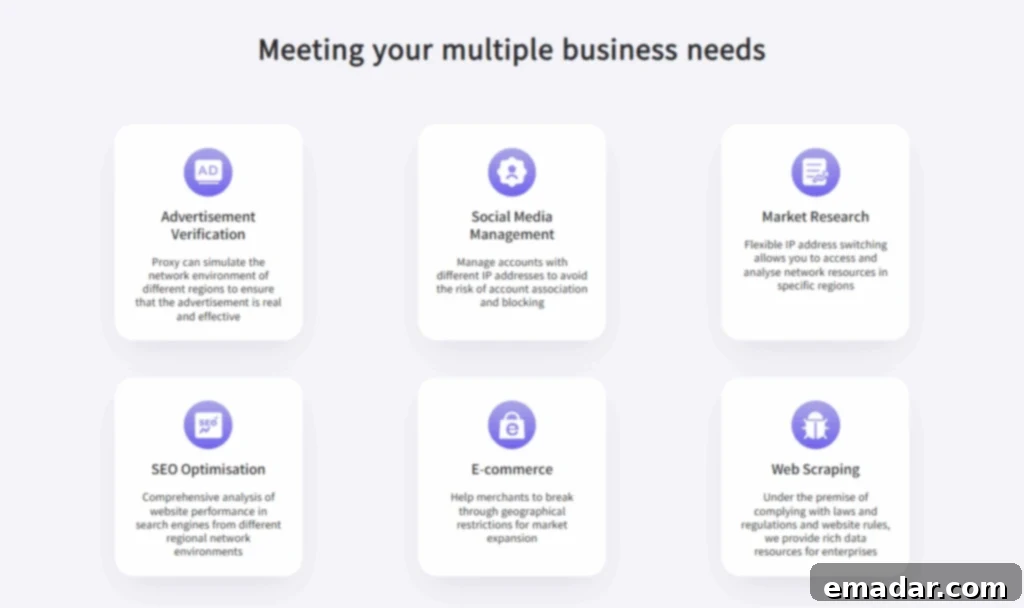
In today’s data-driven economy, businesses leverage proxies to gather invaluable pricing intelligence, meticulously track competitor strategies, and monitor emerging market trends. Both Thordata and IPFLY provide the essential IP diversity and robustness required for large-scale, comprehensive data collection projects. However, IPFLY’s substantially broader network and advanced IP management capabilities allow it to handle significantly higher volumes of requests with remarkably fewer interruptions and a lower incidence of IP blocks. This makes IPFLY particularly advantageous for enterprises engaged in continuous, high-intensity market surveillance that requires accessing numerous data points from various sources simultaneously.
SEO, Ad Verification, and Geo-Testing
For savvy marketers, proxies are indispensable tools. They enable the precise tracking of search engine rankings from different geographical locations, the meticulous verification of how advertisements appear in various regional markets, and the rigorous testing of website functionality and content from specific target locations. Both providers facilitate these critical functions by allowing users to accurately simulate regional browsing behaviors through precisely targeted IP addresses. Thordata’s platform is often lauded for its straightforward interface, making it relatively simple for users to navigate and execute geo-targeted tasks efficiently. Conversely, IPFLY offers more sophisticated automation features and greater scalability, making it an ideal choice for managing expansive marketing campaigns that require dynamic IP changes and extensive geographical coverage for verification and testing purposes.
E-commerce and Inventory Monitoring
The highly competitive e-commerce sector frequently necessitates the use of proxies to discreetly monitor competitor stock levels, track real-time pricing updates, and identify emerging product trends. Both Thordata and IPFLY provide stable, reliable IPs that are crucial for minimizing the risk of detection and blocks during repetitive access to e-commerce sites. This stability ensures uninterrupted data flow, which is vital for maintaining a competitive edge. IPFLY’s automated rotation features, combined with its exceptionally large IP pool, prove to be particularly advantageous for high-volume monitoring tasks, such as frequently checking thousands of product pages or rapidly cycling through different storefronts without triggering bot detection systems.
Brand Protection and Cyber Security
Beyond data collection, proxies play a vital role in brand protection and cybersecurity. Businesses can use proxies from both providers to monitor for instances of intellectual property infringement, detect counterfeit product listings, or track phishing attempts that target their brand. By using geo-targeted IPs, companies can see how their brand is being represented (or misrepresented) in different regions, proactively identifying threats. IPFLY’s vast network and advanced rotation make it particularly effective for large-scale monitoring across numerous platforms and geographies, allowing for comprehensive threat detection that might otherwise be missed.
Security, Privacy, and Compliance: Non-Negotiable Priorities
When operating with proxies, particularly for sensitive business data and operations, security and privacy are paramount concerns. Both Thordata and IPFLY acknowledge these critical requirements:
- Anonymity and IP Masking: A fundamental role of any proxy is to provide a layer of anonymity, masking the user’s true IP address. Both Thordata and IPFLY excel in this aspect, particularly through their residential and ISP proxy offerings. These proxy types ensure a high degree of anonymity, making it exceedingly difficult for target websites to identify the origin of requests, thus safeguarding the user’s real IP address and enhancing the security of online activities. This is crucial for maintaining competitive anonymity and avoiding detection.
- Logging Policies and Data Confidentiality: The logging policies of a proxy provider are a direct reflection of its commitment to user privacy. Both companies publicly declare minimal logging policies, a critical assurance for businesses handling sensitive data. Minimal logging means that detailed records of user activity or connection data are either not kept or are anonymized and retained only for short, essential periods (e.g., for troubleshooting or billing purposes). This commitment is vital for ensuring that user activity remains confidential and protected from potential exposure, aligning with best practices for data security.
- Regulatory Compliance: In an increasingly regulated digital environment, compliance with data protection laws is a key concern. IPFLY explicitly emphasizes its robust compliance with international data protection regulations, such as GDPR and CCPA, ensuring that its IP addresses and operational procedures meet stringent legal and ethical standards. This commitment provides an added layer of assurance for businesses operating in regions with strict data privacy laws. Thordata also adheres to relevant privacy standards and employs practices designed to protect user data, though specific policy details and regional compliance frameworks may vary. Businesses should always review the specific compliance statements of each provider relative to their operational jurisdiction.
Pricing Models and Scalability
The cost-effectiveness and flexibility of pricing models are critical for businesses, from startups to large enterprises, needing to manage budgets efficiently while scaling operations.
- Thordata’s Pricing: Thordata typically offers various packages often tied to bandwidth usage or the number of ports, allowing businesses to choose a plan that fits their anticipated needs. Their models are generally straightforward, making it easy for users to understand and predict costs. They may offer custom solutions for very large clients, focusing on delivering value through reliable service rather than just raw volume.
- IPFLY’s Pricing: IPFLY often provides more granular and flexible pricing structures, which can be particularly beneficial for dynamic usage patterns. This might include pay-as-you-go options, tiered bandwidth packages, or dedicated plans that cater specifically to high-volume users requiring extensive IP pools. Their focus on scalability means their pricing can easily adapt as a business’s proxy needs grow, offering cost-efficiency for both nascent projects and established operations. The ability to filter and select specific IP types and locations might also influence pricing, providing more control over spending.
Customer Support and User Experience
The quality of customer support and the ease of use of a provider’s platform can significantly impact operational efficiency.
- Thordata’s Support: Thordata generally provides responsive customer support through standard channels like email and ticketing systems. Their user interface is often described as intuitive and user-friendly, making it easier for new users to get started and manage their proxies without a steep learning curve. Documentation is typically comprehensive, aiding in self-service.
- IPFLY’s Support: IPFLY often prides itself on offering multi-channel support, potentially including live chat, email, and a dedicated account manager for enterprise clients. Given their focus on large-scale and automated operations, they frequently provide extensive API documentation and detailed guides to facilitate seamless integration into complex systems. Their control panel is designed for scalability, allowing advanced users to manage a large number of proxies and configurations efficiently, though it might appear more complex for absolute beginners due to the breadth of features.
Summary Comparison Table
| Feature / Metric | Thordata | IPFLY |
| Proxy Types | Residential, Data Center, ISP | Residential, Data Center, ISP |
| Network Size | Moderate to Good | Extensive and Large |
| Global Coverage | Multiple countries and regions | 190+ countries & regions with deep city-level targeting |
| Automated IP Rotation | Configurable options for specific tasks | Advanced automated system with active IP filtering for optimal performance |
| Speed | Good to High, task-dependent | Consistently High for all proxy types, optimized for low latency |
| Uptime & Reliability | Reliable and consistent | Excellent, designed for large-scale automated workflows |
| Success Rates | High | Exceptional, actively maintained by filtering underperforming IPs |
| Key Use Cases | SEO, web scraping, ad verification, geo-testing, general data collection | SEO, web scraping, ad verification, e-commerce monitoring, market research, brand protection, high-volume automation |
| Security & Privacy | High anonymity, minimal logging | High anonymity, strict minimal logging, strong emphasis on compliance |
| Ease of Use | User-friendly interface, straightforward setup | User-friendly, highly scalable, advanced API for complex integrations |
| Pricing Flexibility | Standard packages, bandwidth/port-based | Flexible, granular options, suitable for scaling operations |
| Customer Support | Responsive via standard channels | Multi-channel, often with extensive documentation and API support |
Conclusion – Understanding Differences to Make the Right Choice

Both Thordata and IPFLY stand as highly capable and reliable proxy solution providers, serving the diverse needs of businesses, marketers, and developers across the globe. However, the optimal choice between these two leading contenders ultimately hinges on your specific operational requirements, scale of activity, and budgetary considerations.
- Thordata emerges as an excellent choice for businesses that prioritize a straightforward, easy-to-use platform coupled with solid global coverage and robust usability. It is particularly well-suited for standard proxy tasks such as consistent SEO tracking, reliable ad verification, and focused data collection where ease of management and stable performance are key. Businesses with moderate volume needs and a preference for clear, direct configurations will find Thordata’s offerings highly beneficial.
- IPFLY, conversely, is engineered for businesses and enterprises that demand unparalleled capacity for high-volume operations, an exceptionally extensive IP coverage, and sophisticated automated rotation for mission-critical tasks. Its robust infrastructure makes it the superior choice for large-scale web scraping projects, continuous market monitoring, comprehensive geo-targeted testing, and any operation where maximum success rates, stability, and the ability to seamlessly scale are paramount. Companies with complex, data-intensive requirements and a need for advanced automation will find IPFLY’s robust features indispensable.
By diligently evaluating factors such as the specific proxy types offered, the breadth and depth of their network size, their performance metrics across speed and reliability, and their suitability for various strategic use cases, businesses can confidently select the proxy provider that not only meets but actively enhances their operational needs, driving efficiency and competitive advantage in the digital landscape.
Boost Your Online Operations with IPFLY – Unlock the power of fast, reliable, and secure proxies meticulously designed for demanding web scraping, precise SEO monitoring, thorough ad verification, and an array of other critical online tasks. Initiate the optimization of your workflow today and ensure you stay at the forefront of digital efficiency. For the latest updates, expert tips, and community discussions, join IPFLY’s Telegram channel.