
Demystifying Reverse Rotating Proxies: Powering Enterprise Data Operations
In the dynamic realm of web scraping, advanced data analysis, and large-scale automation, sophisticated terminology often emerges. One term frequently encountered by experienced professionals is the “reverse rotating proxy.” While its name might suggest a complex mechanism, it fundamentally represents one of the most robust and efficient solutions for managing online identity and access at an unparalleled scale. But what exactly is this powerful technology? How does it differ from a conventional proxy, and who stands to benefit most from leveraging this cutting-edge solution?
This comprehensive guide aims to thoroughly demystify the concept of reverse rotating proxies. We will delve deep into the powerful technology they embody—more accurately known as backconnect proxies—and meticulously detail why they have become the undisputed gold standard for enterprise-level data acquisition and operational intelligence in 2025 and beyond.
Understanding the Core Components of Proxy Technology
To fully grasp the functionality and significance of a reverse rotating proxy, it’s essential to first understand its foundational elements: the “reverse proxy” and the “rotating (forward) proxy.” These two distinct concepts, though often confused, serve entirely different purposes within network architecture.
What is a Reverse Proxy?
A traditional reverse proxy operates as an intermediary server that sits in front of one or more web servers. Its primary role is to manage and direct incoming client requests from the internet to the appropriate backend server. Crucially, it acts on behalf of the servers it protects, meaning clients communicate with the reverse proxy, which then forwards their requests to the actual web servers. This setup offers several critical advantages:
- Load Balancing: Distributes incoming traffic across multiple servers, preventing any single server from becoming overloaded and ensuring high availability.
- Security: Functions as a Web Application Firewall (WAF), shielding backend servers from direct exposure to internet threats and filtering malicious traffic.
- Caching: Stores frequently accessed content, reducing the load on origin servers and significantly improving website performance and user experience.
- SSL Termination: Handles encryption and decryption of traffic, offloading this CPU-intensive task from backend servers.
It’s important to reiterate: you do not use a reverse proxy to obscure your identity as a client; its purpose is to protect and optimize your servers from incoming traffic.
What is a Forward (Rotating) Proxy?
This is what most individuals envision when they consider proxies for anonymity, accessing geo-restricted content, or web scraping. A forward rotating proxy, or simply a rotating proxy, functions as an intermediary for outgoing client requests. Unlike a reverse proxy, it sits in front of the client (your device or scraping bot) and forwards your requests to the internet on your behalf. The “rotating” aspect refers to its key feature: it provides access to a large pool of IP addresses and automatically assigns a different IP to you with each new request, or after a predetermined time interval. This constant change of IP address is vital for:
- Maintaining Anonymity: Hides your true IP address from target websites.
- Bypassing Geo-restrictions: Allows you to appear as if you’re browsing from a different geographical location.
- Preventing IP Blocks: Makes it difficult for websites to detect and block your scraping activities, as requests appear to originate from many different users.
You use a rotating proxy to continually alter your outgoing identity and circumvent detection. This distinction is crucial for understanding the advanced capabilities of backconnect proxies.
The “Reverse Rotating Proxy” Unveiled: The Power of Backconnect Proxies
The term “reverse rotating proxy” can often be a source of confusion because, in practice, what most users are seeking is a highly advanced form of a forward rotating proxy known as a backconnect proxy. While the name might seem counterintuitive given the definition of a reverse proxy, the underlying concept from the user’s perspective is remarkably simple and profoundly powerful.
Consider this illustrative analogy:
A standard rotating proxy service is akin to being given an enormous binder filled with thousands of different P.O. box addresses. Each time you wish to send a letter (make a web request), you must manually select a fresh P.O. box from your list to use as the return address. This requires active management and selection on your part.
A backconnect (or what is often colloquially referred to as a “reverse rotating”) proxy, on the other hand, is like possessing a single, truly magical mailbox. You simply deposit all your letters into this one mailbox. The magic happens behind the scenes: for every single letter you send, this smart mailbox automatically and instantaneously assigns a different, random return address from an immense pool of millions of legitimate IPs. You interact with only one point, and the system handles the intricate rotation.
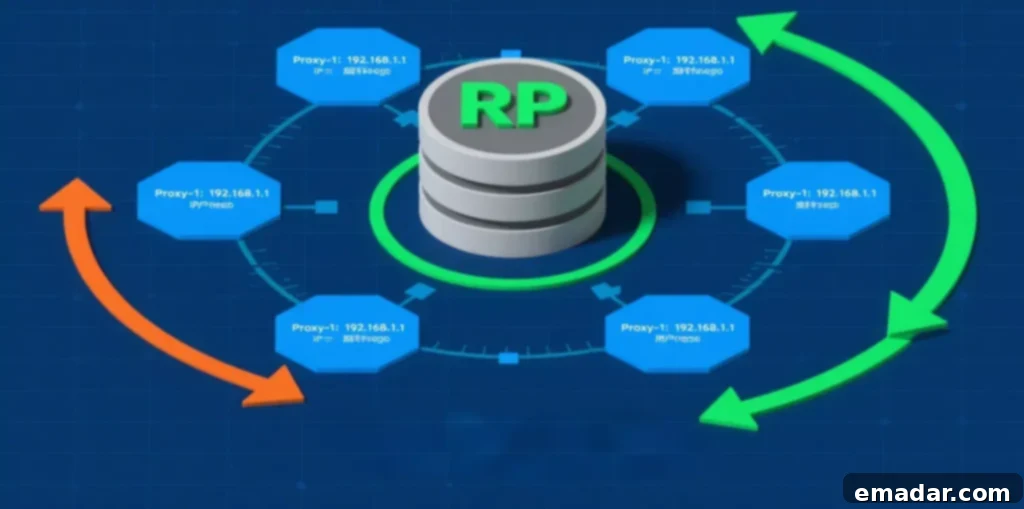
In more technical terms, a backconnect proxy provides you with a single, stable gateway address (e.g., gate.proxyprovider.com:port). All your application’s requests are directed to this solitary endpoint. On the backend, the sophisticated proxy service then automatically “reverses” the typical connection flow from your perspective. It intelligently routes your request through one of its millions of high-quality residential or mobile IP addresses within its vast network, ensuring a fresh IP for nearly every request. The beauty of this system is that you, as the user, never have to see, select, or manage the individual IP addresses; the entire IP rotation and management process is seamlessly handled by the provider’s infrastructure. This automation is precisely why it’s a game-changer for large-scale operations.
Distinct Advantages of Leveraging a Reverse Rotating (Backconnect) Proxy
This highly optimized architecture delivers unparalleled advantages for organizations and individuals engaged in serious data acquisition and operational tasks:
1. Unmatched Simplicity and Seamless Scalability:
One of the most compelling benefits is the sheer simplicity it offers. You only need to configure a single, static endpoint in your application, script, or web scraping framework. This singular gateway grants you immediate access to a virtually limitless and continuously refreshed pool of IP addresses. This streamlined approach makes it incredibly easy to scale your operations from a few requests per minute to millions per day without necessitating complex configuration adjustments or ongoing IP list management. Developers can deploy and forget about the underlying proxy infrastructure, focusing instead on core application logic and data processing.
2. Superior Anonymity and Drastically Reduced Block Rates:
By constantly rotating through a massive pool of high-quality, legitimate residential or mobile IP addresses on the backend, the probability of being detected, blocked, or served CAPTCHAs by target websites is dramatically reduced. Residential IPs are particularly effective because they are associated with real internet service providers and actual home users, making traffic originating from them appear highly legitimate. Websites find it exceptionally challenging to identify and block such diverse traffic, as your requests appear to come from thousands of different, authentic users across various geographic locations. This significantly increases your success rate for data extraction and ensures uninterrupted operations.
3. Effortless IP Management and Zero Overhead:
The backconnect proxy service completely shoulders the arduous task of IP address management. This includes continuous health checks to identify and remove unresponsive, slow, or blacklisted IPs from the active pool, sophisticated rotation logic to optimize IP usage and maximize anonymity, and automatic provisioning of new IPs. This invaluable service liberates your developers and engineers from the burden of proxy infrastructure maintenance, allowing them to dedicate their valuable time and expertise to optimizing data extraction methodologies, data analysis, and developing core business functionalities, rather than constantly troubleshooting proxy issues.
Who Benefits Most from This Advanced Technology? Top Use Cases
Reverse rotating proxies are not designed for casual use; they are a high-performance, enterprise-grade tool engineered for the most demanding and large-scale data-intensive tasks. Their capabilities are indispensable across various industries:
- Enterprise-Grade Web Scraping: For businesses requiring extensive data from heavily protected and dynamically updated websites, such as e-commerce platforms, social media networks, and financial portals. This includes gathering competitive product pricing, inventory levels, user reviews, market trends, and lead generation data at massive scale without detection. The high volume and frequency of requests necessitate an advanced solution to maintain access.
- Large-Scale Market Research and Competitive Intelligence: Analyzing competitor websites, tracking consumer behavior patterns, monitoring industry news, and aggregating vast amounts of data from thousands of diverse online sources. Backconnect proxies enable comprehensive data collection vital for strategic decision-making, allowing businesses to gain deep insights into market dynamics and competitor strategies discreetly.
- Ad Verification and Performance Monitoring: Ensuring that digital advertisements are displayed correctly, reaching the intended audience across various geographic locations, devices, and user profiles. This involves verifying ad placement, checking for ad fraud, and monitoring the performance of campaigns from multiple vantage points, which requires the ability to simulate diverse user identities and locations.
- SEO Monitoring at Scale: Performing tens of thousands of search engine queries from numerous locations and devices to accurately track keyword rankings, monitor local search results, and analyze competitor SEO strategies. The ability to simulate different user origins is crucial for obtaining unbiased and geographically relevant search engine results page (SERP) data.
- Brand Protection and Cybersecurity Intelligence: Monitoring for unauthorized use of brand names, intellectual property infringement, fake product listings, or copyright violations across various online marketplaces, social media, and forums. For cybersecurity, these proxies are essential for gathering threat intelligence by anonymously observing malicious activities or probing vulnerable systems without revealing the source of the investigation.
- Travel Fare Aggregation: Collecting real-time pricing data for flights, hotels, and rental cars from hundreds of travel sites simultaneously. This requires constant rotation and the appearance of unique users to avoid rate limits and disguised pricing.
Selecting the Ideal Provider for Your Specific Requirements
The efficacy and reliability of a backconnect proxy solution are entirely contingent upon the quality, size, and diversity of the provider’s underlying IP network. When evaluating and selecting a provider, it’s paramount to consider several key criteria to ensure your operations are seamless and efficient:
- IP Pool Size and Diversity: A vast pool of millions of real residential and mobile IPs (not just datacenter IPs) is crucial for maintaining anonymity and avoiding detection. Geographic diversity is also vital if you need to target specific regions.
- Speed and Reliability: The network should offer high-speed connections and consistent uptime to ensure your data acquisition is fast and uninterrupted. Look for providers with robust infrastructure.
- Pricing Models: Understand the pricing structure, whether it’s based on bandwidth usage, number of requests, or active ports. Choose a model that aligns with your operational volume and budget.
- Customer Support and Documentation: Responsive and knowledgeable customer support, along with clear documentation, can be invaluable for setup, troubleshooting, and optimizing your usage.
- Ease of Integration: The proxy service should offer simple API access and user-friendly dashboards for monitoring usage and managing settings, facilitating quick integration into your existing systems.
- Ethical Sourcing: Ensure the provider sources its residential IPs ethically, transparently, and with the explicit consent of the IP owners.
Leading services in this specialized domain, such as IPFLY, exemplify these qualities, offering advanced backconnect rotating proxies that grant users access to millions of ethically sourced residential and mobile IPs through a single, easy-to-integrate gateway. This powerful combination of simplicity and robust performance is precisely what empowers businesses to scale their data operations effortlessly, without getting entangled in the complexities and constant maintenance of IP management.

Conclusion: The Indispensable Role of Backconnect Proxies in Modern Data Acquisition
While the nomenclature “reverse rotating proxy” can initially be a source of conceptual confusion, the innovative technology it describes—the backconnect proxy—stands as the pinnacle of proxy solutions for large-scale, high-demand data acquisition. By brilliantly combining the unparalleled simplicity of a single entry point with the immense power and resilience of a vast backend pool of continuously rotating residential and mobile IP addresses, it effectively resolves the most significant challenges inherent in modern web automation and data extraction.
For any business, developer, or data professional serious about gaining a competitive edge through comprehensive data intelligence in 2025, understanding and judiciously leveraging this transformative technology is no longer merely an option; it has become an absolute necessity. Backconnect proxies offer the reliability, anonymity, and scalability required to navigate the increasingly complex landscape of online data, ensuring uninterrupted access and successful operations.
Empower your data operations today! Visit IPFLY.net to explore and experience top-tier proxy services designed for performance and reliability. Additionally, join the vibrant IPFLY Telegram community to engage with fellow professionals, uncover the latest strategies, master cutting-edge tips, and access exclusive resources that will help proxies efficiently empower all your critical data needs!