
Transparent vs. Non-Transparent Proxies: A Comprehensive Guide
When first delving into the world of proxy IPs, many individuals find themselves puzzled by two fundamental concepts: transparent proxies and non-transparent proxies. While the names might appear subtly different, the actual impact on your online experience can be dramatically different.
If your primary concerns revolve around account security, IP isolation, or managing multiple accounts simultaneously, understanding the nuances between these proxy types is crucial. This article will provide a detailed explanation to help you make informed decisions.
What is a Transparent Proxy?
Let’s start with a concise definition:
A transparent proxy does not conceal your real IP address.
This means that even when using a transparent proxy:
- The target website can still identify your actual IP address.
- The website is aware that you are using a proxy server.
From a technical standpoint, a transparent proxy typically includes your real IP information in the request headers, often using fields like X-Forwarded-For.
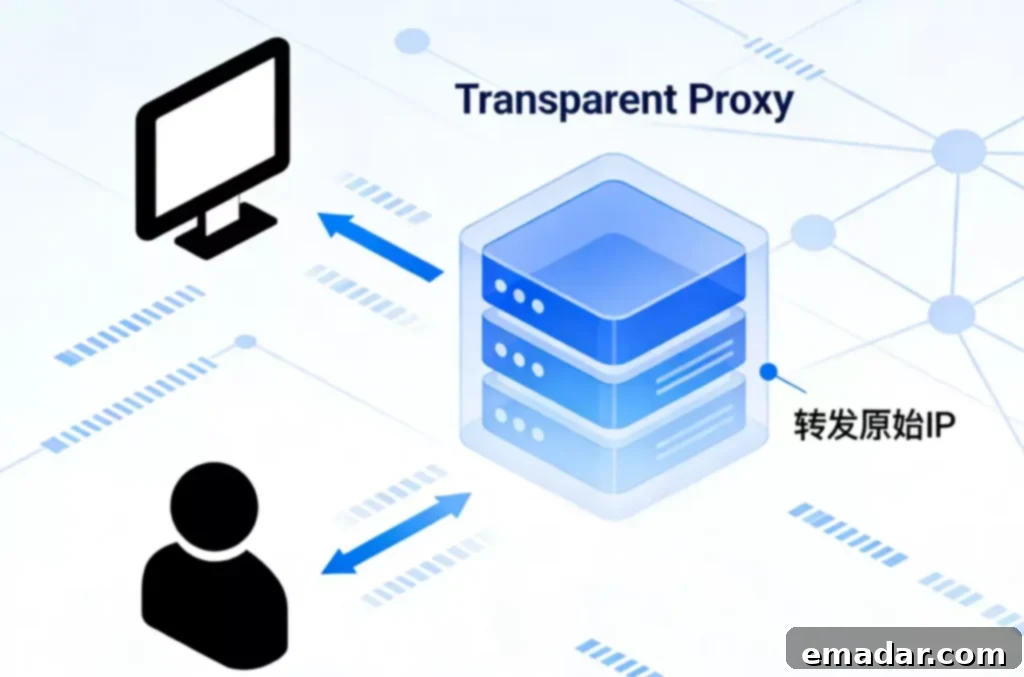
In Simple Terms:
Imagine wearing a mask but simultaneously announcing your true identity to everyone. That’s essentially how a transparent proxy works.
What is a Non-Transparent Proxy?
A non-transparent proxy is defined as:
A type of proxy that prevents your real IP address from being exposed to the target website.
Non-transparent proxies can be further categorized based on their level of concealment:
- Anonymous Proxies
- High-Anonymous Proxies (also known as Elite Proxies)
The common characteristic is that your true IP address is not directly revealed.
This is the type of proxy most often required in scenarios where IP masking and privacy are paramount.
Key Differences Between Transparent and Non-Transparent Proxies
① Real IP Exposure (The Most Critical Difference)
- Transparent Proxy
- ❌ Does not hide your real IP address.
- Websites can directly access your origin IP.
- Non-Transparent Proxy
- ✅ Hides your real IP address.
- Websites only see the proxy server’s IP.
If your goal is to “change your identity” online, this single factor is the deciding element.
② Website Detection of Proxy Usage
- Transparent Proxy
- Explicitly informs the website that you are using a proxy.
- Non-Transparent Proxy
- Depending on the level of anonymity, it may be impossible to determine whether a proxy is being used.
Many risk management systems consider “proxy usage” as a significant indicator.
③ Different Use Cases
This is often overlooked by beginners.
Common Use Cases for Transparent Proxies:
- Unified internet exit for corporate networks
- Management of campus networks
- Traffic auditing and caching
- Content filtering
These scenarios share the following characteristics:
- No need to hide the user’s identity
- The administrator wants to “see the visitor” clearly
Common Use Cases for Non-Transparent Proxies:
- Multi-account login
- IP isolation
- Preventing account association
- Data scraping
- Cross-border access
Essentially, account-related and business-related requirements almost entirely depend on non-transparent proxies.
Why Transparent Proxies Are Rarely Recommended for Proxy IP Scenarios
The reason is quite practical.
In the current platform risk control environment:
- IP origin
- Whether a proxy is used
- The concentration of activity
Are all considered in a comprehensive assessment.
The problem with transparent proxies is:
- Your real IP is already exposed
- Proxy usage is flagged
- Risk is actually more concentrated
Therefore, in social media, e-commerce, and content platforms, transparent proxies not only fail to help but may even increase the probability of anomalies.
Transparent Proxy vs. Non-Transparent Proxy: Which is Safer?
If you consider it purely from a “security” perspective, the answer is clear:
- Transparent Proxy: Offers virtually no account security.
- Non-Transparent Proxy: Forms the foundation for account isolation and risk avoidance.
This is why most mainstream proxy services provide high-anonymous or elite proxies by default. For example, IPFLY uses multi-layer IP filtering and anonymization mechanisms in the proxy chain to prevent the transmission of real IPs, essentially avoiding the risks associated with transparent proxies.
Common Misconceptions Among Beginners
❌ Misconception 1: Transparent Proxies are More “Stable”
Stability depends on:
- Network lines
- Server quality
- IP availability
It has little to do with whether the proxy is “transparent” or not.
❌ Misconception 2: Any Proxy That Connects is a Good Proxy
If your real IP is exposed:
- Being able to connect ≠ Useful
- Being able to access ≠ Safe
This is the fundamental reason why many people get banned even when using a proxy.
How to Determine if You Are Using a Transparent or Non-Transparent Proxy
Several clear indicators can help you self-check:
- The website still displays your real IP after using the proxy.
- The IP geolocation does not change.
- The platform explicitly states “Proxy usage detected.”
- Multi-account operations are still highly correlated.
If these situations occur, you are likely using a transparent proxy.
How to Choose? A One-Sentence Guideline
Remember this:
If you need to hide your identity, do not use a transparent proxy.
If your goals are:
- Account security
- IP isolation
- Distributed activity
Then you need to find a non-transparent proxy (especially the high-anonymous type).
Proxy services like IPFLY emphasize residential proxies, data center proxies, and multi-layer anonymity mechanisms precisely to address the issue of “ineffective transparent proxies.”
Conclusion
Finally, to summarize:
Transparent proxies are “network management tools,” while non-transparent proxies are “business tools.”
Understanding this distinction can help you avoid at least 80% of the pitfalls when selecting and using proxies.
Why Choose IPFLY’s Solutions?
IPFLY helps users efficiently configure proxy IPs through the following technical advantages:
1. Self-built server network: Covering major cities worldwide, with high IP purity to avoid “blacklist” issues.
2. Dynamic IP allocation mechanism: Automatically rotates IPs to reduce the risk of long-term use of the same address.
3. Multi-level IP filtering: Uses big data algorithms to remove low-quality IPs, ensuring proxy chain success.
👉Choose IPFLY for peace of mind, Claim your discount and get high-quality IPs now!