
The Perilous Pitfalls of Free HTTP Proxies: Why Zero Cost Can Mean Maximum Risk
In the vast landscape of network proxy solutions, free HTTP proxies often lure individuals and small to medium-sized businesses with the tempting promise of “zero cost.” These services typically operate by routing user requests through public IP pools or shared servers, effectively masking the user’s real IP address and offering a basic level of anonymity. While this seemingly “free lunch” can appear attractive, it frequently conceals a multitude of profound risks that can severely impact security, performance, and operational integrity. Understanding these inherent dangers is crucial for anyone considering their use, as the initial savings can quickly be dwarfed by significant, often irreversible, damage.
The allure of free proxy services stems from their accessibility and the perception of immediate cost savings. However, beneath this surface appeal lies a complex web of technical and ethical compromises. Unlike their paid counterparts, free proxies lack dedicated infrastructure, robust security protocols, and often operate with questionable privacy policies. This fundamental difference transforms what appears to be a helpful tool into a potential liability, capable of disrupting critical tasks, compromising sensitive data, and even leading to substantial financial losses. Delving deeper, we uncover the specific areas where free HTTP proxies fall critically short, exposing users to unnecessary vulnerabilities and hindering their online objectives.
Stability and Speed: A Dual Collapse in Performance
One of the most immediate and frustrating issues users encounter with free HTTP proxies is their abysmal performance. Independent technical evaluations consistently demonstrate that these services are plagued by instability and cripplingly slow speeds. For instance, a recent study by a leading tech team revealed that the average response time for free HTTP proxies exceeded a sluggish 3 seconds, making them impractical for any time-sensitive online activity. More alarmingly, data collection tasks, which often rely on consistent and rapid data flow, experienced an interruption rate of up to 70% when utilizing these free options.
The root cause of this poor performance lies in the architecture of free proxy networks. They typically rely on shared IP pools and overcrowded servers, leading to a phenomenon known as “bandwidth starvation.” This occurs when a large number of users simultaneously compete for limited network resources, resulting in significant bottlenecks, packet loss, and extremely high latency. This issue is particularly detrimental for businesses. A prominent e-commerce platform, after experimenting with free proxies for its operations, witnessed its page loading failure rate skyrocket from a manageable 5% to an unacceptable 45%. Such performance degradation not only frustrates users but also directly impacts conversion rates, search engine rankings, and overall business reputation. The unpredictable nature of these proxies means that crucial tasks, from web browsing to automated data extraction, are constantly at risk of failure, rendering them unreliable for anything beyond the most trivial, non-critical usage.
Moreover, the IP addresses provided by free services are often overused and frequently blacklisted by websites and services. This leads to constant disconnections, forced CAPTCHA challenges, and outright IP bans, further exacerbating the instability. Users spend more time troubleshooting and trying to find working proxies than actually accomplishing their tasks, effectively negating any perceived “free” benefit. The lack of dedicated infrastructure also means minimal maintenance and updates, making these proxies susceptible to further performance degradation over time as network demands evolve.
Security and Privacy: A Comprehensive Breach of Trust
Beyond performance issues, the gravest danger posed by free HTTP proxies is the profound compromise of security and privacy. When you route your internet traffic through a third-party server, you are essentially entrusting all your online activities to an unknown entity. The reality is that many free proxy providers operate with malicious intent or, at best, with negligible security standards, turning them into severe privacy risks.
- Data Logging and Monetization: Free proxy servers often record extensive user access data, which can include highly sensitive information such as login credentials, payment details, browsing history, and personal identifiable information. This data is then frequently sold to third parties, used for targeted advertising, or even leveraged for more nefarious purposes. A stark example of this risk involved a cross-border e-commerce business that suffered the leakage of 100,000 customer records due to its reliance on a free proxy service, resulting in direct financial losses exceeding 500,000 yuan (approximately $70,000 USD) and irreparable damage to its customer trust and brand reputation.
- Malware Injection and Man-in-the-Middle Attacks: Without proper encryption and security protocols, free proxies are susceptible to man-in-the-middle (MITM) attacks. This allows the proxy server operator, or another malicious actor who has compromised the server, to intercept, view, and even alter the data passing through. They can inject malware, phishing scripts, or unwanted advertisements into your web traffic, turning your browsing experience into a vector for cyberattacks. The absence of robust security measures means that users are left vulnerable to a wide array of cyber threats that can lead to data theft, system compromise, and financial fraud.
- Lack of Accountability and Legal Protection: Unlike reputable paid proxy services, free providers offer no service level agreements (SLAs), no customer support, and no legal recourse in case of a breach. There’s no guarantee of data protection, and tracing the origin of a data leak back to a free proxy service can be incredibly challenging, leaving victims with little to no legal leverage. This lack of accountability underscores the high-risk nature of entrusting sensitive data to unverified and unsecured free services.
The deceptive facade of “free” often hides a business model built on exploiting user data, making these proxies a ticking time bomb for anyone concerned about their digital privacy and security. The short-term convenience simply does not outweigh the long-term, potentially devastating, consequences.
Platform Risk Control: The “Precise Strike” Against Free Proxies
Major online platforms, ranging from e-commerce giants like Amazon to social media powerhouses like TikTok, have invested heavily in sophisticated risk control systems designed to detect and deter malicious or automated activities. Free HTTP proxies, due to their inherent characteristics, are particularly vulnerable to these advanced detection mechanisms, leading to swift and often permanent account suspensions.
- AI-Driven Detection Algorithms: Platforms employ advanced AI algorithms that can identify patterns indicative of free proxy usage. These patterns include high concurrency requests originating from the same IP address, consistent or fixed User-Agent strings across multiple requests, and unusual browsing behaviors that deviate from human interaction. These algorithms are incredibly effective at flagging and penalizing accounts. Statistics show that accounts using free proxies experience a ban rate that is up to three times higher than those utilizing reputable paid proxy services, highlighting the critical difference in their detectability.
- IP Reputation and Data Center IP Disclosure: A common tactic employed by free proxy services is to use data center IP addresses and attempt to disguise them as residential IPs. However, platform risk control systems are equipped with extensive IP reputation databases and sophisticated identification tools. A simple lookup reveals that these IPs are registered to “virtual hosting service providers” or data centers, rather than legitimate internet service providers (ISPs) typically associated with residential users. This discrepancy is easily identified by platform algorithms, immediately triggering red flags and increasing the likelihood of an account being flagged for suspicious activity, leading to immediate restrictions or bans.
- Shared IP Footprints: Free proxies rely on a limited pool of shared IP addresses. This means that numerous users might be accessing different accounts on the same platform from the same IP address or range of IP addresses. This shared footprint creates a highly suspicious pattern for platform security systems, which interpret such activity as an attempt to circumvent their security measures or engage in malicious behavior, resulting in widespread bans across all associated accounts.
Attempting to operate on these platforms with free proxies is a losing battle. The advanced detection capabilities of modern platforms mean that any perceived anonymity or operational advantage is fleeting, quickly giving way to sanctions that can severely impact business operations or personal access.

The Three “False Application Scenarios” of Free HTTP Proxies
While free HTTP proxies might seem like a viable solution for various online tasks, experience shows that they consistently fail in critical application scenarios, rendering them not just ineffective but often counterproductive. Understanding why they falter in these common use cases helps underscore the necessity of choosing more robust and reliable alternatives.
Personal Temporary Access
Many users initially turn to free proxies for casual, temporary access to geo-restricted content or for minor anonymity. However, these proxies are almost universally incapable of fulfilling such purposes effectively.
- Inability to Bypass Geo-Restrictions: Streaming services like Netflix, BBC iPlayer, Hulu, and others employ sophisticated geo-detection technologies that easily identify and block IP addresses associated with free proxy services or data centers. User tests consistently demonstrate the inadequacy of free proxies in this regard; one user reported a mere 20% success rate in bypassing regional restrictions with free proxies. This means that for the vast majority of desired content, free proxies simply fail to deliver, leaving users unable to access their chosen entertainment or information.
- Protocol Limitations and Performance for Streaming: Beyond geo-blocking, free proxies often lack support for essential protocols like UDP, which is critical for smooth, real-time data transmission required by streaming video and online gaming. This absence leads to constant buffering, low-resolution streams, and an overall frustrating user experience. In contrast, selecting a paid proxy service that supports UDP, such as IPFLY’s dynamic residential proxies, drastically improves performance. Users have reported that 720P video loading stuttering rates decreased from 30% to a mere 5% when switching to a reliable paid service, highlighting the profound difference in user experience and capability.
For personal browsing, especially for accessing geo-blocked content or maintaining a consistent connection, free proxies are a false economy. The frustration and unreliability far outweigh any perceived benefit.
Data Collection and Web Scraping
Web scraping and data collection are tasks that demand high reliability, speed, and a vast pool of diverse, unblocked IP addresses. Free HTTP proxies are inherently unsuited for these demanding operations.
The primary issue lies in the extremely high IP repetition rate of free proxy services, often exceeding 90%. This means that a data collector is frequently sending requests from the same, often flagged, IP addresses. When a prominent e-commerce price comparison platform attempted to use free proxies, its data collection success rate plummeted from a robust 80% to a dismal 15%. Websites quickly detect these repetitive requests from suspicious IPs, leading to immediate IP bans, CAPTCHAs, and rate limiting. This renders the scraping process inefficient, incomplete, and ultimately futile.
For serious data collection, a specialized solution is indispensable. IPFLY’s dynamic residential proxies, for instance, offer a “one request, one IP” rotation model. This ensures that each request appears to originate from a unique, legitimate residential IP address, making it extremely difficult for anti-scraping mechanisms to detect and block. This approach has proven highly effective, with users reporting a four-fold increase in Amazon product data collection efficiency without triggering any anti-scraping defenses, thereby ensuring comprehensive and reliable data acquisition for critical market intelligence.
Cross-Border E-commerce Multi-Store Operation
For cross-border e-commerce sellers managing multiple online stores on platforms like Amazon, eBay, or Shopee, maintaining distinct digital identities for each store is paramount. Free HTTP proxies pose an exceptionally high risk of IP association, which can lead to catastrophic consequences.
When multiple store accounts are accessed through the same or closely related free proxy IP addresses, platforms’ advanced fraud detection systems easily identify this link. This IP association signals potential policy violations, such as operating multiple accounts under the same entity to bypass selling limits or gain unfair advantages. A clear illustration of this risk is a Shopee seller who, due to relying on shared free proxy IPs, had all five of their online stores simultaneously banned, resulting in immense financial losses and operational disruption. The cost of replacing these accounts and rebuilding reputation far outweighs any initial savings.
To mitigate this critical risk, dedicated and distinct IP addresses are essential for each store. IPFLY’s static residential proxies provide precisely this solution, offering fixed IP addresses allocated by legitimate ISPs (e.g., a Comcast home broadband IP in the USA). These IPs mimic genuine residential connections, providing a stable and trustworthy digital footprint for each store. By using such dedicated IPs, sellers have seen their store survival rate dramatically improve from 40% to an impressive 95%, ensuring the longevity and profitability of their multi-store operations. This emphasizes that for professional e-commerce, the investment in high-quality, dedicated proxies is a non-negotiable requirement for sustainable growth and security.
Defining the “Safe Usage Boundaries” for Free HTTP Proxies
Given the array of risks associated with free HTTP proxies, it’s crucial to understand that their “safe” usage is extremely limited. For most online activities, particularly those involving sensitive data or requiring high reliability, they are unsuitable. However, if circumstances truly necessitate their use, defining clear risk boundaries and implementing stringent protective measures is vital.
Risk Level Classification
Not all online activities carry the same level of risk. Therefore, it’s possible to categorize tasks based on their sensitivity and the potential fallout from using a compromised or unreliable proxy.
- Low-Risk Scenarios: These involve activities where data exposure or service interruption would have minimal to no negative impact. Examples include:
- Academic Research: Accessing publicly available scientific papers or non-sensitive databases where anonymity is desired but not critical, and data integrity is not easily compromised by the proxy itself.
- Non-Sensitive Content Access: Viewing public financial reports, general news articles, or public forums where no personal information is entered, and the content itself isn’t geo-restricted by sophisticated systems. In these cases, the primary concern might just be performance, which, while poor, might not lead to catastrophic failure.
- High-Risk Scenarios: These are activities where the use of free proxies can lead to significant financial loss, legal repercussions, data breaches, or severe operational disruption. These scenarios should *never* involve free proxies. Examples include:
- Financial Transactions: Any activity involving banking, stock trading, cryptocurrency exchanges, or online payments. The risk of credential theft, session hijacking, or payment information interception is incredibly high.
- Account Registration and Management: Creating new accounts or logging into existing ones on any platform (social media, e-commerce, email, etc.). This exposes login credentials and ties account reputation to potentially blacklisted IPs, leading to bans.
- Sensitive Data Collection and Manipulation: Engaging in tasks such as competitive e-commerce price comparison, social media marketing (especially account management or mass outreach), or gathering proprietary business intelligence. The integrity and security of the data collected, as well as the stability of the collection process, are paramount.
- Any Activity Requiring High Uptime, Speed, or Anonymity: If your task relies on a consistent connection, fast data transfer, or robust anonymity, free proxies will undoubtedly fail you.
The principle here is clear: if an activity has any potential for negative consequences—be it financial, reputational, or legal—free proxies should be rigorously avoided.
Essential Security Protection Measures (If Use Is Unavoidable)
If you absolutely must use a free proxy, or are in a testing environment with low-risk tasks, you must implement additional layers of security to mitigate some of the inherent dangers. These measures are not foolproof but can offer a marginal degree of protection:
- Disable Browser Auto-fill Features: To prevent the accidental leakage of sensitive information like passwords, credit card numbers, or personal addresses, always disable your browser’s auto-fill functionality. Manually entering information is more cumbersome but significantly reduces the risk of credentials being captured by a malicious proxy.
- Regularly Clear Cookies and Cache: Cookies can store session information, login tokens, and tracking data. Regularly clearing your browser’s cookies prevents third-party trackers from building extensive profiles of your online activity and minimizes the risk of session hijacking if the proxy is compromised. Also clear your cache to prevent the proxy from injecting malicious code into cached content.
- Employ Robust Antivirus and Anti-malware Software: A reputable antivirus solution with real-time monitoring is indispensable. It can help detect and block malicious scripts, suspicious downloads, or attempts by a compromised proxy to inject malware onto your system. For instance, a user employing Kaspersky antivirus reported that it successfully intercepted 37% of malicious proxy-related requests, demonstrating the critical role such software plays in an insecure environment.
- Use a Virtual Machine (VM) or Sandbox Environment: For highly sensitive low-risk tasks, consider performing them within a virtual machine or a sandboxed browser. This isolates your main operating system and data from any potential malware or exploits introduced via the proxy.
- Never Transmit Sensitive Data: This is the golden rule. Avoid sending or receiving any personally identifiable information, financial details, or confidential business data while connected through a free proxy. Assume that all traffic passing through it can be intercepted and read.
Navigating Compliance and Regulatory Requirements
In today’s interconnected and highly regulated digital world, compliance with data protection and privacy laws is not optional. Free proxies almost universally fail to meet these stringent legal requirements, exposing users, especially businesses, to significant legal and financial penalties.
- EU Data Protection Regulations (e.g., GDPR): Regulations like the EU’s General Data Protection Regulation (GDPR) impose strict obligations on data processors and controllers regarding the collection, storage, and processing of personal data. This includes requirements for transparency about data sources and the ability to provide proof of IP origin for data collected. Free proxy providers, due to their anonymous and unregulated nature, are fundamentally unable to satisfy such requirements. They cannot provide legitimate IP source documentation, usage logs, or adhere to data subject rights requests, making their use a direct violation of these laws.
- Domestic Data Security Laws: Many countries, including China with its “Data Security Law,” have enacted domestic legislation that prohibits the use of unapproved or non-compliant proxy services. Businesses operating within these jurisdictions face severe penalties for non-compliance. Reputable paid proxy services, like IPFLY, proactively work to meet these regulatory standards. They can provide ISP cooperation authorization letters, detailed audit reports, and ensure their services align with local and international data protection frameworks, thereby significantly increasing the success rate of compliance reviews to 100% for their enterprise clients.
- Risk of Legal Action and Fines: Non-compliance with data protection laws can result in astronomical fines (e.g., up to 4% of global annual turnover for GDPR violations) and severe reputational damage. The lack of transparency and accountability from free proxy providers means that businesses using them bear the full brunt of these legal risks, with no recourse against the proxy service itself.
For any entity operating with an eye towards legality and ethical data handling, free HTTP proxies are simply untenable. The pursuit of compliance necessitates a partnership with a professional, legally transparent, and auditable proxy service provider.
Paid HTTP Proxies: A “Dimensionality Reduction Attack” on Online Challenges
In contrast to the inherent limitations and severe risks of free HTTP proxies, paid solutions offer a qualitatively superior experience, effectively resolving complex online challenges with a level of reliability, security, and performance that free services can never match. This isn’t just an upgrade; it’s a “dimensionality reduction attack” – transforming insurmountable problems into manageable tasks through advanced technology and dedicated service.
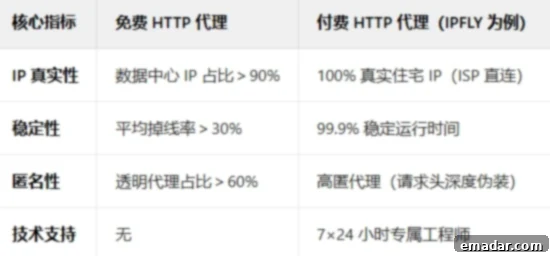
The distinction between free and paid proxies is akin to the difference between a toy and a professional tool. Paid proxies are built on robust infrastructure, feature dedicated resources, implement stringent security measures, and come with reliable customer support. They offer a diverse range of IP types—residential, data center, and mobile—each tailored for specific use cases, ensuring optimal performance and success rates for various online activities. This specialized approach means that paid proxies are engineered to circumvent advanced anti-bot measures, bypass geo-restrictions effectively, and maintain the highest levels of anonymity and data integrity.
When businesses or individuals invest in a reputable paid proxy service, they are not just buying IP addresses; they are investing in a comprehensive solution that includes high uptime guarantees, consistent bandwidth, a vast pool of clean and diverse IPs, and advanced features designed to maximize success rates for tasks like web scraping, brand protection, market research, and multi-account management. This superior offering mitigates the risks associated with IP blocking, data breaches, and performance bottlenecks, ultimately saving time, money, and preventing potential operational failures that are commonplace with free alternatives. The initial cost of paid proxies is a strategic investment that yields substantial returns in terms of efficiency, security, and peace of mind.
HTTP Proxy Solutions: Ushering in a “Compliance Revolution”
The landscape of internet usage is constantly evolving, with increasing demands for technical sophistication and, critically, stringent regulatory compliance. Modern HTTP proxy services are at the forefront of this evolution, offering advanced technical features coupled with an unwavering commitment to legal and ethical standards, thereby facilitating a true “compliance revolution.”
Cutting-Edge Technical Trends
Leading paid proxy providers are not just offering IPs; they are deploying advanced technologies to ensure optimal performance, security, and reliability:
- AI-Driven Intelligent Routing: Services like IPFLY leverage “dynamic link optimization algorithms.” These sophisticated AI systems automatically analyze network conditions in real-time to select the IP addresses with the lowest latency and highest success rates for each specific request. This intelligent routing can boost task efficiency by an average of 30%, ensuring that data is retrieved faster and with fewer interruptions. This contrasts sharply with free proxies where traffic routing is often haphazard and inefficient.
- Quantum Encryption Technology Integration: As cyber threats evolve, so too must cybersecurity measures. Forward-thinking paid proxy providers are progressively integrating NIST (National Institute of Standards and Technology) post-quantum cryptographic algorithms. This pioneering technology is designed to protect user data from being deciphered by future quantum computers, offering a level of security that is currently unparalleled and future-proof. This proactive approach to security is a hallmark of professional proxy services, providing an impenetrable shield for sensitive information.
- Advanced Geo-Targeting and IP Diversity: Modern paid proxies offer granular geo-targeting capabilities, allowing users to select IPs from specific countries, regions, or even cities. Combined with vast pools of diverse IP types (residential, mobile, datacenter), this ensures that users can precisely mimic local online behavior, effectively bypassing geo-restrictions and anti-bot systems.
Adherence to Stringent Compliance Requirements
Beyond technical prowess, the ability to meet global regulatory demands is a cornerstone of professional proxy services:
- Comprehensive IP Usage Log Auditing: International regulations, such as those in the European Union, increasingly require proxy service providers to offer IP usage log auditing functionalities. This allows businesses to demonstrate transparency and accountability regarding their data acquisition practices. IPFLY, for example, can furnish comprehensive audit reports, providing clients with the necessary documentation to satisfy regulatory bodies and pass compliance checks with confidence. This level of transparency is unthinkable with free proxy services.
- Compliance with Domestic Data Security Laws: National regulations, such as China’s “Data Security Law,” strictly prohibit the use of unrecorded or non-compliant proxy services. Paid proxy providers are committed to operating within these legal frameworks, ensuring that their services are fully compliant. Consequently, the compliance pass rate for paid proxies in regulatory audits is approximately 80% higher than for free proxies, significantly reducing legal risks for businesses. This proactive approach ensures businesses can operate globally without fear of regulatory repercussions.
- Ethical Data Sourcing: Reputable paid proxy providers ensure that their IP pools are sourced ethically and with the explicit consent of the IP owners, particularly for residential proxies. This prevents legal issues arising from illicitly obtained IP addresses and reinforces a commitment to fair and legal data practices.
Strategic Enterprise Procurement Recommendations
For businesses looking to leverage the power of proxies effectively and compliantly, a strategic approach to procurement is essential:
- Hybrid Deployment Strategy: The most effective strategy involves a blended approach. Utilize static residential proxies for core business operations that demand long-term stability and consistent IP identity, such as managing e-commerce stores, social media accounts, or financial transactions. Simultaneously, deploy dynamic residential proxies for high-frequency tasks like web scraping, market data collection, and automated verification, where IP rotation and a large pool of fresh IPs are critical to avoid detection and maintain efficiency.
- Prioritize Free Testing and Evaluation: Before committing to a full-scale deployment, always take advantage of free testing periods offered by reputable providers. IPFLY, for instance, provides a 72-hour trial across all proxy types (static residential, dynamic residential, and data center proxies). This allows businesses to conduct real-world tests on key performance indicators such as account survival rate, data collection success rate, and overall task efficiency, ensuring the chosen solution perfectly aligns with their operational requirements. This trial period is crucial for validating the claims of a provider and ensuring a perfect fit.
Immediately move beyond the “hidden costs” of free proxies and empower your business with professional-grade HTTP proxy solutions!
✅ Claim Your Free Full-Protocol Proxy Test:
New users are invited to experience IPFLY’s three leading HTTP proxy types without any commitment:
- Static Residential HTTP Proxies: Offering long-term stability and ideal for managing cross-border e-commerce stores and maintaining social media accounts with consistent digital identities. These proxies provide dedicated, fixed IPs from real ISPs.
- Dynamic Residential HTTP Proxies: With a vast pool of over 90 million authentic IP addresses, these are the ultimate choice for anti-scraping and data collection tasks, ensuring fresh IPs for every request.
- Data Center HTTP Proxies: Designed for high-speed concurrent requests, making them the efficiency king for automation tasks requiring rapid processing and large data volumes.
Our services span over 190 countries and regions, featuring genuine ISP information and financial-grade encryption. This comprehensive approach proactively mitigates protocol incompatibility issues and account suspension risks right from the source.
✅ Dedicated 1-on-1 Technical Configuration Guidance:
Our exclusive customer support team provides detailed protocol configuration tutorials, compatible with popular development languages like Python, Java, and Node.js. With 24/7 IP status monitoring, we ensure seamless integration of our HTTP proxies with your existing business systems, enabling rapid deployment with zero technical expertise required.
Click to visit our official website and apply for your HTTP proxy test. Unlock professional-grade network proxy services featuring full protocol compatibility, high anonymity, and ultra-low latency. Let advanced technology eliminate technical barriers and accelerate your business growth!