
In the expansive landscape of cross-border marketing and global business expansion, the stability of underlying infrastructure directly dictates operational costs and overall business success. Many professionals engaging in overseas e-commerce operations, social media community building, or market research frequently encounter limitations imposed on their accounts and activities. The core reason for these restrictions often stems from a failure to select the appropriate **Static IP** or **Dynamic IP** solution tailored to specific business logic. As we navigate the increasingly sophisticated risk control algorithms of 2026, a profound understanding of the distinctions between these two forms of “digital identity” has become an indispensable requirement for any enterprise venturing into international markets.
Beyond “Blind Selection”: Understanding the Foundation of Digital Identity
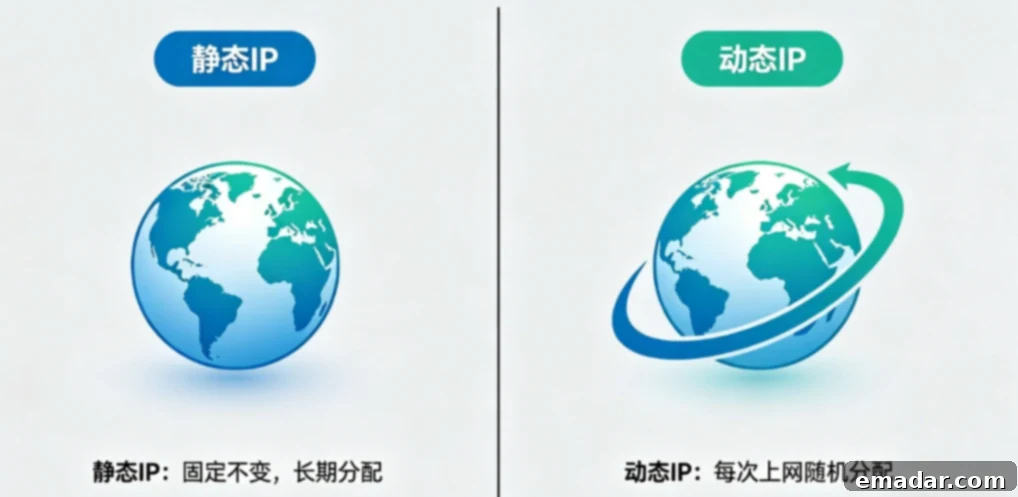
At its heart, choosing a proxy service is about selecting a specific “digital identity” that your online operations will assume. A **Static IP** is meticulously designed to construct a long-term, stable, and consistent virtual workspace, akin to a permanent digital office. Conversely, a **Dynamic IP** prioritizes providing extensive, high-frequency global research capabilities, allowing for a broad and ever-changing perspective on the internet.
Regrettably, many teams, in an attempt to minimize initial expenses, indiscriminately opt for inexpensive resources to manage critical accounts. This often leads to severe security challenges, such as frequent geographic location shifts, which trigger sophisticated platform risk control systems. The resultant account suspensions and bans invariably incur costs far exceeding any perceived savings from cheap proxies. This comprehensive guide will delve into the technical underpinnings, compliant business scenarios, and the evolving risk control trends of 2026, offering an in-depth framework for informed decision-making.
Unpacking the Core: The Technical Foundation of Static IP vs. Dynamic IP
To make an informed decision, it’s crucial to grasp the fundamental technical differences and operational implications of each IP type. These differences form the “technical moat” that either protects or exposes your online activities.
1. Static IP (Static IP): Your Permanent “Exclusive Digital Address”
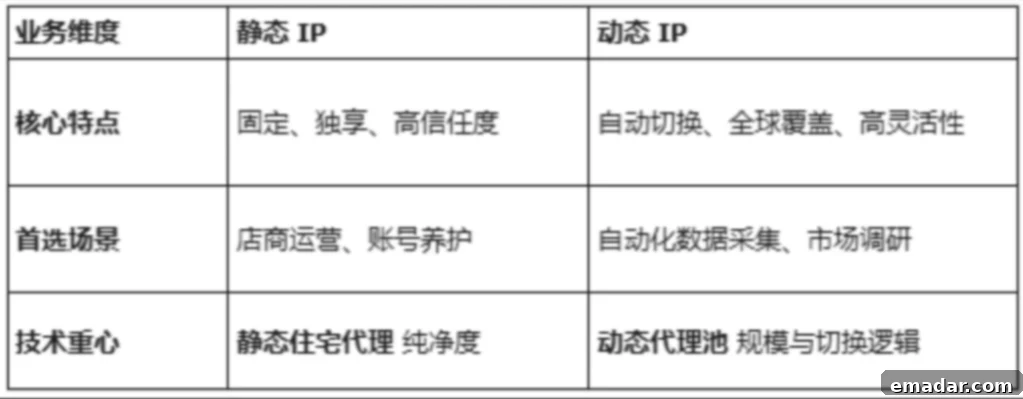
A **Static IP** refers to an internet protocol address that, once assigned to a user, remains constant and unchanged throughout the contract lease period. These IPs are typically directly hosted and allocated by top-tier Internet Service Providers (ISPs), endowing them with an exceptionally high degree of identity weight and authenticity. They represent a fixed point of origin in the digital realm, making them ideal for operations requiring unwavering consistency.
- Core Advantages: Possessing unparalleled environmental consistency, Static IPs are foundational for establishing “account trust scores” on platforms like Google Ads, Meta (Facebook/Instagram), or Amazon, which employ complex behavioral analysis models. A consistent IP address signifies legitimate, predictable user behavior, preventing flags for suspicious activity. This stability is critical for long-term account health, preventing geo-location discrepancies that often trigger security alerts. Furthermore, these IPs are often linked to dedicated servers or accounts, offering enhanced security and reduced chances of being blacklisted due to the actions of other users.
- Limitations: Their inherent fixed nature means they offer relatively lower flexibility compared to their dynamic counterparts. Moreover, these dedicated resources are scarcer, leading to a higher per-unit cost than IPs drawn from a shared dynamic pool. This makes them a premium solution, best reserved for high-value, long-term operational needs where stability trumps rapid geo-switching.
2. Dynamic IP (Dynamic/Rotating IP): The Flexible “Global Access Perspective”
A **Dynamic IP** refers to an address that automatically switches from a vast pool of available resources based on predefined logic, such as per request, after a set time interval, or upon failure. This constant rotation provides a shifting digital footprint, making it incredibly difficult for target websites to track or block sequential requests originating from a single source. These IPs are often sourced from real residential users or mobile networks, mimicking genuine user traffic at scale.
- Core Advantages: Dynamic IPs offer exceptional access coverage and versatility. Through highly efficient **IP switching logic**, they can simulate the online presence of tens of thousands of real home users across numerous global regions. This makes them an invaluable tool for conducting large-scale automated tasks that require accessing vast amounts of data without triggering anti-bot mechanisms. Use cases include web scraping for market research, ad verification, SEO monitoring, and competitor analysis. The ability to frequently change IP addresses allows users to bypass rate limits, captchas, and IP bans effectively, ensuring uninterrupted data flow.
- Limitations: The inherent stability of Dynamic IPs is contingent on the sophistication of the switching algorithm. They are generally not recommended for business operations that demand long-term, uninterrupted online presence or require a consistent geographic origin, such as managing payment systems, critical backend administration, or maintaining sensitive logged-in sessions. Frequent IP changes can disrupt session continuity and potentially raise security flags on platforms designed to detect unusual login patterns.
2026 Industry Insights: Why “Underlying Source” Trumps “Type”
In discussions surrounding **Static IP** and **Dynamic IP**, a critical dimension often overlooked by many users is the ASN (Autonomous System Number) attribute. The ASN reveals the true origin of an IP address, distinguishing between data centers and genuine residential or mobile networks. This distinction is paramount in the current and future risk control landscape.
1. Why Advertising Platforms Favor Static Residential Proxies?
In the advanced risk control environment of 2026, most major online platforms default to implementing stringent scrutiny policies against data center IPs. This is because real human users rarely access social media, browse shopping sites, or stream videos from an IP address associated with a commercial data center. Data center IPs are typically flagged due to their association with server farms, VPNs, and known bot networks.
- Native Residential Attributes: IPs derived from genuine home broadband connections are inherently trusted. In the eyes of platforms, these IPs are linked to real, natural persons engaging in authentic online activities. A **Static Residential Proxy** ensures that your digital presence consistently appears to originate from a legitimate home network, significantly reducing the likelihood of detection and account flagging. This authenticity is a powerful shield against sophisticated fraud detection systems.
- IPFLY’s Technical Endorsement: Through strategic direct partnerships with global ISPs, IPFLY meticulously ensures that every single **Static Residential Proxy** node possesses pure, native residential attributes. This infrastructure-level trust endorsement is the cornerstone for achieving high success rates in critical business operations, providing an unparalleled layer of legitimacy and reliability that generic data center proxies simply cannot match.
2. The Scale and Cleansing Mechanisms of Dynamic Proxy Pools
The true value of a high-quality **Dynamic Proxy Pool** lies not merely in its sheer quantity of IPs, but critically, in its “purity.” A polluted pool, despite its size, can quickly lead to bans and wasted efforts. IPFLY addresses this by implementing a sophisticated, real-time cleansing mechanism. This system continuously identifies and removes “pollutant sources”—IPs with low trust scores due to previous misuse, blacklisting, or suspicious activity. By doing so, we ensure that every resource you receive from the pool is in a “high-trust” state. This commitment to purity guarantees that when conducting global market research or data collection, you obtain the most accurate and unbiased feedback, free from the distortions caused by compromised or flagged IP addresses.
Practical Scenarios: Optimal Configuration Standards for Compliant Business Operations
Choosing the right IP strategy is not a one-size-fits-all solution; it depends entirely on the specific needs and risk profile of your business operations. Here, we outline optimal configurations for common cross-border business scenarios.
1. Cross-border E-commerce (Amazon/eBay/Etsy) Store Management
Optimal Choice: Static IP (especially Static Residential Proxy)
- Justification: E-commerce platforms maintain an exceptionally rigorous detection system for “account correlation” and suspicious activity. Even minor IP fluctuations, such as an IP changing cities within a short timeframe, will immediately trigger platform security alerts. These systems are designed to detect attempts to manage multiple accounts from a single underlying entity or to circumvent regional restrictions. Maintaining a consistent digital identity is paramount for long-term store health and avoiding “stealth bans” where accounts gradually lose visibility without explicit notification.
- Operational Standard Procedure (SOP): Established and successful teams in the industry consistently adopt a compliant strategy of “one store, one account, one **Static IP**.” This ensures 100% physical and digital isolation of storage, login credentials, and operational environments, effectively preventing any unintended linking of accounts by the platform’s advanced fraud detection algorithms. A dedicated, consistent Static IP, particularly a residential one, signals legitimate, stable business operations.
2. Social Media Matrix and Brand Communication (TikTok/Instagram)
Hybrid Strategy: Static IP for Account Stability, Dynamic Proxy Pool for Outreach and Research
- Strategy Analysis: For primary brand accounts, critical influencer profiles, or main advertising accounts, it is absolutely essential to bind them to a dedicated **Static IP**. This ensures the accumulation of “long-term geographic weight” for the account, which positively impacts reach, engagement, and algorithmic favoritism within specific regions. A consistent IP contributes to the account’s reputation and authenticity. However, when conducting extensive global trend research, competitive analysis, or large-scale content distribution tests across diverse regions, leveraging a **Dynamic Proxy Pool** with its rapid IP switching capabilities becomes the most efficient and scalable automated research method. This allows for localized content testing, audience segmentation analysis, and understanding regional engagement without jeopardizing the stability of core accounts.
3. Automated Data Collection and Global Market Research
Optimal Choice: Dynamic IP (utilizing highly customizable IP switching logic)
- Case Study: Consider a global travel aggregation platform that needs to collect real-time flight and accommodation pricing information from numerous sources worldwide. Direct access would quickly lead to IP blocks and rate limits. By integrating with the IPFLY API and configuring a sophisticated **IP switching logic**—which can be customized based on parameters like request frequency, successful response codes, or time intervals—the platform can seamlessly cycle through a vast pool of dynamic IPs. This approach not only effectively circumvents frequency restrictions and anti-bot measures but also drastically enhances the efficiency and completeness of data acquisition. The ability to simulate thousands of unique users from various locations ensures comprehensive and accurate market data.
Strategic Play: A Second Assessment from Cost and Risk Control Dimensions
Beyond technical suitability, a pragmatic evaluation of cost-efficiency and risk mitigation is crucial for any sustainable proxy strategy.
1. Cost Optimization Logic: The Combination Punch of Static IP and Dynamic IP
An intelligent proxy strategy leverages the strengths of both Static and Dynamic IPs to optimize costs without compromising security or efficiency.
- Static IP: Typically operates on a “fixed period/exclusive use” billing model. The primary advantage here is predictable, constant costs, making it an ideal candidate for long-term, foundational enterprise investments that protect core assets. You know exactly what you’re paying for dedicated resources.
- Dynamic IP: Utilizes a “pay-as-you-go” or “usage-based” billing model. Its key benefit is that costs are directly proportional to usage, preventing any expenditure on idle or unused resources. This flexibility makes it highly cost-effective for burstable, intermittent, or large-scale tasks.
- Expert Recommendation: Industry experts strongly advise allocating approximately 60% of your proxy budget towards **Static IP** solutions to safeguard core business assets and critical accounts. The remaining 40% should be dedicated to purchasing **Dynamic Proxy Pool** services for scalable research and fluctuating demands. This “static-dynamic combination” approach is proven to reduce overall operational expenses by approximately 25%, while maximizing both security and adaptability.
2. 2026 Security Pitfall Guide: Identifying Counterfeit Static Residential Proxies
A significant risk in the proxy market is the proliferation of misleadingly advertised “residential” IPs. Many budget-friendly providers claim to offer residential proxies, but in reality, these are often data center addresses merely masquerading as residential through routing tricks. The truth can be unveiled by checking their ASN information, which will reveal their true data center origin. IPFLY’s **Static Residential Proxy** resources, however, all support real-time verification. This ensures that every resource acquired by our users is genuinely “native and pure” residential, providing an unmatched level of trust and authenticity that protects your operations from sophisticated platform detection mechanisms and potential blacklisting.
Advanced Guidance: SOP for Practical Configuration Techniques
Effective proxy management goes beyond simple selection; it involves integrating proxies with other tools and practices to maximize security and efficiency.
1. Static IP + Fingerprint Browser for Enhanced Identity Protection
When utilizing a **Static IP**, it is absolutely critical to pair it with an anti-detect or fingerprint browser for comprehensive hardware environment simulation. A fingerprint browser manipulates various browser parameters (such as user agent, canvas fingerprint, WebGL, WebRTC, screen resolution, operating system, and installed plugins) to create a unique and consistent digital persona. This ensures that the browser’s timezone, language settings, and other identifiable characteristics are perfectly aligned with the geographic information of the chosen **Static IP**. This synergy creates a highly convincing and consistent digital identity, significantly reducing the chances of detection by advanced anti-fraud systems that analyze discrepancies between IP location and browser fingerprints.
2. Dynamic Proxy Pool API Automation and IP Switching Logic
For technically proficient teams, integrating the Dynamic Proxy Pool via an API is the most efficient and powerful approach. This allows for granular control and automation. In your code, you should implement robust `Retry` mechanisms that intelligently handle various HTTP status codes (e.g., retrying on 429 Too Many Requests, 503 Service Unavailable). Furthermore, precise **IP switching logic** should be designed. For instance, implementing “sticky sessions” ensures that the same IP address is maintained for the entirety of a single, multi-step task (such as completing an e-commerce checkout process or filling out a form). This maintains session continuity and prevents disruptions that could lead to task failure, while still benefiting from the broader IP rotation for new tasks or after a set duration.
Conclusion: Your Digital Moat in a Globalized World
In 2026, network proxies are no longer merely simple “connectors” to the internet; they have evolved into an indispensable digital moat, protecting the integrity and operational continuity of cross-border enterprises. The strategic choice of your proxy provider directly impacts your ability to scale, your security posture, and your overall success in the competitive global marketplace. By selecting IPFLY, you are not just acquiring IP addresses; you are choosing a robust, compliant, and secure infrastructure solution that spans over 190 countries worldwide, comprised of 100% real ISP nodes. This commitment to authenticity and security ensures that your global operations are built on a foundation of trust and reliability, empowering your business to navigate the complexities of international digital environments with confidence.