
In the vast and interconnected world of the internet, managing traffic, ensuring robust privacy, and efficiently scaling data collection tasks are paramount for businesses of all sizes. At the core of these operations lie proxies – essential intermediary servers that facilitate communication between clients and destinations. Among the diverse range of proxy configurations, two stand out as fundamental pillars: reverse proxies and forward proxies. While both play crucial roles in network architecture, they serve distinct purposes, operating from opposite sides of the communication flow. The complexity further deepens when we introduce the concept of rotating proxies, a dynamic solution designed for enhanced anonymity and resilience. This innovation leads to the intriguing concept of reverse rotating proxies, prompting many enterprises to ponder: Which proxy setup is truly optimal for my specific business requirements?
This comprehensive guide will meticulously unravel the differences between forward and reverse proxies, delve into the transformative power of rotating proxy technology, and ultimately provide clarity on how to select the ideal proxy solution tailored to various business objectives, ensuring both efficiency and security.
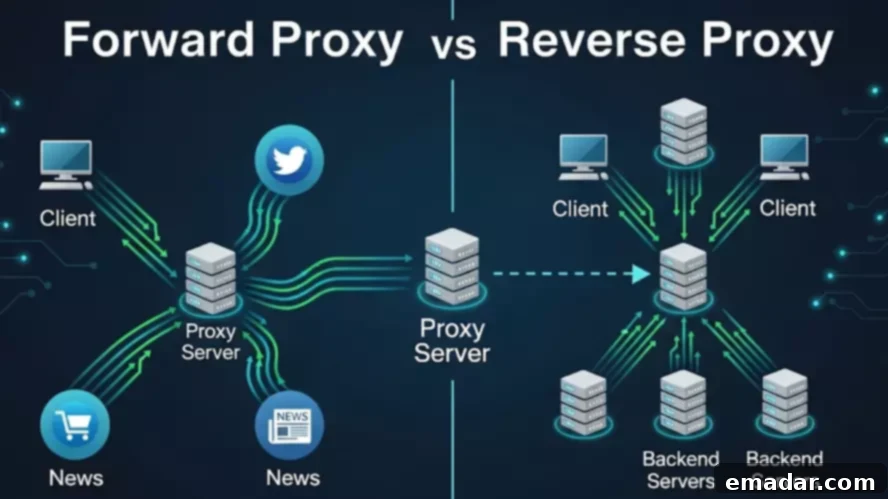
What Is a Forward Proxy?
A forward proxy is arguably the most recognized and classic type of proxy server, commonly envisioned when discussing proxy technology. It acts as an intermediary layer positioned between a user (the client) and the vast expanse of the internet. When a client initiates a request to access a website or online resource, instead of connecting directly to the target server, the request is first routed through the forward proxy. The proxy then forwards this request to the internet on behalf of the client, effectively masking the client’s true IP address. This design inherently offers a layer of anonymity and control for the client.
Forward proxies are invaluable tools, frequently employed for a variety of critical functions:
- Enhanced Anonymity & Privacy: By substituting the client’s real IP address with its own, a forward proxy makes it incredibly difficult for target servers to identify the original requester. This is crucial for privacy-conscious users and businesses conducting sensitive online operations.
- Access Control & Filtering: Organizations utilize forward proxies to enforce internet usage policies. They can restrict employees or users from accessing specific websites, categories of content, or even block malicious domains, thereby boosting network security and productivity.
- Large-Scale Data Scraping: For businesses that rely on collecting vast amounts of public web data, forward proxies are indispensable. By allowing the rotation of IP addresses, they help bypass IP-based rate limits and blocks, ensuring continuous and uninterrupted data collection processes.
- Bypassing Geo-Restrictions: Forward proxies enable users to access content that is geographically restricted. By connecting through a proxy server located in a different region, users can appear to be browsing from that location, unlocking access to region-specific content, services, or market data.
- Caching for Faster Access: Many forward proxies can cache frequently accessed web content. This means that if multiple users request the same resource, the proxy can serve it directly from its cache, significantly reducing bandwidth usage and improving loading times.
For example, when businesses deploy IPFLY’s high-quality residential or datacenter proxies, these proxies primarily function as forward proxies. This empowers companies to conduct essential activities like in-depth market research, thorough ad verification, or comprehensive e-commerce monitoring without the constant threat of being blocked, flagged, or rate-limited by target websites, ensuring smooth and efficient data acquisition.
What Is a Reverse Proxy?
In stark contrast to a forward proxy, a reverse proxy operates in the inverse direction, serving as a critical gateway situated in front of one or more web servers. Rather than protecting the client, its primary function is to protect and manage traffic for the server. When users or clients send requests to a website or application, these requests do not directly reach the backend servers. Instead, they are first intercepted by the reverse proxy. The reverse proxy then intelligently decides how to route these incoming requests to the appropriate backend server, ensuring optimal performance, security, and scalability.
Reverse proxies are foundational components in modern web infrastructure and are widely deployed for several high-level functions:
- Load Balancing: This is one of the most significant benefits. A reverse proxy can distribute incoming network traffic across multiple backend servers. This prevents any single server from becoming overloaded, improving application responsiveness, reliability, and ensuring high availability, even under heavy traffic loads.
- Enhanced Security: By acting as a shield for backend servers, a reverse proxy can filter out malicious traffic, block DDoS attacks, and conceal the identities and configurations of the origin servers. It acts as a single point of entry, simplifying security management and making it harder for attackers to directly target valuable infrastructure.
- Web Acceleration and Caching: Similar to forward proxies, reverse proxies can cache static content (like images, CSS, JavaScript files). When a client requests this content, the reverse proxy can serve it directly from its cache without forwarding the request to the backend server, drastically reducing server load and accelerating content delivery.
- SSL/TLS Termination: Reverse proxies can handle the computationally intensive process of decrypting incoming SSL/TLS encrypted requests and re-encrypting responses. This offloads the encryption burden from the backend servers, allowing them to focus solely on processing application logic, thereby improving their performance.
- Application Delivery & Optimization: They can compress responses, serve static content more efficiently, and manage HTTP/2 or HTTP/3 connections, all contributing to a faster, more reliable, and optimized user experience. They also provide a centralized point for managing API gateways and microservices.
Essentially, while a forward proxy acts as a protective mask for clients, enabling them to browse the internet anonymously and securely, a reverse proxy functions as a robust protective shield for servers, guarding them against direct threats and optimizing their performance and availability. This fundamental distinction defines their respective applications in the digital landscape.
Introducing Rotating Proxies: The Dynamic Edge
To further enhance the capabilities of proxy technology, we introduce another crucial layer: rotating proxies. These are sophisticated proxy servers that automatically switch their IP addresses at predefined intervals or after every single request. This dynamic assignment of IP addresses provides an unparalleled level of anonymity and resilience, making them indispensable for various demanding online operations.
Businesses increasingly leverage rotating proxies when their operations demand:
- Large-Scale Web Scraping Without IP Bans: When collecting data from numerous websites, static IPs are quickly identified and blocked. Rotating proxies provide a fresh IP for each request or after a short period, mimicking organic user behavior and effectively circumventing rate limits and IP bans, ensuring uninterrupted data flow for market intelligence, price monitoring, or content aggregation.
- Continuous SEO Monitoring Across Regions: For digital marketing agencies and SEO professionals, monitoring search engine results pages (SERPs) from different geographic locations is vital for understanding rankings and competitive landscapes. Rotating proxies allow businesses to simulate requests from various countries and cities, providing accurate, unbiased local search results for comprehensive analysis.
- Secure Access to Social Media Platforms with Multiple Accounts: Managing multiple social media accounts for marketing, branding, or community management purposes often triggers security measures if all accounts log in from the same IP. Rotating proxies assign a unique IP to each account login or subsequent activity, significantly reducing the risk of account suspension or flagging, thus enabling safe and scalable social media operations.
- Ad Verification and Brand Protection: Companies need to verify that their advertisements are displayed correctly and are not associated with fraudulent activities. Rotating proxies enable ad verification platforms to check ad placements from diverse geographical locations and IP addresses, ensuring integrity and protecting brand reputation.
At IPFLY, we recognize the critical need for dynamic IP solutions. We offer both advanced dynamic residential rotating proxies and powerful datacenter rotating proxies. These services empower businesses with access to a massive pool of continually refreshed IPs from a vast global network. This ensures that every outgoing request appears organic, originating from a distinct and legitimate source, making them significantly harder for target websites to detect, block, or fingerprint, thereby guaranteeing consistent and reliable online performance.
Where Do Reverse Rotating Proxies Fit In?
The concept of reverse rotating proxies represents an advanced fusion of traditional reverse proxy functionality with the dynamic nature of IP rotation. In this innovative setup, the reverse proxy, which sits in front of the backend servers, not only handles incoming user traffic by routing it intelligently but also actively cycles through multiple IP addresses or exit nodes for its own outgoing connections to the internet or other services. This creates a highly secure and resilient infrastructure layer.
This sophisticated configuration becomes particularly relevant and beneficial when:
- A Business Aims to Fortify Backend Servers Against IP-Based Attacks: Traditional reverse proxies protect servers by obscuring their direct IP. Reverse rotating proxies take this a step further by ensuring that the public-facing IP address of the entry point to the server infrastructure frequently changes. This makes it significantly harder for attackers to map the server’s network topology, launch targeted DDoS attacks, or exploit vulnerabilities associated with a persistent IP.
- Enterprises Manage High Volumes of API Traffic Requiring Distributed Exit Nodes: SaaS providers, large e-commerce platforms, or applications with extensive third-party API integrations often send out millions of requests. A reverse rotating proxy can ensure these outbound API requests are balanced across multiple exit IP addresses, preventing rate limiting from API providers, enhancing reliability, and ensuring continuous service delivery.
- Companies Require Both Robust Server Protection and Enhanced Anonymity in One Solution: For operations where the server itself needs to make outbound requests (e.g., fetching data from external services, calling webhooks, or interacting with payment gateways) while remaining anonymous or distributed, a reverse rotating proxy provides a unified solution. It shields incoming traffic and anonymizes outgoing server-initiated requests simultaneously.
- Global Scaling Demands Dynamic IP Presence: For applications serving a global user base or interacting with global services, a reverse rotating proxy can route server-initiated requests through IP addresses geographically closer to the target service or user, reducing latency and improving performance, while also ensuring localized presence for various operations.
Consider an advanced e-commerce platform that processes thousands of transactions per second and integrates with numerous payment gateways and third-party logistics providers. Implementing reverse rotating proxies would allow it to manage high volumes of incoming customer requests efficiently while simultaneously using rotating IPs for its outbound requests to various external services. This setup prevents attackers from gaining a stable IP footprint of its server infrastructure, enhances the security of outbound API calls, and ensures seamless operation even if certain external services rate-limit based on IP addresses.
Reverse Proxy vs Forward Proxy for Rotating Proxies: A Deeper Dive
Understanding the fundamental distinction between forward and reverse proxies is paramount, especially when integrating the dynamic capabilities of IP rotation. The choice between a forward rotating proxy and a reverse rotating proxy hinges entirely on whether your primary objective is to protect and anonymize the client initiating the request or to protect and optimize the server receiving the request.
| Aspect | Forward Rotating Proxies | Reverse Rotating Proxies |
| Position in Network | Situated between the client (user) and the internet (target servers). It serves the client’s interests. | Located between the internet (incoming client requests) and the backend server(s). It serves the server’s interests. |
| Primary Direction of Traffic | Manages outbound traffic originating from the client to various internet destinations. | Manages inbound traffic from the internet, distributing it to one or more backend servers. Can also manage server-initiated outbound requests with rotating IPs. |
| Main Use Case | Enhancing client anonymity, facilitating large-scale web scraping, implementing client-side access control, and bypassing geo-restrictions for users. | Protecting backend servers, distributing server load efficiently, improving server-side security, caching content, and optimizing application delivery from the server perspective. |
| Rotation Benefit | Dynamic IP switching helps clients avoid IP bans, circumvent rate limits, maintain anonymity, and appear as diverse, organic users to target websites. Essential for data collection at scale. | Rotating the public-facing IP of the proxy prevents static backend exposure, makes infrastructure mapping difficult for attackers, and allows for distributed outbound server-initiated requests, enhancing security and resilience. |
| Best For | Market research, competitive intelligence, large-scale SEO monitoring, ad verification, social media account management, consumer data aggregation, and general anonymous browsing. | Enterprise applications, SaaS platforms, high-traffic APIs, gaming servers, content delivery networks (CDNs), financial services, and any infrastructure requiring robust server protection and dynamic traffic distribution. |
| Who Benefits Most | Individuals, researchers, marketing agencies, data analysts, and companies focused on gathering external data or operating multiple client-side accounts. | System administrators, DevOps engineers, security teams, and companies focused on scaling server infrastructure, ensuring high availability, and defending against cyber threats. |
In essence, the choice boils down to your operational focal point:
- If your primary goal is to collect data from the web, manage numerous online accounts, perform market research, or simply maintain anonymity as a client, then forward rotating proxies are almost always the optimal choice. They empower the client’s outbound activities.
- Conversely, if your core responsibility involves managing incoming web traffic, scaling backend infrastructure to handle high loads, enhancing server-side security, or shielding your servers from direct exposure, then reverse rotating proxies offer the superior solution. They fortify the server’s inbound (and potentially distributed outbound) operations.
Why Businesses Are Increasingly Considering Reverse Rotating Proxies
The burgeoning demand for reverse rotating proxies reflects a significant shift in the complexity of modern business infrastructure. As digital environments become more intricate and threat landscapes evolve, businesses are seeking more dynamic and resilient solutions to protect their critical assets. Common and compelling reasons for this growing interest include:
- Advanced Cybersecurity Defense: Traditional server security measures are often challenged by sophisticated attackers who meticulously map server IPs for targeted assaults like DDoS (Distributed Denial of Service) attacks, brute-force attempts, or vulnerability exploitation. By constantly rotating the public-facing IP address of the reverse proxy, it becomes exponentially harder for malicious actors to establish a stable target. This dynamic defense significantly frustrates reconnaissance efforts and enhances overall infrastructure resilience against persistent threats.
- Robust API Protection and Management: SaaS providers, major e-commerce platforms, and cloud-native applications often handle millions of API requests daily, both incoming and outgoing. A reverse rotating proxy helps in distributing the load of incoming API calls, preventing any single server from becoming a bottleneck. For outbound API calls initiated by the server itself, rotation helps to circumvent external API rate limits, reduces the likelihood of an IP being blacklisted, and ensures continuity of service by presenting diverse IP identities to third-party services. This is crucial for maintaining seamless integration and preventing service interruptions.
- Facilitating Global Scaling and Localized Presence: Businesses serving a worldwide user base or interacting with globally distributed services face challenges with latency and regional access. Reverse rotating proxies can be strategically deployed in various geographic regions. This allows for intelligent routing of incoming traffic to the nearest server and, more importantly, enables the backend servers to make outbound requests appearing from localized IPs. This localized IP presence can significantly reduce latency for users, ensure compliance with regional data regulations, and optimize interactions with geographically specific online services.
- Enhanced Resilience and Uninterrupted Continuity: In an environment where even temporary outages can lead to significant financial losses and reputational damage, resilience is key. If a particular IP address or exit node used by a reverse proxy faces temporary blockage, rate limiting, or becomes compromised, a reverse rotating proxy seamlessly switches to a fresh, operational IP. This automatic failover mechanism ensures continuous operation, maintains high availability, and significantly reduces the risk of service interruptions, providing an invaluable layer of business continuity.
- A/B Testing and Intelligent Traffic Routing for Backend Services: Beyond security, reverse rotating proxies can also be used for advanced operational strategies. They can intelligently route a small percentage of traffic to new backend versions for A/B testing purposes, without exposing the internal IP addresses. This allows for controlled rollout of new features and services, monitoring their performance in real-world scenarios before full deployment.
How IPFLY Approaches These Evolving Needs

At IPFLY, we pride ourselves on being at the forefront of proxy technology, offering tailored solutions that address the diverse and evolving needs of modern businesses. While our core strength lies in providing robust and high-performance forward rotating proxies for residential, ISP, and datacenter use cases – perfectly suited for large-scale data collection, SEO monitoring, and brand protection – our expertise extends significantly further. We actively collaborate with a growing roster of enterprise clients to meticulously design and implement highly customized reverse rotating proxy setups.
What truly distinguishes IPFLY in the competitive proxy landscape is the unparalleled combination of several critical factors:
- An Enormous 90M+ IP Pool: We offer access to an expansive network of over 90 million unique IP addresses, spanning across 190+ countries worldwide. This immense pool guarantees an inexhaustible supply of fresh, diverse IPs, crucial for maintaining anonymity, avoiding detection, and ensuring seamless operations at any scale.
- Comprehensive Residential, ISP, and Datacenter Coverage: Our diverse proxy types – residential, ISP, and datacenter – provide unparalleled flexibility. Whether you require the authenticity of real user IPs (residential), the stability of static residential IPs (ISP), or the raw speed and power of datacenter IPs, IPFLY offers the precise solution to match your specific operational requirements and budget.
- Advanced Smart Traffic Distribution Systems: Our sophisticated infrastructure is engineered with intelligent traffic distribution systems that proficiently manage IP rotation, load balancing, and connection handling. This ensures optimal performance, minimizes latency, maximizes uptime, and provides seamless IP switching, making every request appear legitimate and untraceable.
- Customizable Solutions for Unique Challenges: We understand that one size does not fit all. For complex enterprise needs, particularly in the realm of reverse rotating proxies, our team of experts works closely with clients to architect bespoke solutions that integrate perfectly with existing infrastructure and meet unique security, performance, and compliance demands.
By blending these cutting-edge technologies and offering unparalleled customization, IPFLY empowers businesses to strategically choose the proxy approach that perfectly aligns with their operational goals. Whether the objective is to meticulously protect and optimize backend servers with state-of-the-art reverse rotating proxies or to confidently scale client-side data collection and account management operations with resilient forward rotating proxies, IPFLY provides the tools and expertise to succeed in today’s dynamic digital landscape.
Conclusion: Strategic Proxy Selection for Digital Success

The world of proxy technology is multifaceted, with both forward proxies and reverse proxies standing as indispensable components of modern internet infrastructure. While they both act as intermediaries, their fundamental roles are distinctly different: one safeguards the client’s identity and activity, and the other shields and optimizes the server’s performance and security. When these foundational concepts are enhanced and combined with the dynamic capabilities of IP rotation, they unlock a formidable array of powerful use cases – ranging from highly anonymous and scalable web scraping operations to robust, enterprise-level server protection and API management.
For any business that relies heavily on large-scale data operations, meticulous market research, secure online interactions, or the maintenance of highly available and secure infrastructure, a clear understanding of the nuanced distinctions between forward rotating proxies and reverse rotating proxies is not merely beneficial—it is absolutely crucial for strategic decision-making. The optimal choice will always hinge on your specific operational focus: are you primarily looking to protect, anonymize, or scale client-side activities, or is your objective to secure, load balance, and optimize your server infrastructure from incoming traffic and outbound server-initiated requests?
Making an informed choice will directly impact your operational efficiency, security posture, and ability to scale. Leverage the right proxy solution to drive your digital strategy forward.
To explore the full spectrum of proxy solutions designed for performance and reliability, visit ipfly.net today. Stay ahead of evolving proxy trends and enhance your online operations by joining IPFLY’s Telegram channel, where you’ll never miss important updates and insights.