
In the rapidly evolving landscape of global commerce and digital operations, the quality of your online presence, specifically your IP address, has become an undeniable cornerstone of business stability and success. A recent analysis, highlighted in the 2026 Global Cross-Border Cybersecurity Report, reveals a stark reality: a staggering 72% of enterprises engaged in international business rank IP quality among their top three factors influencing operational stability. Furthermore, 68% of these businesses have endured direct financial losses due to the use of non-residential IPs, with the average incident costing over $80,000 (equivalent to 600,000+ CNY).
This escalating trend underscores a critical shift in how overseas platforms manage risk. We are now firmly entrenched in an era of “biological-level identification,” where sophisticated risk control systems can meticulously analyze digital footprints to an unprecedented degree. In this environment, traditional data center IPs and shared IPs have become largely ineffective, if not outright detrimental. They are easily flagged, leading to disruptions, bans, and significant operational hurdles. Consequently, residential proxy IPs, by virtue of their authentic user identity attributes, have emerged as the indispensable foundational network infrastructure for virtually all cross-border business endeavors.
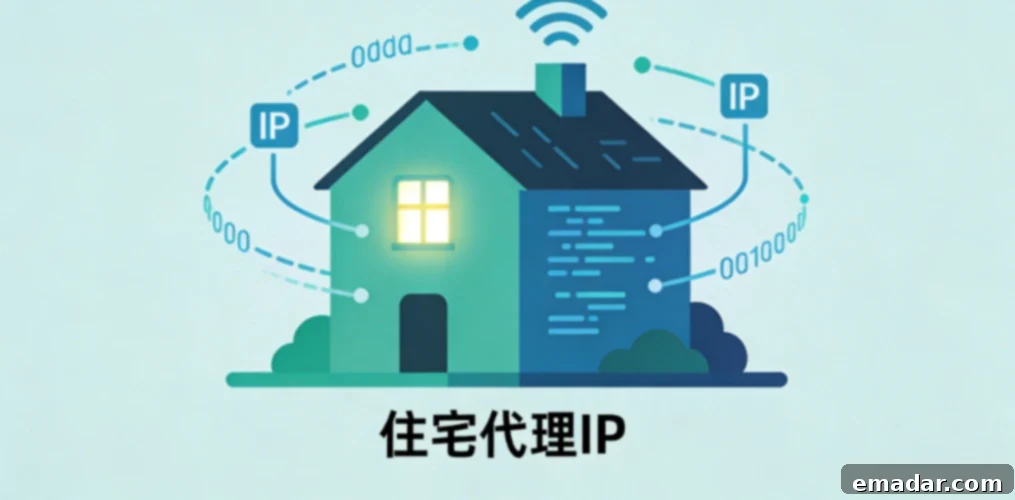
Understanding Residential Proxy IPs: Your Authentic Digital Identity Gateway
At its core, a residential proxy IP is much more than just an IP address; it’s a digital credential that carries the authenticity of a real user. These IPs are genuinely allocated by Internet Service Providers (ISPs) to individual residential homes across the globe. This fundamental characteristic ensures that their network routing, WHOIS information, and device fingerprints are indistinguishable from those of a regular civilian internet user. This is the paramount difference that sets them apart from all other proxy types and underpins their efficacy in navigating complex digital environments.
To fully appreciate the unique value proposition of residential proxies, it’s crucial to understand how they contrast with their counterparts:
- Data Center IPs: These IPs originate from commercial server farms and data centers. They are typically clustered within highly concentrated IP ranges and subnetworks. Modern platform algorithms, equipped with advanced detection capabilities, can easily identify these IPs by their Autonomous System Number (ASN) and geo-location inconsistencies, often flagging them as proxies with a single automated check. The result is an alarming ban rate exceeding 90%, rendering them largely unsuitable for sensitive or long-term operations.
- Shared IPs: As the name suggests, shared IPs are utilized simultaneously by dozens, sometimes hundreds, of different users. This widespread usage often leads to a complex and often checkered history of abuse, including spamming, credential stuffing, and other malicious activities. Consequently, platforms assign extremely low trust scores to shared IPs, making them highly susceptible to blacklisting, rate limiting, and immediate detection by risk control systems.
- Residential Proxy IPs: Unlike their counterparts, each residential proxy IP is genuinely associated with a distinct residential address. This intrinsic link means they possess complete and consistent user behavior profiles, making it virtually impossible for platforms to differentiate them from ordinary, legitimate users. This authenticity translates into an exceptionally low average ban rate, typically less than 5%, offering unparalleled reliability and stealth.
This inherent attribute of a “real identity” empowers residential proxy IPs to be the only network resource capable of effectively bypassing the multi-layered and increasingly sophisticated risk control frameworks that define modern digital platforms. They are not merely tools for anonymity; they are gateways to legitimate, unhindered access in a world of stringent digital gatekeepers.
The Irreplaceability of Residential Proxy IPs Across Four Critical Scenarios
The strategic value of residential proxy IPs extends across various pivotal sectors, making them an indispensable asset for any enterprise operating on a global scale. Their ability to simulate genuine user presence unlocks opportunities and mitigates risks in ways no other proxy solution can.
Cross-Border E-commerce: Fortifying Store Security and Preventing Account Bans
In the hyper-competitive world of cross-border e-commerce, platforms like Amazon, Walmart, and eBay have implemented advanced risk control systems that employ a “four-dimensional binding” approach. This means they meticulously link and analyze IP addresses, device fingerprints, user behavior patterns, and payment information to create a comprehensive profile of each seller. Any inconsistency across these dimensions can trigger immediate alerts.
Logging into seller accounts from non-residential IPs often directly flags them for secondary verification (two-step authentication or manual review), causing significant delays and operational friction. More critically, using shared IPs across multiple accounts can lead to mass account association bans, where an entire cluster of accounts is shut down due to perceived linking, resulting in massive financial losses and reputational damage. Industry statistics confirm the profound impact of residential proxies: stores utilizing residential proxy IPs experience a 93% lower risk trigger rate compared to those using data center IPs, and their average store lifecycle is extended by more than five times.
Premium residential proxy IPs enable a crucial strategy known as “one store, one IP” independent deployment. This ensures that each e-commerce store is assigned a unique, dedicated static residential IP. This dedicated IP maintains consistent login environments over extended periods, effectively eliminating any risk of IP-based account association and safeguarding against bans. For example, a leading Amazon seller reported a dramatic reduction in monthly account bans, plummeting from 35 to just 2, after switching to high-quality residential proxy IPs, ultimately saving them over $1.6 million (12 million CNY) annually in recovered losses.
Social Media Marketing: Unlocking Local Engagement and Expanding Reach
For social media marketing professionals, platforms such as TikTok, Instagram, and Facebook operate with sophisticated traffic recommendation algorithms that are heavily tied to the geographical region of the IP address. Content posted from a non-local residential IP is often unable to penetrate the target region’s local traffic pool. This leads to issues such as content suppression, zero views, and a complete lack of recommendations, rendering marketing efforts largely ineffective and wasting valuable resources.
The only way to achieve parity with local users and gain full access to region-specific content algorithms is by utilizing native residential IPs from the target geographical area. These IPs grant content the same local traffic weight and visibility, ensuring it reaches the intended audience. An overseas marketing agency, after integrating residential proxy IPs into their TikTok account management strategy, witnessed an impressive 12-fold increase in average content views. Furthermore, their account ramp-up cycle was significantly shortened from 45 days to just 7 days, leading to a remarkable 65% improvement in client conversion rates.
Ad Verification and Fraud Prevention: Safeguarding Your Advertising Budget
The global advertising industry grapples with an immense challenge: an estimated $80 billion is lost annually to various forms of ad fraud. A significant portion of this waste stems from the inability of businesses to accurately verify ad placements and impressions. Non-residential IPs often fail to render authentic ad content, leading to a distorted view of campaign performance. This results in enterprises inadvertently wasting substantial portions of their advertising budget on fraudulent traffic, fake clicks, and misrepresented impressions.
By deploying residential proxy IPs from the target region, businesses can simulate genuine user visits and access 100% accurate ad display data. This critical capability allows them to effectively identify and counter fraudulent activities such as bot traffic, click farms, and impression fraud. With real-time, authentic verification, companies can ensure their ads are seen by real people in the intended locations, maximizing the impact of every dollar spent. Data indicates that companies employing residential proxies for ad verification can, on average, save 28% of their advertising budget and achieve an increase in Ad ROI exceeding 32%.
Data Collection and Market Research: The Cornerstone of Accurate Insights
For businesses that rely on robust data collection and market research, the accuracy and integrity of gathered information are paramount. Using non-local or flagged IPs for data scraping frequently results in severely distorted data. For instance, e-commerce platforms may display non-local pricing, search engines might return generic rather than geographically relevant results, and competitor data can deviate by over 40% from actual market conditions. Decisions made based on such flawed and inaccurate data can have devastating consequences for an enterprise.
Residential proxy IPs offer unparalleled precision, supporting city-level matching across more than 190 countries and regions worldwide. This allows businesses to collect data through local IPs, ensuring that the information gathered perfectly mirrors what a local user would see. This meticulous approach guarantees data authenticity at its very root, providing a true reflection of the market. A market research firm, after integrating residential proxy IPs into their operations, reported an astounding improvement in data accuracy, soaring from 58% to 99.2%. This enhanced reliability also boosted their client renewal rate from 62% to an impressive 95%.
Three Essential Pillars of a High-Quality Residential Proxy IP Service
Not all residential proxy services are created equal. To ensure optimal performance, reliability, and security for your cross-border operations, it’s vital to evaluate providers based on three core standards:
- Nativety (Authenticity and Origin): A truly high-quality residential proxy IP must be a native IP, meaning it is directly supplied by a local Internet Service Provider (ISP) and possesses all the complete attributes of a genuine residential network connection. This includes correct geolocation, ASN registration, and network routing. Its authenticity should be verifiable through public WHOIS lookup services, confirming its legitimate origin and residential classification. Non-native IPs, even if appearing residential, lack this foundational trustworthiness and are more prone to detection.
- Purity (Cleanliness and Reputation): The purity of an IP refers to its historical usage and reputation. An ideal residential proxy IP must have zero history of abuse, meaning it has never been involved in spamming, fraud, bot activity, or other illicit online behaviors. Furthermore, it should not be blacklisted or flagged by any major platform or security database. A crucial metric for purity is the IP reuse rate; a truly pure residential IP service will boast a 0% reuse rate, ensuring that the IP you receive is dedicated and untainted by previous users’ actions, preserving its high trust score.
- Stability (Reliability and Uptime): Stability is paramount for uninterrupted business operations. A superior residential proxy service guarantees an availability rate exceeding 99.9%, supporting seamless, 24/7 operation without frequent disconnections or unexpected downtime. Frequent disconnections can severely disrupt ongoing tasks, lead to data loss, and undermine the efficiency of automated processes. High stability ensures consistent connectivity, which is critical for continuous data gathering, maintaining seller accounts, and running long-term marketing campaigns.
IPFLY stands at the forefront of this industry, offering a premium residential proxy IP service built on these exacting standards. All IPFLY residential IPs are sourced directly from global mainstream ISPs, undergoing a rigorous 7-layer big data screening process to meticulously filter out any low-quality or compromised IPs. Our expansive network covers over 190 countries and regions, offering both static and dynamic residential IPs to perfectly adapt to every conceivable cross-border business scenario, ensuring optimal performance and unmatched reliability.

In an era where overseas platform risk control mechanisms are becoming increasingly stringent and sophisticated, residential proxy IPs are no longer merely an optional value-added service. They have evolved into an indispensable, core infrastructure requirement for the survival and growth of any cross-border enterprise. By choosing a high-quality residential proxy IP service, businesses can confidently ensure the stable operation of their ventures, effectively circumvent unnecessary risks, and gain a decisive competitive edge in the fierce global marketplace.
IPFLY is dedicated to providing globally leading residential proxy IP solutions. We invite you to register now to experience unparalleled service, backed by our professional technical team offering 24/7 online support. Empower your enterprise to build a stable, efficient, and secure global network ecosystem with IPFLY.