

Have you ever encountered the frustrating “Content not available in your region” message when trying to access international websites, or had your social media accounts suspended due to IP association issues? These common digital hurdles often point to a fundamental challenge in online operations. The key to unlocking these problems and navigating the complex online landscape effectively lies in understanding and utilizing **residential proxy IPs**. This comprehensive guide will delve deep into the technical logic of residential proxies, combining real-world case studies and industry insights to empower you with the knowledge to leverage this powerful tool efficiently.
Understanding Residential Proxy IPs: Definition and Core Mechanics
When operating online, particularly in a global context, your IP address is your digital fingerprint. It reveals your geographical location and can link your activities across different platforms. This is where residential proxies become invaluable.
⭐Core Concept Breakdown
A Residential Proxy IP refers to a genuine IP address assigned by a legitimate Internet Service Provider (ISP) to a residential user. Unlike data center IPs, which are easily identifiable and often flagged, residential IPs are indistinguishable from those used by typical home internet subscribers. This inherent authenticity is their most significant advantage, making them appear as standard user traffic to target websites.
- Authenticity: Each residential IP address is genuinely tied to a physical location, such as a home internet connection in Los Angeles, California, or an apartment in Tokyo, Japan. This geographical accuracy can be verified through Whois lookups, providing transparent ownership information and significantly boosting credibility. This makes it extremely difficult for sophisticated detection systems to differentiate between a real user and a residential proxy.
- Low Risk Profile: The traffic generated through residential proxies mirrors that of an ordinary home internet user. This natural traffic pattern makes it exceptionally difficult for websites and online platforms to identify and flag the activity as originating from a proxy. Consequently, the risk of encountering CAPTCHAs, IP bans, or other anti-bot measures is drastically reduced, ensuring smoother and more consistent access to desired content or services.
- Resource Scarcity: Unlike data center IPs, which can be generated in large batches, residential IPs are finite resources. Each IP must be legitimately assigned by an ISP to a household, making them inherently more valuable and costly to acquire and maintain. This scarcity contributes to their higher price point compared to data center proxies, but also underpins their superior quality and effectiveness.
⭐Technical Implementation Principles
The operational framework of residential proxy IPs typically involves a three-layer architecture designed to seamlessly route user requests through real residential connections, thereby masking the user’s actual identity and location:
- User End: You, the user, initiate a request through a residential proxy service provider (like IPFLY). Instead of your request going directly to the target website, it’s first sent to the proxy network.
- Proxy Node: The proxy service then routes your request through an available residential IP address, which acts as an intermediary. This IP belongs to a real device (e.g., a desktop computer, a mobile phone, or a router) connected to the internet in a specific geographical location. The request appears to originate from this residential IP, effectively camouflaging your actual IP address.
- Target Platform: The destination website or online service receives the request, seeing only the residential IP address. It processes the request as if it came from a regular home user, completely unaware of your true location or the use of a proxy. This process ensures anonymity and allows you to bypass geographical restrictions or interact with platforms without triggering detection mechanisms based on your original IP.
Practical Case Study: Data Center IP vs. Residential Proxy on Amazon
- Data Center IP on Amazon: Attempting to scrape product data from Amazon using a data center IP often results in immediate detection by Amazon’s sophisticated anti-scraping mechanisms. Typically, within 30 minutes, the data center IP is flagged, blocked, and subsequent requests are met with an IP ban, rendering data collection efforts futile and costly.
- Residential Proxy IP on Amazon: In contrast, utilizing a residential proxy IP for the same task yields dramatically different results. A robust residential proxy setup can consistently collect an average of 5,000 product data entries daily from Amazon, operating continuously for 7 days or more without triggering any abnormal security alerts or IP blocks. This stark difference highlights the efficacy and reliability of residential proxies for large-scale, sustained data collection.
Five Undeniable Advantages of Residential Proxy IPs in the Digital Sphere
In today’s interconnected yet fragmented digital world, residential proxies offer a suite of indispensable advantages for individuals and businesses alike, enabling operations that would otherwise be impossible.
⭐Unrestricted Access: Bypassing Geographical Limitations
Many online services, content providers, and websites implement geo-restrictions, limiting access based on a user’s geographical location. This is prevalent in streaming services, e-commerce sites, and even some news portals. Residential proxies provide a legitimate workaround, making your internet traffic appear to originate from a chosen region.
- Application Scenarios: This is critical for accessing region-locked content on platforms like Netflix, Hulu, or BBC iPlayer (e.g., watching exclusive anime content available only in Japan using a Japanese IP). It’s also vital for marketers who need to verify how their Google Ads campaigns are displayed and ranked in different countries, ensuring their localized strategies are effective and visible to the target audience. Beyond entertainment, businesses can conduct market research, competitor analysis, and price comparisons across various geographical markets without being blocked or shown localized, potentially biased, content.
- Technical Implementation: Services like IPFLY offer extensive global IP pools, covering over 195 countries. This allows users to seamlessly switch their apparent location with a single click, providing instantaneous access to content and services worldwide. The authenticity of these IPs ensures that target platforms treat the requests as genuine, local traffic.
⭐Enhanced Security: Mitigating Account Association Risks
Operating multiple online accounts, especially on social media or e-commerce platforms, often leads to account suspensions due to IP-based detection of suspicious activity. Platforms employ sophisticated algorithms to link accounts that share the same IP address, device fingerprints, or browsing cookies, leading to ‘account association’ bans.
- Platform Risk Logic: Giants like Facebook, TikTok, Instagram, and Amazon use advanced security protocols to detect and prevent spam, fraud, and policy violations. A key component of this is identifying patterns of multi-account usage from a single IP address or device. If multiple accounts log in from the same IP or exhibit similar digital footprints, they are quickly flagged and often suspended.
- Strategic Solution: Residential proxies provide a robust defense against these risks. The core strategy is One Account = One Residential IP. By assigning a unique, dedicated residential IP to each online account, you effectively isolate their digital footprints, making each account appear as an independent user. Furthermore, combining this with advanced browser isolation tools (often called ‘fingerprint browsers’) helps to quarantine local storage data, cookies, and device fingerprints, creating a completely distinct digital environment for each account. This minimizes the risk of cross-account contamination and significantly enhances operational security for tasks like social media management, affiliate marketing, or e-commerce scaling.
⭐Superior Performance: Efficient and Stable Data Collection
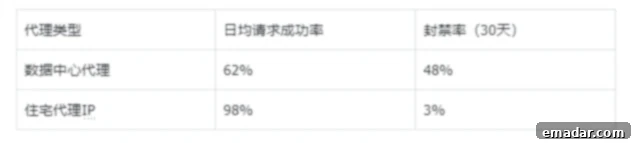
For businesses that rely on web scraping and data aggregation, the stability and efficiency of data collection are paramount. Data center IPs are notoriously prone to being blocked during intensive scraping operations, leading to incomplete datasets and wasted resources. Residential proxies, with their organic appearance, enable sustained and reliable data extraction.
- The Challenge: Large-scale data collection from websites often triggers sophisticated anti-bot and anti-scraping measures. These systems are designed to detect automated requests, distinguishing them from human behavior. Data center IPs, often used by many scraping operations, are easily identified and quickly blacklisted, leading to frequent interruptions, CAPTCHAs, and outright bans. This makes consistent, high-volume data acquisition nearly impossible without a robust solution.
- The Residential Proxy Advantage: Residential proxies circumvent these issues by routing requests through diverse, legitimate IP addresses. This makes each request appear to originate from a different, genuine user, significantly reducing the chances of detection. The result is a much higher success rate for data collection, improved data integrity, and a more stable scraping infrastructure. For tasks like competitive intelligence, market trend analysis, or academic research, this translates into actionable insights derived from comprehensive and reliable data sets. The ability to maintain long-running scraping sessions without interruption is a game-changer for data-driven strategies.
⭐Strategic Edge: Advanced Advertising and SEO Optimization
Digital marketing thrives on accurate, localized data. Residential proxies empower marketers and SEO specialists to gain unparalleled insights into regional market dynamics, competitor strategies, and campaign performance without bias or restrictions.
- SEO & Ad Verification: One of the most critical aspects of global SEO and advertising is understanding how your content and ads appear to users in different geographical locations. Traditional tools often provide generalized data, which can be misleading. Residential proxies allow marketers to view search engine results pages (SERPs) from specific cities or countries, gaining precise insights into keyword rankings, local pack results, and competitor ad placements. This capability extends to verifying ad creatives, landing pages, and price points as they appear to target audiences, ensuring compliance and effectiveness across diverse regions.
- Real-world Example: A prominent e-commerce brand utilized residential proxy IPs based in various US cities to conduct a batch query of keyword rankings. Through this process, they discovered a significant surge in search volume for a particular product keyword specifically within the New York metropolitan area. Armed with this localized insight, the brand was able to tailor their advertising campaigns to target this specific region more aggressively. The result was a remarkable 25% increase in conversion rates for the targeted campaigns, demonstrating the direct impact of geographically precise data on marketing ROI. This capability also extends to competitor ad intelligence, allowing brands to see competitor campaigns in real-time from various locations, aiding in strategic planning.
⭐Economical in the Long Run: Long-term Cost Control

While the per-unit cost of a residential proxy IP might initially seem higher than that of a data center IP, this perspective often overlooks the comprehensive financial implications of online operations. The true value emerges when considering the potential losses incurred from using inferior alternatives.
- Debunking the Misconception: The initial sticker shock of residential proxy pricing often deters users who might opt for cheaper data center alternatives. However, this is a short-sighted view. The cost of an IP ban can be astronomical for businesses. Consider the scenario of a Facebook advertising account being frozen. This doesn’t just mean a temporary halt; it can result in lost ad spend, inability to reach target audiences, damaged brand reputation, and significant operational delays in setting up new accounts and rebuilding trust. For an e-commerce business, account suspensions can mean lost sales, disruption of marketing funnels, and a direct impact on revenue.
- Holistic Cost-Benefit Analysis: When you factor in the cumulative costs of dealing with constant IP blocks, repeated CAPTCHA challenges, the time spent troubleshooting, and the direct financial impact of suspended accounts or failed data collection projects, the “expensive” residential proxy IP reveals itself as a cost-effective solution. By preventing these disruptions, residential proxies ensure operational continuity, protect digital assets, and allow businesses to maintain their revenue streams and growth trajectories. The investment in high-quality residential proxies safeguards against far greater potential losses, leading to a significantly lower overall operational cost in the long term. This makes them an essential investment for sustained and secure online activity.
Five Practical Applications and Operational Guides for Residential Proxy IPs
Residential proxies are versatile tools with broad applications across various industries. Here, we outline five key scenarios and provide step-by-step guidance for effective implementation.
1. Cross-Border E-commerce Price Monitoring
In the highly competitive e-commerce landscape, real-time price monitoring of competitors and market trends is crucial for maintaining a competitive edge. Residential proxies enable businesses to overcome geographical pricing, dynamic pricing strategies, and IP-based restrictions on e-commerce platforms.
- Workflow:
- IP Acquisition: Begin by obtaining target-country residential IPs through a reputable service like IPFLY. For instance, if monitoring Amazon’s German marketplace (Amazon.de), you would acquire German residential IPs.
- Crawler Deployment: Develop and deploy a robust web scraping script, often using frameworks like Python with Scrapy. Crucially, configure the request interval to be at least 15 seconds (or more, depending on the platform’s anti-bot measures) between requests. This minimizes the risk of detection by mimicking human browsing patterns.
- Data Synchronization and Alerts: Once data is collected, it undergoes a thorough cleaning process to ensure accuracy and consistency. The refined data is then synchronized with a Business Intelligence (BI) system. This system is configured to automatically generate price fluctuation alerts, allowing businesses to react quickly to changes in competitor pricing, optimize their own pricing strategies, and identify market opportunities.
2. Strategic Social Media Matrix Operations
Managing multiple social media accounts for marketing, brand protection, or community engagement requires a delicate approach to avoid platform detection and bans. Residential proxies are fundamental to establishing a secure and sustainable social media presence across various accounts.
- Facebook Account Warming Standardized Procedure: To avoid immediate bans, new social media accounts, particularly on platforms like Facebook, need a “warming-up” period, simulating genuine user activity.
- Days 1-3: Profile Setup with Static Residential IP: Dedicate a static (sticky) residential IP to each new account. Use this IP to complete profile information, upload a realistic profile picture, and add a small number of legitimate friends (3-5). The static IP ensures consistency, signaling stability to the platform.
- Days 4-7: Mimicking Human Behavior: Continue using the dedicated static residential IP. Engage in light, natural activities: like 5 posts daily, comment on 1-2 posts, and browse your feed for short periods. This gradually builds a legitimate activity history, making the account appear organic.
- Day 8 Onwards: Gradual Expansion & Long-term IP Binding: As the account gains trust, gradually introduce more complex actions like posting content, joining groups, or initiating ad campaigns. Maintain the IP binding cycle for at least 30 days to reinforce the account’s authenticity and stability. For advanced operations, integrate with an anti-detect browser to manage browser fingerprints, cookies, and local storage, ensuring each account operates in a completely isolated and unique digital environment.
3. Localized Content and Application Testing
For global businesses, ensuring that website content, advertisements, and applications perform optimally and are culturally relevant across different regions is critical. Residential proxies enable precise localization testing from the perspective of the target audience.
- Case Example: Game Company’s Ad Testing: A leading game development company utilized Brazilian residential IPs to test the performance of its advertising creatives in the Brazilian market. They discovered that the Portuguese-language version of their ad displayed a remarkable 37% higher click-through rate (CTR) compared to the English-language version. This immediate, data-driven insight allowed them to promptly adjust their multi-language marketing strategy for Brazil, leading to significantly improved campaign performance and user acquisition in the region. This principle applies to any business needing to verify localized website layouts, pricing, product availability, or app functionality from various geographic vantage points.
4. Robust Anti-Scraping Countermeasures
Websites are constantly evolving their anti-scraping technologies. To maintain consistent access for data collection, a dynamic and sophisticated approach involving residential proxies is essential.
- Technical Solutions for Sustained Access:
- Intelligent IP Rotation: Implement a strategy of rotating residential IPs frequently. For example, change the IP address after every 100 requests (or even more frequently, depending on the target site’s sensitivity). This ensures that no single IP makes an excessive number of requests, preventing it from being flagged as a bot. Advanced rotation schemes can incorporate geographical diversity and IP “stickiness” where appropriate.
- User-Agent and HTTP Header Spoofing: Websites often inspect HTTP headers (especially the User-Agent string) to identify bots. Always modify your User-Agent string and other HTTP headers to mimic those of popular web browsers like Chrome, Firefox, or Safari, across different operating systems. This makes your requests appear as legitimate browser traffic, further enhancing the chances of successful data retrieval. Additionally, consider randomizing other headers like `Accept-Language`, `Accept-Encoding`, and `Referer` to create more natural browsing patterns.
5. Competitor Research and Real-time Sentiment Monitoring
Understanding competitor strategies and public sentiment is vital for strategic planning. Residential proxies facilitate comprehensive intelligence gathering across various platforms, including social media, news sites, and review platforms.
- Integrated Toolchain: To achieve robust competitor intelligence and sentiment monitoring, residential proxy IPs are integrated into a powerful toolchain. This often includes:
- Residential Proxy IPs: Providing localized, anonymous access to target platforms.
- Brand24 (or similar social listening tools): Used to aggregate mentions, comments, and discussions related to competitors or specific industry keywords.
- Natural Language Processing (NLP) Models: Employed to analyze the collected textual data, identify sentiment (positive, negative, neutral), extract key themes, and track shifts in public opinion.
This combination allows businesses to track competitor product launches, marketing campaigns, pricing changes, customer feedback, and overall brand perception in real-time, gaining an invaluable strategic advantage.
Three Common Pitfalls of Residential Proxy Usage and How to Avoid Them
While residential proxies are powerful, their effectiveness can be undermined by common mistakes. Understanding these pitfalls and implementing preventative strategies is crucial for maximizing their benefits.
1. The Trap of Low-Quality IP Pools
Not all residential proxies are created equal. Opting for providers with low-quality or compromised IP pools can negate all the advantages and lead to immediate detection and blocking.
- Associated Risks: Using shared IPs that have been overused or previously flagged for suspicious activity by other users can lead to immediate blacklisting by target platforms. If multiple users are making requests from the same residential IP, websites can easily identify this as anomalous behavior, marking the traffic as “suspicious” or originating from a proxy network, thus defeating the purpose of using a residential IP in the first place. These IPs often belong to networks that fail to maintain the purity and integrity of their IP addresses, leading to rapid detection.
- Effective Detection Methods:
- IP Type Verification: Always use an independent IP address lookup website (e.g., ipinfo.io, whatismyipaddress.com) to verify the IP type. Ensure it explicitly states “residential” and not “data center,” “hosting,” or “mobile.” A reputable proxy provider should also offer an API to check IP health.
- Behavioral Test: Connect to the proxy and attempt to visit a sensitive website like Google repeatedly (e.g., 10 times consecutively). If you consistently encounter CAPTCHAs, “I’m not a robot” checks, or temporary blocks, it’s a strong indicator that the IP has a low reputation or is already flagged. High-quality residential IPs should allow seamless browsing.
2. Neglecting IP Purity and Digital Footprint Maintenance
Even with high-quality residential IPs, failure to manage associated digital footprints can lead to account bans and operational failures. IP purity extends beyond just the IP address itself to the entire browsing environment.
- Negative Case Study: TikTok Account Association: A team managing 20 TikTok accounts, despite using residential IPs, experienced mass account suspensions. The root cause was identified as a failure to properly clear browser cookies and manage device fingerprints. The identical device fingerprints and shared cookies across multiple accounts, even with different IPs, allowed TikTok’s detection systems to link and subsequently ban all associated accounts, demonstrating that IP alone is not enough for advanced platforms.
- Proactive Maintenance Solutions:
- Regular IP Blacklist Checks: Integrate with your proxy provider’s API (e.g., IPFLY’s API) to regularly check the blacklist status and reputation score of your active residential IPs. Immediately replace any IPs that appear on known blacklists.
- Diversified IP Rotation and Replacement: Implement a strategy to periodically refresh a portion of your IP pool. For instance, replace 30% of your active IPs monthly. Prioritize replacing IPs from regions known for higher risk or stricter platform monitoring (e.g., specific countries or regions that are often targeted by bot activity).
- Comprehensive Browser Hygiene: Always use anti-detect browsers or secure browser profiles that isolate cookies, local storage, cache, and device fingerprints for each account. Never reuse browser profiles across different accounts, even if IPs are rotated. This creates a clean, unique digital environment for every session.
3. Incorrect Protocol Configuration
Misconfiguring the proxy protocol can lead to connectivity issues, failed requests, and expose your real IP, compromising security and operational efficiency.
- Common Errors: A frequent mistake is attempting to use an HTTP-only proxy for applications or scenarios that specifically require the SOCKS5 protocol. HTTP/HTTPS proxies are generally designed for web traffic (HTTP/HTTPS requests) and operate at the application layer. They can often modify request headers and are limited in their scope. In contrast, SOCKS5 proxies operate at a lower level (the session layer) and are protocol-agnostic, meaning they can handle any type of network traffic, including UDP (User Datagram Protocol), which is essential for activities like peer-to-peer sharing, gaming, video streaming, or VoIP communications. Using an HTTP proxy for these UDP-dependent tasks will simply fail, leading to connectivity errors and unfulfilled requests.
- Optimal Solution: To ensure broad compatibility and robust functionality across various applications and network traffic types, prioritize choosing residential proxy service providers that explicitly offer and support the SOCKS5 protocol. SOCKS5 provides greater flexibility, better performance for non-HTTP traffic, and often enhanced security compared to HTTP proxies, making it the preferred choice for more complex or diverse operational needs. Always verify the protocol support of your chosen proxy service and configure your applications accordingly.
From being a niche tool, residential proxy IPs have evolved into an indispensable asset for cross-border businesses, data-driven enterprises, and individuals seeking online freedom and security. Through advanced technology service providers like IPFLY, users can gain quick access to high-quality IP resources, simultaneously mastering advanced techniques in IP maintenance and behavior simulation. Whether you are an individual developer, a digital marketer, or part of an enterprise team, a profound understanding of the underlying logic and practical applications of residential proxy IPs will undoubtedly position you at the forefront of digital competition and innovation.