
Unlocking the Power of Residential IPs: A Comprehensive Guide
For businesses operating in the long term, the true value of residential IPs lies not just in their availability, but in their strategic implementation. Mastering the art of utilizing residential IPs allows you to maximize their authenticity and stability, effectively bypass platform risk controls, and significantly boost business efficiency. While many users opt for residential IPs, improper usage can lead to account anomalies and business interruptions. This guide provides a comprehensive overview of how to effectively leverage residential IPs for optimal performance.
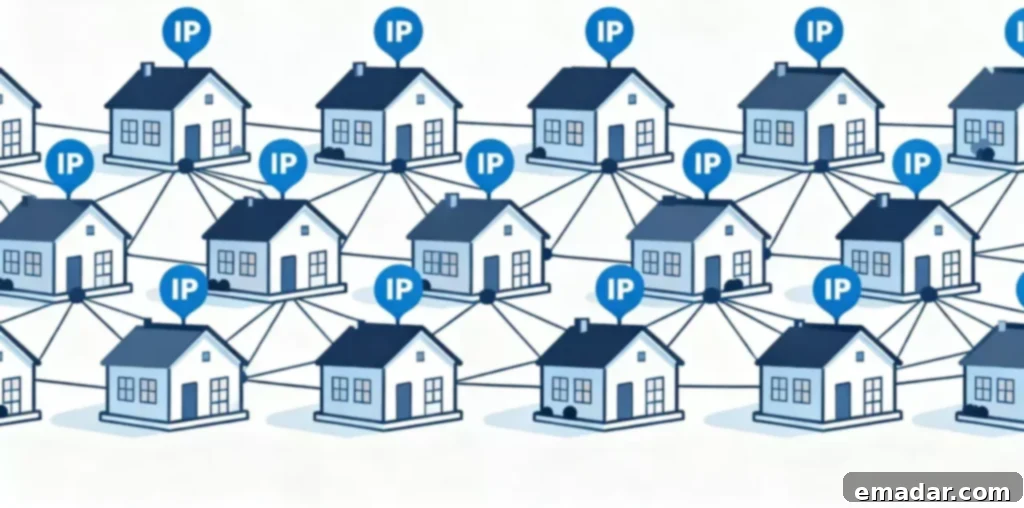
The Core of Residential IP Strategy: Establishing a Stable and Compliant Online Identity
The practical application of residential IPs hinges on the creation of a “stable and compliant online identity” through a combination of genuine IP attributes and consistent usage patterns. This approach ensures that platforms recognize you as a legitimate user, mitigating the risk of security breaches and ensuring continuous business operations. Whether you’re involved in cross-border e-commerce, social media marketing, or data collection, this fundamental logic remains the same. It can be broken down into three key principles:
1. Consistent Online Identity: Avoiding Frequent Changes
Platforms place a high premium on the consistency of an account’s network environment. Frequent changes to IP addresses, devices, or network types can trigger suspicion and be flagged as anomalous behavior. When using residential IPs, it’s crucial to maintain a long-term association between the same account and the same residential IP. Avoid frequently switching between different service providers’ IPs, and consistently use the same device to log in. This minimizes environmental variations that could negatively impact your account.
2. Compliant Operational Behavior: Mimicking Authentic User Habits
Even when using residential IPs, inappropriate operational behavior can trigger risk controls. It’s essential to regulate the frequency of your actions, avoiding high-frequency content posting, modifications to store information, or account logins within short periods. Furthermore, simulate the browsing patterns and interactions of a genuine user. Spend time navigating pages, engaging with content, and avoid following fixed operational patterns. This reduces the platform’s vigilance and lowers the risk of triggering security alerts.
3. Precise Scenario Adaptation: Choosing the Right Static or Dynamic Residential IP
Different scenarios necessitate different types of residential IPs, requiring precise matching. For long-term operations (cross-border e-commerce stores, social media accounts), opt for static residential IPs. The long-term consistency of a fixed IP address establishes a stable online identity and increases platform trust. For high-frequency operations (data collection, advertisement verification), dynamic residential IPs are more suitable. The stable rotation of IPs distributes access pressure, preventing any single IP from being blocked due to frequent access.
Core Scenario Applications: Specific Techniques for Using Residential IPs
1. Cross-Border E-Commerce Operations: Account Security and Store Stability
The primary needs of cross-border e-commerce are account security and long-term store operation. The use of residential IPs should be centered around these two priorities.
Account Registration and Warm-up: Use a static residential IP from the target region to register your account. During the warm-up period, maintain IP stability and avoid frequent switching. Gradually complete your account information to enhance its credibility.
Daily Store Management: Log in to your store backend through a residential IP, controlling the frequency of your actions. Avoid bulk editing product information or processing orders within short periods. Also, prevent multiple stores of the same type from logging in using the same residential IP. Ensure that each IP corresponds to one store to avoid account association risks.
Regional Market Expansion: If you need to connect with multiple country markets, configure residential IPs corresponding to each region’s stores. Ensure that the IP’s geographic location matches the store’s operating region to improve platform compatibility.
2. Social Media Marketing: Account Security and Content Exposure
The core of social media platform risk control is identifying authentic users. The use of residential IPs should focus on simulating genuine user behavior.
Account Registration and Warm-up: Use a static residential IP from the target region to register your social media account. During the warm-up period, maintain IP stability, log in at fixed times each day, publish original content, and participate in interactions to gradually enhance account credibility.
Content Posting and Promotion: Publish content that aligns with the preferences of your target market through a residential IP, controlling the posting frequency and avoiding bulk posting within short periods. Participate in local topic discussions and interact with followers to simulate authentic user social behavior, increasing content exposure.
Account Security Maintenance: Regularly log in to your account using the same residential IP to check its status and prevent anomalies caused by logins from different locations. If you need to change devices, perform a security verification on the original device before logging in with the new device through the residential IP.
3. Data Collection: Efficient Acquisition and Compliance Assurance
The core needs of data collection are efficiently acquiring data and avoiding detection by anti-crawler systems. The use of residential IPs should focus on reducing the abnormality of data collection behavior.
Selecting Dynamic Residential IPs: Distribute collection pressure through stable IP rotation, preventing any single IP from being blocked due to frequent access. Also, control the collection frequency, setting reasonable request intervals, and simulating the browsing rhythm of genuine users.
Adapting to Target Regions: Choose residential IPs that match the geographic location of your data sources to ensure access to regionally restricted data and improve compliance.
Ensuring Collection Continuity: Choose residential IPs with strong stability to prevent data loss due to IP disconnections that interrupt data collection. A reliable provider offers millisecond-level stable rotation and 99.9% uptime, effectively supporting large-scale data collection scenarios.
Common Pitfalls in Residential IP Implementation: 4 Mistakes to Avoid
Mistake 1: Logging into Multiple Accounts of the Same Type Using the Same Residential IP
Most platforms prohibit associating multiple accounts with the same IP address. Violating this rule can lead to the ban of all associated accounts. In practice, adhere to the “one IP corresponds to one account” principle, ensuring the unique association of accounts and IPs.
Mistake 2: Frequently Changing Residential IPs
Frequent changes to residential IPs can lead to network instability, which platforms may interpret as anomalous behavior, increasing the risk of security breaches. Unless the IP exhibits anomalies (such as being blocked or invalid), use the same residential IP long-term to maintain a stable online identity.
Mistake 3: Neglecting to Match IP Location with Business Region
If the geographic location of the residential IP does not match the target region of your business (e.g., operating a European store while using an American residential IP), the platform may interpret it as anomalous access, negatively impacting business operations. Ensure that the IP’s geographic location matches your business region to improve compatibility.
Mistake 4: Operating at Excessively High Frequency, Deviating from Authentic User Habits
Even when using residential IPs, performing high-frequency operations within a short period (such as bulk posting or bulk collecting) can be detected as anomalous by the platform. Control the frequency of your actions and simulate the behavioral rhythm of authentic users to reduce the probability of triggering risk controls.
Residential IP Implementation Optimization Techniques: Enhancing Efficiency and Security
Regularly Check IP Status
It’s advisable to regularly use professional tools to check the availability, authenticity, and geographic location accuracy of your residential IP. If you discover that the IP is blocked, invalid, or exhibits anomalous attributes, replace it promptly to avoid impacting business operations.
Optimize Network Connection Configuration
When using residential IPs, ensure a stable network connection. Close programs running in the background that consume network resources to prevent network fluctuations from interrupting the IP connection. Also, configure the protocol corresponding to your residential IP (such as Socks5) to ensure compatibility with your business tools and improve usability.
Use in Conjunction with Business Tools
Integrate your residential IPs with professional business tools (such as social media management tools or data collection tools) to optimize operational workflows, control operation frequency, and leverage features such as breakpoint resumption and automatic retry to improve business efficiency and reduce manual errors.
The Practical Value of Residential IPs Lies in Precise Adaptation and Compliant Operation
The core of residential IP implementation is choosing the right type and operating compliantly. Select static or dynamic residential IPs based on your business scenario, maintain a stable online identity, and simulate authentic user behavior to maximize their authenticity and stability, bypass platform risk controls, and improve business efficiency.
Choosing high-quality residential IPs is fundamental, but mastering practical techniques is key. Reputable providers offer both static and dynamic residential IPs, with global multi-region coverage that can precisely adapt to core scenarios such as cross-border e-commerce, social media marketing, and data collection. A guaranteed uptime of 99.9% ensures business continuity. Mastering the techniques described in this guide will allow residential IPs to truly become a “security guarantee” and “efficiency tool” for your long-term business, helping you advance your business efficiently and compliantly.
By carefully considering these factors and implementing these best practices, you can harness the full power of residential IPs and unlock their potential to enhance your online activities.