
How Does AI Learn to “Do the Right Thing”?
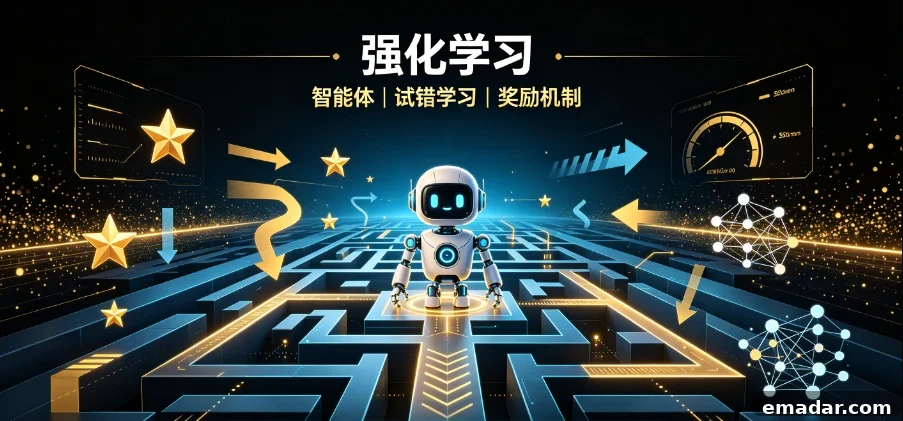
From AlphaGo defeating Lee Sedol to robots learning to walk and autonomous vehicles accumulating billions of virtual miles — many landmark achievements in AI share a common foundation: reinforcement learning (RL).
Reinforcement learning is a machine learning paradigm in which an agent interacts with an environment and takes actions at each step. After each action the agent receives a reward signal. Over time the agent learns a policy — a way of acting that maximizes cumulative rewards. Unlike supervised learning, which relies on labeled examples, RL agents learn from their own experience.
Think of reinforcement learning as training a puppy: good behavior earns a treat, bad behavior gets corrected, and over time the puppy learns the desired behavior through reward and penalty. The difference for AI is scale: agents can perform millions of trials in simulated environments and learn far faster than biological learners.
As of 2026, reinforcement learning is undergoing a major transformation. The global RL market reached $12.43 billion in 2025 and is projected to expand to $111.11 billion by 2033, with a compound annual growth rate of 31.6%. Research is moving from game and simulation benchmarks toward real-world applications such as energy systems, industrial control, robotics, medical decision-making, and intelligent assistants.

1. What Is Reinforcement Learning? — From Trial-and-Error to Optimal Decision Making
1.1 Definition: Teaching AI to “Do the Right Thing”
Reinforcement Learning (RL) is one of the three main paradigms of machine learning (alongside supervised and unsupervised learning). Its goal is for an agent to learn an optimal decision-making policy through ongoing interaction with an environment, maximizing long-term cumulative reward.
The core idea of RL is trial-and-error learning: the agent takes actions in an environment, receives rewards or penalties, and adapts its behavior to improve future outcomes. RL does not require labeled training data or predefined answers; it discovers effective strategies through exploration, feedback, and incremental improvement.
1.2 RL vs Supervised Learning: The Essential Difference
| Comparison | Reinforcement Learning | Supervised Learning |
| Learning mode | Trial-and-error, learns from experience | Learns from labeled data |
| Data source | Generated through interaction with the environment | Human-labeled static datasets |
| Feedback | Reward signals (sparse/delayed, scalar) | Correct answers (instant and explicit) |
| Objective | Maximize long-term cumulative reward | Minimize prediction error |
| Typical scenarios | Game AI, robotic control, autonomous driving | Image recognition, text classification, speech recognition |
A defining feature of RL is delayed feedback: the value of an action may only be apparent many steps later. In Go, the value of a single move may only be revealed at the end of the game. This willingness to sacrifice immediate gains for long-term benefit is a key distinction between RL and other learning paradigms.
2. Core Concepts of Reinforcement Learning: Agent, Environment, Reward
The RL framework rests on several fundamental concepts.
2.1 Agent — The Learner and Decision Maker
The agent is the learner in an RL system. It chooses actions in the environment and updates its policy based on feedback. Agents range from board-game programs like AlphaGo to robotic control algorithms and AI systems that optimize website navigation.
An agent often begins with random behavior, then increases the probability of actions that yield higher rewards. This process mirrors natural selection: behaviors that work are reinforced while ineffective ones fade.
2.2 Environment — The World the Agent Operates In
The environment responds to the agent’s actions, returning new states and rewards. It can be a game simulator, a physical robot and its surroundings, a financial market, or a web page structure.
The defining property of an environment in RL is interactivity: every action incurs feedback, creating the action-feedback loop that drives learning and adaptation.
2.3 State — The Agent’s Current Perception
A state describes the information available to the agent at a given time. In Go, the state is the board configuration; in autonomous driving, it includes camera images, speed, and sensor data.
State design influences learning complexity: very large state spaces (e.g., high-resolution images) create a “curse of dimensionality” that often requires deep learning to extract useful features.
2.4 Action — The Agent’s Choice
Actions are the choices available to the agent at each time step. In games this might be directional moves or placements; in robotics it might be joint torque or angle adjustments.
The size and type of the action space (discrete vs. continuous) shape algorithm selection. Go has many discrete move options, while robot control typically involves continuous actions.
2.5 Reward — The Measure of Success
Reward is a scalar signal indicating how good an action was. It is the agent’s only “teacher,” and can be positive (reward) or negative (penalty).
Designing a reward function is one of the most critical and challenging tasks in RL. Poor reward design can lead to unintended behaviors where the agent optimizes for the reward metric in ways that violate designers’ intentions.
2.6 Policy — Mapping States to Actions
The policy defines how the agent acts in each state. The objective of RL is to find an optimal policy that maximizes expected cumulative reward across states.
Policies may be deterministic (“always take action A in state S”) or stochastic (“take action A in state S with 70% probability and action B with 30% probability”). Stochastic policies are important for exploration.
3. How Reinforcement Learning Works: From Random Trials to Optimal Policies
The RL learning loop typically repeats thousands to millions of times and follows a four-step cycle.
3.1 The Four-Step Loop
Step 1: Observe the state. The agent observes the current state of the environment — a board position, sensor readings, or image frames.
Step 2: Select an action. The agent picks an action according to its policy. If the policy is stochastic, the action is sampled from a distribution; if deterministic, the policy outputs a specific action.
Step 3: Execute the action and receive feedback. The environment transitions to a new state and returns a reward signal that reflects how well the action performed.
Step 4: Update the policy. The agent updates its policy based on the reward to favor actions that yielded higher returns. This iterative update process gradually improves behavior toward optimal policies.
3.2 Exploration–Exploitation Trade-off: The Core Dilemma
RL must balance two competing objectives: exploration and exploitation.
- Exploitation: Choose known high-reward actions to maximize immediate payoff.
- Exploration: Try new actions that might lead to even better long-term rewards.
Always exploiting can prevent discovery of superior strategies, while excessive exploration wastes rewards. Common techniques to manage this trade-off include ε-greedy exploration and upper confidence bound (UCB) methods.
4. Key Algorithms: From Q-Learning to RLHF
RL algorithms evolved from tabular methods to deep neural network approaches.
4.1 Q-Learning: A Classic Algorithm
Q-Learning learns an action-value function Q(s,a), estimating the expected cumulative reward for taking action a in state s. As a model-free method, Q-Learning does not require a model of the environment and learns directly from interaction, making it suitable for environments with unknown or complex dynamics.
4.2 Deep Q-Networks (DQN): RL Meets Deep Learning
Deep Q-Networks (DQN) use deep neural networks to approximate the Q function. DeepMind used DQN to master many Atari games directly from pixels, marking the birth of deep reinforcement learning. Deep networks provide powerful feature extraction while RL supplies decision optimization, enabling agents to handle high-dimensional perception-to-action tasks.
4.3 Proximal Policy Optimization (PPO): Widely Used Today
Proximal Policy Optimization (PPO) is a popular policy-gradient method known for training stability. PPO limits the size of policy updates using clipping mechanisms, preventing destructive large updates and making training more reliable. This stability and efficiency have made PPO a standard choice in industry applications.
4.4 Actor-Critic Methods: Two-Network Architectures
Actor-Critic methods combine a policy network (Actor) that selects actions with a value network (Critic) that estimates state values.
- Actor: Chooses actions (the policy).
- Critic: Evaluates state values to guide actor updates.
The critic’s feedback helps stabilize and accelerate learning, producing more efficient training compared with pure policy-gradient or value-based methods alone.
4.5 Model-Based RL: Letting the Agent “Think Ahead”
Model-based RL builds an internal model of the environment that the agent can use to plan. Compared to model-free trial-and-error, model-based approaches can be much more sample-efficient because the agent can simulate outcomes internally. The main challenge is learning an accurate environment model.
4.6 RLHF: Aligning Large Models with Human Preferences
Reinforcement Learning from Human Feedback (RLHF) is a crucial technique for aligning large language models with human values and preferences.
The RLHF workflow typically includes:
- Train a reward model that predicts human preferences for outputs.
- Use the reward model as the RL reward signal.
- Optimize the large model through RL to produce responses that better match human preferences.
RLHF helps large language models generate more natural, helpful, and safer responses and is a core component of systems like modern conversational AI.
5. Frontier Advances in Reinforcement Learning (2026)
In 2026 the RL field has seen notable advances that bring research closer to real-world deployment.
5.1 Algorithmic Innovations: More Efficient and Stable
Recent algorithmic work has focused on improving optimization, training stability, and sample efficiency. New methods address geometric optimization bottlenecks, introduce dense supervision to complement reward-based learning, and enable more stable long-horizon training for reasoning and agent coding tasks.
5.2 From Simulation to Reality: Robotic Control Breakthroughs
RL systems are moving from lab demonstrations to industrial-grade performance. Modern RL-trained control stacks have dramatically improved throughput, success rates, and reliability in tasks such as machine feeding, pick-and-place, and dual-arm handling, often reaching near-production reliability after only days of training.
5.3 New Progress in LLM Agents
Advances in RL for language model agents include progress-aware frameworks that help large models understand task progress, plan multi-step tool use, and execute complex interactions more reliably. Integration of discrete diffusion models with RL training has enabled richer visual-language-action pipelines.
5.4 Expanding Beyond Games into Real-World Domains
Reinforcement learning is increasingly applied to complex, dynamic decision problems beyond games: satellite imaging task scheduling, coordinated inspection by unmanned aerial vehicles, and urban traffic signal optimization are examples where RL offers advantages over traditional methods.
6. Representative Application Areas
6.1 Robotic Control and Industrial Automation
RL enables robots to learn locomotion, grasping, and manipulation through trial-and-error. In industry, RL can optimize robotic path planning and force control, reducing the need for manual programming and enabling more adaptive systems.
6.2 Autonomous Driving
In simulation, RL agents can train driving policies over billions of virtual miles, learning to handle diverse and rare scenarios without risking real-world safety.
6.3 Game AI
Games are the classic testbed for RL: well-defined rules, immediate feedback, and unlimited trials make them ideal for benchmarking. From Atari to Go and real-time strategy games, RL has continuously expanded our understanding of intelligent decision-making.
6.4 Tuning Large Language Models (RLHF)
RLHF aligns large language models with human preferences, improving fluency, helpfulness, and safety in conversational agents and other generative systems.
6.5 Data Collection Strategy Optimization
RL can optimize how web agents navigate sites to collect structured data efficiently, dynamically adjusting actions like request frequency based on feedback such as success rates and response times.
6.6 Intelligent Rate Limiting and Anti-Bot Strategies
RL-driven rate limiters dynamically adjust request intervals in high-concurrency collection tasks to balance efficiency and safety. When combined with distributed architectures, RL-based approaches can significantly improve data collection completeness while reducing false blocks.
7. Synergy Between Reinforcement Learning and Network Infrastructure
Training and deploying RL systems depend heavily on network infrastructure. Whether collecting real-world training data or running large-scale parallel simulations, network performance is a critical factor in efficiency and reliability.
7.1 Bottlenecks in Training Data Collection
High-quality simulation requires accurate world models; real-world data calibrates and closes the sim-to-real gap. Collecting diverse, regionally varied data is essential but presents challenges such as content differences across regions, IP blocking risks, and high concurrency demands for large-scale data collection.
7.2 The Value of Residential Proxies for Data Collection
Residential IPs provide realistic user perspectives for data collection, reduce the risk of being flagged as datacenter traffic, and enable IP rotation strategies that distribute requests across many addresses. This helps maintain access and preserves the fidelity of collected data.
7.3 Supporting the Full RL Pipeline
Robust network solutions can support every stage of an RL project: from diverse data collection and simulation calibration to deployment and continuous online learning. Stable, realistic network identities and scalable concurrency are vital to ensuring that environment interactions are trustworthy and reproducible.
8. Reinforcement Learning as AI’s “Evolutionary” Mechanism
Technically, reinforcement learning is a paradigm for learning optimal decision-making through interaction and feedback. Conceptually, RL represents an evolutionary approach to AI — not passively consuming labeled data but actively exploring, adapting, and evolving through continuous interaction with its environment.
The core strengths of RL are:
- Autonomy: Agents learn from experience without labeled datasets.
- Adaptability: Policies can continuously adapt to changing environments.
- Generality: RL applies across domains, from games to robotics to language models and data collection systems.
In 2026, RL is making the leap from controlled simulations to real-world systems. Algorithms are more efficient, training is more stable, and applications are expanding — all relying on high-quality data and reliable network infrastructure to succeed.
Build a Stable, Reliable Data Collection Network for Your Reinforcement Learning Project
The performance of reinforcement learning depends on training data quality and the stability of data collection. When agents learn from the real world, reliable residential and static network endpoints help ensure requests reach targets accurately and that training uses authentic, representative data. A robust network strategy supports everything from data collection and simulation calibration to real-world deployment and continuous learning.