
Proxy Pool: A Comprehensive Guide for 2025
In the world of data acquisition, web scraping, and cross-border e-commerce, the dreaded “403 Forbidden” error is a common nightmare. When your IP address is blocked by a target website due to excessive requests, your operations are abruptly halted, and efficiency plummets. This is where a proxy pool becomes an invaluable asset.
This article provides an in-depth exploration of the core mechanisms of proxy pools, contrasts the advantages and disadvantages of free and paid options, and guides you on how to build or choose a highly available proxy pool system.

What is a Proxy Pool and Why is it Essential for Web Scraping?
In simple terms, a proxy pool is a reservoir containing a large collection of proxy IP addresses. It’s not just a list of IPs; it’s a dynamic management system that continuously provides available IPs while removing those that are no longer functional.
The Core Functions of a Proxy Pool
In web scraping and automated testing, proxy pools address the following critical challenges:
- Circumventing IP Blocking: By rotating through different IP addresses for each request, the target server perceives requests as originating from numerous distinct users, rather than a single machine. This effectively bypasses IP-based rate limiting and blocking.
- Enhancing Concurrency and Efficiency: Single IPs are often subject to request frequency limitations. A proxy pool enables multi-threaded concurrent data collection, drastically increasing efficiency. Imagine scaling your data extraction processes exponentially by leveraging a vast network of IP addresses.
- Masking Your True Identity: Proxy pools shield the real IP address of your local server, reducing the risk of attacks or being blacklisted. This is crucial for maintaining anonymity and ensuring the longevity of your scraping operations.
How Proxy Pools Work: Architecture and Key Components
A robust proxy pool system typically comprises four core modules: the Getter, the Tester, the Storage, and the API.
- Getter
The Getter is responsible for acquiring proxy IP addresses from various sources. Common sources include:
- Free Proxy Websites: Periodically scraping publicly available free proxies from websites. While these are often of lower quality, they offer a zero-cost option. However, be prepared for high failure rates and potential security risks.
- Paid Proxy APIs: Integrating with third-party proxy providers to regularly obtain high-quality IP addresses. These services often offer advanced features like geo-targeting, rotating proxies, and dedicated support.
- Storage
The Storage module serves as the “warehouse” for the proxy pool. Given the ephemeral nature of proxy IPs and the need for frequent read/write operations, a Redis database (specifically, a Sorted Set) is often the preferred choice. Redis allows for rapid sorting and de-duplication of IPs based on their availability score, ensuring you always have access to the best-performing proxies.
- Tester
The Tester acts as the “quality control” for the proxy pool. It periodically retrieves IPs from the database and attempts to access specific test websites (e.g., Google, or the target website you are scraping). The results of these tests determine the fate of the IP:
- Successful Connection: The IP is retained and its score is potentially increased, indicating its reliability.
- Failed Connection/Timeout: The IP’s score is lowered, or it is directly removed from the pool, signifying its unsuitability for use.
- API
The API provides an interface for external services to access the proxy pool. Typically, a simple web service is built using frameworks like Flask or FastAPI, allowing scraping programs to obtain a highly-rated, available proxy IP via an API endpoint (e.g., GET /get). This allows for seamless integration with your existing scraping infrastructure.
Free vs. Paid Proxy Pools: Which is Right for You?
Many are tempted to use open-source free proxy pool projects available on GitHub. But is this really a cost-effective solution?
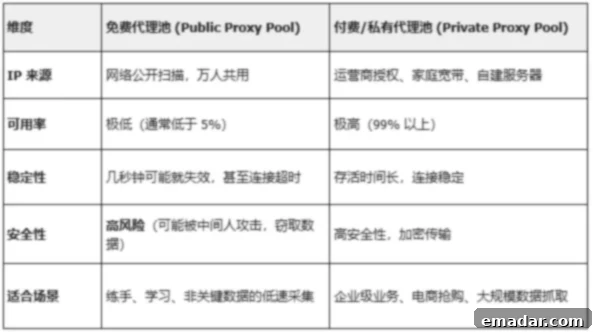
Conclusion: For enterprise-level operations, avoid using free proxy pools. The time and server resources spent maintaining a free pool often outweigh the cost of purchasing paid proxies directly. Opting for a cost-effective proxy provider like IPFLY eliminates the hassle and provides a reliable and stable network environment.
Building a Highly Available Proxy Pool: A Practical Python Approach
If you’re interested in building your own proxy pool, Python is a popular choice. Here’s a simplified outline of the setup process:
Step 1: Environment Setup
You’ll need to install a Redis database and a Python environment. Ensure you have the latest versions of these technologies for optimal performance and security.
Step 2: Selecting an Open-Source Framework
Instead of writing code from scratch, leverage a mature open-source project. Recommended options include:
- ProxyPool (by Python3WebSpider): An open-source project with a standard architecture, offering a solid foundation for building your proxy pool.
- Gerapy/Proxypool: Supports one-click Docker deployment for ease of setup and management. Dockerization simplifies deployment and ensures consistency across different environments.
Step 3: Configuring Proxy Sources
In the configuration file, add specific free proxy website URLs or the API endpoint for your purchased paid proxy service. This step defines the sources from which your proxy pool will draw its IP addresses.
Step 4: Starting the Scheduler
Once the program is running, the scheduler will launch two key processes:
- Periodic Scraping: Retrieves new IP addresses from the configured sources every X minutes. This ensures a continuous influx of fresh proxies into the pool.
- Periodic Testing: Checks the liveness of IPs in the database every Y seconds. This process identifies and removes non-functional proxies, maintaining the quality of the pool.
Step 5: Integrating with Your Scraper
Here’s an example of how you might integrate your proxy pool with a Python-based web scraper:
To efficiently integrate a proxy pool into your Python web scraping project, the following points should be considered. First, the `get_proxy()` function retrieves a proxy IP address from a local proxy pool service. This function assumes that a service is running on `http://localhost:5555`, which is configured to provide available proxy addresses. The `crawl(url)` function then utilizes the obtained proxy to send an HTTP request to a specified URL. This function handles potential proxy-related errors, such as connection failures, and retries the request if necessary. Finally, the proxy is applied to the request using the `proxies` parameter of the `requests.get()` method, which ensures that all HTTP requests are routed through the proxy server. For enhanced reliability, incorporate error handling and retry mechanisms to accommodate potential proxy failures or network issues.
Key Strategies for Proxy Pool Maintenance and Optimization in 2025
As anti-scraping technologies advance (e.g., TLS fingerprinting, AI-powered behavior analysis), simply having a proxy pool is no longer sufficient. You need optimized strategies:
- Graded Storage Strategy: Avoid immediately deleting failed IPs. Implement a scoring system (e.g., out of 100), deducting points for failed checks and adding points for successful ones. Only remove IPs when their score falls below a certain threshold, preventing accidental deletion of good IPs due to temporary network fluctuations. This nuanced approach allows you to retain potentially valuable proxies that might recover.
- Business and IP Isolation: Different tasks have varying IP requirements. For instance, account registration requires long-lasting IPs, while web scraping demands short-lived, high-frequency IPs. Segment your proxy pool into distinct “pools” for different use cases, optimizing resource allocation and improving performance.
- Bandwidth and Concurrency Control: The bottleneck for proxy pools is often server bandwidth, not the number of IPs. Ensure your proxy server has sufficient bandwidth; otherwise, your server’s network card will become congested under high concurrency, even if the IPs themselves are functional.
- Fingerprint Consistency: In 2025, simply changing IPs isn’t enough. Ensure that the browser’s User-Agent, cookies, and TLS fingerprint are logically consistent with the proxy IP’s geographical location and other characteristics. This helps to avoid detection by sophisticated anti-scraping systems that analyze these subtle inconsistencies.
Conclusion
A proxy pool is the result of a constant battle between web scrapers and anti-scraping strategies.
For beginners, building a free proxy pool via GitHub is a good way to understand network principles. However, for commercial projects that demand efficiency and stability, “purchasing high-quality residential proxies + building your own scheduling system” is the most cost-effective solution.
Regardless of the approach you choose, remember that the core value of a proxy pool lies in its dynamism. Only a constantly updated and maintained IP pool can ensure the long-term viability of your operations.
Use IPFLY Residential Proxies
IPFLY offers self-built servers + a big data filtering system, providing only:
- Residential IPs assigned by real ISPs
- Clean and unpolluted IP ranges, non-shared, with no history of abuse
- Support for IP detection, location filtering, and multi-country switching
Prevent risk control and manage risk with IPFLY for IP isolation!