
In the vast and interconnected digital landscape, where data is currency and online presence is paramount, the concepts of privacy, security, and efficient web operations have become more critical than ever. For businesses, researchers, and individuals engaged in web scraping, marketing, or safeguarding their digital footprint, proxy servers serve as indispensable tools. Yet, the world of proxies is diverse, with various types offering distinct capabilities and limitations. Among the most widely utilized and discussed are residential proxies and datacenter proxies, each catering to specific needs, budgets, and technical requirements.
This comprehensive guide delves deep into the fundamental differences between residential and datacenter proxies, offering a clear roadmap to help you determine which proxy solution is best suited for your unique challenges. Whether your objectives involve orchestrating sophisticated marketing campaigns, adeptly managing multiple social media accounts, conducting extensive market research, or executing large-scale data scraping operations, a thorough understanding of these proxy types is crucial for optimizing your online activities and achieving your desired outcomes effectively.
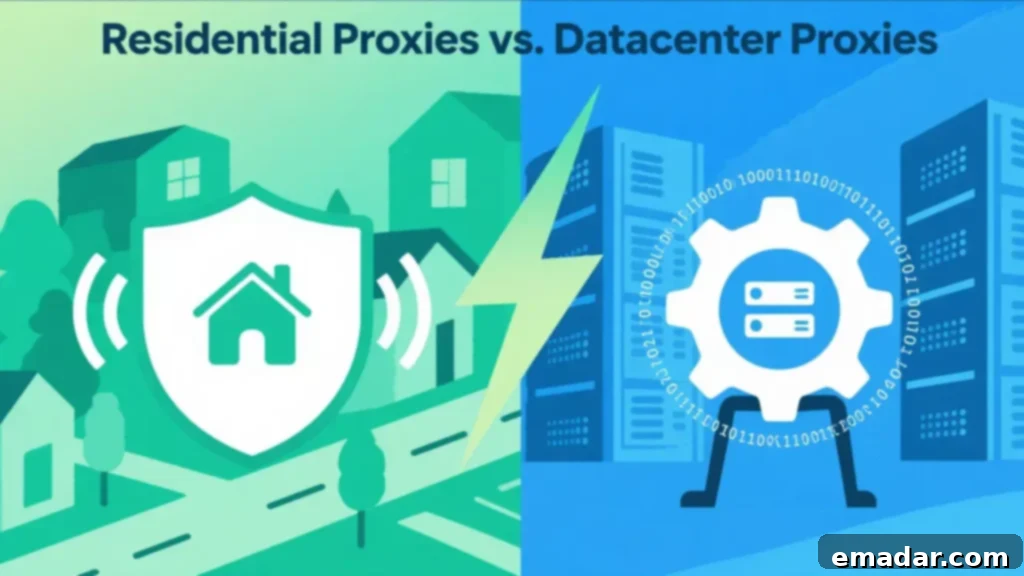
Understanding Residential Proxies: The Gateway to Authentic Online Presence
Residential proxies are IP addresses provided by Internet Service Providers (ISPs) to real, physical residential devices, such as home computers, smartphones, and tablets. When you route your internet traffic through a residential proxy, your online requests appear to originate from a genuine home user in a specific geographic location. This fundamental characteristic makes residential proxies exceptionally effective for tasks requiring high anonymity and the ability to bypass sophisticated detection systems, as websites perceive the traffic as coming from legitimate, ordinary users.
Key Features and Advantages of Residential Proxies:
- Authentic IP Addresses: Utilizing genuine IPs tied to real devices and ISPs significantly reduces the likelihood of being flagged, blocked, or challenged by anti-bot measures. This authenticity is a cornerstone of their effectiveness, allowing for seamless integration into various online environments.
- Superior Geo-targeting Capabilities: Since residential IPs are distributed globally and tied to actual physical locations, users can precisely target content, verify ads, or access geo-restricted services from specific countries, cities, or even neighborhoods. This precision is invaluable for market research and localized content strategies.
- Enhanced Anonymity and Trust: Operating behind a residential IP grants a high level of anonymity, making it incredibly difficult for target websites to distinguish your automated traffic from genuine human interaction. This trust factor is paramount for sensitive operations, significantly minimizing the risk of IP bans or CAPTCHA challenges.
- Bypassing Advanced Detection Systems: Websites often employ advanced algorithms to detect and block traffic originating from known datacenter IP ranges. Residential proxies, by masquerading as regular user traffic, are adept at circumventing these sophisticated blocking mechanisms, ensuring consistent access to target resources.
- High Success Rates: Due to their legitimate nature, residential proxies boast superior success rates for tasks that demand persistent access and a low detection footprint, translating to more efficient and reliable operations.
Potential Drawbacks of Residential Proxies:
- Higher Cost: The infrastructure required to maintain a vast network of legitimate residential IPs is complex and expensive, making residential proxies generally more costly than their datacenter counterparts.
- Variable Speed: As residential proxies rely on real home internet connections, their speed and reliability can fluctuate based on the end-user’s bandwidth, network congestion, and location.
What Are Datacenter Proxies? The Power of Speed and Scalability
In contrast to residential proxies, datacenter proxies are IP addresses that originate from commercial data centers and cloud service providers. These IPs are not associated with physical home users or local ISPs but are instead virtual IP addresses hosted on powerful servers. While they offer unparalleled speed and cost-effectiveness, their artificial nature makes them generally easier for websites to identify and potentially block.
Key Features and Advantages of Datacenter Proxies:
- Blazing Fast Speeds: Datacenter proxies are hosted on robust, high-bandwidth servers, offering exceptionally fast connection speeds and minimal latency. This makes them ideal for tasks that prioritize rapid data retrieval and high-volume operations.
- Cost-Effective Solutions: Due to their easier acquisition and maintenance, datacenter proxies are significantly more affordable than residential proxies. This makes them an attractive option for large-scale projects or bulk operations where budget is a primary concern.
- Effortless Scalability: Providers of datacenter proxies typically offer vast pools of IP addresses that can be easily scaled up or down according to demand. This flexibility is perfect for tasks requiring a massive number of IPs for heavy-duty, concurrent operations.
- Consistent Performance: Unlike residential proxies, which can be subject to varying home internet conditions, datacenter proxies provide a consistent and stable performance environment, ensuring predictable operation speeds and uptime.
- Ease of Management: Datacenter proxy networks are often simpler to configure and manage, allowing users to quickly deploy and integrate them into their existing systems.
Potential Drawbacks of Datacenter Proxies:
- Higher Detectability: Websites can more easily identify and flag IP addresses originating from known datacenter ranges, leading to a higher risk of blocks, CAPTCHAs, or IP bans.
- Limited Anonymity: While they hide your real IP, the artificial nature of datacenter IPs offers a lower level of anonymity compared to residential proxies, making them less suitable for tasks requiring absolute stealth.
- Fewer Geo-targeting Options: Datacenter IPs are generally tied to the physical location of the data center, limiting precise geo-targeting capabilities compared to the global distribution of residential IPs.
Residential Proxies vs. Datacenter Proxies: A Detailed Comparison
To make an informed decision, it’s essential to compare these two proxy types across several critical dimensions:
1. Trust and Legitimacy
Residential proxies inherently command higher trust from websites because they appear as legitimate users with genuine ISP-assigned IPs. This significantly reduces the risk of encountering bot detection systems, CAPTCHAs, or outright IP bans. Datacenter proxies, conversely, originate from commercial server farms, making them easier for sophisticated websites to identify and block, especially if they are known to be associated with proxy providers or suspicious activities. Their “artificial” nature can trigger immediate flags, leading to higher rates of rejection or challenges.
2. Speed and Performance
When it comes to raw speed and consistent performance, datacenter proxies typically outperform residential proxies. Operating on powerful, high-bandwidth servers within data centers, they offer robust, low-latency connections that are ideal for speed-intensive operations. Residential proxies, relying on the varied quality of end-user internet connections, can exhibit fluctuating speeds and higher latency, making them less predictable for time-critical tasks.
3. Cost-Effectiveness
Datacenter proxies are notably more affordable, making them the preferred choice for budget-conscious projects or those requiring a massive volume of IP addresses without a premium on authenticity. Residential proxies, due to the complex infrastructure and acquisition costs of legitimate ISP-assigned IPs, come at a higher price point, reflecting their superior authenticity and stealth capabilities.
4. Anonymity and Detectability
Residential proxies offer a superior level of anonymity. Their traffic mimics that of a regular internet user, blending seamlessly with organic website visitors, thus minimizing detection risk. Datacenter proxies, while masking your original IP, are more prone to detection because their IP ranges are often known to be associated with commercial hosting providers, making them easier to blacklist by websites employing advanced anti-proxy measures.
5. Geographic Scope and Geo-targeting
Residential proxies excel in geo-targeting, allowing users to select IPs from virtually any country, city, or even specific regions, reflecting their real-world distribution. This precision is invaluable for localized campaigns, market research, and accessing geo-restricted content. Datacenter proxies usually offer location options tied to the data center’s physical location, which is typically limited to major global hubs, thus providing less granular geo-targeting capabilities.
6. Ideal Use Cases
- Residential Proxies are the go-to solution for tasks demanding high anonymity, low detectability, and precise geo-targeting. These include:
- Sneaker Purchasing Bots: Bypassing strict anti-bot measures on limited-edition product releases.
- Social Media Account Management: Safely managing multiple accounts without triggering suspicious activity flags.
- Ad Verification and Market Research: Ensuring ads are displayed correctly in target regions and gathering unbiased data from specific locales.
- Accessing Geo-restricted Content: Unlocking streaming services, websites, or online content unavailable in your actual location.
- Price Comparison and E-commerce Monitoring: Gathering accurate pricing data that might be geo-specific.
- Brand Protection: Monitoring for intellectual property infringement across different regions.
- Datacenter Proxies are better suited for projects where speed, volume, and cost-effectiveness are priorities, and where occasional blocks can be tolerated. These applications include:
- Bulk Data Scraping: Collecting large amounts of publicly available information from non-sensitive websites (e.g., product catalogs, basic news articles).
- SEO Monitoring: Tracking keyword rankings, competitor analysis, and SERP (Search Engine Results Page) analysis efficiently.
- Automated Testing: Performing performance and load testing on web applications and websites.
- Content Delivery: Enhancing content distribution for certain applications, though less common for general web scraping.
- Cybersecurity Research: Conducting vulnerability scans or analyzing network traffic at scale.
How to Choose the Right Proxy Solution for Your Specific Needs
Selecting the optimal proxy type requires a careful evaluation of several factors:
Consider Your Task’s Sensitivity and Requirements
Begin by clearly defining the nature and sensitivity of your project. If your operation demands high reliability, stealth, and a low risk of detection (e.g., social media management, accessing protected content, or purchasing limited items), residential proxies are unequivocally the better choice. If your primary needs are speed, volume, and cost-efficiency for tasks that can tolerate occasional IP blocks or CAPTCHAs (e.g., large-scale, non-sensitive data scraping or SEO monitoring), then datacenter proxies will likely be more suitable.
Evaluate Your Budget Constraints
Your budget plays a significant role in this decision. Residential proxies, offering superior features, come at a higher price point. For startups, small businesses, or projects with tight budgetary restrictions, datacenter proxies provide a more economical entry point, allowing you to scale operations without excessive costs, albeit with a trade-off in authenticity.
Factor in Geo-targeting Needs
If your work necessitates targeting specific countries, cities, or even localized regions for market research, ad verification, or accessing geo-specific content, residential proxies with their diverse and globally distributed IP pools offer unparalleled accuracy and coverage. Datacenter proxies, with their more limited geographical presence, may not meet such precise geo-targeting demands.
Assess Anonymity and Detectability Requirements
How important is it for your activity to remain completely anonymous and undetectable? If bypassing advanced anti-bot measures and maintaining a genuine user appearance is paramount, residential proxies are indispensable. If a basic level of IP masking is sufficient and the target website’s defenses are less stringent, datacenter proxies can serve the purpose.
Consider Scalability and Hybrid Approaches
Think about the volume of traffic and the number of IPs you anticipate needing. Datacenter proxies offer immense scalability at a lower cost per IP. For complex operations with diverse requirements, a hybrid approach combining both residential and datacenter proxies might be the most effective strategy. You could use datacenter proxies for initial, less sensitive scraping and switch to residential proxies for sensitive data points or regions where blocks are frequent.
Why IPFLY Residential and Datacenter Proxies Stand Out
Beyond choosing the right proxy type, selecting a reputable and reliable proxy provider is equally crucial for the success of your online operations. IPFLY emerges as a leading provider, offering a robust and extensive range of proxy solutions specifically designed to meet the diverse and evolving needs of businesses and individuals alike. Their commitment to quality, performance, and customer satisfaction sets them apart in a competitive market.
IPFLY’s residential proxies are sourced from an expansive network of real ISPs worldwide, ensuring maximum authenticity, high success rates, and unparalleled anonymity for even the most demanding tasks. This allows users to operate with confidence, knowing their traffic appears genuine and can bypass sophisticated detection systems. Simultaneously, IPFLY’s datacenter proxies provide lightning-fast speeds and exceptional scalability, making them the perfect choice for bulk operations, high-volume data scraping, and SEO monitoring where efficiency and cost-effectiveness are key.
Users partnering with IPFLY benefit from a state-of-the-art infrastructure, transparent and competitive pricing models, and a dedicated customer support team available to assist with any technical queries or operational challenges. This holistic approach ensures that IPFLY remains a trusted and go-to partner for reliable, high-performance proxy solutions in the dynamic world of internet privacy and data acquisition. Their vast IP network, advanced rotation options, and commitment to uptime guarantee provide a stable foundation for all your proxy needs.
Conclusion: Making an Informed Proxy Choice for Optimal Online Operations

The choice between residential and datacenter proxies is not a matter of one being inherently superior to the other, but rather about selecting the tool that best aligns with your specific operational requirements, budget, and desired outcomes. Each proxy type presents a unique set of strengths and weaknesses that must be carefully weighed. Residential proxies offer unmatched legitimacy, superior anonymity, and precise geo-targeting capabilities, albeit at a higher cost. They are the premium choice for sensitive tasks that cannot afford detection or blocking. Datacenter proxies, on the other hand, provide exceptional speed, scalability, and cost-effectiveness, making them ideal for high-volume, less sensitive operations where raw performance is prioritized over absolute stealth.
For individuals and businesses seeking quality, reliability, and scalable proxy solutions across the spectrum of online activities, IPFLY stands as a premier provider. With advanced technology, a diverse range of proxy options, and unwavering customer support, IPFLY is equipped to help you navigate the complexities of online operations. By understanding the distinct characteristics of residential and datacenter proxies and aligning them with your project’s unique demands, you can make an informed decision that significantly enhances your online presence, data acquisition strategies, and overall digital security. Explore their comprehensive offerings and find the perfect proxy fit for your projects by visiting https://www.ipfly.net/ today.
Ready to elevate your online operations and ensure unparalleled digital success? Join the vibrant IPFLY Telegram community for the latest updates, expert insights, and dedicated support: https://t.me/IPFLY_PROXY