
IP addresses are often seen as the digital identity of devices on the internet. However, this seemingly simple concept extends far beyond mere numbering, touching upon critical aspects of online security, digital privacy, successful cross-border account operations, and efficient automated deployments. Understanding the full spectrum of IP addresses is paramount in today’s interconnected world. This comprehensive guide aims to demystify IP addresses, equipping you with the knowledge to leverage them effectively for your personal or business needs.
1. The Fundamentals: What Exactly is an IP Address?
At its core, an IP (Internet Protocol) address is a unique numerical label assigned to every device connected to a computer network that uses the Internet Protocol for communication. Think of it as a digital street address or a phone number for your device, allowing it to send and receive information across the vast global network.
There are two primary versions of IP addresses that you’ll encounter:
- IPv4 (Internet Protocol version 4): This is the older, more widely used version, characterized by a 32-bit numerical address, typically displayed as four sets of numbers separated by dots (e.g., 192.168.1.1). IPv4 can support approximately 4.3 billion unique addresses. While seemingly large, the rapid growth of the internet and the proliferation of connected devices have led to a significant shortage of available IPv4 addresses. This scarcity has driven various solutions, including Network Address Translation (NAT) and the development of its successor.
- IPv6 (Internet Protocol version 6): Developed to address the limitations of IPv4, IPv6 uses a 128-bit address, represented by eight groups of four hexadecimal digits separated by colons (e.g., 2001:0db8:85a3:0000:0000:8a2e:0370:7334). This massive address space allows for an astronomically larger number of unique addresses—enough to assign an IP address to every grain of sand on Earth, and then some. IPv6 offers enhanced security features, more efficient routing, and better support for real-time applications. Its adoption is steadily growing as the internet evolves.
Beyond versions, IP addresses are also categorized by their accessibility and scope:
- Public IP (Public Internet Protocol): This is your device’s “external identity” on the internet. A public IP address is globally routable and uniquely identifies your network or device to the rest of the world. It’s assigned by your Internet Service Provider (ISP) and is how websites, online services, and other devices locate and communicate with you directly over the internet. If you host a website or a server that needs to be accessed from anywhere, it must have a public IP address.
- Private IP (Private Internet Protocol): In contrast, a private IP address is used within a local network (LAN), such as your home network, office network, or within a company’s internal system. These addresses are not routable on the public internet. Devices within the same local network can communicate using their private IPs, but to access the internet, traffic from private IPs is typically routed through a device (like a router) that performs Network Address Translation (NAT), mapping multiple private IPs to a single public IP. Common private IP ranges include 10.0.0.0/8, 172.16.0.0/12, and 192.168.0.0/16.
2. Static IP vs. Dynamic IP: Your Digital Doorbell – Fixed or Rotating?
The assignment of IP addresses also falls into two distinct categories: static and dynamic. Understanding the difference is crucial for various online activities, from casual browsing to running complex business operations.
🔹 Static IP (Static Internet Protocol)
- Definition: A static IP address is a fixed, unchanging numerical label assigned to a device by an ISP. Once assigned, this IP address remains constant unless manually changed or the service is terminated. It’s like having a permanent, unchangeable house number for your digital presence.
- Advantages:
- Stability and Reliability: Offers unparalleled consistency, which is vital for services requiring constant accessibility.
- Reliable Remote Access: Ideal for remote workers or businesses needing to access specific devices (like servers, security cameras, or office computers) from anywhere in the world.
- Server Hosting: Essential for hosting websites, email servers, FTP servers, or gaming servers, ensuring they are always discoverable at the same address.
- Account Binding and Cross-border Operations: Provides a stable digital identity, crucial for binding to specific accounts, maintaining trust with online platforms, and managing multiple accounts in e-commerce or digital marketing, especially in cross-border contexts where consistent geographic identity is important.
- Geolocation Consistency: For businesses that rely on consistent geographic identification, a static IP ensures that their online footprint always appears from the same location.
- Disadvantages:
- Higher Cost: ISPs typically charge more for static IP addresses due to the resources required to reserve and manage them.
- Increased Security Risk: Because the IP address never changes, it can become a more persistent target for cyberattacks. It’s easier for malicious actors to track and launch targeted attacks against a known, fixed address.
- Less Anonymity: Your online activities can be more easily traced back to you or your organization due to the constant identifier.
🔹 Dynamic IP (Dynamic Internet Protocol)
- Definition: A dynamic IP address is a temporary numerical label assigned to a device each time it connects to a network. This assignment is typically managed by a DHCP (Dynamic Host Configuration Protocol) server, which allocates addresses from a pool. Your IP address can change periodically, for instance, every time you reconnect to the internet or after a certain time interval. It’s like having a house number that changes every time you move or even just periodically.
- Advantages:
- Lower Cost: Dynamic IPs are usually free or included in standard internet packages, making them more budget-friendly for general users.
- Enhanced Security (Passive): The frequent change of IP addresses makes it more challenging for malicious entities to track your online activities or launch persistent, targeted attacks, as the target keeps moving.
- Improved Scalability: ISPs can efficiently manage their IP address pools, automatically assigning them as needed, which is particularly beneficial in scenarios with many intermittent connections.
- Better Anonymity (Relative): For casual browsing, a dynamic IP offers a small layer of anonymity compared to a static one, as your traceable digital footprint changes more often.
- Disadvantages:
- Instability: The changing nature of dynamic IPs can lead to connectivity issues for services that require a consistent address, such as remote access, server hosting, or specific online games.
- Not Suitable for Long-Term Deployment: For businesses that depend on consistent online presence, such as e-commerce platforms, dedicated servers, or specific software licensing, dynamic IPs are impractical and can cause disruptions.
- Challenging for Account Binding: Many online platforms use IP addresses as a factor for security and trust. A constantly changing IP can trigger security alerts, lead to account suspensions, or complicate multi-account management.
3. Deep Dive into Proxy IPs: Residential vs. Datacenter Proxies
While static and dynamic IPs define how your direct connection operates, proxy IPs introduce an intermediary layer, allowing you to route your internet traffic through another server. This server acts as a go-between, masking your original IP address and presenting its own. Proxies are invaluable for various advanced online tasks, from enhancing privacy to bypassing geo-restrictions and managing large-scale data operations. The two most prominent types are residential and datacenter proxies, each with distinct characteristics and use cases.
🔸 Residential Proxy IP (Residential Proxy)
- Origin: Residential proxies are IP addresses provided by Internet Service Providers (ISPs) to real home users. When you use a residential proxy, your internet traffic is routed through a device (like a desktop computer or a mobile phone) owned by a real person. This makes your traffic appear as if it’s originating from a genuine residential internet connection.
- Key Characteristics:
- High Reliability and Trust: Because they belong to legitimate residential users, these IPs are highly trusted by websites and online services. They are significantly less likely to be detected as proxies or bots, making them ideal for sensitive operations.
- Low Detection Rates: Websites and anti-bot systems are designed to detect suspicious activity originating from data centers, but they rarely flag traffic from real residential IPs. This means you can browse, scrape, and manage accounts with a much lower risk of being blocked, flagged, or CAPTCHA’d.
- Geo-targeting Capabilities: Residential proxies allow for precise geographic targeting, enabling you to appear as if you are browsing from virtually any city or country where the proxy network has real users.
- Types of Residential Proxies:
- Static Residential IP: Also known as Dedicated Residential Proxies or ISP Proxies, these are residential IP addresses that remain constant over an extended period. They combine the high trust factor of a residential IP with the stability of a static IP. This makes them the top choice for:
- Account Binding and Management: Essential for creating and managing multiple social media accounts, e-commerce stores, or other online profiles where a consistent, trustworthy IP identity is crucial to avoid detection and bans.
- Brand Protection: Monitoring brand reputation and intellectual property from specific locations without being blocked.
- Ad Verification: Checking ad placements and performance from targeted geographic regions.
- Dynamic Residential IP: These proxies frequently rotate their IP addresses, providing a new IP for each connection or after a set time interval. They offer high anonymity and are perfect for:
- Web Scraping and Data Collection: Ideal for large-scale data harvesting from websites, as the constantly changing IP makes it difficult for target sites to track and block the scraping efforts.
- Market Research: Collecting competitor data, pricing information, and trend analysis without revealing your true identity.
- SEO Monitoring: Checking search engine rankings from different locations without IP bans.
- Static Residential IP: Also known as Dedicated Residential Proxies or ISP Proxies, these are residential IP addresses that remain constant over an extended period. They combine the high trust factor of a residential IP with the stability of a static IP. This makes them the top choice for:
🔸 Datacenter IP (Datacenter Proxy)
- Origin: Datacenter proxies originate from secondary servers hosted in data centers. These are not associated with an ISP or a residential address but are provided by cloud hosting providers or specialized proxy services.
- Key Characteristics:
- High Speed and Low Cost: Datacenter proxies are typically very fast due to their robust infrastructure and direct connection to high-bandwidth servers. They are also generally more affordable than residential proxies.
- Ease of Use: Often available in large quantities and easy to set up and manage.
- Higher Detection Risk: The primary drawback is that these IPs are more easily identified by sophisticated websites and anti-bot systems. Many online platforms have databases of known datacenter IP ranges and are programmed to flag or block traffic originating from them, as it often signals automated activity rather than genuine user behavior. They are often perceived as “non-human” traffic.
- Best Use Cases:
- Mass Data Collection (Non-Sensitive): Suitable for scraping large volumes of data from less sensitive websites or those with weaker anti-bot measures.
- Traffic-Insensitive Scenarios: Excellent for tasks where the origin IP’s perceived legitimacy is not a critical factor, such as internal testing, cybersecurity research, or downloading public domain files.
- High-Volume, Low-Risk Operations: When speed and cost are primary concerns, and the risk of detection is acceptable or minimal.
4. Static vs. Dynamic Residential IP: A Crucial Distinction for Your Operations 📊
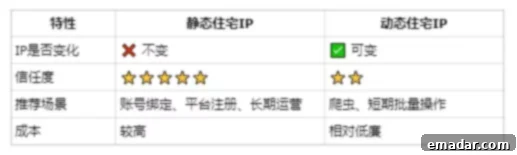
While both static and dynamic residential IPs offer the invaluable advantage of appearing as genuine users, their operational differences dictate their suitability for various business scenarios. Choosing between them is critical for the success and sustainability of your online ventures.
Static Residential IPs excel in scenarios demanding unwavering stability and consistent digital identity:
- Cross-border E-commerce: For merchants operating multiple online stores (e.g., on Amazon, eBay, Shopify) across different regions, assigning a unique, static residential IP to each store prevents account linking and ensures a consistent local presence, significantly reducing the risk of bans or suspensions.
- Multi-Account Management: Businesses managing numerous social media profiles, advertising accounts, or gaming accounts benefit immensely from static residential IPs. Each account can be bound to a dedicated, unchanging IP, fostering trust with platforms and enabling seamless, long-term operation.
- Ad Verification and Compliance: Advertisers and agencies can precisely verify ad placements, content, and targeting in specific geographic locations over time, ensuring compliance and effectiveness without triggering fraud detection systems.
- Brand Protection: Monitoring for trademark infringement, unauthorized sales, or fraudulent activities requires a consistent, untraceable presence. Static residential IPs allow for continuous monitoring from specific locations, mimicking real consumer behavior.
Dynamic Residential IPs are the powerhouse for operations requiring high anonymity and rapid, high-frequency changes:
- Large-scale Web Scraping and Data Aggregation: When collecting vast amounts of public data (e.g., competitor pricing, market trends, public reviews) from numerous websites, rotating IPs frequently is essential to avoid IP bans and CAPTCHAs. Dynamic residential proxies ensure a fresh IP for each request, making scraping efforts efficient and discreet.
- SEO Monitoring and Keyword Tracking: For SEO professionals needing to check search engine rankings, local results, and competitor movements from various geo-locations, dynamic residential IPs provide the necessary anonymity and rotational capability to gather comprehensive data without being blocked.
- Price Comparison and Lead Generation: Businesses can swiftly and anonymously gather pricing data across different e-commerce sites or scrape directories for potential leads, ensuring they always have the most up-to-date information.
- Ad and Content Verification at Scale: While static IPs are good for consistent monitoring, dynamic IPs are perfect for verifying ad displays or content accessibility across a massive number of geo-locations and devices in a short period.
5. How to Choose Your IP Strategy: Tailored Configuration for Efficient Start

Selecting the right IP strategy is not a one-size-fits-all decision. It requires a careful evaluation of your specific goals, the nature of your online activities, your budget, and your tolerance for risk. Here’s a framework to help you make an informed choice:
- Define Your Objective:
- Are you looking to host a stable server? (Likely Static IP)
- Do you need to manage multiple online accounts without detection? (Static Residential Proxy)
- Is your primary goal large-scale data collection or web scraping? (Dynamic Residential Proxy)
- Are you just browsing the internet casually? (Dynamic IP from ISP)
- Do you require high-speed, high-volume data collection for less sensitive targets? (Datacenter Proxy)
- Assess Stability Requirements: If uninterrupted connectivity and a consistent digital identity are paramount (e.g., for e-commerce stores, remote access, or maintaining account trust), then static IPs, particularly static residential proxies, are your best bet. For tasks where short-term connections and rotating identities are beneficial, dynamic IPs or dynamic residential proxies are more suitable.
- Consider Anonymity and Detection Risk: For activities requiring the highest level of anonymity and low detection risk, such as managing sensitive online accounts, bypassing geo-restrictions on high-security websites, or maintaining a persistent, genuine user appearance, residential proxies (both static and dynamic) are superior. If the risk of detection is low or acceptable for your task, datacenter proxies can offer a cost-effective and fast alternative.
- Evaluate Budget Constraints: Generally, dynamic IPs are the most cost-effective. Datacenter proxies offer a good balance of speed and affordability for many automated tasks. Residential proxies, especially static ones, tend to be premium options due to their high trustworthiness and legitimacy, but they offer unparalleled value for critical business operations where avoiding bans is paramount.
- Geographic Targeting Needs: If your operations require you to appear from specific countries, cities, or even ISPs, ensure your chosen proxy provider offers a wide array of geo-locations. Residential proxy networks typically provide the most granular geographic targeting options.
- Scalability of Operations: For operations that require a vast pool of IPs that can be rapidly scaled up or down, dynamic residential proxies or datacenter proxies are usually more flexible. For dedicated, long-term use cases, a smaller pool of static residential IPs might suffice.
For businesses engaged in cross-border e-commerce, multi-account management, or advanced digital marketing, a robust proxy solution is often indispensable. IPFLY offers a comprehensive suite of global residential IPs, designed to meet diverse operational needs, ensuring you have the right tool for every scenario.
6. Conclusion: IP Strategy – Not a Small Detail, But a Pillar of Online Success!
In the complex digital landscape, an effective IP strategy is far from a minor consideration; it’s a foundational element for ensuring secure, private, and efficient online operations. The type of IP address you employ fundamentally dictates your digital environment’s security posture and the perceived authenticity of your online presence. Furthermore, the stability and quality of residential IPs are often the determining factors in the longevity and survival rates of your online accounts, especially in competitive markets. Ultimately, the judicious choice between static and dynamic IPs directly impacts your long-term operational efficiency and overall success.
To summarize your journey from IP novice to expert, remember these essential distinctions:
- An internal network’s dynamic allocation via DHCP signifies a Dynamic IP, ideal for general browsing and offering cost-effectiveness with variable identity.
- A constant, manually configured address provided by your ISP is a Static IP, indispensable for stability, remote access, and hosting dedicated services.
- Utilizing a genuine residential network through a proxy IP translates to a low-risk, high-trust environment, making it the preferred choice for critical cross-border scenarios. For these advanced needs, IPFLY proxy IPs stand out as the premium solution.
Embrace the power of “One Store, One IP – Association Eliminated!”🎯 Equipping each of your online stores or accounts with an independent, dedicated digital identity acts as an indispensable “anti-association shield,” a strategy widely adopted by leading cross-border e-commerce professionals. Don’t let IP-related issues hinder your global ambitions. Click 👉 to unlock your multi-store IP matrix, claim exclusive offers, and effortlessly take command of your overseas operations!