
When embarking on a journey into software development or deciding on a technical stack, the question of “Java vs Python” is almost universally encountered by aspiring and experienced developers alike. Both are among the most popular programming languages globally, yet they possess distinct differences in syntax, execution mechanisms, performance characteristics, and primary application domains. This comprehensive guide will systematically compare Java and Python, helping you determine which language to learn, when to use each, and where they excel in the modern development landscape.

Understanding the Origins and Core Philosophy of Java and Python
Before diving into their practical distinctions, let’s explore the foundational “background” of these two powerful languages, understanding the intentions behind their creation and their inherent design philosophies.
| Aspect | Java | Python |
| Creation Year | 1995, by Sun Microsystems (later acquired by Oracle) | 1991, by Guido van Rossum |
| Language Type | Compiled + Interpreted (compiled to bytecode, then run on a JVM) | Interpreted (executed line-by-line by an interpreter) |
| Key Characteristics | Strongly typed, object-oriented, cross-platform, high security, robust. | Dynamically typed, simple syntax, high development efficiency, highly readable. |
| Core Philosophy | “Write Once, Run Anywhere” (WORA), emphasizing platform independence and reliability. | “Beautiful is better than ugly,” focusing on code readability, simplicity, and developer productivity. |
From their origins, it’s clear that Java was designed with an emphasis on enterprise-grade development, large-scale systems, and engineering robustness. Its “Write Once, Run Anywhere” mantra aimed to solve platform compatibility issues, making it ideal for distributed applications. Conversely, Python was conceived to prioritize rapid development, scriptability, and scientific innovation, with an elegant syntax that makes complex tasks easier to implement and understand.
Syntax Differences: Verbosity vs. Conciseness in Programming
One of the most immediate and striking differences between Java and Python lies in their syntax. This impacts everything from initial learning difficulty to daily coding efficiency and code readability.
1. Syntax Structure and Readability
- Java: Known for its strict, verbose, and explicit syntax. Every variable must have its type declared, and code blocks are defined by curly braces (`{}`). Statements typically end with a semicolon (`;`). This strictness ensures type safety at compile time and makes the code very explicit, which can be beneficial in large team environments.
- Python: Stands out for its elegant, minimalist, and highly readable syntax, often likened to natural language. It is a dynamically typed language, meaning variable types do not need to be explicitly declared. Code blocks are defined by indentation, and semicolons and curly braces are largely optional, contributing to a significantly less cluttered codebase.
Example Comparison: Printing a Simple Message
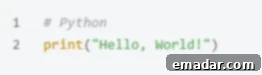
This simple example clearly illustrates the difference: Java requires more boilerplate code, including class definition and method declaration, even for a basic operation. Python’s directness allows for quick scripting and ease of expression. A common analogy is that writing Java feels like constructing a robust, multi-story building from scratch, while writing Python is akin to rapidly assembling functional structures using Lego blocks.
2. Type Systems: Static vs. Dynamic Typing
- Java is a statically typed language: This means that the type of a variable is checked at compile time. Any type mismatches or errors are caught before the program even runs. While this makes Java code more verbose, it leads to fewer runtime errors related to types, enhancing code stability and making large projects easier to maintain and refactor.
- Python is a dynamically typed language: In Python, variable types are determined at runtime. This offers greater flexibility and allows for faster prototyping, as developers don’t need to worry about type declarations. However, it also means that type-related errors might only surface when the specific problematic code path is executed, potentially making debugging more challenging in complex systems without robust testing.
The choice between static and dynamic typing often comes down to a trade-off between early error detection and development speed. Static typing provides safety nets for large, complex applications, while dynamic typing offers agility for rapid development and scripting.
Execution Mechanism Differences: Performance and Concurrency
The way Java and Python code is executed under the hood profoundly impacts their performance, memory usage, and suitability for various types of applications, especially those requiring high concurrency.
| Characteristic | Java | Python |
| Execution Method | Compiled into bytecode (.class files), then executed by the Java Virtual Machine (JVM). The JVM performs Just-In-Time (JIT) compilation for further optimization. |
Interpreted directly by a Python interpreter (e.g., CPython). Code is executed line by line without a separate compilation step to machine code. |
| Performance | Generally faster due to compilation, JIT optimization, and direct execution on the JVM. Can approach C++ speeds for CPU-bound tasks. | Relatively slower than Java for CPU-bound tasks due to the interpretation process and overhead from dynamic typing. |
| Memory Management | Automatic garbage collection (GC) by the JVM, which efficiently manages memory allocation and deallocation, reducing memory leaks. | Automatic garbage collection for memory management. However, Python objects can have higher memory footprints compared to Java objects due to dynamic typing and object overhead. |
| Multi-threading Support | Native, robust multi-threading support. JVM handles thread scheduling and synchronization efficiently, allowing for true parallel execution on multi-core processors. Excellent for high-concurrency applications. | Limited true parallelism due to the Global Interpreter Lock (GIL) in CPython. The GIL ensures only one thread can execute Python bytecode at a time, even on multi-core systems, restricting CPU-bound concurrency. Multi-processing is used to bypass the GIL for CPU-bound parallelism. |
Consequently, Java holds a significant advantage in scenarios demanding high-performance concurrent processing, such as building large-scale backend systems for e-commerce, banking applications, online gaming servers, or critical enterprise software. Its JVM and robust threading model are engineered to handle millions of simultaneous requests efficiently.
Conversely, Python excels in environments requiring rapid development, extensive data manipulation, scripting, and AI/machine learning model building. While its single-thread performance might be lower, its rich ecosystem of C-optimized libraries (like NumPy and Pandas) allows it to perform exceptionally well in numerical and scientific computing. For I/O-bound tasks (network requests, file operations), Python’s asynchronous programming capabilities can also achieve high concurrency.
Ecosystem and Application Domains: Where Each Language Reigns Supreme
The vast ecosystems of libraries, frameworks, and community support built around Java and Python are pivotal in defining their primary application areas and strengths.
| Application Area | Java Strengths | Python Strengths |
| Enterprise Backend | ✅ Dominant with robust frameworks like Spring (Spring Boot, Spring Cloud, Spring Data) and Hibernate. Ideal for scalable, secure, and maintainable large-scale systems. | ❌ Less common for core large-scale enterprise architecture due to performance and dynamic typing concerns, though gaining traction for specific services. |
| Web Development | ✅ Strong with frameworks like Spring Boot (for REST APIs, microservices) and servlet containers like Apache Tomcat. Provides enterprise-grade web solutions. | ✅ Extremely popular for rapid web development with frameworks like Django (full-stack, batteries-included) and Flask (micro-framework). Great for prototyping and complex web applications. |
| Data Analysis & Big Data | ❌ While Hadoop (originally Java) exists, Java itself is less preferred for direct data manipulation. Scala (on JVM) is an option. | ✅ The de-facto standard. Rich ecosystem with libraries like NumPy (numerical computing), Pandas (data manipulation), SciPy (scientific computing), and Matplotlib/Seaborn (data visualization). |
| Artificial Intelligence & Machine Learning | ❌ Limited direct support compared to Python. Deep learning frameworks like Deeplearning4j exist, but Python dominates. | ✅ The undisputed leader. Home to industry-standard frameworks like TensorFlow, PyTorch, Keras, and Scikit-learn. Essential for AI research, development, and deployment. |
| Mobile Development | ✅ The primary language for native Android app development. Kotlin (JVM-based) is also popular, but Java’s foundational role is undeniable. | ❌ Not natively supported for mobile. Relies on third-party frameworks like Kivy or PySide, or hybrid solutions like React Native with Python backend. |
| Financial Services & E-commerce | ✅ Preferred for high-security, high-transaction volume, and high-concurrency systems (e.g., trading platforms, banking applications). Its stability is crucial. | ✅ Used for quantitative finance, algorithmic trading models, risk management, and data analysis within financial institutions due to its powerful data science libraries. |
| Automation & Scripting | ✅ Can be used for automation, but its verbosity makes it less ideal for quick scripts. Selenium + Java is common for test automation. | ✅ Excellent for general-purpose scripting, system automation, web scraping (Beautiful Soup, Scrapy), and automated testing (Pytest, Requests). Its simplicity makes it highly efficient. |
In essence: Java remains the backbone for robust, scalable, and secure enterprise backend systems and native Android development. Its reliability and performance make it indispensable for mission-critical applications where stability is paramount. Conversely, Python is the undisputed champion for AI, machine learning, data science, web development, and automation, primarily due to its expressive syntax and an unparalleled array of specialized libraries that accelerate development in these domains.
Learning Curve and Development Efficiency: A Tale of Two Philosophies
The ease with which a developer can pick up a language and the speed at which they can build applications are significant factors when choosing between Java and Python.
| Metric | Java | Python |
| Entry Difficulty | Medium to high. Requires understanding of object-oriented principles, explicit type declarations, and boilerplate code. | Low. Beginner-friendly syntax, fewer complex concepts to grasp initially, and a focus on readability. |
| Code Readability | Rigorous and explicit, which can make it verbose but also very clear for experienced developers in large codebases. | Highly readable and concise, often resembling pseudocode. Indentation enforces a consistent style. |
| Learning Cost (Time/Effort) | Higher. Involves mastering concepts like the JVM, class hierarchies, interfaces, abstract classes, and complex design patterns. | Lower. Allows for quicker “learn-as-you-go” and rapid prototyping. Focuses on getting things done efficiently. |
| Development Efficiency | Slower for initial setup and rapid prototyping due to strict syntax and compilation steps. Suitable for long-term, large-scale projects. | Very fast for prototyping, scripting, and small to medium-sized projects. Enables quick iteration and deployment. |
Therefore, if you are a programming novice seeking to quickly build scripts, automate tasks, or get into data analysis or AI, Python is an excellent starting point due to its gentle learning curve and immediate productivity. Its simplicity allows for a focus on problem-solving rather than wrestling with language intricacies.
However, if your ambition is to work for large tech companies, contribute to complex enterprise systems, or develop native Android applications, Java remains a robust and highly valued skill. While its initial learning curve might be steeper, the rigor and structure it instills are invaluable for building high-quality, maintainable software at scale.
Performance and Runtime Speed: Benchmarking the Execution
The speed at which a program executes is a critical factor, especially for performance-sensitive applications. Due to its compiled nature and the sophisticated optimizations of the Java Virtual Machine (JVM), Java typically boasts superior performance compared to interpreted Python.
Java code is compiled into bytecode, which is then executed by the JVM. The JVM performs Just-In-Time (JIT) compilation, converting bytecode into native machine code at runtime and applying advanced optimizations. This process allows Java to achieve performance levels that are often comparable to, and sometimes even exceed, those of languages like C++ for CPU-bound tasks.
For example:
- In many common algorithm implementations or intensive loop computations, Java can execute 2 to 5 times faster than standard Python (CPython). This makes it highly suitable for applications where every millisecond counts, such as real-time trading systems or high-frequency data processing.
- However, Python’s performance narrative isn’t as straightforward. While pure Python can be slow for CPU-bound tasks, its strength lies in its ability to seamlessly integrate with C/C++ extensions. Libraries like NumPy and Pandas, fundamental to scientific computing and data analysis, are largely written in optimized C/C++ code. When Python leverages these extensions, its performance for numerical operations or data manipulation can be exceptionally fast, often matching or even surpassing Java for these specific tasks.
Therefore, it’s crucial not to judge a language’s superiority solely based on raw speed. The “best” language depends heavily on the project type, target application scenario, and whether the performance bottleneck is CPU-bound or I/O-bound. For raw computational speed, Java often wins; for leveraging optimized C libraries in data science, Python shines.
Security and Stability: Building Robust Software
For applications where security and stability are paramount, the intrinsic design features of a programming language play a crucial role. Java, by design, incorporates several features that contribute to its high security and robustness.
Java’s strong type checking at compile time, comprehensive exception handling mechanisms, and sophisticated access control features (like modifiers and the Java Security Manager) provide a highly secure and stable execution environment. Its memory management through automatic garbage collection also reduces common programming errors that lead to vulnerabilities (e.g., buffer overflows). This makes Java a preferred choice for developing critical systems where reliability, data integrity, and protection against malicious attacks are non-negotiable requirements.
Python, on the other hand, is known for its open and flexible nature. While this flexibility boosts development speed, it can sometimes introduce challenges in large, complex, and highly distributed systems. The dynamic typing, if not rigorously tested, can lead to runtime type mismatches or unexpected behavior. While Python’s ecosystem offers tools and best practices to mitigate these risks, the language itself doesn’t impose the same level of compile-time scrutiny as Java. This is precisely why sectors like banking, insurance, and large government systems continue to predominantly rely on Java for their core infrastructure, prioritizing its battle-tested stability and security features.
Employment and Industry Trends: Navigating the Job Market
For developers choosing a language, understanding the current job market and future industry trends is vital for career planning.
- Java Job Market: Java remains a bedrock of the software industry. Job roles are predominantly in backend development, Android application development, and large-scale enterprise systems (especially in finance, telecom, and healthcare). These positions are typically stable, offering competitive salaries and established career paths within large organizations. Java developers are highly sought after for building scalable, high-performance, and secure applications.
- Python Job Market: Python’s job opportunities are experiencing rapid growth, particularly in emerging fields. These roles are concentrated in artificial intelligence, machine learning, data science, big data engineering, automation testing, web development (Django/Flask), and quantitative finance. The demand for Python skills is fueled by the explosion of data and AI applications, offering dynamic career paths and often higher growth potential in innovative sectors.
According to various global hiring data and developer surveys, Python has seen a faster rate of adoption and growth in recent years, reflecting its versatility and dominance in new tech domains. However, Java continues to hold a strong and stable position as the leading language for enterprise-grade applications, underpinning a vast amount of the world’s critical digital infrastructure. Both languages offer excellent career prospects, but they cater to slightly different segments of the tech industry.
Beyond Comparison: Choosing a Language in the AI Era
The rise of artificial intelligence, cross-border e-commerce, and intelligent applications has reshaped the landscape of programming language relevance. Python, with its powerful libraries and active community, has become the de-facto “standard language” for AI research, development, and experimentation. Its ease of use and rich data science ecosystem accelerate the iterative process of model building and analysis.
However, when it comes to deploying these AI models into production and providing robust, scalable backend support, Java continues to be a primary choice. Enterprise-grade AI applications often require the performance, security, and stability that Java excels at. This has led to the emergence of a prevalent “hybrid architecture” in the industry. For instance, the core AI algorithm or model training might be developed and run in Python, but the inference services or the API endpoints that serve these models to users are frequently implemented and managed by Java servers. This approach allows organizations to leverage the best of both worlds: Python’s agility for AI development and Java’s robustness for production deployment and backend infrastructure.
Conclusion: Aligning Your Goals with the Right Programming Language
Ultimately, the choice between Java and Python isn’t about one being inherently “better” than the other. It’s about clarifying your specific goals and target application scenarios. Both languages are exceptionally powerful and have vibrant ecosystems, making them invaluable tools in a developer’s arsenal.
- If your ambition is to build scalable, high-performance, and secure backend systems for large enterprises or develop native Android applications, Java is the clear choice. Its structured nature and robust ecosystem are designed for long-term maintainability and reliability.
- If you’re passionate about artificial intelligence, machine learning, data science, scientific computing, or rapid web development and automation, Python is your go-to language. Its simplicity and extensive libraries will accelerate your progress in these innovative fields.
- For those aiming to become a full-stack developer or tackle diverse projects, learning both languages can provide a significant advantage. Mastering both allows you to choose the optimal tool for each component of a system, or even combine them in hybrid architectures to maximize efficiency and performance.
In real-world projects, especially those involving global deployments, data scraping, or accessing overseas servers for AI training, developers often face challenges like IP environment isolation, cross-border network access, and ensuring stable connectivity. In such cases, leveraging specialized proxy services like IPFLY can be crucial. With over 90 million IP resources spanning 190+ countries, IPFLY provides a stable, secure, and reliable network environment essential for tasks like AI model training, web scraping, market intelligence, and cross-border development, ensuring your applications perform optimally regardless of geographic constraints.
The evolution of technology is rarely a victory for a single language, but rather a testament to the power of ecological synergy. The true core competency of a modern programmer lies not just in mastering one language, but in understanding how to effectively utilize various tools and adopt a multi-language mindset to solve complex problems efficiently and innovatively.