
Enhancing Network Security and Performance with ISP Whitelisting: A Comprehensive Guide
In today’s interconnected digital landscape, organizations face an ever-growing barrage of cyber threats. From sophisticated phishing attacks and ransomware to large-scale distributed denial-of-service (DDoS) campaigns, protecting critical assets and sensitive data has become paramount for businesses of all sizes. One of the most effective, yet often underutilized, strategies in a robust cybersecurity framework is the implementation of an Internet Service Provider (ISP) whitelist. This comprehensive guide explores the strategic importance, technical intricacies, and advanced solutions for leveraging ISP whitelisting to fortify your network defenses, improve operational efficiency, and ensure stringent regulatory compliance in a complex global environment.
Understanding the Strategic Value and Technical Positioning of ISP Whitelisting
An ISP whitelist operates on the principle of explicit permission: only network traffic originating from pre-approved Internet Service Providers is granted access to your systems and resources. This proactive security approach significantly reduces the attack surface by inherently blocking all traffic from untrusted, unknown, or potentially malicious sources. By defining a perimeter based on known and reputable ISPs—such as China Telecom, AT&T, Verizon, Deutsche Telekom, or British Telecom—businesses can establish a foundational layer of trust. This ensures that only legitimate and expected connections are allowed to interact with their digital infrastructure, creating a secure and predictable network environment.
Fortified Risk Reduction and Proactive Threat Mitigation
The primary and most critical benefit of an ISP whitelist is its unparalleled capacity for advanced risk reduction. By restricting network access exclusively to IPs from authorized ISPs, organizations can effectively block a vast array of malicious traffic at the earliest possible point. This includes, but is not limited to, automated attacks from botnets, ransomware distribution networks, brute-force credential stuffing attempts originating from compromised residential IPs, various forms of reconnaissance activities, and spam campaigns often conducted from suspicious or unknown ISP ranges. This preventative measure acts as a formidable first line of defense, stopping threats at the network edge before they can even reach internal systems or applications. It fundamentally shifts the security posture from reactive detection and response to proactive prevention, significantly lowering the probability of successful cyberattacks, data breaches, and their associated financial and reputational damages.
Ensuring Regulatory Compliance and Data Sovereignty
In an era of stringent global data protection regulations, ISP whitelisting plays a crucial role in helping organizations maintain compliance and uphold data sovereignty. For businesses dealing with cross-border data flows, aligning with international standards such as the General Data Protection Regulation (GDPR) in Europe, China’s Data Security Law, the California Consumer Privacy Act (CCPA), and industry-specific regulations like HIPAA or PCI DSS is non-negotiable. By explicitly controlling which ISPs can access sensitive data or systems, businesses can enforce strict geographical restrictions and data residency requirements. For instance, an organization can configure its systems to only accept connections from ISPs located within specific compliant regions, thereby ensuring that personal data remains within designated legal boundaries. This proactive measure significantly reduces the risk of non-compliance fines, legal repercussions, and severe reputational damage.
Optimized Performance and Enhanced User Experience
Beyond its robust security advantages, ISP whitelisting also offers tangible performance benefits. By prioritizing and channeling traffic exclusively through high-reputation and trusted ISPs, businesses can ensure faster, more reliable, and lower-latency content and service delivery. This is particularly advantageous for services utilizing Content Delivery Networks (CDNs), where traffic routing through established, high-bandwidth ISP networks can dramatically reduce latency and improve page load times. For applications requiring consistent high performance and responsiveness, such as real-time financial trading platforms, high-definition streaming services, online gaming, or voice-over-IP (VoIP) communications, this network optimization translates directly into a superior and seamless user experience. It helps prevent network bottlenecks, minimizes packet loss, and ensures smooth, uninterrupted access for legitimate users.
Versatile Use Cases Across Diverse Industries
The applicability and benefits of ISP whitelisting extend across a wide spectrum of industries and operational scenarios, proving its versatility as a core security and performance tool:
- Enterprise VPN Access: Limiting Virtual Private Network (VPN) access exclusively to pre-approved partner ISPs ensures that remote connections originate only from trusted corporate networks or verified partner locations, significantly enhancing security for sensitive internal resources and proprietary data.
- Streaming and Content Platforms: Unlocking premium content, such as 4K streaming or region-specific media, only for subscribers connecting through specific, verified ISPs helps content providers manage distribution rights, prevent geo-piracy, and ensure a consistent quality of service for legitimate users.
- Financial Systems and Banking: Implementing stringent controls to block transactions, login attempts, or administrative access from non-trusted or high-risk regions or ISPs fortifies defenses against financial fraud, account takeovers, and unauthorized financial activities, protecting both institutions and their customers.
- E-commerce and Online Retail: Preventing sophisticated bot traffic, fraudulent purchases, and competitor scraping by restricting access to known legitimate residential ISPs, particularly in regions prone to cybercrime, helps maintain fair market practices and protects revenue.
- Critical Infrastructure Protection: Securing Operational Technology (OT) networks, Industrial Control Systems (ICS), and other critical infrastructure components by allowing access only from a very limited set of highly controlled and continuously monitored ISPs, mitigating risks to essential services.
- Government and Defense Agencies: Implementing whitelists for classified networks and sensitive communications ensures that all traffic originates from government-approved secure networks, preventing espionage and unauthorized access to national security assets.

Navigating the Challenges of ISP Whitelist Implementation and Advanced Solutions
While the benefits of ISP whitelisting are clear and compelling, implementing and managing it effectively in modern, dynamic network environments presents several practical challenges. Organizations require sophisticated solutions to overcome these hurdles and ensure their whitelist remains accurate, efficient, and aligned with evolving security paradigms.
1. Addressing Dynamic IP Allocation Errors
Issue: A significant and persistent challenge arises from the widespread use of dynamic IP addresses, especially by residential ISPs. Unlike static IPs, dynamic IPs are frequently reassigned to different users by the ISP. This means an IP address that was once trusted and whitelisted might later be allocated to an unauthorized user, a malicious entity, or even a different geographic location. This constant churn renders traditional, static whitelists quickly outdated, leading to legitimate users being inadvertently blocked (false positives) or, worse, malicious actors gaining unintended access if the whitelist isn’t meticulously and continuously updated. The administrative overhead required to manually manage such a dynamic environment is often unsustainable at scale.
Solutions:
- IP Range Aggregation using ASN (Autonomous System Number): Instead of attempting to whitelist individual IP addresses, a far more robust and scalable approach involves authorizing entire IP ranges or Autonomous System Numbers (ASNs) associated with a trusted ISP. An ASN is a globally unique identifier for a group of IP networks operated by one or more network operators that has a single and clearly defined external routing policy. For instance, whitelisting
AS4134for China Telecom allows all IPs under that specific ASN to access the network. This method inherently accounts for dynamic IP changes within a trusted ISP’s infrastructure, as the ASN itself remains stable, significantly reducing the need for constant manual updates. It provides a broader, more stable, and administratively efficient trust boundary. - Real-Time Verification via APIs and Geolocation Services: Implementing real-time verification mechanisms is crucial for maintaining whitelist accuracy. This involves using specialized APIs, such as those offered by IP2Location, MaxMind, or other reputable geolocation services, to validate the ISP ownership and geographic origin of an incoming IP address. Before granting access, the system queries the API to confirm that the connecting IP belongs to an authorized and whitelisted ISP within an approved region. This ensures that even with dynamic IP allocation, the whitelist remains accurate and effective, adding an immediate and dynamic layer of verification to every access request.
2. Mastering Global Multi-ISP Coordination and Management
Issue: For organizations operating on a global scale, managing and coordinating whitelists across hundreds or even thousands of diverse ISPs in different countries becomes an incredibly unwieldy, complex, and inefficient task. Each region may have its own dominant ISPs, varying IP allocation practices, unique regulatory landscapes, and specific network behaviors. Manual management of such a vast and fragmented network is highly prone to errors, incredibly time-consuming, and simply unsustainable at scale, hindering global expansion, consistent security policy enforcement, and operational agility.
Solutions:
- AI-Powered Engine for Automated Identification and Policy Enforcement: Leveraging advanced Artificial Intelligence (AI) and machine learning engines can revolutionize the process of identifying, categorizing, and continuously monitoring trusted ISPs. These intelligent systems can analyze vast amounts of network traffic logs, user behavior patterns, threat intelligence feeds, and ISP reputation data to intelligently detect legitimate ISPs, identify anomalies, and flag suspicious ones in real-time. This capability not only dramatically reduces manual effort and improves accuracy but also allows for proactive adaptation to new threats, network changes, and evolving compliance requirements.
- Certified Proxy Integration with Global Coverage: Integrating with a globally certified, robust proxy pool, like that offered by IPFLY, provides a streamlined and highly effective solution. Such platforms offer access to a vast network of verified, legitimate residential and datacenter IP addresses across 190+ countries and territories. By routing traffic through these certified and managed proxies, organizations can significantly simplify their whitelist management. They can trust the proxy provider to maintain a robust, compliant, and continuously updated network of IP addresses, thereby eliminating the cumbersome need to manage individual ISP relationships and their dynamic IP allocations directly.
3. Harmonizing ISP Whitelisting with Zero Trust Architecture
Issue: The modern security paradigm of Zero Trust, which fundamentally operates on the principle of “never trust, always verify” and demands authentication and authorization for every access request, seemingly presents a conflict with the concept of a static whitelist that inherently “trusts” certain ISPs. A purely static whitelist, if not intelligently integrated, might inadvertently undermine the granular, context-aware verification steps central to Zero Trust. It could potentially create blind spots if an authorized ISP’s network is compromised or if an internal user, connecting from a whitelisted ISP, deviates from expected behavior.
Solutions:
- Dynamic Whitelisting with Adaptive Security Policies: Instead of rigid, static “allow or deny” rules, implement dynamic whitelisting as part of an adaptive security policy. This approach applies whitelists only to low-risk ISP traffic or in specific, well-defined contexts where a high degree of trust has been established. For higher-risk scenarios, or when traffic originates from potentially compromised but whitelisted ISPs, stricter enforcement mechanisms are triggered. These can include Multi-Factor Authentication (MFA), continuous authentication checks, behavioral analytics to detect anomalies, or even step-up authentication. This method effectively combines the efficiency of whitelisting with the strong, continuous verification principles of Zero Trust.
- Micro-Segmentation for Granular Access Control: Apply the principle of micro-segmentation directly to ISP whitelisting strategies. Rather than maintaining a monolithic, network-wide whitelist, segment your network into smaller, isolated zones and apply highly specific, context-aware ISP access policies to each segment. For example, you could restrict access to critical US finance systems exclusively to users connecting via
AS7922 (Comcast)within specific geographic parameters (e.g., only from authorized corporate offices), while allowing different ISPs for less sensitive applications or public-facing services. This ensures that even within a trusted ISP’s network, access is granted only to the precise resources needed, adhering strictly to the principle of least privilege.
IPFLY Tech Empowerment: Advanced Enterprise ISP Whitelist Management Solutions
IPFLY stands at the forefront of network optimization and cybersecurity, offering sophisticated solutions meticulously designed to empower enterprises with superior ISP whitelist management capabilities. Our cutting-edge technology is purpose-built to address the inherent complexities of global network operations, providing unparalleled reliability, exceptional performance, and robust compliance assurance.
1. Unrivaled Trusted ISP Proxy Pool
IPFLY provides enterprises with exclusive access to an extensive and meticulously curated pool of ISP-certified proxies, ensuring that your critical traffic flows through only the most reputable, secure, and legitimate channels.
- Verified Sources and Unquestionable Authenticity: All IP addresses within our vast network are sourced directly from established, legitimate, and tier-1 Internet Service Providers globally, including industry leaders such as Verizon, NTT, China Telecom, AT&T, and many others. This rigorous, multi-layered verification process guarantees the absolute authenticity, reliability, and stellar reputation of every IP address you utilize, minimizing detection risks.
- Comprehensive Compliance Reports and Auditable Trails: We go beyond simple IP provision by conducting regular, in-depth monthly ISP audits. Clients receive detailed compliance reports that demonstrate our adherence to critical international security standards, including SOC2 Type II and ISO27001. This level of transparency and documentation assures our clients that their network interactions and data handling practices meet the highest standards of data security, privacy, and regulatory compliance, which is absolutely crucial for highly regulated industries.
2. Intelligent Traffic Routing for Optimal Performance and Enhanced Security
Our intelligent traffic routing capabilities extend far beyond conventional IP blocking, offering advanced features for fine-grained control, proactive anomaly detection, and adaptive security responses across your network.
- ASN-Level Rules with Seamless Integration: IPFLY empowers businesses to create sophisticated and highly granular ASN-level rules. This allows for the automatic permission or denial of traffic based on entire ISP networks, providing a powerful layer of control. For instance, you can effortlessly auto-allow all traffic originating from
AS7018 (AT&T)by integrating directly with your existing network infrastructure, such as Nginx web servers, or programmatically via the IPFLY API. This automation streamlines policy enforcement, ensures consistent application across diverse geographical environments, and significantly reduces manual configuration errors. - Proactive Anomaly Blocking and Dynamic Threat Response: Our system is engineered with advanced machine learning algorithms to continuously monitor and detect anomalous behavior in real-time. This includes sophisticated attempts to bypass security measures via unauthorized VPNs, proxy networks, or other evasion techniques. Upon the immediate detection of suspicious activity, the system can automatically trigger pre-defined, dynamic responses, such as instantly blocking the suspicious traffic, escalating detailed alerts to your security operations center, or enforcing Multi-Factor Authentication (MFA) to re-verify user identity and access context. This adds an essential, dynamic layer of security to your whitelisting strategy.
3. Unlocking Significant Cost Efficiencies and Value
IPFLY’s innovative pricing structures and powerful suite of tools are meticulously designed to deliver substantial cost savings to enterprises without compromising on the highest standards of security, performance, or reliability.
- Flexible Pay-Per-ISP Elastic Pricing Model: Our groundbreaking elastic pricing model allows organizations to pay only for the exact ISP access and resources they utilize, rather than incurring the often exorbitant and inflexible fixed costs associated with traditional hardware firewalls, complex on-premise solutions, or bundled software licenses. This “pay-per-ISP” approach offers remarkable financial flexibility and scalability, allowing businesses to adapt their network infrastructure to fluctuating demands, potentially reducing operational expenditures by as much as 45% compared to conventional solutions.
- Empowering Free Tools and Resource Generators: We provide a comprehensive suite of complimentary tools designed to empower your security and network teams. These resources include an intuitive ISP reputation scoring system, which provides real-time insights into the trustworthiness of various ISPs, and powerful rule generators that simplify the creation and management of complex whitelist policies. These free-to-use tools significantly reduce administrative overhead, accelerate decision-making, and enhance your overall security posture without additional investment.

IPFLY ISP Whitelist Solutions: Global Compliance and Unmatched Reliability at Scale
As a recognized global leader in network optimization and cybersecurity, IPFLY offers a comprehensive portfolio of three core solutions. Each solution is meticulously engineered for seamless ISP whitelist integration, catering to the diverse enterprise needs for unwavering stability, exceptional agility, and unparalleled speed across global operations.
Static Residential IP Whitelists: Unwavering Stability and Authenticity for Persistent Operations
For operations demanding consistent, long-term IP stability and absolute authenticity, our Static Residential IP Whitelists represent the definitive choice for critical enterprise applications.
- Key Advantages: We provide real, ISP-assigned fixed IP addresses, such as dedicated nodes strategically located in major global hubs like London, UK. These IPs come with official certification from their respective ISPs, guaranteeing their legitimacy and significantly reducing the likelihood of detection, blocking, or blacklisting—achieving an impressive <1% blocking rate. Our service supports widely used protocols including HTTP, HTTPS, and Socks5, offering versatile integration options for both straightforward manual browser setups and advanced, complex enterprise API applications, ensuring secure and flexible connectivity.
- Ideal Use Cases: This solution is perfectly suited for long-term cross-border e-commerce operations that require a stable geographic presence for market analysis or sales, secure social media account matrix management (e.g., daily Facebook US account maintenance for brand presence), consistent brand monitoring, and reputation management where IP credibility is paramount for maintaining trust and avoiding detection.
Dynamic Residential IP Whitelists: Agility and Scale for High-Frequency and Evasive Tasks
When high-frequency tasks, large-scale data collection, and the intelligent evasion of sophisticated detection mechanisms are critical, our Dynamic Residential IP Whitelists provide the necessary agility, immense scale, and unparalleled flexibility.
- Key Advantages: Clients gain access to a vast, continuously updated pool of over 90 million global dynamic residential IP addresses. These can be precisely filtered by country, region, and even specific city (e.g., target specific nodes in Vancouver, Canada, or Frankfurt, Germany). The system features advanced automatic IP rotation capabilities, intelligently switching nodes (e.g., every 50 requests or based on time intervals) to effectively bypass sophisticated anti-crawl and anti-bot detection mechanisms, such as those employed by TikTok, Google, or other data-sensitive platforms. This ensures uninterrupted data access and operational continuity.
- Ideal Use Cases: This solution excels in demanding scenarios such as large-scale data scraping operations (e.g., collecting Indeed US job data, competitive pricing intelligence), comprehensive SEO keyword rank monitoring across multiple regions and search engines, market research initiatives requiring diverse geographic perspectives without detection, and ad verification to ensure proper ad placement and delivery.
Dedicated Datacenter IP Whitelists: Priority for High-Speed, High-Volume, and Low-Latency Operations
For mission-critical applications where speed, ultra-low latency, and massive bandwidth are non-negotiable requirements, our Dedicated Datacenter IP Whitelists deliver unparalleled performance and reliability.
- Key Advantages: We offer exclusive, high-speed nodes with ultra-low latency, typically less than 80ms, exemplified by our Frankfurt, Germany nodes specifically optimized for European servers. This makes them inherently ideal for real-time streaming, high-frequency trading, online gaming, and other time-sensitive operations where every millisecond counts. Furthermore, unlimited bandwidth support significantly boosts enterprise batch operations, large-scale data transfers, and concurrent processes by over 30%, ensuring rapid completion of intensive tasks without throttling.
- Ideal Use Cases: This solution is critical for automated testing scenarios (e.g., multi-region APP compatibility testing, performance testing), rapid financial data synchronization (e.g., real-time forex platform updates, stock market data feeds), large-scale content delivery for high-demand media, cloud-based rendering, and any data processing task where raw throughput and instantaneous response times are key performance indicators.

ISP Whitelist Setup Guide: Leveraging IPFLY for Seamless Integration and Optimization
Implementing an ISP whitelist with IPFLY is a straightforward process designed for both ease of use and powerful, granular control. This comprehensive guide outlines the essential steps to get your network secured, optimized, and fully operational with IPFLY’s cutting-edge solutions.
Step 1: Choose the Right Whitelist Plan Tailored to Your Specific Needs
Begin your journey by visiting the official IPFLY website at https://www.ipfly.net. Our intuitive platform offers a diverse variety of node types and flexible plans, each meticulously tailored to different operational requirements and security postures. Carefully evaluate your specific use case—whether you need unwavering static stability for long-term presence, dynamic agility for high-frequency data collection, or dedicated high-speed performance for real-time applications—and select the most suitable plan. For example, you might opt for “Dynamic Residential Nodes – Asia Plan” for regional high-frequency tasks, or a Static Residential plan for persistent access needs in a specific location. Consider key factors such as desired geographic coverage, required bandwidth, IP rotation frequency, and the level of anonymity needed.
Step 2: Node Configuration and Seamless Whitelist Synchronization
Once your ideal plan is selected and activated, proceed with configuring your chosen nodes and integrating them seamlessly with your existing network infrastructure. IPFLY offers flexible integration options to accommodate both individual users and large-scale enterprise deployments:
Manual Setup (Example: Google Chrome Browser)
For individual users, small teams, or specific application requirements, manual setup is quick, intuitive, and offers direct control. Navigate to your browser’s proxy settings (e.g., in Google Chrome: go to “Settings → Advanced → System → Open proxy settings”). Within the network settings, you can input the specific IPFLY node IP address and port number provided in your secure account dashboard under “Manual proxy configuration.” Our nodes robustly support both Socks5 and HTTP/HTTPS protocols, offering broad compatibility with various applications and ensuring secure, encrypted communication where needed. This method allows you to directly control which applications, browsers, or systems utilize the whitelisted IP, providing immediate localized benefits.
Developer API Call for Enterprise-Grade Integration and Automation
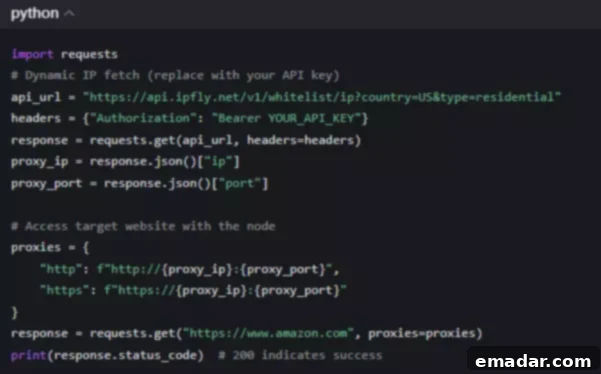
For large-scale deployments, robust automation, and seamless integration into existing enterprise systems and custom applications, IPFLY provides a powerful and well-documented Developer API. This API allows programmatic access to manage your proxy nodes, dynamically retrieve current IP lists, and synchronize your whitelist configurations directly with your applications, servers, or network security devices. Developers can use standard HTTP requests from any modern programming language (e.g., Python, Java, Node.js, PHP) to dynamically fetch and apply whitelisted IP addresses. This enables advanced functionalities such as automatic IP rotation, real-time blacklist/whitelist updates, and integration with custom security policies, ensuring your infrastructure always uses the most current, secure, and optimal IP assignments without any manual intervention, dramatically increasing operational efficiency and security posture.
Step 3: Effect Verification and Continuous Optimization for Peak Performance
After completing the configuration steps, it is absolutely crucial to rigorously verify the setup and continuously optimize for peak performance. These essential steps ensure that your ISP whitelist is operating precisely as intended and delivering maximum value and security:
- Confirm IP Location and Authenticity: Utilize a reputable “WhatIsMyIP” service (e.g., IP2Location.com, WhatIsMyIP.com) to confirm that your detected public IP address and associated geographic location accurately match the target region of your chosen IPFLY node. This critical verification step ensures that your traffic is indeed routing through the whitelisted ISP and the specific location you intended, preventing misconfigurations or unexpected routing.
- Test Network Speed and Latency: Conduct comprehensive download and upload speed tests using reliable services like SpeedTest.net or Fast.com. For residential nodes, aim for consistent download speeds greater than 10Mbps, while dedicated datacenter nodes should ideally achieve speeds exceeding 50Mbps, often much higher. Measure latency (ping) to target servers to ensure optimal response times. Consistent high speeds and low latency indicate optimal routing, robust network health, and efficient proxy performance, ensuring your operations are not hindered by unexpected slowdowns or bandwidth limitations. Regularly monitoring these key metrics allows for continuous optimization, proactive troubleshooting, and prompt identification of any potential issues, guaranteeing sustained peak performance.
Future Trends in ISP Whitelisting: Towards AI-Driven Trust Models and Advanced Security
The landscape of network security is continually evolving, driven by rapid technological advancements and increasingly sophisticated cyber threats. ISP whitelisting is poised for significant future advancements, propelled by emerging technologies that promise more intelligent, adaptive, and resilient trust models for global networks.
- Federated Learning for Cross-Enterprise ISP Risk Profiling: This innovative approach will enable multiple organizations to collaboratively train advanced Artificial Intelligence (AI) and machine learning models on vast ISP risk profiles without the need to directly share sensitive raw data. This collective intelligence will facilitate real-time, dynamic updates on emerging threats, newly compromised ISP networks, and evolving malicious patterns. The result will be a more robust, responsive, and globally aware whitelist that benefits all participating entities, enhancing collective cybersecurity.
- Blockchain Audits for Immutable ISP Certification and Trust: Blockchain technology offers the transformative potential for creating immutable, transparent, and cryptographically secured records of ISP certifications, reputation scores, and network trustworthiness. This distributed ledger could provide irrefutable, verifiable proof of an ISP’s legitimacy and compliance, making it significantly harder for malicious actors to spoof identities, manipulate routing, or compromise network segments. It would streamline global compliance verification processes, enhance supply chain security, and build unparalleled trust within the digital infrastructure.
- 5G Network Slicing for Carrier-Grade Whitelists and Dedicated Bandwidth: As 5G networks become ubiquitous and foundational to modern digital infrastructure, network slicing will allow for the creation of dedicated, isolated virtual networks tailored for specific applications or enterprise use cases. This capability will enable the implementation of true carrier-grade whitelists that can enforce granular access controls and security policies directly within the telecom infrastructure itself. This will provide unparalleled security guarantees, ensured bandwidth, ultra-low latency, and enhanced reliability for critical enterprise applications, revolutionizing how businesses secure and manage their connectivity.

Conclusion: Fortify Your Network with IPFLY ISP Whitelisting Solutions for a Secure Future
In a rapidly evolving digital landscape where cyber threats are constantly adapting and becoming more sophisticated, a proactive, intelligent, and multi-layered approach to network security is no longer an option but an absolute necessity for every organization. ISP whitelisting, when implemented strategically and managed effectively, offers a remarkably powerful defense mechanism that simultaneously enhances your security posture, ensures stringent regulatory compliance across borders, and significantly boosts overall network performance. By explicitly defining trusted network entry points and blocking all unverified traffic, organizations can dramatically reduce their attack surface and robustly protect their invaluable digital assets, sensitive data, and critical operational systems.
IPFLY stands as your trusted and innovative partner in this critical endeavor, providing cutting-edge ISP whitelist solutions that are not only robust and highly reliable but also incredibly flexible and scalable to meet the demands of any enterprise, regardless of size or global reach. From meticulously verified static and dynamic residential IPs to ultra-high-speed dedicated datacenter nodes, and supported by intelligent traffic routing, advanced anomaly detection, and cost-efficient operational models, IPFLY empowers businesses to achieve unparalleled fine-grained access control and optimal network performance. Embrace the future of secure, compliant, and high-performing networks by leveraging IPFLY’s advanced solutions.
To enhance your network security, optimize performance with ISP whitelisting, and explore how IPFLY can help you achieve precise, fine-grained access control while navigating the complexities of the global digital environment, we invite you to visit the IPFLY official website. Discover our comprehensive range of industry-leading proxy services and innovative tools meticulously designed to help you manage your network more efficiently, more securely, and in full compliance with all relevant global standards and regulations.