
The term “ISP” frequently appears in the digital landscape, yet its full meaning and significance are often overlooked by the average user. ISP stands for Internet Service Provider, a crucial entity that acts as the essential bridge connecting your devices to the vast global internet. Understanding what an ISP is means recognizing its indispensable role within the internet’s foundational infrastructure.
More specifically, an Internet Service Provider is an organization that offers a wide array of internet access and related information services to consumers and businesses alike. ISPs come in various categories, differentiated by their service scope and operational capabilities. These include access-oriented ISPs that provide home broadband (such as Comcast, AT&T, or China Telecom), service-oriented ISPs that focus on content delivery and hosting, and transit-oriented ISPs that manage the high-capacity backbone networks. Regardless of their specific type, the primary mission of every ISP remains the same: to seamlessly connect user devices to the interconnected global network, enabling the free and efficient flow of information from one end to another.
To truly grasp the essence of an ISP, one must understand its three core functionalities. Firstly, the Physical Connection Function: ISPs establish physical links between user terminals and the internet’s backbone network using diverse mediums like fiber optics, copper cables, and wireless base stations. Secondly, the IP Address Allocation Function: ISPs assign unique public IP addresses to users from their allocated IP address pools. This assignment is fundamental, as an IP address serves as the unique identifier for a device on the internet, allowing it to send and receive data. Thirdly, the Routing and Forwarding Function: ISPs maintain intricate routing tables that ensure data packets sent by users are accurately delivered to their intended destination servers, and equally important, that response data is correctly returned to the user. These foundational functions collectively ensure the smooth and reliable operation of your internet experience.
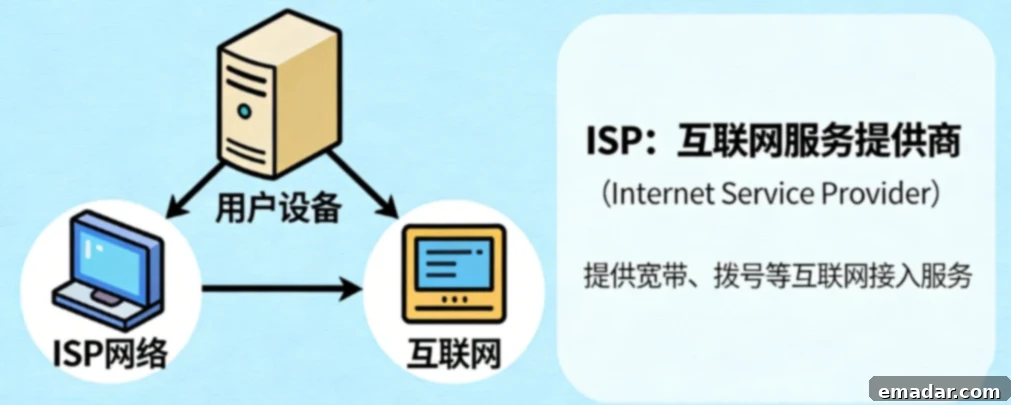
ISP Technical Architecture: From User Device to Global Interconnectivity
A deeper understanding of what an ISP entails requires an examination of its technical architecture and the hierarchical layers of the internet. The internet is not a flat, undifferentiated network but rather a meticulously structured system where various ISPs operate at different levels, each playing a distinct role in ensuring global connectivity. This layered approach enhances efficiency, scalability, and resilience across the vast network.
Access Layer ISPs (Tier 3 ISPs)
These are the ISPs closest to the end-user, directly providing broadband internet access services to homes and businesses. When you sign up for home internet or a dedicated business line, you are typically contracting with an access layer ISP. These Internet Service Providers own and operate local access networks, which might include fiber optic networks, DSL networks, or cable television networks, covering a specific geographic area. However, they generally lack the extensive infrastructure for long-haul, cross-regional data transmission. Consequently, Tier 3 ISPs purchase transit services from higher-tier ISPs to connect their local networks to the broader internet. They are responsible for directly assigning IP addresses to their users, whether dynamic IPs for residential broadband or static IPs for business lines. Understanding this allocation mechanism is crucial for comprehending subsequent proxy IP technologies, as it highlights the origin and characteristics of the IP addresses you use.
Regional Layer ISPs (Tier 2 ISPs)
Regional layer ISPs possess more extensive network infrastructure, typically covering larger geographical areas such as provinces, countries, or even multiple regions. These ISPs serve a dual role: they provide upstream connectivity to Tier 3 ISPs, enabling them to reach the global internet, and they may also offer direct dedicated internet access to large enterprises. Tier 2 ISPs frequently engage in “peering” with other Tier 2 ISPs. Peering is a direct exchange of internet traffic between two networks, often without charge, reducing their reliance on purchasing expensive transit services from Tier 1 ISPs. This strategic peering helps optimize network paths, improve latency, and lower operational costs for regional providers. Their networks are more robust and designed to handle greater traffic volumes than access layer ISPs, forming a critical intermediate layer in the internet’s global mesh.
Backbone Layer ISPs (Tier 1 ISPs)
At the pinnacle of the internet’s architecture are the backbone layer ISPs, also known as Tier 1 ISPs. These elite Internet Service Providers own and operate vast global transmission networks, spanning entire continents or multiple major regions. They are distinguished by the fact that they do not purchase upstream transit services from any other network; instead, they peer with every other Tier 1 ISP to achieve global reachability. Essentially, they are the “internet backbone” itself. There are only a handful of true Tier 1 ISPs worldwide, such as Level 3 (now Lumen Technologies), NTT, and GTT, among others. When a user accesses a website, their data packets traverse multiple ISP networks: originating from an access layer ISP, passing through regional layer ISPs, potentially crossing a backbone layer ISP, and finally reaching the ISP network where the target server resides. The complexity of this path and the quality of each segment of the network collectively determine the user’s overall internet experience, affecting speed, reliability, and latency.
IP Address Allocation Mechanism: ISP’s Core Resource Management
To fully grasp what an ISP signifies, one must delve into its fundamental role in IP address allocation. IP addresses are akin to unique “street addresses” on the internet, and the way ISPs manage and distribute these addresses directly influences the network identity and characteristics of their users. This core function is critical for the internet’s organized operation and has significant implications for online security and service delivery.
IPv4 Address Scarcity and Allocation Hierarchy
IPv4 addresses, utilizing a 32-bit encoding scheme, theoretically offer approximately 4.3 billion unique addresses. However, due to initial inefficient allocation and the explosive growth of the internet, IPv4 addresses have become a scarce commodity. The allocation process is hierarchical: IANA (Internet Assigned Numbers Authority) distributes large blocks of IP addresses to the five RIRs (Regional Internet Registries) globally. Each RIR, in turn, allocates smaller blocks to national-level ISPs, and ultimately, these addresses are distributed by access layer ISPs to individual users and businesses. This structured allocation ensures a managed distribution of a finite resource.
ISP IP address management strategies typically include:
- Dynamic Allocation: Most home broadband users are assigned dynamic IP addresses. This means their IP address changes each time they connect to the internet (e.g., dial-up) or at regular intervals. This method conserves IP address resources but results in an unstable network identity for the user.
- Static Allocation: Enterprise customers requiring dedicated internet access often receive fixed, static IP addresses. These are essential for hosting servers, deploying business systems, or ensuring consistent remote access. Static IPs offer stability but come at a significantly higher cost than dynamic IPs due to their scarcity and dedicated nature.
- NAT (Network Address Translation) Sharing: To further mitigate IPv4 address scarcity, ISPs commonly employ NAT. This technology allows multiple devices within a private network to share a single public IP address. While effective in conserving addresses, NAT can introduce complexities for certain applications and services that require direct, public IP visibility.
Geographical and Ownership Attributes of IP Addresses
IP addresses assigned by ISPs carry a wealth of metadata. Through IP lookup services, one can ascertain critical information such as the name of the owning ISP (e.g., “China Telecom,” “Comcast Cable,” “AT&T”), its registered geographical location (often pinpointed to a city level), and the type of IP (residential, data center, commercial, mobile). This metadata forms an “IP reputation profile,” which is extensively used by various online services for risk assessment, content geo-targeting, and fraud prevention.
For instance, when a user accesses an online banking website from their home broadband connection, the banking system typically identifies a combination of “residential IP + local ISP + regular geographical location.” This profile usually results in a low-risk rating. However, if the same account suddenly logs in from a data center IP address or an unusual geographical location, the system may flag it as suspicious and trigger additional security verifications, such as multi-factor authentication or account lockdown. Understanding this mechanism is paramount, particularly when exploring the value and applications of proxy IP technology, as it highlights how an IP’s perceived legitimacy is tied to its ISP and geographic origin.
ISP and Proxy IP Technology: A Convergent Evolution
The modern understanding of what an ISP means extends to its profound connection with the rise of proxy IP technology. Proxies have become an indispensable tool in the digital age, driven by the need for enhanced privacy, access control, and the circumvention of sophisticated online restrictions.
The Technical Principle of Proxy IPs
A proxy IP works by inserting an intermediary server, known as a proxy server, between the user’s device and the target server. When a user sends a network request, it first goes to the proxy server, which then forwards the request to the target server on behalf of the user. Consequently, the target server perceives the proxy server’s IP address as the origin of the request, effectively masking the user’s real IP address. This technology, initially developed for privacy protection and controlled access to resources, has evolved into a complex ecosystem of commercial services, each tailored to specific needs and levels of anonymity.
The relationship between proxy IP services and ISP resources has evolved through three distinct stages, each driven by advancements in anti-bot technologies and the demand for higher authenticity:
First Stage: Data Center Proxies.
Early proxy services predominantly utilized IP addresses from cloud servers or co-located servers hosted in data centers. These IPs are typically acquired in large blocks by data centers, making them easily identifiable by their distinct characteristics, such as contiguous IP ranges and specific Autonomous System Numbers (ASNs) belonging to cloud providers. Consequently, these IPs are often flagged as “non-human” or “bot traffic” by advanced anti-bot systems due to their known origins and patterns of use. While offering speed and affordability, their traceability limited their effectiveness for tasks requiring high anonymity.
Second Stage: ISP Direct Proxies.
As anti-bot measures became more sophisticated, a need arose for proxies that could mimic real user traffic more closely. This led to a stage where some service providers established direct partnerships with ISPs. Through these collaborations, they acquired IP addresses directly allocated by ISPs, simulating the network characteristics of genuine broadband users. Although the service infrastructure might still reside in data centers, the IP addresses themselves possessed the genuine ISP attribution, making them harder to detect than pure data center IPs. This represented a significant step forward in achieving greater legitimacy for proxy traffic.
Third Stage: True Residential Proxies.
The most advanced and highly sought-after proxy service model today is the true residential proxy. This method directly routes user requests through real internet-connected devices belonging to actual residential users, or through residential network resources obtained via direct cooperation with ISPs. These proxies provide an IP environment virtually indistinguishable from a genuine home broadband connection. The IP addresses are registered under legitimate ISPs, carry authentic geographical metadata, and exhibit natural usage patterns. This level of authenticity is crucial for tasks requiring the highest degree of anonymity and for bypassing the most stringent anti-bot and fraud detection systems, as they blend seamlessly with normal consumer traffic.
Static Residential Proxies: Enterprise Application of ISP-level IP Resources
Building on the understanding of what an ISP represents, enterprise users can leverage ISP-level IP resources for critical business applications. Static residential proxies stand out as a prime example of this advanced utilization, offering unparalleled authenticity and stability for demanding online operations.
Technical Definition and Core Features
A static residential proxy is defined by its use of an active, static IP address directly allocated by an ISP. This type of proxy flawlessly replicates a real residential network environment. Key features include an IP address that remains permanently unchanged, offers unlimited bandwidth, and supports all major protocols (HTTP/HTTPS/Socks5). Critically, these resources are exclusively dedicated to individual users, ensuring pure and uncompromised IP credibility, free from the detrimental effects of shared usage or abuse by others. These IPs are genuinely registered in RIR databases under established ISP names, complete with authentic residential address segments, making them virtually indistinguishable from a regular home internet connection.
This product category masterfully combines the authoritative nature of ISP-assigned IPs with the flexibility of proxy services:
- ISP Direct Allocation: The IP addresses are recorded in RIR databases with information consistent with real home broadband connections, showing clear ownership by a recognized ISP and associated with residential address blocks.
- Permanently Static: Unlike the dynamic IP assignments typical for home broadband, businesses receive a long-term, fixed IP address. This stability allows for the establishment of a consistent and reliable network identity, which is crucial for sensitive operations.
- Exclusive Use: Each static residential proxy is a private, dedicated resource, meaning its reputation and performance are entirely under the control of the user, untainted by the actions of other users.
- Full Protocol Support: Compatibility with HTTP, HTTPS, and Socks5 protocols ensures that these proxies can be integrated with a wide range of applications and tools, catering to complex business requirements.
Typical Application Scenarios
Cross-border e-commerce operations represent one of the primary application scenarios for static residential proxies. Operators managing multiple store accounts on platforms like Amazon, eBay, or Shopify face stringent anti-fraud and risk management systems that heavily scrutinize login IP addresses, particularly their ISP attribution and type. Logging in with a data center IP is highly likely to trigger security verifications, account reviews, or even suspension. By using a static residential proxy, the platform’s systems perceive the login as a typical consumer accessing the site via a local ISP, significantly enhancing account operational security and stability.
Social media marketing also greatly benefits from ISP-level proxy resources. Platforms such as TikTok and Instagram employ strict detection mechanisms for multi-account operations. They often identify account authenticity by analyzing the ISP ownership and residential characteristics of the login IP. Static residential proxies provide marketing accounts with a network identity identical to that of a real user, drastically reducing the risk of account flagging or banning, enabling scaled and effective social media campaigns.
In the fields of financial services and advertising verification, static residential proxies help businesses maintain continuity in highly regulated and risk-averse environments. Banking systems and advertising platforms are increasingly scrutinizing login IPs. The high reputation of ISP-level residential IPs ensures that critical business transactions and ad verification processes are executed smoothly, preventing unwarranted blocks or fraud alerts. These proxies provide the trusted digital footprint necessary for operating in sensitive sectors, confirming the authenticity of user interactions and ad placements.
Dynamic Residential Proxies: Efficient Utilization of Scaled ISP Resources
For business scenarios that require frequent IP address changes or large-scale concurrent access, dynamic residential proxies offer an alternative and highly effective way to leverage vast ISP resources. This solution is designed for flexibility and anonymity on a grand scale, making it ideal for tasks that involve navigating complex online environments.
Technical Architecture and Resource Scale
Dynamic residential proxies operate on a foundation of real user devices globally, providing a continuously rotating pool of residential IP addresses. These IPs can change periodically or on a per-request basis, offering immense flexibility. Providers typically boast pools of tens of millions of high-quality, genuine residential proxy IPs, supporting all major protocols (HTTP/HTTPS/Socks5). Such services guarantee millisecond-level response times, ensuring uninterrupted business operations, backed by 24/7 technical support. This model is essentially a massive aggregation of diverse ISP resources, offering an unparalleled level of anonymity and geo-targeting capability.
This service model integrates a massive volume of ISP resources:
- Global Coverage: Access to ISP network resources across 190+ countries and regions, including both major global carriers and numerous regional ISPs. This extensive reach allows users to simulate presence almost anywhere in the world.
- Real End-User Devices: The IP addresses originate from legitimate ISPs, assigned to actual home users, mobile devices, and IoT endpoints. This ensures the highest level of authenticity, as the traffic appears to come from diverse, real-world sources.
- Dynamic Scheduling: Intelligent algorithms are employed to assign the optimal IP address based on specific business needs. This includes rotation strategies based on time, per request, or even per target domain, enabling sophisticated and highly effective evasion of detection systems.
- High Anonymity: By constantly rotating through a vast pool of real residential IPs, the user’s true network identity is effectively concealed, allowing for efficient bypassing of access restrictions and anti-bot measures.
Core Application Scenarios
Data scraping (web scraping) is a quintessential application for dynamic residential proxies. Target websites often implement sophisticated anti-scraping mechanisms that monitor the frequency and patterns of access IPs. Detecting excessive requests from a single IP can lead to immediate blocking. By using dynamic residential proxies, requests are distributed across a vast pool of ISP-assigned residential IPs. Each IP maintains a normal user’s access frequency, thereby bypassing anti-scraping measures and enabling large-scale, efficient data collection without detection. This is invaluable for competitive intelligence, market analysis, and content aggregation.
SEO optimization and market research also heavily rely on the geographical masking capabilities of dynamic residential proxies. Search engine results vary significantly based on the user’s geographical location, and advertising displays differ according to the IP’s ISP attribution and region. By dynamically switching between residential IPs from various countries and regions, businesses can accurately obtain localized search results and ad display data. This provides reliable information for making informed decisions regarding SEO strategies, local marketing campaigns, and understanding global market trends.
In ad verification scenarios, advertisers need to confirm the actual display effect of their ad creatives in target markets. Dynamic residential proxies support IP targeting down to the city level, allowing users to simulate the complete network environment of a real user in a specific target region. This includes replicating the ISP attribution, IP type, and geographical location, ensuring that verification results are authentic and accurate. This capability is vital for ensuring ad spend efficiency and preventing ad fraud, as it allows advertisers to see exactly what their target audience sees.
Static Data Center Proxies: A Complementary Solution Beyond ISP Resources
While understanding what an ISP is provides insight into the authenticity of residential IPs, it’s equally important to recognize the value of non-ISP resources in specific scenarios. Static data center proxies offer a distinct and complementary technical solution, tailored for different performance and cost considerations.
Technical Features and Positioning
Static data center proxies are characterized by dedicated IP addresses assigned by service providers. They offer a potent combination of high speed, stability, and robust anti-blocking capabilities. These proxies come from an absolutely exclusive and highly pure IP pool, supporting HTTP/HTTPS/Socks5 protocols. They provide permanently static IP addresses with unlimited bandwidth, ensuring excellent anonymity and often exceeding expectations in terms of cost-effectiveness. Backed by 24/7 technical support and featuring one of the largest proxy pools available globally with extensive location options, they present a compelling alternative for certain use cases.
The core difference from residential proxies lies in IP ownership: data center proxies’ IPs are registered under the Autonomous System Number (ASN) of data centers or cloud service providers, rather than traditional ISPs. While this characteristic can make them more identifiable in some contexts, it also brings unique advantages:
- High Speed and Low Latency: Data center network infrastructure is typically optimized for performance, offering superior speeds and lower latency compared to residential broadband. This makes them ideal for applications where speed is a critical factor.
- Cost-Effectiveness: Compared to the premium cost of residential IP resources, data center IPs are generally more affordable to acquire and maintain, offering significant cost savings, especially for large-scale deployments.
- Massive Concurrency: Data center proxies are well-suited for tasks that require a high volume of concurrent connections, such as large-scale data processing or load testing, thanks to their robust infrastructure.
- Stability Assurance: Professional data center environments, with their controlled conditions and redundant network architectures, ensure high service continuity and reliability, minimizing downtime.
Applicable Scenario Analysis
Automated testing and continuous integration (CI) pipelines often prioritize static data center proxies. These scenarios do not typically require the residential authenticity of an IP but demand stringent connection stability, rapid response times, and high concurrency. The high-speed and low-latency characteristics of data center proxies can significantly enhance the efficiency and speed of test execution, making them an excellent choice for development and quality assurance processes.
Streaming media unlocking and enterprise security contexts also find data center proxies applicable. While some streaming services may have limitations on data center IPs, high-quality data center proxies can still effectively bypass geo-restrictions to unlock content. In enterprise security scenarios, tasks such as traffic filtering, threat intelligence gathering, or vulnerability scanning do not have specific requirements for IP type. Here, the cost-effectiveness and performance advantages of data center proxies come to the fore, providing an efficient solution for network defense and intelligence operations.
For high-speed data collection tasks, if the target system exhibits a higher tolerance for data center IPs, static data center proxies can achieve results comparable to residential proxies at a lower cost. This makes them a rational choice for balancing performance requirements with budgetary constraints, particularly when the primary goal is rapid data acquisition rather than strict anonymity or residential authenticity.
Summarizing the Enterprise Value of ISP Knowledge
Understanding what an ISP means goes beyond merely knowing a technical abbreviation; it involves comprehending the operational logic of the entire internet infrastructure. This foundational knowledge is crucial for businesses looking to formulate effective and robust network strategies that can adapt to the dynamic online environment.
By delving into the technical architecture of ISPs, businesses gain insight into the intricate complexity of network paths. This reveals that optimizing network connectivity requires a global perspective that extends far beyond the confines of local networks, affecting factors like latency, reliability, and access. From the IP address allocation mechanism, enterprises learn about the constituent elements of network identity, recognizing the profound impact that IP type, ISP attribution, and geographical location have on business operations and access to online services. Furthermore, by understanding the evolution of proxy IP technology, businesses acquire practical tools for optimizing their online identity, overcoming access restrictions, and ensuring uninterrupted business continuity in an increasingly scrutinized digital world.
The three primary product categories – static residential proxies, dynamic residential proxies, and static data center proxies – each represent distinct methods of leveraging ISP resources and cater to different business scenario requirements. Enterprises should meticulously evaluate their specific business characteristics, risk control demands, performance needs, and budgetary constraints. By making an informed choice based on this comprehensive understanding, they can select the most appropriate proxy solution to build a resilient, secure, and highly effective network infrastructure capable of supporting their strategic objectives and navigating the complexities of the modern internet.
Empowering Enterprise Network Strategy with ISP-level Proxy Resources
Once you thoroughly understand what an ISP is and recognize the critical value of ISP-allocated IP addresses for your business operations, you have taken the essential first step towards optimizing your network infrastructure. This knowledge is the cornerstone for building a competitive and resilient online presence.
IPFLY stands as a leader in the proxy network domain, distinguished by its direct and extensive partnerships with global ISP resources. This strategic collaboration has enabled IPFLY to construct a colossal IP resource network spanning over 190 countries and regions. Within its vast pool of 90 million+ overseas proxy IPs, IPFLY offers diverse solutions tailored to every business need: Static Residential Proxies provide true residential IPs directly allocated by ISPs, ensuring permanent fixation, exclusive usage, and unparalleled purity. Dynamic Residential Proxies integrate ISP-assigned IPs from real global user devices, supporting intelligent rotation and precise geographical targeting. For high-volume and performance-driven tasks, Static Data Center Proxies deliver exceptional cost-effectiveness without compromising on speed or reliability.
Whether your business requires a consistent, fixed IP identity for managing cross-border e-commerce platform accounts, demands a global IP rotation strategy for large-scale data collection tasks, or needs high-speed and stable proxy connections to support automated testing and continuous integration, IPFLY offers ISP-level proxy solutions precisely matched to your operational requirements. Our commitment to excellence is reflected in our guaranteed 99.9% uptime, millisecond-level response times, and 24/7 professional technical support, all designed to ensure your business network remains operational and efficient around the clock.
We invite you to register for an IPFLY account today. Explore our range of proxy product types and select the solution best suited for your specific business scenarios. With simple configuration, you can immediately begin to experience the enhanced network capabilities provided by ISP-level premium IP resources. Let IPFLY’s professional proxy network services become a powerful accelerator for your business growth, ensuring that every online connection you make is backed by the authentic, stable, and trusted quality of an ISP-level IP address.