
In today’s interconnected digital landscape, understanding the nuances of internet protocols and IP addresses is paramount, especially for businesses and individuals engaged in activities like cross-border e-commerce, multi-account management, data scraping, or operating sensitive online services. The quality and authenticity of your IP address can significantly impact your operational success, account security, and overall digital footprint. This comprehensive guide will demystify two critical concepts: Native ISP and Dual ISP. We’ll explore what each entails, their fundamental differences, advantages, potential pitfalls, and how to identify them, ultimately helping you make informed decisions when selecting proxy IPs or configuring your network infrastructure.
Understanding Native ISP: The Gold Standard of IP Authenticity
A Native ISP IP, also known as a Residential IP, represents the pinnacle of IP authenticity and trustworthiness. It is an IP address directly assigned by a local Internet Service Provider (ISP) to a genuine residential or business user. The key characteristic of a Native ISP IP is its consistent and verifiable “native geographic attribute.”
A Native ISP IP means that the IP address range is directly allocated by a local Internet Service Provider (ISP), and all associated metadata—including the registered location, physical exit node (server facility), BGP routing information, and WHOIS data—are consistently aligned. This alignment provides a robust “native geographical identity” for the network connection.
In simpler terms, a Native ISP IP authentically belongs to a specific geographical region, both technically and geographically. It hasn’t been masked, rerouted, or broadcasted through intermediate servers or non-native providers. This inherent transparency and consistency make it highly valued by online platforms and services that prioritize genuine user identities and geographical accuracy.
✅ Key Characteristics of Native ISP IPs:
- Geographic Alignment: The IP address’s registered geolocation and the physical location of the server or exit node are identical. This means if an IP is registered to New York, the traffic genuinely originates from a New York-based network.
- Direct Routing Path: Traffic flows directly from the user’s device through the assigned ISP without unnecessary intermediaries, re-routing, or redirection. The routing path is natural and logical, reflecting a legitimate user connection.
- High Platform Acceptance: Native ISP IPs are highly trusted by stringent online platforms and verification systems, including social media giants like TikTok and Facebook, e-commerce platforms like Amazon, and various financial services. They pass most IP geolocation and authenticity checks without issues.
- Lower Risk Profile: Online fraud detection and risk management systems are more likely to categorize traffic from Native ISP IPs as originating from a “real user.” This significantly reduces the chances of triggering CAPTCHAs, security challenges, or account flags.
- Consistent WHOIS Data: The WHOIS lookup for the IP address will clearly show the legitimate local ISP as the registrant, with matching geographical information for the allocated IP block.
- Autonomous System Number (ASN) Consistency: The ASN, which identifies the network operator, typically belongs to the local ISP, further confirming its authenticity and direct connection to the stated region.
Choosing Native ISP IPs is crucial for operations where geographical identity, user authenticity, and bypassing advanced fraud detection systems are paramount. They offer a higher degree of anonymity and a lower footprint for detection, ensuring smoother, more reliable online interactions.
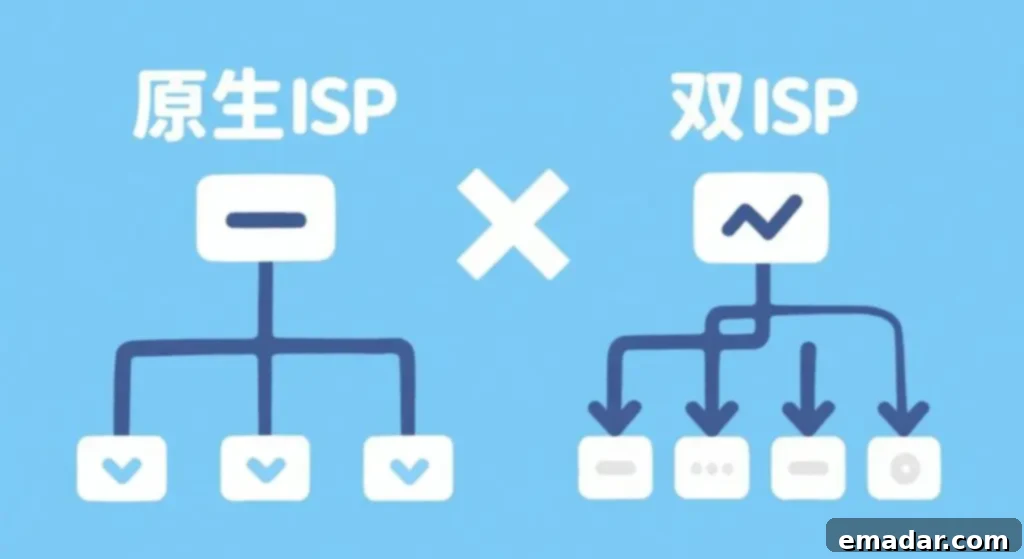
Decoding Dual ISP: A Hybrid Approach with Hidden Risks
Dual ISP, or Hybrid ISP, refers to a more complex IP configuration that can often be misleading. It typically involves a setup where an IP address is registered or appears to be associated with one Internet Service Provider, but its actual network traffic exits through the infrastructure of a different ISP or cloud provider. This arrangement can sometimes be used to achieve a semblance of stability or to circumvent basic geo-restrictions, but it introduces significant risks, especially for sensitive online operations.
Dual ISP generally describes a proxy service that leverages two distinct ISPs (e.g., one a smaller local carrier, the other a major cloud service provider) to route its network traffic. This approach aims to offer a degree of stability while attempting to evade certain risk detection systems.
Essentially, with a Dual ISP setup, the IP address might be formally registered under one operator, but the actual data packets are transmitted through the data centers or network infrastructure of another. While the WHOIS information might initially appear legitimate, deeper analysis of routing paths or BGP (Border Gateway Protocol) information can expose this discrepancy, revealing the true origin and path of the traffic.
❗ Illustrative Example of Dual ISP:
- WHOIS Data Shows: The IP address appears to belong to “AT&T” (a well-known residential ISP).
- Actual Exit Node: However, the network traffic is actually routed through and exits via an “Amazon Web Services (AWS)” cloud server or another data center provider.
This scenario creates a “mismatch” between the advertised IP owner and the actual network infrastructure handling the traffic. While this might suffice for casual browsing, it poses considerable challenges for platforms employing sophisticated fraud detection mechanisms.
⚠️ Potential Issues and Risks Associated with Dual ISP IPs:
- Proxy Detection: Many advanced online platforms utilize sophisticated algorithms to detect inconsistencies between an IP’s registered owner (WHOIS) and its actual routing path (BGP/ASN). A Dual ISP setup, with its inherent discrepancy, is a common indicator of proxy or VPN usage.
- Increased Risk Flags: Such discrepancies frequently trigger security measures like CAPTCHAs, multi-factor authentication requests, device verification, or even immediate account suspension on sensitive platforms (e.g., financial services, popular social media, e-commerce marketplaces).
- “Broadcast IP” Masquerade: Dual ISP can sometimes be a clever disguise for “broadcast IPs.” These are IP addresses that are registered to one location but are globally advertised and routed through servers in completely different geographical areas. While the registration might look convincing, the actual network path betrays the true origin, making them highly prone to detection.
- Reduced Trustworthiness: Because of their deceptive nature, Dual ISP IPs are generally considered less trustworthy than Native ISP IPs. They carry a higher likelihood of being flagged as suspicious or associated with automated bot activity, impacting account longevity and operational efficiency.
- Unpredictable Performance: The fragmented nature of Dual ISP routing can sometimes lead to less stable connections, increased latency, or unpredictable performance compared to direct Native ISP connections.
Understanding the intricacies of Dual ISP is vital. While they might be cheaper or more readily available, the potential for detection and the associated risks often outweigh the initial cost savings, especially for operations requiring high levels of trust and consistent online presence.
Native ISP vs. Dual ISP: A Critical Comparison for Digital Operations
The distinction between Native ISP and Dual ISP is not merely technical; it has profound implications for anyone operating online, particularly in high-stakes environments. Understanding these differences is key to mitigating risks and ensuring the longevity of your digital initiatives.

Let’s delve deeper into their comparative aspects beyond a simple table, focusing on the real-world impact:
- Authenticity and Trust:
- Native ISP: Offers undeniable authenticity. Its consistent data across WHOIS, BGP, and physical location signals a genuine user connection to online platforms. This builds a high level of trust and significantly reduces the likelihood of being flagged as a proxy or bot.
- Dual ISP: Lacks true authenticity due to the discrepancy between registered ownership and actual traffic routing. This inconsistency is a major red flag for advanced detection systems, eroding trust and often leading to immediate suspicion.
- Risk of Detection:
- Native ISP: Extremely low risk of detection by sophisticated anti-fraud systems. Because everything aligns, it appears as a typical residential or legitimate business connection.
- Dual ISP: High risk of detection. The very nature of its setup—where an IP registered to one entity exits through another’s infrastructure—is a primary indicator for platforms looking to identify and block proxy usage. This often results in CAPTCHAs, access restrictions, or even permanent account bans.
- Use Case Suitability:
- Native ISP: Ideal and often mandatory for operations requiring a genuine geographical presence and high account security, such as managing multiple social media accounts, running targeted advertising campaigns, operating e-commerce stores, or engaging with financial platforms.
- Dual ISP: Potentially suitable only for very low-risk activities that don’t involve sensitive logins or transactions, like general web browsing, basic content scraping of non-gated public information, or simple geo-unblocking where detection is not a major concern.
- Performance and Stability:
- Native ISP: Generally offers stable and predictable performance because traffic follows a direct, logical path through a single, dedicated ISP.
- Dual ISP: Can exhibit varied performance and stability due to the multiple hops and different network infrastructures involved. This can sometimes lead to increased latency or intermittent connection issues.
- Cost vs. Value:
- Native ISP: Typically higher in cost due to its scarcity, authenticity, and high demand. However, the value proposition in terms of reliability, security, and operational success far outweighs the expense for critical tasks.
- Dual ISP: Often marketed as a cheaper alternative to Native ISPs. While seemingly cost-effective upfront, the hidden costs in terms of blocked accounts, operational downtime, and potential data loss can quickly diminish any perceived savings.
The choice between Native ISP and Dual ISP is a strategic one, directly impacting the success and security of your online ventures. For any operation that relies on maintaining a credible, trustworthy online identity, Native ISP remains the superior and safer option.
How to Accurately Identify the Type of IP You Are Using
Detecting whether an IP is Native ISP or Dual ISP requires a multi-faceted approach, combining technical checks with practical observation. Don’t rely on just one method; a combination provides the most accurate assessment. Here are the most effective ways to determine the nature of your IP:
- Comprehensive WHOIS Lookup:
The WHOIS database provides registered information about an IP address block, including the organization that owns it, its registered country, and contact details. Look for:
- Organization Name: Is the registrant a known residential or business ISP in the target country (e.g., AT&T, Verizon, BT, Deutsche Telekom)? Or is it a cloud provider (e.g., AWS, Google Cloud, Azure, Alibaba Cloud) or a data center? If it’s a cloud provider, it’s highly likely to be a data center IP, which often acts like a Dual ISP if presented as residential.
- Country and State/Region: Ensure the registered country and region align perfectly with your desired geolocation.
- Abuse Contact: Check if the listed abuse contact corresponds to a legitimate ISP.
- Registration Date: While not a direct indicator, unusually recent registrations for large blocks might warrant further scrutiny.
A true Native ISP IP will clearly show a local residential or legitimate business ISP as the registered owner.
- BGP Routing and ASN Check:
BGP (Border Gateway Protocol) is the routing protocol that directs traffic across the internet. An ASN (Autonomous System Number) identifies an independent network operator. Checking these provides deep insight into the actual traffic path:
- ASN Lookup: Use tools like IPinfo.io, bgp.he.net, or RIPE NCC to find the ASN associated with your IP. Then, cross-reference this ASN with the organization listed in the WHOIS data. A Native ISP IP will have a consistent ASN belonging to the local ISP.
- Route Tracing (Traceroute): Perform a traceroute to your IP address. Observe the sequence of hops and the ASNs encountered along the path. If the initial hops or the exit hop show ASNs belonging to a major cloud provider (e.g., Google, Amazon) while the WHOIS states a local ISP, it’s a strong indication of a Dual ISP or data center IP being masqueraded.
- Geolocation Discrepancy: If the traceroute reveals routing through geographically distant nodes before reaching the stated location, or if the ASN’s registered country doesn’t match the IP’s WHOIS country, it’s a red flag.
- IP Reputation and Usage History Databases:
Several commercial and open-source databases track IP reputation, identifying IPs previously used for malicious activities, proxies, VPNs, or data centers. Popular tools include:
- IP2Location: Provides geolocation and identifies IP types (residential, data center, mobile).
- MaxMind GeoIP2: Offers IP intelligence including proxy/VPN detection scores.
- Scamalytics: Focuses on fraud detection, scoring IPs based on various risk factors.
- VirusTotal: Can sometimes offer insights into whether an IP has been blacklisted.
These services can tell you if an IP is flagged as a known proxy, VPN, or data center IP, or if it has a history of suspicious behavior, which is common for Dual ISP IPs.
- Platform Behavior and Validation:
The most practical test is observing how sensitive online platforms react to your IP. If you’re using an IP and:
- Immediate Security Challenges: Upon logging into platforms like TikTok, Facebook, Amazon, eBay, or sensitive financial sites, you immediately encounter CAPTCHAs, phone/email verification prompts, or “unusual activity” warnings.
- Account Flags/Suspensions: Your newly created accounts are swiftly flagged, limited, or suspended without apparent reason.
- Geo-restriction Failures: You are still blocked from accessing region-specific content despite using an IP supposedly from that region.
- Device Anomaly Detection: Platforms consistently report “device anomaly” or “suspicious login attempts,” even from a clean browser environment.
These are strong indicators that your IP is not being perceived as a genuine, Native ISP connection and is likely being flagged as a proxy or suspicious connection.
By systematically applying these methods, you can gain a clear understanding of your IP’s true nature and make informed decisions about its suitability for your specific online tasks.
Strategic Selection: When to Choose Which IP Type
The choice between Native ISP and Dual ISP IPs is not arbitrary; it’s a strategic decision that should align with the specific requirements and risk tolerance of your online operations. Making the right choice can save you significant time, money, and frustration in the long run.
- Opt for Native ISP IPs when:
If your operations involve cross-border e-commerce, social media management, financial account operations, or any business requiring a “real geographic identity” and low risk of detection, Native ISP IPs are indispensable. These scenarios demand the highest level of IP authenticity and trust to ensure account stability, prevent bans, and maintain operational continuity. This includes:
- Multi-Account Management: Operating multiple accounts on platforms like Amazon, eBay, Shopify, Etsy, or TikTok, where each account needs to appear as a unique, genuine user from a specific location.
- Social Media Marketing and Growth: Warming up new accounts, running targeted advertising, managing multiple profiles on Facebook, Instagram, TikTok, etc., where IP reputation is critical for avoiding shadowbans or account suspension.
- Financial Transactions and Crypto: Accessing online banking, trading platforms, cryptocurrency exchanges, or other sensitive financial services where IP inconsistencies can immediately trigger fraud alerts and block access.
- Localized Content Testing/SEO: Verifying localized search results, ad campaigns, or website content from specific geographic regions, requiring an IP that genuinely appears to be from that location.
- Sensitive Data Scraping: Scraping data from websites with advanced anti-bot measures, where being detected as a proxy can lead to immediate blocking and IP blacklisting.
- Ensuring Account Longevity: For any long-term digital asset (e.g., aged social media accounts, e-commerce seller accounts), Native ISP IPs significantly reduce the risk of unexpected issues.
The premium cost of Native ISP IPs is a necessary investment for the security, reliability, and success of these high-value activities.
- Dual ISP or Broadcast IPs might suffice if:
If your activities are low-stakes, purely informational, or do not involve sensitive logins or financial transactions, Dual ISP or basic broadcast IPs might be adequate. This category typically includes:
- Light Web Scraping: Gathering publicly available, non-gated information from websites without aggressive anti-bot systems, where occasional CAPTCHAs are manageable.
- General Web Browsing or Content Access: Simple tasks like accessing geo-restricted streaming content or news, where the primary goal is access, and the risk of account loss is non-existent.
- Testing or Development Environments: Internal testing of applications or websites where IP authenticity is not a critical security factor.
However, it’s crucial to acknowledge that even in these scenarios, there’s always a risk of unexpected blocking or degraded performance. For any task even moderately sensitive, relying on Dual ISP IPs is a gamble.
- General Recommendation:
For operations prioritizing stability, account security, and minimizing risk, it is strongly advised to avoid Dual ISP or mixed-type IPs, especially those not originating from self-owned and directly managed infrastructure. The peace of mind and operational efficiency provided by genuine Native ISP connections far outweigh the perceived cost savings of lesser alternatives.
Why IPFLY Stands Out for Native ISP Solutions
Recognizing the critical demand for high-quality, authentic IP addresses, reputable providers like IPFLY specialize in delivering solutions that meet the stringent requirements of today’s digital landscape. As a compliant cross-border network infrastructure service provider, IPFLY distinguishes itself by offering Native ISP IPs that are genuinely reliable and secure.
IPFLY’s commitment to quality ensures that its Native IPs are sourced from real, direct ISP connections. This means they are not broadcast IPs, nor do they rely on the problematic Dual ISP model. Every IP address provided by IPFLY undergoes rigorous testing and verification, consistently passing multi-platform validation checks. This rigorous approach guarantees high stability, exceptional trustworthiness, and significantly reduces the risk of detection or flagging by sophisticated anti-fraud systems.
IPFLY’s Native ISP solutions are particularly well-suited for scenarios demanding the highest caliber of IP quality, including:
- TikTok and Other European/American Social Media Account Management: Essential for successful cold-starts and day-to-day operations of multi-regional accounts, ensuring they appear as genuine local users and avoid immediate algorithmic flagging.
- Amazon Multi-Store Isolation Login: Provides the necessary separation and authentic geographical identity for managing multiple Amazon seller accounts, crucial for preventing account linkage and potential suspension.
- Financial Platform Multi-Account Management and Anti-Association: Offers a robust defense against fraud detection and account correlation on banking, trading, or cryptocurrency platforms, securing sensitive transactions and user data.
- High-Intensity Social Media Data Collection and Analysis: Enables effective and undetected scraping of social media data for market research, trend analysis, and competitive intelligence, bypassing sophisticated bot detection systems.
Beyond providing top-tier Native IPs, IPFLY enhances user confidence by offering comprehensive IP reports and detailed testing data. This transparency allows users to independently verify routing paths, WHOIS information, and overall IP authenticity, effectively mitigating potential risks. Furthermore, IPFLY supports new users with a free trial, empowering them to validate the quality and performance of their IPs before committing. This commitment to transparency, quality, and user satisfaction makes IPFLY a trusted partner for any operation where IP integrity is non-negotiable.