
In today’s fast-paced digital landscape, the integrity and quality of Internet Protocol (IP) addresses have emerged as a paramount factor, directly influencing the stability and success of core business operations. High-quality IPs are not merely a technical requirement; they are the bedrock upon which reliable digital interactions are built, impacting critical aspects such as:
- Account Stability: Preventing bans, flags, or restrictions on various online platforms.
- Advertising Verification Accuracy: Ensuring ads are displayed to the correct target audiences in specific geographical regions and for competitive intelligence.
- Market Research Data Reliability: Guaranteeing the authenticity and geographical relevance of data collected for analysis.
- Platform Trust Assessment Results: How online platforms perceive the legitimacy and trustworthiness of user activities.
While many users instinctively turn to third-party IP detection tools to gauge IP quality, this approach often falls short. These tools, despite their widespread use, typically suffer from significant inherent limitations, which can lead to misleading or inaccurate assessments:
- Reliance on Static IP Databases: These databases are often slow to update, lagging behind the dynamic evolution of network infrastructure.
- Data Update Lag: The rapid changes in IP allocation and network usage patterns mean that database entries can quickly become outdated.
- Simplistic Classification Models: Most tools use basic rules and historical data, failing to capture the complexity of modern network behaviors and sophisticated platform algorithms.
Consequently, the results from such third-party tools frequently fail to reflect the intricate and real-time risk control logic employed by major online platforms. This discrepancy highlights a fundamental gap between superficial IP labeling and genuine platform trust evaluation.
IPFLY, recognizing these critical shortcomings, adopts a fundamentally different and superior standard. Our approach is centered on an internal quality verification mechanism meticulously constructed around the actual trust assessment frameworks utilized by real online platforms. This ensures that every IP address provided by IPFLY is rigorously vetted against the very criteria that matter most to online services, offering unparalleled reliability and performance.

Our Core Principle: Prioritizing Internal Standards Over External Labels
While third-party IP detection tools can offer some baseline reference, their utility is often limited. They typically provide a narrow view, unable to fully encompass the multifaceted and dynamic dimensions that truly define an IP’s quality and trustworthiness in the eyes of advanced online platforms. These crucial dimensions include:
- Dynamic IP Reputation Scoring Mechanisms: Modern platforms assess reputation based on real-time usage patterns and historical behavior, not just static classifications.
- Behavioral Modeling and Traffic Evaluation Systems: Analyzing how an IP behaves over time, the nature of its traffic, and its interaction patterns with a platform.
- Authenticity Judgment of Network Identity: Differentiating between genuine residential users and potentially suspicious network origins.
This fundamental distinction leads to a critical realization: a static IP label found in a public database does not necessarily equate to its actual performance and trustworthiness in a live business environment. An IP might be flagged by a third-party tool, yet perform flawlessly on a major platform because the platform’s internal systems recognize it as legitimate residential traffic.
Building upon this profound understanding, IPFLY has engineered a vastly superior internal quality inspection system. This proprietary framework is designed to ensure that our IP resources consistently deliver stable and reliable performance within the demanding and dynamic environment of real online platforms, far exceeding the superficial checks offered by conventional tools.
IPFLY’s Comprehensive Five-Tier IP Quality Inspection System
Every single IP resource designated for inclusion in IPFLY’s extensive pool must successfully navigate a rigorous, multi-layered verification process. This meticulous system guarantees that only the highest quality, most reliable IP addresses are made available to our users, ensuring optimal performance and minimizing risk.
1. Real Network Environment Verification
The initial and foundational step in our quality assurance process involves a thorough verification of the IP’s origin. We ensure that each IP possesses genuine network attributes, confirming its legitimacy and suitability for critical business operations:
- Origin from Legitimate ISPs (Internet Service Providers): We verify that the IP addresses are sourced directly from reputable, established ISPs, ensuring their authenticity and adherence to industry standards. This avoids IPs originating from data centers or unknown sources.
- Belonging to Authentic Network Infrastructure: Each IP is checked to confirm it is part of a real, actively used network infrastructure, indicative of genuine user activity rather than simulated environments.
- Possessing Natural User Traffic Characteristics: We analyze the traffic patterns associated with the IP to confirm they mimic natural user behavior, distinguishing them from bot-like or automated traffic that could trigger platform flags.
The core objective of this critical stage is to unequivocally establish the authenticity and consistency of the network identity, laying a robust foundation for subsequent quality checks.
2. Reputation and Blacklist Screening
Following the initial environmental verification, each IP undergoes an exhaustive multi-dimensional reputation assessment. This involves cross-referencing against an extensive array of global databases and analyzing historical behavior to ensure a pristine record:
- Comparison Against Global IP Reputation Databases: We consult numerous international databases that track IP reputation, identifying any past associations with spam, malicious activity, or fraudulent schemes.
- Analysis of Historical Risk Behavior Records: A deep dive into the IP’s history reveals any instances of suspicious or high-risk activities, such as involvement in botnets, brute-force attacks, or other forms of digital abuse.
- Identification of Potential Abnormal Usage Traces: Our systems look for subtle indicators of past misuse that might not be explicitly blacklisted but suggest a history of undesirable online behavior.
Through this stringent screening, only IP resources with an impeccably clean reputation record are retained. This process ensures that the IPs provided by IPFLY possess a higher trust score within critical platform trust systems, minimizing the likelihood of immediate flagging or suspicion.
3. Usage Behavior and Abuse Detection
Beyond historical blacklists, IPFLY conducts a sophisticated behavioral analysis of each IP’s past usage patterns. This layer of inspection is crucial for identifying any latent anomalies that could compromise performance or trigger platform risk controls:
- Abnormal Usage Intensity Assessment: We evaluate whether the IP has been used with an unusually high frequency or intensity that deviates from typical residential usage, which could indicate bot activity.
- Reasonableness of Traffic Distribution: The distribution of traffic across various online services and destinations is analyzed to ensure it aligns with normal user behavior rather than concentrated, automated access patterns.
- Stability of Behavioral Patterns: We look for consistent and predictable behavior over time. Any erratic or rapidly changing patterns, which might suggest frequent rotation or questionable usage, are flagged.
Any IP exhibiting characteristics of abnormal behavior is immediately excluded from our pool. This meticulous step is vital in ensuring that the IP addresses deliver stable, predictable, and trustworthy performance during actual use, aligning with genuine human interaction patterns.

4. Geographical Location Accuracy Verification
The precision of geographical location is an indispensable factor for a multitude of business applications, where accuracy is paramount to success and compliance. This includes scenarios such as:
- Advertising Campaign Verification: Ensuring that geo-targeted ads are indeed being served and validated from the intended location, preventing wasted ad spend and ensuring compliance.
- Localized Content Testing: Verifying that websites, applications, and services display region-specific content correctly for diverse markets.
- Market Research Data Collection: Guaranteeing that demographic and sentiment data is collected from the exact geographical regions required for accurate analysis.
IPFLY employs a sophisticated multi-dimensional verification mechanism to meticulously ensure the accuracy of each IP’s geographical data:
- Accurate Country-Level Positioning: Ensuring the IP is correctly identified with its designated country.
- Precise City-Level Positioning: Offering granular accuracy down to the city level, critical for highly localized operations.
- Consistent ISP and Regional Information Matching: Verifying that the IP’s associated ISP and regional data are coherent and match expected geographic parameters.
This stringent process ultimately delivers highly credible geographical positioning capabilities, empowering users with confidence in their location-dependent operations.
5. Platform Risk Control Simulation Testing
This stage represents the most critical and sophisticated component of IPFLY’s entire quality inspection framework. Here, we move beyond generic checks to directly challenge IPs against the very systems they are intended to interact with.
IPFLY rigorously simulates real platform environments to conduct comprehensive verification of IP performance, scrutinizing key metrics:
- Login Behavior Stability: Testing how consistently and smoothly an IP can initiate and maintain login sessions across various platforms, identifying any patterns that might trigger automated security alerts.
- Session Persistence Performance: Evaluating the IP’s ability to maintain stable, uninterrupted sessions over extended periods, a crucial indicator of genuine user interaction.
- Consistency of Traffic with Platform Expectations: Analyzing whether the volume, frequency, and type of traffic generated by the IP align with what mainstream platforms expect from a legitimate residential user, avoiding anomalies that flag bots or unusual activity.
This pivotal verification phase is directly benchmarked against the actual risk control logic employed by leading online platforms. The ultimate outcome is that only those IP addresses successfully passing these intensive simulations are deemed capable of meeting the stringent trust assessment standards of mainstream platforms, ensuring they perform reliably in real-world scenarios.
Why Third-Party Detection Tools Often Produce Misleading Results
It’s not uncommon for users to observe an IP provided by IPFLY showing up as “suspicious” or “non-residential” on a third-party detection website, while simultaneously performing perfectly in their actual business operations. This seemingly contradictory situation has a fundamental underlying cause:
👉 A profound difference in detection logic.
Inherent Limitations of Public Detection Systems
The vast majority of publicly available IP detection tools rely on outdated and simplistic methodologies. They typically base their assessments on:
- Static IP Mapping Relationships: Their databases primarily store fixed associations between IPs and their perceived type (e.g., residential, data center, mobile), which quickly becomes obsolete.
- Historical Categorization Results: Decisions are made based on how an IP was classified in the past, without accounting for current usage or network changes.
- Simple Rule-Based Judgments: They employ basic, predetermined rules that lack the nuance to understand complex network dynamics.
Crucially, these tools are inherently incapable of accurately reflecting several critical real-time and evolving factors:
- Real-time Network Environment Changes: The internet is dynamic; IP allocations, network routes, and infrastructure constantly evolve.
- Evolution of ISP Network Structures: Internet Service Providers frequently update their networks, blurring old classification lines.
- Platform-Level Behavioral Analysis Models: Sophisticated platforms use advanced AI and machine learning to analyze user behavior, not just static IP labels.
Deconstructing Common Misjudgment Types
Several categories of legitimate residential IP addresses are frequently, and incorrectly, flagged as data center or non-residential by older, less sophisticated detection tools:
- Mobile Network IP Segments: IPs assigned to mobile devices, often dynamic and shared.
- Dynamic ISP-Allocated IPs: Many residential ISPs dynamically assign IPs, which can change frequently.
- CPE (Customer Premise Equipment) Networks: IPs assigned to devices like modems/routers in residential settings.
- Base Station Exit IPs: IPs that are egress points for cellular network traffic, representing legitimate mobile users.
These IP types, while representing genuine human users, might be erroneously tagged as “non-residential” in outdated public databases. However, in the sophisticated risk control systems of actual online platforms:
→ They are correctly identified as an integral part of legitimate, real user network traffic.
This critical distinction explains precisely why:
👉 An IP might appear abnormal on a basic detection tool but performs with perfect stability and trust in a live business environment. The platform recognizes the underlying legitimate behavior, while the tool only sees a static, potentially mislabeled attribute.
The Key Cognitive Discrepancy
It is imperative to understand that third-party tools primarily evaluate static “labels,” whereas sophisticated platform systems assess “behavior and trust signals.” These two evaluation logics are fundamentally divergent.
Therefore:
→ Solely relying on the results of a single detection website will inevitably lead to an incomplete and often inaccurate assessment of an IP’s true quality and utility.
Why IPFLY’s Internal Quality Inspection System Holds Superior Value
IPFLY’s proprietary quality inspection logic is not predicated on static categorization, which is prone to obsolescence. Instead, it is meticulously built around the concept of “actual usage performance” – how an IP truly behaves and is perceived in real-world scenarios.
Our core methodology integrates several advanced approaches:
- Validation Based on Behavioral Models: We utilize sophisticated algorithms to analyze IP behavior, ensuring it aligns with legitimate human usage patterns rather than simply checking a static database entry.
- Testing in Real Business Scenarios: IPs are put through simulated interactions with actual platforms, mimicking real user activities to prove their reliability and bypass risk controls.
- Continuous Updating of IP Reputation Data: Our systems constantly monitor and update IP reputation, adapting to the dynamic nature of online trust and weeding out newly compromised IPs.
This comprehensive and dynamic system ensures that IPFLY’s resources consistently maintain stable and trustworthy performance within authentic platform environments, rather than merely “appearing compliant” in the limited scope of a third-party detection tool. We guarantee performance where it truly matters: in your actual business operations.
The Tangible Impact on Your Actual Business Operations
In practical application, the profound value delivered by genuinely high-quality IP addresses manifests primarily through several critical advantages:
- Enhanced Network Identity Stability: Your online presence appears consistent and reliable, reducing the likelihood of sudden flags or blocks.
- More Continuous Behavioral Patterns: Activities conducted through the IP exhibit natural, uninterrupted sequences, which platforms interpret as legitimate human interaction.
- Higher Platform Trust Score: Over time, consistent legitimate behavior fosters a strong trust relationship with online platforms, unlocking smoother operations.
These intrinsic characteristics are particularly indispensable for a diverse range of demanding business scenarios, where IP quality can make or break an operation:
- Cross-Border E-commerce Account Management: Essential for maintaining multiple seller accounts, avoiding regional restrictions, and ensuring smooth transaction processing.
- Advertising Verification and Localization Testing: Crucial for advertisers needing to accurately verify ad displays, competitor monitoring, and ensure content is rendered correctly in specific geographical markets.
- Automated Market Research: Vital for collecting accurate, geo-targeted data without triggering bot detection, enabling reliable market insights.
- Compliant Data Collection Processes: Ensuring web scraping and data aggregation activities adhere to platform policies and legal frameworks, minimizing risk.
- Multi-Account Environment Management: Providing distinct, trustworthy identities for managing numerous social media, e-commerce, or service accounts simultaneously without inter-account flagging.
Fundamentally, the core purpose of leveraging high-quality IP addresses is to:
→ Construct a stable, reliable, and inherently trustworthy network infrastructure that supports and scales your digital business endeavors without compromise.
IPFLY’s Unwavering Quality Commitment
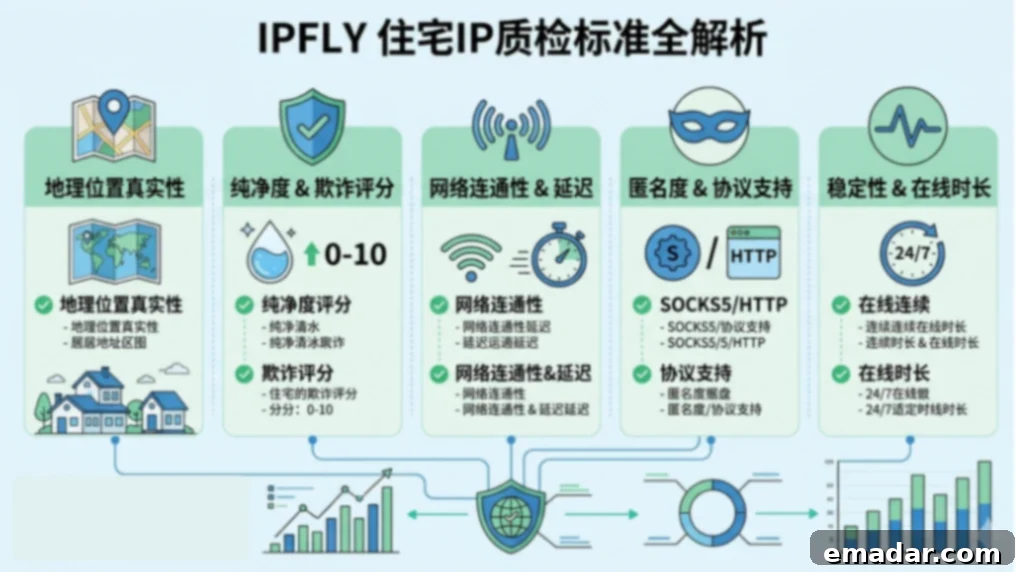
Within the IPFLY ecosystem, every single resource designated as a “Residential IP” is not merely labeled as such; it is unequivocally required to fulfill a rigorous set of stringent standards, meticulously verified through our multi-tier inspection process:
- Sourced from Genuine ISP Networks: Guaranteed to originate from legitimate Internet Service Providers, affirming their residential nature.
- Possesses a Pristine Historical Reputation Record: Free from any past associations with blacklists, spam, or malicious activities, ensuring a clean slate.
- Exhibits Stable and Continuous Behavioral Patterns: Demonstrated consistent, human-like usage patterns over time, essential for bypassing advanced platform risk controls.
- Successfully Passed Platform Risk Control Simulation Verification: Proven to perform reliably and be trusted in simulated environments mirroring major online platforms.
This meticulous commitment signifies that:
→ Every single IP address provided by IPFLY has undergone rigorous, multi-faceted screening, far beyond simple, arbitrary classification or labeling.
IPFLY’s overarching objective is not merely to furnish “available IPs” but to deliver a far superior product:
→ IP resources that are consistently stable, highly reliable, and genuinely usable within the demanding and dynamic environments of real business operations.
Compliance and Responsible Usage Guidelines
IPFLY’s entire product suite and operational design are exclusively geared towards supporting legitimate and fully compliant business scenarios. We are committed to fostering a secure and ethical online environment for our users. These approved applications include, but are not restricted to:
- Cross-border E-commerce Operations: Enabling global business expansion while adhering to platform policies.
- Advertising Verification and Localization Testing: Ensuring marketing campaigns are accurately targeted and perform as expected.
- Automated Market Research: Conducting ethical and compliant data gathering for informed business decisions.
- Data Collection Processes within Platform Policy Limits: Facilitating responsible web scraping and data aggregation in line with website terms of service and legal regulations.
Simultaneously, IPFLY unequivocally prohibits and does not support any activities that deviate from ethical and legal standards. Our service must not be used for:
- Unauthorized System Access: Attempting to gain access to systems or data without explicit permission.
- Operations Violating Platform Usage Policies: Any activity that contravenes the terms of service of any online platform.
- Any Form of Fraud or Abuse: Engaging in deceptive practices, spamming, phishing, or any other malicious behavior.
This clear and comprehensive policy ensures that:
→ Users operating with IPFLY are provided with explicit compliance boundaries and robust risk control capabilities, promoting responsible and sustainable digital business practices.
Summary: The Evolving Standards of IP Quality Assessment
As online platform risk control mechanisms continue to advance and grow in sophistication, the fundamental criteria for evaluating IP quality have undergone a significant transformation. The assessment has definitively shifted from a simplistic “static label judgment” to a more dynamic and nuanced “real-time behavioral evaluation.”
Consequently, reliance on single, isolated detection tools is no longer sufficient to meet the complex and evolving demands of modern business operations. True and reliable IP quality must be built upon a robust foundation comprising:
- A Multi-Tiered Verification System: Comprehensive checks across various dimensions of IP authenticity and performance.
- Authentic Scenario Testing: Validating IPs in environments that mimic real-world platform interactions.
- Continuous Data Optimization: Constantly updating and refining IP reputation and performance data to adapt to new threats and changes.
IPFLY’s unique and innovative internal quality inspection system is meticulously constructed around these very principles. This unwavering commitment to advanced, real-world validation is precisely why we are consistently able to provide stable, trustworthy, and high-performing IP resources, even within the most complex and challenging digital environments.
Frequently Asked Questions (FAQ)
Why might a detection tool show different results than actual usage?
Detection tools typically rely on static, often outdated databases and simple rules, whereas online platforms employ dynamic, AI-driven behavioral assessment models. This fundamental difference in logic leads to discrepancies between external labels and real-world performance.
Does IPFLY depend on third-party detection tools for its quality assessment?
No, IPFLY does not primarily rely on third-party detection tools. While such tools might be used for initial reference, our core IP quality assessment is based on our proprietary, five-tier internal inspection system, which includes real platform risk control simulations.
Is the quality of all residential IPs uniform?
Absolutely not. The quality of residential IPs can vary significantly. It is highly dependent on factors such as the IP’s origin, its historical reputation, its prior usage patterns, and the rigor of the verification processes it undergoes before being put into service.
How does IPFLY guarantee the quality of its IP addresses?
IPFLY ensures IP quality through a comprehensive five-tier inspection system. This includes verifying real network environments, rigorous reputation and blacklist screening, detailed usage behavior and abuse detection, precise geographical location validation, and crucially, extensive platform risk control simulation testing.
Which types of businesses benefit most from high-quality IPs?
Businesses requiring high IP quality include cross-border e-commerce, advertising verification and competitive intelligence, automated market research, and multi-account management scenarios. These operations critically depend on stable network identities and high platform trust to avoid interruptions and ensure success.