
In the proxy IP market, many users encounter datacenter proxies before residential ones.
The reason is simple: datacenter proxies are faster, more stable, and more cost-effective, making them better suited for large-scale automated operations.
However, there have long been misconceptions about datacenter proxies.
Some claim they are “not authentic”;
some say they are “easy to detect”;
and others confuse low-quality shared datacenter IPs with genuinely high-quality datacenter proxy services.
In reality, as global network infrastructure, IP allocation algorithms, ASN resource management, and enterprise proxy architectures evolve, modern datacenter proxies are no longer the risky, cheap IPs of the past.
For tasks like AI data collection, ad verification, account automation, global content access, crawling systems, API request pools, and large-scale checking, high-quality datacenter proxies remain one of the best options for balancing efficiency and cost.
That is why more companies are refocusing on datacenter proxies.
IPFLY is redefining this product through a more stable global datacenter architecture, a cleaner IP resource pool, and higher-availability proxy scheduling.
Why did datacenter proxies become central again in 2026?
In recent years, the proxy IP industry has changed noticeably. Initially, the focus was on whether an IP could bypass protections. Later, attention shifted to account registration stability, and then to the rise of high-purity residential proxies.
With the arrival of AI automation and global data competition, enterprises began to ask a different question: how to support long-term automated systems at lower cost, higher efficiency, and greater stability?
Datacenter proxies returned to the center of attention for precisely these reasons.
They are especially valuable in:
- AI data scraping
- Large model training
- SEO monitoring
- Global ad verification
- Overseas SaaS operations
- Automated workflows
- Agent systems
- API scheduling networks
- High-frequency checking systems
Technical teams increasingly recognize that while residential proxies offer stronger authenticity, datacenter proxies are irreplaceable for high-concurrency, high-frequency, long-running automation.
As a result, many companies have adopted hybrid proxy architectures: residential proxies handle authenticity, and datacenter proxies provide efficiency. The datacenter layer often determines overall system stability.
What is a datacenter proxy?
A datacenter proxy is an IP address provided by server farms. Unlike residential proxies, it originates from cloud servers, IDC datacenters, enterprise network nodes, or high-performance server clusters—not from home networks.
In short: residential proxies resemble “real user networks,” while datacenter proxies act as “high-performance network nodes.”
Key characteristics of datacenter proxies include:
- Fast response times
- High bandwidth
- Strong stability
- High concurrency
- Controllable costs
- Suitability for large-scale automation
They excel in scenarios such as:
- Large-scale data scraping
- SEO monitoring
- Automated API requests
- Ad verification
- AI training data collection
- Price monitoring
- Social media automation
- Bulk account management
- Overseas testing
- Multi-threaded high-concurrency systems
In short: residential proxies solve authenticity; datacenter proxies solve efficiency.
How do datacenter and residential proxies differ?
When users ask “which is better,” there is no absolute answer—each addresses different needs.
Residential proxies mirror real users
Residential proxies come from real home networks, so they offer high geographic authenticity and user behavior realism. They simulate natural visits more easily and suit platforms with strict risk controls.
Typical use cases include:
- Social media management
- Ad campaigns
- Localization testing
- TikTok scenarios
- Facebook account environments
- Local Google search verification
Datacenter proxies act as enterprise-grade high-speed networks
Datacenter proxies prioritize throughput, stability, concurrency, automation efficiency, and low latency over mimicking home users.
They fit scenarios like:
- Crawlers
- API scheduling
- AI data collection
- SEO scraping
- Automation scripts
- Price monitoring
- High-frequency tasks
In practice, mature architectures combine both proxy types rather than choosing one exclusively.
Why do many companies still prefer datacenter proxies?
In many real-world systems, speed and stability matter more than residential attributes. Technical teams focus on request stability, high API success rates, support for concurrency, low latency, sufficient IP pools, and long-term cost control—areas where datacenter proxies excel.
1. Stronger concurrency capability
Residential proxies rely on real devices that can go offline, change IPs, or suffer bandwidth fluctuations. Datacenter proxies operate in high-performance server environments with stable network links, abundant bandwidth, and higher throughput, making them ideal for scenarios with tens of thousands of requests per minute, multi-country scraping, and continuous automated execution.
2. Lower latency
Network latency directly affects automation efficiency in ad verification, real-time monitoring, high-frequency requests, global sync tasks, game network testing, and AI agent execution. Datacenter proxies typically have shorter, more stable network paths, faster TCP handshakes, less jitter, and more reliable responses compared with typical residential networks.
3. Clear cost advantages
Residential proxies incur higher costs due to the need for real devices and networks. Datacenter proxies, built on server resources, provide lower per-request costs and more predictable expenses at scale—important for long-running large systems where instability can lead to significant data loss and increased overall cost.
Why is demand for datacenter proxies growing in the AI automation era?
Contrary to the belief that AI will make residential proxies dominant, AI-driven systems increase demand for high-stability, high-throughput, low-cost network resources. AI systems differ from human users; they can issue thousands of requests per minute, run 24/7 across regions, and maintain long-term API schedules, making underlying network capability the real bottleneck.
AI data collection
AI models need vast amounts of web content, product data, SEO data, public social media information, market data, and news—tasks that require high-concurrency networks, a core advantage of datacenter proxies.
Agent automation workflows
AI Agents that automatically execute tasks, visit sites, monitor information, sync data, and trigger workflows need a stable proxy network. Datacenter proxies offer low latency, high concurrency, and stable costs, making them ideal for these agent-based systems.
Global real-time monitoring
Global SERP monitoring, ad verification, multi-region content checks, and price monitoring become costly with purely residential proxies. Increasingly, teams adopt hybrid architectures—datacenter proxies supplemented with some residential proxies—which is now mainstream for many large systems.
Why do low-quality datacenter proxies get blocked?
It’s a misconception that datacenter proxies are inherently easy to detect. The real culprits are low-quality shared IPs, heavily polluted datacenter ranges, blacklisted ASNs, high-reuse IPs, proxy ranges flagged by fraud systems, and pools lacking rotation strategies or health management.
In short, the issue is proxy quality rather than the datacenter category itself. This explains why some datacenter IPs achieve high success rates while others fail.
Why do users misjudge datacenter proxies?
Many users conclude “datacenter proxies are unstable” after using poor services. Problems often stem from cheap shared proxies, overused IPs, blacklisted datacenters, unmaintained pools, outdated nodes without rotation, and vendors without IP health monitoring. High-quality datacenter services differ dramatically from low-cost shared offerings—much like the difference between a cheap VPS and an enterprise cloud server.
What defines high-quality datacenter proxies?
Professional teams evaluate several key metrics when choosing datacenter proxies.
IP purity
Whether an IP has been historically abused is critical. If an IP has been used for spam, widely shared on public proxy platforms, listed on multiple blacklists, or associated with abusive behavior, it will be hard to use reliably. High-quality providers continuously screen IPs, detect blacklists, filter risky ASNs, assess behavioral quality, and run multi-layer health checks. IPFLY applies layered IP selection and big-data quality monitoring to improve overall IP availability.
Network stability
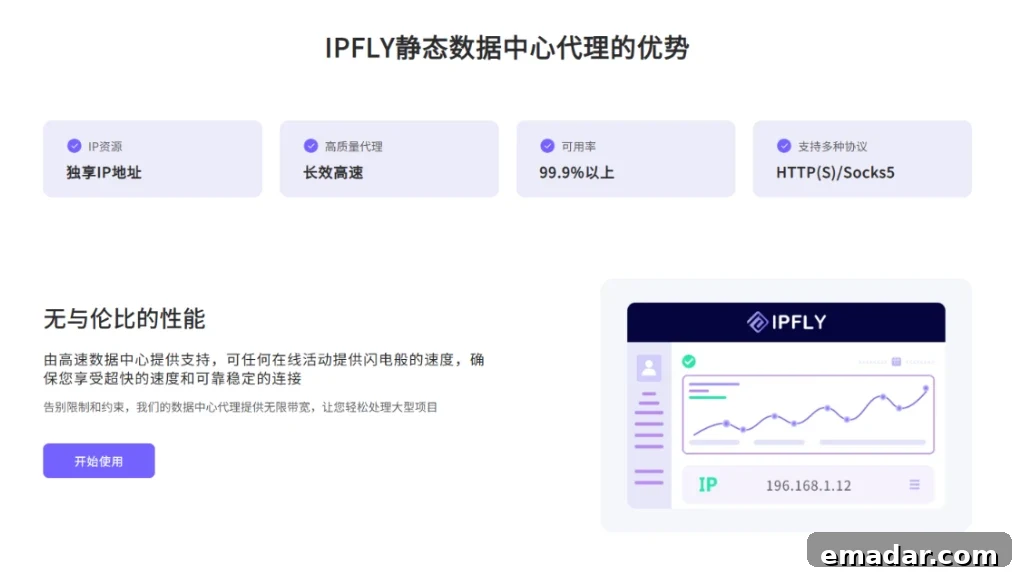
Enterprises fear unpredictability more than slowness. Stable proxies require high online rates, consistent bandwidth, persistent connection support, low packet loss, and global datacenter scheduling. For long-running systems, 99.9% uptime outweighs short-lived peak speeds.
Global coverage
Many operations need multi-region IPs for global ad verification, international SEO monitoring, multi-country data collection, overseas app testing, and worldwide content access. A provider’s global node coverage directly affects deployment flexibility. IPFLY currently covers 190+ countries and regions, expanding datacenter nodes through a global network to give teams greater scheduling options.
Core features of IPFLY datacenter proxies
Users now expect more than mere usability. They want stability, purity, long-term suitability for systems, scalability, and compatibility with the AI automation era—areas IPFLY focuses on.
1. High-performance global server network
IPFLY uses self-built servers and global nodes, which improves network link stability, server scheduling, peak resource control, and consistent request success rates—reducing fluctuations during high-concurrency tasks.
2. Large-scale IP pool
IPFLY currently manages over 90 million IPs, including datacenter, dynamic residential, and static residential proxies. Multiple proxy types can be combined, enabling hybrid architectures where datacenter proxies deliver efficiency while residential proxies provide authenticity—an increasingly common strategy among AI automation teams.
3. Better fit for automation systems
AI Agents, RPA, automated scraping, and bulk API systems require more than IP rotation: they need stable long connections, high concurrency, quick responses, sustainable calls, and low failure rates. Datacenter proxies naturally meet these needs, and for 24/7 automated systems, stability is more valuable than short-term speed.
Future directions for datacenter proxies
Residential proxies will not fully replace datacenter proxies. Instead, a “dual-proxy architecture” is likely to dominate: residential proxies for authenticity and datacenter proxies for concurrency, efficiency, automation, and low-cost requests.
As AI automation, agent workflows, and global data systems expand, businesses will increasingly layer proxy solutions. Datacenter proxies will remain a fundamental part of the underlying network infrastructure, especially for AI data collection, large-model training, global content analysis, automated business systems, overseas SaaS infrastructure, and real-time monitoring networks.
Why branded proxy providers matter more
Choosing the cheapest proxy once looked attractive, but the market has changed. Low-quality proxies bring IP pollution, request failures, risk-control escalations, system instability, abnormal data, and account security issues. Short-term savings can create long-term business risk.
Companies now weigh provider stability, IP source quality, technical capability, network infrastructure, and long-term sustainability. Brand providers add value by delivering reliable, maintainable network connectivity for automated operations. IPFLY invests in global nodes, IP screening, and high-performance network architecture to help enterprises build stable, long-term connections suited to the automation era—not merely to sell IPs.
Conclusion
Datacenter proxies are not obsolete. On the contrary, in an era of AI automation, global data systems, and increasing high-concurrency demands, their importance is being reassessed.
High-quality datacenter proxies represent a stable global network infrastructure rather than just an IP address. Future competition will be about who can provide more stable connections, cleaner resources, higher success rates, and proxy systems optimized for automation.
That is the core direction of IPFLY’s ongoing investment in datacenter proxy products.