
Are you confused by the differences between HTTP proxies and Socks5 proxies? Does the thought of setting up your own HTTP proxy server seem as daunting as writing complex code? This comprehensive guide will demystify these concepts in minutes, offering practical advice to help you determine: Which proxy IP is truly the best fit for your specific needs?
1. Understanding HTTP Proxy Servers: Are They as Complicated as They Seem?
In its simplest form, an HTTP proxy acts as an intermediary “jump-off point” that facilitates your access to the internet. Instead of directly connecting to a website, your request first goes through the proxy server, which then forwards it to the intended destination. This indirect connection offers several critical advantages that enhance your online experience and operational security.
When you connect directly to a website, such as Google, you expose your real IP address. This direct connection carries inherent risks: your IP can be easily identified, potentially leading to geographical restrictions, rate limiting by websites, or even security vulnerabilities. By routing your traffic through an HTTP proxy, the proxy server’s IP address is seen by the target website, effectively masking your own. This mechanism makes your online activities significantly more concealed and secure.
HTTP proxies are specifically designed to handle traffic based on the HTTP (Hypertext Transfer Protocol) and HTTPS (HTTP Secure) protocols. This means they are ideal for standard web-based activities. Common applications include general web browsing, automated web scraping and data collection, and SEO monitoring tools that require simulating various user locations or avoiding IP bans from search engines.

Is Setting Up an HTTP Proxy Server Difficult?
To be entirely frank: it can be quite challenging!
For individuals without extensive technical expertise, attempting to set up your own HTTP proxy server typically involves a steep learning curve and several potential hurdles:
- VPS Acquisition and Configuration: You’ll need to purchase a Virtual Private Server (VPS), which requires choosing the right specifications, operating system, and a reliable hosting provider.
- Environment Deployment: After acquiring a VPS, you must install and configure the necessary software environment, which might include web servers (like Nginx or Apache) or dedicated proxy software (such as Squid).
- Port Configuration and Forwarding Rules: Correctly setting up network ports, configuring firewall rules, and defining specific forwarding rules for proxy traffic demands a solid understanding of networking principles.
- IP Stability and Longevity: Ensuring that your proxy IP remains stable, fully functional, and isn’t quickly blacklisted by target websites requires continuous monitoring and management. This often involves implementing IP rotation strategies and maintaining server health.
- Security and Maintenance: You are solely responsible for the security of your proxy server, including applying updates, patching vulnerabilities, and monitoring for unauthorized access.
These tasks can be time-consuming and complex, potentially leading to instability or security risks if not handled correctly. For most users, especially those focusing on their core business or research, a more efficient and reliable approach exists.
A more effective and hassle-free solution is to leverage professional proxy service platforms like IPFLY. These providers offer ready-to-use HTTP proxy IPs, eliminating the need for self-setup, ensuring optimal security, and saving you valuable time and effort. They handle all the technical complexities, allowing you to focus purely on your objectives.
2. HTTP Proxy IP vs. Socks5 Proxy IP: A Detailed Comparison
HTTP and Socks5 proxies are two of the most commonly encountered proxy types, often mentioned in the same breath. While both serve to route your internet traffic through an intermediary server, their fundamental differences in operation, capabilities, and ideal use cases are crucial to understand for effective proxy deployment.
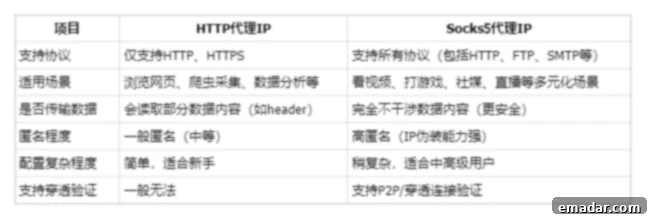
The primary distinction lies in the level of the network stack at which they operate and the protocols they support:
- HTTP Proxies: These proxies operate at the application layer (Layer 7 of the OSI model). They are specifically designed to understand and process HTTP and HTTPS traffic. This means they are excellent for web browsing, making requests like GET and POST, and can sometimes offer features like caching and content filtering. However, their protocol-specific nature limits them to web traffic and they generally do not support other protocols like UDP.
- Socks5 Proxies: In contrast, Socks5 proxies operate at a lower level – the session layer (Layer 5 of the OSI model). This makes them protocol-agnostic, meaning they can handle any type of network traffic, regardless of the application protocol. Socks5 supports both TCP (Transmission Control Protocol) and UDP (User Datagram Protocol) connections. This broader capability allows them to be used for a much wider range of applications beyond just web browsing, including gaming, P2P file sharing, and streaming. They also offer higher levels of anonymity compared to basic HTTP proxies because they don’t modify the data packet headers.
Let’s summarize the key differences more comprehensively:
| Feature | HTTP Proxy | Socks5 Proxy |
|---|---|---|
| OSI Layer | Application Layer (Layer 7) | Session Layer (Layer 5) |
| Protocols Supported | HTTP, HTTPS (Web traffic only) | TCP, UDP (Any protocol) |
| Data Handling | Understands and processes HTTP requests, can cache content, modify headers. | Forwards data packets as is, does not interpret traffic. |
| Anonymity Level | Varies; can be transparent, anonymous, or highly anonymous, but generally less private than Socks5 due to header modification. | Generally offers higher anonymity; client’s real IP is less likely to be revealed. |
| Performance | Can be faster for web browsing due to caching. | Can be slightly slower due to extra encapsulation, but more flexible. |
| Use Cases | Web scraping, SEO monitoring, web browsing, ad verification. | Gaming, streaming, P2P, VoIP, SSH, RDP, any application requiring non-HTTP traffic or higher anonymity. |
| Complexity | Simpler to implement for web-specific tasks. | More versatile but requires applications to support Socks5. |
✅ In essence, to make your choice simple:
- If your tasks are primarily web-based, such as routine web browsing or focused web scraping, an HTTP proxy will generally suffice and be efficient.
- However, if you require superior anonymity, support for multiple protocols beyond just HTTP/HTTPS, or if account security is a paramount concern, opting for a Socks5 proxy is a more robust and reliable choice.
3. Choosing the Right Proxy for Your Daily Operations
Selecting the appropriate proxy type is critical for ensuring the success and efficiency of your online activities. Here’s a breakdown of common scenarios and our recommendations:
🔹 For Web Scraping, Data Collection, and Website Access ➡️ HTTP proxies are exceptionally well-suited. They provide stable access to e-commerce platforms for competitor price monitoring, allow for precise keyword ranking checks, and enable efficient extraction of publicly available page data. Given their specialization in HTTP/HTTPS traffic, they offer optimized performance for these web-centric tasks. Many web scraping tools are natively compatible with HTTP proxies, streamlining integration and operation.
🔹 For Cross-border E-commerce, Social Media Management, Live Streaming, and New Account Creation (e.g., TikTok) ➡️ We strongly recommend using high-anonymity Socks5 proxies in combination with a fingerprint browser. This powerful duo is essential for mitigating the risk of account association and platform risk control. E-commerce sites and social media platforms employ sophisticated detection mechanisms to link accounts to specific IPs or browser fingerprints. Socks5 proxies offer a higher degree of anonymity, preventing your real IP from being exposed, while fingerprint browsers simulate unique device profiles, making it appear as if each account is managed from a distinct, legitimate user environment. This setup is vital for maintaining multiple accounts without triggering security alerts or bans.
🔹 For Gaming Acceleration, Streaming Media Unblocking, and Region Unlocking ➡️ Socks5 proxies are the superior choice. Unlike HTTP proxies, Socks5 supports the UDP protocol and facilitates complete connection streams, which are critical for real-time applications like online gaming. They can significantly reduce latency, allowing access to region-locked game servers and improving overall gameplay experience. For streaming services such as Netflix, Hulu, or BBC iPlayer, Socks5 proxies can bypass geographical restrictions by presenting an IP address from the desired region, enabling seamless access to content libraries that would otherwise be unavailable. This capability also extends to unblocking other region-specific online content and services.
4. What Makes a Proxy IP “Pure” and How to Evaluate It?
Regardless of whether you choose an HTTP or Socks5 proxy, the effectiveness and reliability of your operations hinge on the quality of the IP addresses you use. When evaluating proxy IPs, three core factors are paramount:
1. High IP Purity: An IP’s “purity” refers to its reputation and history. A pure IP has not been previously abused, has no history of being blacklisted by websites or email providers, and has not been flagged for spamming or other illicit activities. Using an impure IP can lead to immediate blocks, CAPTCHA challenges, or reduced trust from target websites, severely hampering your operations. Prioritizing IPs with a clean slate is crucial for long-term success and avoiding unnecessary obstacles.
2. High Anonymity Level: The level of anonymity a proxy provides determines how much information about your real identity (specifically your IP address) is revealed to the target server. There are generally three levels:
- Transparent Proxies: Reveal your real IP and also indicate that you are using a proxy. These offer no anonymity.
- Anonymous Proxies: Hide your real IP but still indicate that you are using a proxy. This offers moderate anonymity.
- Highly Anonymous Proxies (Elite Proxies): Hide your real IP and do not indicate that you are using a proxy. This makes your traffic appear as if it originates from a regular user, offering the highest level of privacy and protection against detection. For most professional use cases, aiming for highly anonymous proxy types is the gold standard.
3. Authentic Proxy Source: The origin of the proxy IP significantly impacts its detectability and trustworthiness. The two most recommended types for simulating genuine user environments are:
- Residential Proxies: These IPs are assigned by Internet Service Providers (ISPs) to actual residential homes. Traffic routed through residential proxies appears to originate from real users in real locations, making them extremely difficult for websites to detect and block. They are ideal for sensitive tasks like social media management, e-commerce, and high-volume web scraping where mimicking human behavior is crucial.
- ISP Proxies (also known as Static Residential Proxies): These are a hybrid solution. They are hosted in data centers but are classified as residential IP addresses by ISPs. This combination offers the high anonymity and low block rate of residential IPs with the stability and speed often associated with datacenter proxies. They are excellent for long-term projects requiring a consistent, reliable IP address that maintains a residential reputation.
While the idea of setting up your own server might appeal to those seeking ultimate control, the reality is that it involves a multitude of challenges: ongoing maintenance, ensuring IP stability, avoiding blacklists, and staying ahead of platform detection mechanisms. These complexities can quickly become a significant drain on resources and time.
For a truly hassle-free and highly efficient solution, direct engagement with a reputable proxy provider is unequivocally the best path. Providers like IPFLY offer a comprehensive, one-stop solution, taking care of all the intricate details so you can focus on your core objectives without interruption.
🎯 IPFLY’s comprehensive proxy IP resources include:
- Flexible Protocol Support: Choose seamlessly between HTTP and Socks5 protocols to match your specific application requirements.
- Dynamic and Static IP Options: Access both dynamic, rotating IPs for large-scale data collection and static, dedicated IPs for consistent, long-term sessions.
- Extensive Global Coverage: Benefit from an expansive network spanning over 190 countries, boasting an impressive pool of more than 90 million IP addresses, ensuring you can target almost any geographical location worldwide.
Are you unsure which proxy solution is the perfect fit for your business or project needs? Don’t hesitate to reach out! Register today and consult with our team of experts to receive personalized guidance and find the optimal proxy strategy tailored just for you.