
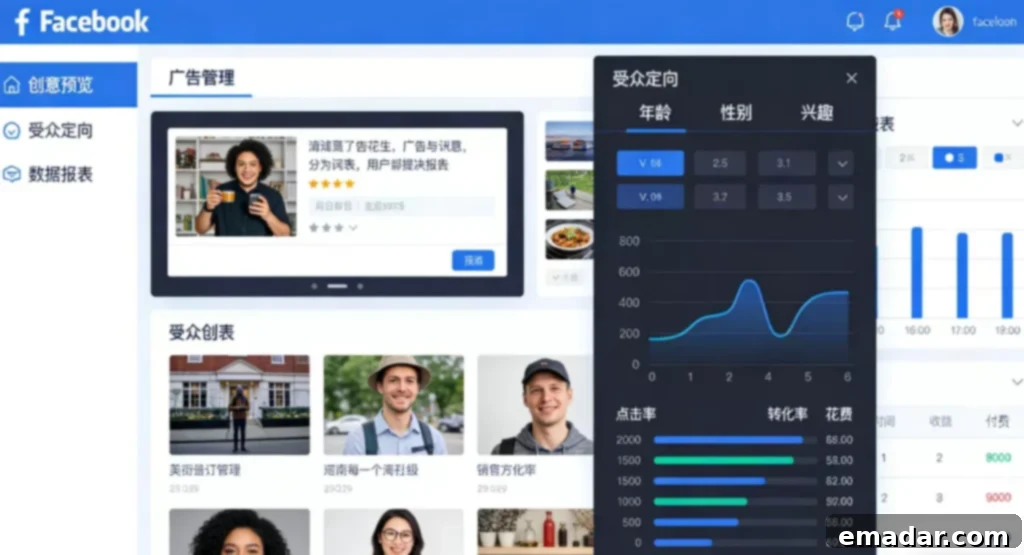
Mastering Facebook Advertising: A Comprehensive Guide for 2024
Are you running Facebook ads but not seeing the results you expect? Many businesses struggle with this, asking:
How can I effectively run Facebook ad campaigns? Why am I spending money without achieving desired conversions?
The truth is, simply launching Facebook ads isn’t enough. Truly effective advertising requires a complete cycle, from goal setting and audience targeting to creative optimization, data analysis, and campaign verification.
If you’re involved in e-commerce, running an independent website, or expanding your brand globally, this guide is for you. We’ll cover the entire Facebook ad operation, including the advertising process, optimization methods, common issues, and how to use dynamic proxy IPs to verify ad performance. By the end, you’ll have a solid foundation for managing successful Facebook ad campaigns.

Facebook Advertising: Basic Steps
1. Define Your Advertising Goals
In the Facebook Ads Manager, the first step is to define your campaign objective. Common options include:
- Brand Awareness
- Traffic
- Engagement
- Conversions
- Sales
Your selected objective determines how Facebook optimizes your ad delivery.
For e-commerce businesses, “Conversions” or “Sales” are often the most suitable choices.
2. Target the Right Audience
Facebook’s strength lies in its ability to target specific audiences based on:
- Country/Region
- Gender/Age
- Interests
- Behaviors
- Retargeting Audiences
Best Practices for Beginners:
- Start with broad targeting to gather data.
- Refine your audience based on performance data.
- Avoid overly granular targeting initially.
3. Optimize Your Ad Creatives
High-converting ads typically include:
- A captivating opening within the first 3 seconds.
- Clear problem/solution messaging.
- A strong Call to Action (CTA).
- Localized language adaptation.
Remember, your ad creative is paramount.
Even with precise targeting, ineffective creative will hinder your campaign’s performance.
Key Strategies for Facebook Ad Optimization
1. Monitor Key Performance Indicators (KPIs)
Pay close attention to these metrics:
- Click-Through Rate (CTR)
- Cost Per Click (CPC)
- Cost Per Mille (CPM)
- Return on Ad Spend (ROAS)
- Conversion Rate
Recommended Optimization Order: Creative → Audience → Bidding → Landing Page
2. Challenges of Multi-Country Advertising
Many cross-border sellers face challenges when advertising in multiple countries:
- Is the ad actually displaying correctly in the target country?
- Are network issues causing display problems?
- Is the ad being incorrectly flagged as non-compliant?
Especially when testing different regional markets, it’s difficult to gauge creative localization success without seeing how the ad displays locally.
This is where dynamic proxy IPs become essential for verification.
Using Dynamic Proxy IPs to Verify Your Facebook Ad Content
1. Why Use Dynamic Proxy IPs?
When viewing ads from your home country or a non-target region:
- You see a non-localized version.
- You may not trigger actual ad impressions.
- The recommendation algorithms differ.
- Ad ranking varies.
Using dynamic residential IPs from your target countries allows you to simulate a real local user environment, enabling you to:
- View the actual ad display.
- Check if the landing page loads correctly.
- Verify the accuracy of local language.
- Observe competitor ad campaigns.
2. The Benefits of Dynamic Proxy IPs
Compared to static IPs, dynamic residential IPs:
- More closely resemble real home networks.
- Allow you to rotate through different locations.
- Are ideal for multi-market testing.
- Reduce the risk of being flagged as suspicious activity.
For example, in cross-border ad testing, some teams use dynamic residential proxy IP products like Dynamic Residential Proxy IP to verify ad displays and monitor competitors across multiple countries.

3. Practical Example: Testing Ads in the US Market
Step-by-step:
Step 1: Select a US residential IP.
Step 2: Log in to your Facebook account or use a browser in incognito mode.
Step 3: Search for relevant keywords or browse content related to your target interests.
Step 4: Check if the ad displays as expected.
Step 5: Evaluate the landing page loading speed and localization.
This approach provides a more realistic assessment of your ad campaign’s effectiveness.
Common Facebook Advertising Issues
1. What to Do When Your Ad Is Rejected
Common reasons for ad rejection:
- Sensitive language in the ad copy.
- Prohibited elements in the images.
- Exaggerated claims.
- Insinuations related to personal attributes.
Solutions:
- Modify the creative.
- File an appeal.
- Change your phrasing.
2. High Click-Through Rate (CTR) but No Conversions?
Investigate these factors in the following order:
- Landing page loading speed.
- Smoothness of the payment process.
- Relevance of the landing page to the local language.
- Potential cross-regional access issues.
Testing with a proxy IP from the target country can quickly pinpoint the problem.
3. Why Are Data Discrepancies High Between Regions?
Possible causes:
- Cultural differences.
- Variations in price sensitivity.
- Differences in internet speed.
- Varying levels of ad competition.
For multi-country advertising, it’s best to create separate ad sets for each region and test them independently.
Advanced Facebook Advertising Tips
1. Establish a Multi-Country Testing Framework
- Create separate ad sets for each country.
- Conduct independent creative testing.
- Control the budget for each region separately.
2. Perform Regular Ad Display Verification
Avoid these issues:
- Ads appearing normal in the backend but not loading correctly for users.
- Landing pages that are not accessible.
- Incorrect local language.
Using a dynamic residential IP tool for periodic checks can significantly reduce these issues.
3. Maintain a Stable Account Environment
Account security is also crucial:
- Avoid frequently changing your login IP.
- Maintain consistency in your account’s region.
- Avoid sharing accounts with multiple users.
When multi-region testing is needed, use multi-country residential IP resources provided by vendors rather than frequently switching your main account environment.
Conclusion
Effective Facebook advertising is more than just running ads. It requires: precise targeting + high-converting creatives + data optimization + authentic local verification.
Especially in multi-country markets, relying solely on backend data is insufficient.
By simulating a real local browsing environment using dynamic proxy IPs, you can more accurately assess:
- Whether your ads are displaying correctly.
- Whether your landing page provides a good user experience for local users.
- The actual advertising activity of your competitors.
When you have established:
- A solid data analysis capability.
- A localized testing process.
- A reliable network verification system.
You will reach a new level of control over your Facebook advertising campaigns.
If you are running cross-border ads, consider incorporating “authentic local verification” into your regular optimization process; the results will often be more significant than simply adjusting your budget.
Not sure which solution is right for your business? Contact a specialist for assistance today!