
IP Cleanliness: The Ultimate Guide to Checking and Maintaining IP Purity
IP Cleanliness, also known as IP Purity, refers to the “innocence” or “reputation” of an IP address within the online environment. It directly impacts whether an IP address can successfully access target websites and conduct business operations without being blocked or flagged. A high-purity IP signifies:
- ✅ Not Blacklisted: Absent from over 200 Real-time Blackhole Lists (RBLs) databases like Spamhaus and Barracuda.
- ✅ No Fraudulent History: Not marked for malicious activities such as web scraping, spamming, or fraudulent transactions.
- ✅ Genuine User Characteristics: Appears to originate from a legitimate residential network or a trusted data center.
- ✅ Accurate Geolocation: The IP’s location aligns with its actual usage location, free from DNS leaks or geolocation spoofing.
In scenarios such as cross-border e-commerce, social media management, and data collection, a low IP cleanliness can lead to account bans, payment gateway blocks, advertising account restrictions, and interruptions to web scraping projects. Industry data from 2025 indicated that businesses using low-quality proxy IPs experienced a staggering 67% ban rate. However, adopting high-purity IP solutions can reduce this risk to below 5%.

Top IP Cleanliness Check Tools
1. IPQS (IP Quality Score) – Fraud Risk Assessment
Core Function:
IPQS is a benchmark tool for IP quality assessment, known industry-wide. It performs real-time scans against 200+ IP blacklists and provides a fraud risk score from 0 to 100. The lower the score, the cleaner and safer the IP.
Detection Dimensions:
- Proxy/Tor Node Identification
- Geolocation and ISP Authenticity Verification
- Historical Fraudulent Activity Marking (Web Scraping, Bulk Emailing, Port Scanning)
- Device Fingerprint Association Analysis
Suitable Scenarios: Financial risk control, e-commerce anti-fraud, advertising traffic verification.
Pricing: Offers free basic queries; API access requires a subscription (starting around $199/month).
2. Scamalytics – Professional Anti-Fraud Scoring System
Core Function:
Scamalytics provides a detailed Fraud Score and IP risk profile, excelling at differentiating between data center proxies and residential proxies. Its database covers historical behavior records of billions of IPs globally.
Detection Dimensions:
- Fraud Score (0-100, lower is better)
- Proxy Type Identification (Data Center/Residential)
- Open-Source Blacklist Cross-Validation
- Geolocation Accuracy Detection
Suitable Scenarios: Cross-border e-commerce account registration, payment risk control, affiliate marketing anti-cheating.
Features: Offers API interfaces and bulk IP queries; supports CSV export.
3. Ping0 (ping0.cc) – User-Friendly IP Detection Platform
Core Function:
Ping0 is a commonly used IP detection tool, featuring a straightforward interface. It monitors past IP usage behavior (including web scraping, bulk emailing, and scanning activities) through big data and provides an intuitive IP risk control value.
Detection Dimensions:
- IPv4 Geolocation and ASN Information
- IP Type Identification (Residential/Data Center/Proxy)
- Real-Time Risk Control Score
- Historical Abuse Record Query
Suitable Scenarios: Proxy IP verification before purchase, cross-border e-commerce multi-account management, web scraping project IP selection.
Advantages: No registration required, fast response speed.
4. IPinfo – Developer-Preferred IP Data Platform
Core Function:
IPinfo is a well-known international IP data service provider, offering real-time IP type detection (proxy/hosting service) and geolocation data. Its API is integrated by over 100,000 developers worldwide.
Detection Dimensions:
- Privacy Detection (Proxy/Tor/Hosting Service Identification)
- ASN and Company Information Association
- Geolocation (City-Level)
- WHOIS Data Query
Suitable Scenarios: Application development integration, automated risk control processes, large-scale IP batch detection.
Pricing: Free version offers basic data; commercial API starts at $49/month.
5. Whoer – Comprehensive Anonymity Check Tool
Core Function:
Whoer automatically detects the current device IP upon website access. It not only analyzes basic device information and ASN data but also conducts DNS leak tests—comparing DNS server locations with IP display locations to determine the IP’s true cleanliness.
Detection Dimensions:
- Anonymity Score (0-100%)
- DNS Leak Detection
- WebRTC Leak Detection
- Browser Fingerprint Analysis
Suitable Scenarios: Proxy effect verification, privacy protection detection, personal user anonymity testing.
Advantages: Completely free, no registration required.
6. Sender Score – Dedicated Email Sending Reputation Check
Core Function:
While Sender Score is primarily aimed at email marketing scenarios, its IP reputation score (0-100) directly reflects the historical quality of IP behavior. The score is based on a 30-day rolling average and is an indicator of whether an IP is trusted by email service providers.
Detection Dimensions:
- Sender Reputation Score
- Complaint Rate, Unknown User Ratio
- Spam Trap Hit Records
- Email Volume Anomaly Detection
Suitable Scenarios: Email marketing, EDM sending, SMTP server IP selection.
Threshold Reference: Scores below 70 will be heavily filtered by email service providers.
IP Cleanliness Check in Practice: Choosing the Right Tools
Scenario 1: Proxy IP Verification
Recommended Combination: Ping0 + IPQS
Operation Flow:
- Obtain a list of proxy IPs from the provider.
- Use Ping0 for quick batch detection of risk control values, eliminating high-risk IPs.
- For IPs passing the initial screening, use IPQS for in-depth blacklist status detection.
- Retain IPs with a fraud score < 30 and not on any blacklists.
Professional Advice: If you are looking for a high-purity proxy IP service provider, IPFLY’s static residential proxies are worth considering. All their IPs undergo multi-layer filtering to ensure no historical abuse records, and the fraud score remains below 10, making them particularly suitable for e-commerce account management scenarios requiring long-term stable IPs.
Scenario 2: Cross-Border E-Commerce Multi-Account Operation
Recommended Combination: Scamalytics + IPinfo
Operation Flow:
- Assign a unique IP to each account.
- Use Scamalytics to verify whether the IP is a genuine residential IP (not a data center).
- Confirm that the IP’s geolocation matches the target market using IPinfo.
- Regularly (weekly) retest IP cleanliness and promptly replace IPs with rising scores.
Risk Control: Platforms like Amazon and eBay are sensitive to IP association. It is recommended to use static residential proxies (such as IPFLY’s native residential IPs), binding each account to a unique residential IP, and using a fingerprint browser to effectively prevent account association bans. Their IP pool covers 190+ countries, supporting city-level positioning to ensure each account has a unique “digital fingerprint.”
Scenario 3: Large-Scale Data Collection Projects
Recommended Combination: IP Data Cloud + Talos Intelligence
Operation Flow:
- Establish an IP quality scorecard (blacklist status, response speed, geolocation).
- Use the IP Data Cloud API for real-time IP health monitoring.
- Integrate Talos Intelligence for continuous reputation tracking.
- Establish an IP rotation mechanism, automatically decommissioning IPs with a score > 50.
Scenario 4: Enterprise-Level Risk Control Compliance
Recommended Combination: PowerDMARC + Barracuda Central
Operation Flow:
- Monitor 200+ RBL real-time blacklists.
- Establish an IP reputation baseline (Good/Neutral/Poor three-level classification).
- Immediately disable and trace Poor-level IPs.
- Generate compliance audit reports.
Solving the Problem at the Source: Choosing High-Purity IPs
Instead of continuously testing and replacing low-quality IPs, it’s better to choose high-purity proxy services from the outset. A qualified proxy service provider should have:
✅ Self-built server infrastructure
✅ Multi-layer IP filtering mechanism
✅ Real-time IP pool updates
✅ 99.9% availability guarantee
✅ Precise Geolocation
IPFLY, as a leading proxy service provider, has an IP cleanliness control system worth emulating:
- 90 million+ global residential IP pool, all IPs are strictly screened to ensure no historical abuse.
- Three-layer quality filtering: Entry screening (ISP cooperation verification) → Behavior monitoring (real-time risk control scoring) → Exit quality inspection (pre-use testing).
- Exclusive IP allocation: Each static residential IP is only assigned to a single user, preventing “IP pollution.”
- Coverage of 190+ countries: Supports city-level IP positioning to meet localization business needs.
For business scenarios requiring long-term stable operation (such as Amazon multi-store management and social media matrix operation), their static residential proxies provide enterprise-level IP cleanliness assurance.
IP Cleanliness Check Tool Quick Reference Table
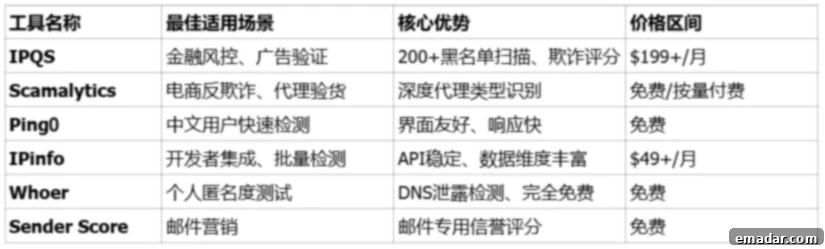
IP cleanliness is a dynamic indicator that cannot be permanently guaranteed by a one-time check. It is recommended to establish a closed-loop management system of “detection-use-monitoring-replacement,” combine it with business scenarios to choose appropriate tool combinations, and introduce professional proxies like IPFLY to ensure IP quality from the source. Doing so will help you gain a competitive edge in the cross-border business competition.
“Dirty IP, Double Account Trouble!” 👉 Claim Your Discount and Get Premium IPs Now! A pool of 90 million real residential IPs awaits you!