
In the dynamic landscape of cross-border e-commerce, international advertising campaigns, social media management, and data collection, an IP address transcends its basic function as a network identifier. It plays a pivotal role in shaping account behavior, influencing security and risk assessment, and determining content distribution. As businesses navigate the complexities of major global markets such as North America, Australia, and Europe, merely having a “US IP” or a “UK IP” is no longer sufficient. An increasing number of operational teams are now prioritizing proxy services that offer the critical ability to select IPs by state. This advanced functionality has become indispensable for various digital operations. But why is this feature so crucial? And in which scenarios does it offer a distinct advantage? This comprehensive guide will explain everything you need to know about state-specific IP proxies.
1. Traditional IP Proxies vs. State-Specific IP Proxies: A Crucial Distinction
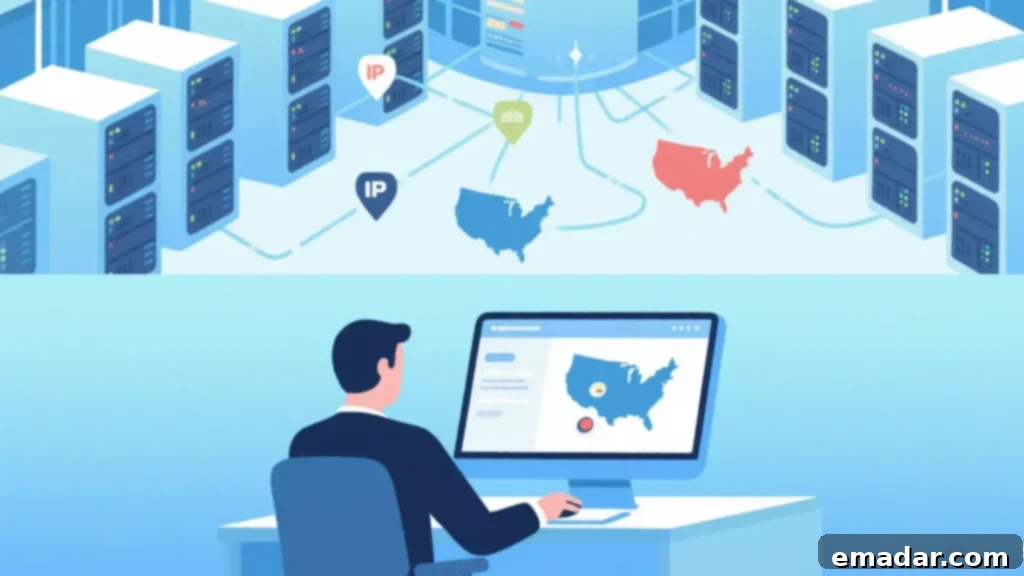
Traditional proxy IP services typically offer node selection at a country level, providing options like the United States, the United Kingdom, Japan, or Singapore. While these services route your connection through the chosen country, the actual IP addresses originate from various, often random, states or cities within that nation. This inherent randomness can pose significant challenges. When platforms use IP location to distribute localized content or detect potential risks, frequent and inconsistent IP switching across different geographical regions within the same country can easily trigger flags for unusual activity, leading to account suspensions or content restrictions.
In stark contrast, state-specific IP services empower users to pinpoint their desired exit IP location down to a particular state within the target country. For example, users can explicitly choose an IP address from “California, USA,” “Texas, USA,” or “Ontario, Canada.” This level of precise geo-targeting ensures that accounts, advertising campaigns, and data scraping operations maintain a consistent, stable, and credible geographical footprint. Such consistency is vital for mimicking genuine user behavior, bypassing geo-restrictions, and avoiding the scrutiny of sophisticated platform algorithms. By providing granular control over the IP’s origin, state-specific proxies eliminate the variability associated with general country-level proxies, thereby enhancing operational stability and effectiveness across diverse digital activities.
2. Why Cross-Border Operations Increasingly Rely on State-Specific IP Proxies
The strategic advantage of geo-targeted IP addresses extends across numerous facets of cross-border digital operations. Here’s why selecting IPs by state has become a non-negotiable tool for success:
2.1. Mitigating Advertising Account Risk and Enhancing Compliance
Overseas advertising platforms such as TikTok Ads, Facebook Ads, Google Ads, and others have implemented increasingly stringent risk control mechanisms. These systems don’t merely monitor the country of origin for an IP; they meticulously analyze city and state-level IP information. If an ad account’s login location frequently changes across different states, or if multiple accounts log in from the same state and city in a manner that suggests coordinated activity, platforms are likely to identify this as suspicious “group control” behavior, leading to warnings, ad disapproval, or even permanent account suspension. This is especially true for accounts running high-spend campaigns or targeting sensitive demographics.
By leveraging state-specific IP proxies, cross-border advertisers can significantly mitigate these risks:
- Stable Login Environments: Each advertising account can be matched with a dedicated IP from a specific, fixed state, ensuring long-term, stable login consistency. This creates a realistic user profile, making it harder for platforms to detect unusual login patterns.
- Enhanced Ad Review & Approval: Advertisers can ensure that their campaign creatives and target audience settings align perfectly with the geographical location of their ad account’s IP. This geographical congruence reduces the likelihood of audit obstacles and improves ad approval rates, as platforms see a consistent and legitimate operational context.
- Boosting Ad Weight and Performance: Simulating localized operational paths, such as managing an ad account from the same state where the target audience resides, can significantly enhance an ad’s relevance and perceived legitimacy. This can lead to higher ad scores, improved delivery, and ultimately, better campaign performance and ROI, as the ad system trusts the source more.
- Avoiding IP Blacklisting: Consistent, residential state-specific IPs are less likely to be flagged or blacklisted compared to shared, frequently changing IPs from data centers, which can negatively impact ad delivery.
2.2. Precision for Localized Marketing Content Testing and SEO
User search habits, trending keywords, and advertising preferences can vary dramatically from one state to another within a large country like the United States. SEO optimizers, social media marketing teams, and content strategists need the ability to accurately replicate local search results and truly understand keyword rankings and competitor content performance. This requires testing within the network environment of the target state, not just the country.
In this context, having access to state-specific IP proxies becomes an invaluable asset. It allows marketers to:
- Accurate SERP Analysis: Directly simulate the browsing experience of users in specific states like California, Florida, or New York on search engines such as Google, Bing, and Yahoo. This provides an authentic view of Search Engine Results Pages (SERPs), revealing local keyword variations, top-ranking competitors, and featured snippets unique to that region.
- Localized Keyword Research: Discover geographically relevant keywords and long-tail phrases that perform better in one state compared to another. This is crucial for hyper-targeting content and ad campaigns.
- Competitor Intelligence: Monitor how competitors are performing in specific states, identify their localized strategies, and uncover opportunities for market penetration.
- A/B Testing Content: Test different versions of web pages, landing pages, or ad copy to see which resonates best with audiences in particular states, optimizing conversion rates.
- Geo-Targeted Content Verification: Ensure that geo-restricted content, special offers, or localized website versions are displaying correctly for users in their intended regions, which is critical for compliance and user experience. This precision is key to fine-tuning marketing strategies and maximizing their impact.
2.3. Ensuring Compliance and Stability in Data Collection
Many online platforms impose strict limitations on data scraping activities, especially for e-commerce sites, social media networks, and financial portals. Requests originating from frequently changing or geographically inconsistent IP addresses are often identified as automated bot activity, leading to access blocks, CAPTCHAs, or even permanent IP bans. This poses a significant hurdle for businesses relying on real-time market intelligence.
By utilizing state-specific IP proxies, data teams can overcome these challenges effectively:
- Targeted Data Extraction: Precisely collect information on trending products, promotional activities, and user reviews from specific states or regions. This allows for highly granular market analysis and competitive intelligence that reflects local dynamics.
- Distributed Scraping Missions: Deploy data collection tasks across multiple states simultaneously. This distributed approach significantly reduces the risk of single-point blocking, as requests appear to originate from diverse, legitimate user locations, mimicking genuine user traffic.
- Accurate Regional Data Categorization: Achieve precise “state-by-state scraping” and “regional data classification,” which is invaluable for businesses needing to segment their market data geographically for detailed analysis and strategic decision-making.
- Bypassing Rate Limits: With a pool of state-specific IPs, scrapers can distribute requests more effectively, staying under platform rate limits and avoiding detection.
- Accessing Geo-Restricted Data: Collect data that might only be visible or accessible to users within a certain state due to licensing agreements or local content policies.
2.4. Building Isolated Environments for Multi-Account Management
MCN (Multi-Channel Network) agencies, cross-border e-commerce sellers, and live-streaming teams often manage a large portfolio of accounts across various platforms. If these accounts log in from different states or frequently jump between locations using inconsistent IPs, it can easily trigger platform association mechanisms. These mechanisms, often based on IP address, browser fingerprinting, and behavioral patterns, can link seemingly disparate accounts, leading to mass suspensions if one account is flagged.
Leveraging state-specific IP proxies provides an elegant solution for this complex problem:
- True Account Isolation: Each account within a multi-account matrix can be assigned a dedicated, exclusive residential proxy from a specific state. This ensures that each account maintains a unique and consistent digital footprint, preventing platforms from correlating them based on shared IP addresses.
- Reduced Verification Frequency: By maintaining a stable IP address for each account, the frequency of login verifications, CAPTCHAs, and security challenges is significantly reduced, streamlining operations and saving valuable time.
- Mimicking Real User Behavior: Using residential IPs from distinct states makes each account appear as a genuine, independent user operating from a fixed location, thereby enhancing credibility and reducing the risk of detection by sophisticated platform algorithms designed to identify bot networks.
- Enhanced Security and Control: Provides an additional layer of security by segmenting account access. Should one IP be compromised, it won’t affect other accounts operating from different state-specific proxies.
3. Essential Capabilities of a State-Specific IP Proxy Provider
Not all proxy service providers offer the sophisticated functionality of state-specific IP selection. To ensure high-quality and reliable service, businesses should look for providers that meet the following criteria:
- Extensive Residential Proxy Network: The provider must possess a vast pool of genuine residential IP addresses, ideally covering all major 50+ states in key markets like the USA. Residential IPs are crucial because they originate from real internet service providers and are thus perceived as legitimate users by online platforms, significantly reducing the risk of detection and blocking compared to datacenter IPs.
- Broad Protocol Support: Compatibility with HTTP, HTTPS, and SOCKS5 protocols is essential. This ensures that the proxies can be seamlessly integrated with a wide range of applications, browsers, and automation tools used for various digital operations, offering maximum flexibility.
- Self-Service State/City Selection: Users should be able to easily select specific states and even cities through a user-friendly dashboard or API. Furthermore, the nodes should be updated in real-time and consistently online, ensuring continuous availability and reliability of the chosen locations.
- Low Latency and High Bandwidth: For critical tasks like ad serving and real-time data collection, low latency and high bandwidth are paramount. These features ensure fast connection speeds, smooth operation, and efficient data transfer, preventing delays that could impact campaign performance or data accuracy.
- Regular IP Blacklist Cleaning: A reputable provider will routinely clean its IP pools to remove any blacklisted or compromised IP addresses. This proactive measure guarantees a high degree of IP purity, ensuring that users always have access to clean, unflagged IPs that can perform their tasks without immediate suspicion.
- Robust Customer Support: Access to responsive and knowledgeable customer support is vital for troubleshooting, technical assistance, and guidance on optimal proxy usage.
Service providers like IPFLY, for example, offer a comprehensive US state-node selection function. This allows users to custom filter residential or datacenter IPs from key markets such as California, Texas, New York, and Florida, catering to the diverse needs of various operational scenarios with precision and reliability.
4. Practical Application Examples of State-Specific IP Proxies
To illustrate the tangible benefits, consider these real-world applications:
- Brand Advertiser A: Enhancing Ad Account Security in the East Coast. Facing challenges with frequent ad account flags and suspensions for their campaigns targeting the U.S. East Coast, Brand Advertiser A decided to implement a solution. They bulk-purchased dedicated residential proxies specifically from New York, Pennsylvania, and Massachusetts. By assigning a stable, state-specific IP to each ad account, they effectively simulated local user behavior and circumvented platform risk detection systems. As a result, their account risk rate plummeted to just 30% of its original level, significantly reducing ad spend waste and improving campaign continuity.
- SEO Team B: Optimizing for Western U.S. Market Performance. SEO Team B was tasked with improving search rankings for clients in the competitive Western U.S. market but found their general U.S. IP testing unreliable for local nuances. They strategically deployed California and Washington state IPs for their testing and analysis. This enabled them to accurately gauge search engine ranking performance for different keywords and content variations specifically within these states. The granular insights gained allowed them to refine their SEO strategies, leading to an approximate 40% improvement in SEO conversion effectiveness for their targeted Western U.S. campaigns.
- Data Company C: Hyper-Targeted Social Media Data Collection. Data Company C needed to collect local trending keywords from TikTok across four major U.S. states for market research. Relying on state-specific IP proxies, they implemented a partitioned scraping strategy, ensuring that data extraction requests for each state originated from an IP within that respective state. This geo-distributed approach allowed them to bypass platform restrictions and rate limits that would typically hinder broad scraping efforts. Consequently, their data collection success rate for localized TikTok trends soared to an impressive 98%, providing richer, more accurate regional insights.
5. Conclusion: The Strategic Imperative of State-Specific IP Proxies
In the rapidly evolving cross-border market of 2025 and beyond, proxy IP addresses are no longer merely “IP switching tools.” They have emerged as fundamental infrastructure for digital marketing, data operations, and account security. Specifically, services equipped with the ability to select IPs by state offer unparalleled advantages, enabling higher productivity and significantly lower risks for multi-account management, sophisticated ad account setups, precise local SEO monitoring, and granular regional data collection. This advanced capability transforms how businesses operate online, providing the control and authenticity needed to thrive in competitive global markets.
If you are planning to deploy a multi-account matrix in the U.S., launch highly targeted advertising campaigns, collect localized market data, or perform regional SEO optimization, it is highly recommended to prioritize proxy services that support state-specific IP selection (such as IPFLY). By strategically combining different proxy types and ensuring consistent geo-targeting, you can construct a stable, secure, and authentic operating environment. This approach is not just a tactical advantage but a long-term strategy for enhancing the efficiency and effectiveness of your cross-border business operations, securing your digital footprint and maximizing your return on investment.