
GPT-5.2: Revolutionizing E-commerce with AI and the Critical Role of IP Stability
On December 11, 2025, OpenAI released GPT-5.2, marking the fastest iteration of its large language model in the past year. The interval between GPT-5 and GPT-5.1 was three months, while the release of GPT-5.2 followed in less than 30 days.
Fueled by competitive pressure from Google’s AI advancements, especially the impressive performance of Gemini 3, OpenAI has shifted into “acceleration mode.” This change in pace presents both opportunities and risks for the cross-border e-commerce industry.
Similar to GPT-5.1, the newly released GPT-5.2 comes in three versions, all of which have updated world knowledge up to August 2025.
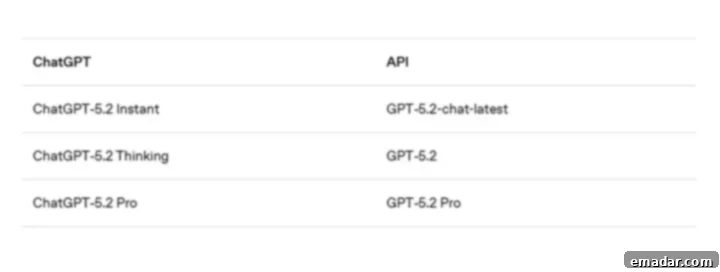
GPT-5.2 Instant: This model is designed as the “go-to” for everyday work and learning. It offers significant improvements in information retrieval, how-to guides, step-by-step explanations, technical writing, and translation. It also maintains the warm and natural conversational style of GPT-5.1 Instant.
GPT-5.2 Thinking: Created for more in-depth tasks, this version helps users tackle complex projects with a higher degree of completion. It excels at coding, summarizing long documents, answering questions related to uploaded files, step-by-step deduction of mathematical and logical problems, and supporting planning and decision-making with clearer structure and more useful details.
GPT-5.2 Pro: This is the smartest and most reliable option for handling challenging problems. It’s especially suitable for scenarios requiring high-quality answers. GPT-5.2 is now the default model within ChatGPT.
Key Enhancements in GPT-5.2
The most significant aspect of GPT-5.2 isn’t just improved conversational ability; it’s the model’s advancement into expert-level task capabilities:
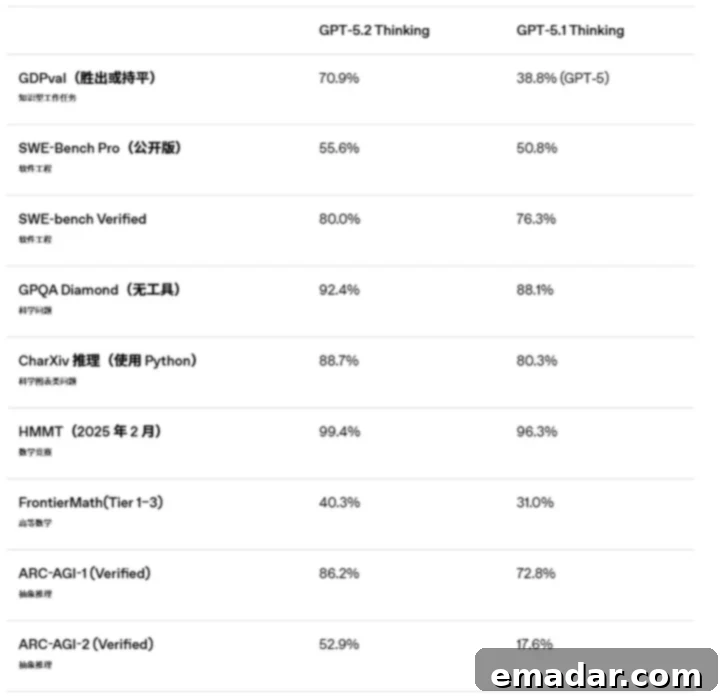
- In the GDPval test (covering 44 professional tasks), 70.9% of GPT-5.2 Thinking’s outputs were rated as “equal to or better than top industry experts.” This includes creating PPT presentations, Excel spreadsheets, and other professional documents.
- Under supervised conditions, its processing speed is more than 11 times faster than that of humans.
- The cost is less than 1% of that of human labor.
These improvements allow GPT-5.2 to perform the following tasks with higher quality:
- Large-scale spreadsheet processing
- Generation of business documents
- Market analysis and forecasting
- Bulk production of multilingual content
- Automation of cross-platform operational SOPs
Importantly, OpenAI has removed the automatic model switching: Instant now runs stably by default, while Thinking requires users to actively enable it. This is a significant improvement in “controllability” for teams relying on AI for account management, data analysis, and content automation.
Emerging Risks in the Age of Accelerated AI: Higher Thresholds for Risk Control
While GPT-5.2 boosts team productivity, it also makes it easier for platforms to detect automated behavior.
Platforms like TikTok, Amazon, Meta, PayPal, and Shopify are simultaneously strengthening their risk control logic, particularly concerning:
- Inconsistent login IP addresses
- Poor-quality ASN segments
- Suspected automation due to dynamic IP fluctuations
- High degree of repetition in multi-account environments
- Large numbers of operations performed on the same network segment
The tolerance level has decreased. What was previously tolerated at 80% may now only be tolerated at 40%.
More and more cross-border teams are finding that:
AI has increased the number of “detectable behaviors,” making risk control stricter than ever.
This is another overlooked risk in the era of GPT-5.2.

Why “Network Identity Stability” is Becoming a Fundamental Capability in the AI Era
When you use AI to execute business workflows, such as:
- Bulk uploading
- Automated customer service
- Automated reviews
- Automated generation of notes/comments
- Automated replenishment monitoring
- Automated advertising assistants
These are the areas that platforms are most closely monitoring. This means that IP consistency + cleanliness + long-term stability have become fundamental requirements for cross-border operations.
For example, several teams have recently reported:
- Dynamic IPs triggering secondary verification on Stripe/PayPal
- Increased account suspension rates when using shared ASNs on TikTok Shop
- “Suspicious login” alerts on Facebook BM due to inconsistent IPs
- Account association triggered by repeated network segments on Amazon multi-stores
These risks will be further amplified in the GPT-5.2 era.
AI’s Strength, Account Environment Weakness: Why GPT-5.2 Makes IP a Critical Resource
This is a logic that many sellers haven’t yet realized:
GPT-5.2 Allows You to Perform More Operations
→ The platform detects more risk events
→ The importance of IP environment stability is infinitely amplified
AI drives business expansion, while IP determines whether the business can survive.
The industry recognizes the “three elements of security” in the GPT-5.2 era:
- Authenticity of the account environment
- Diversification of operational logic
- Consistency of network identity (most critical)
The foundation of network identity is: static, high-quality, dedicated residential IPs.
Adapting Your IP Strategy for the GPT-5.2 Era: Maximizing Benefits and Minimizing Risks
Many advanced cross-border teams have begun upgrading their IP infrastructure, such as using high-quality ISP static residential IPs from providers like IPFLY. This involves fixing the account environment to be “consistently the same, non-fluctuating, and non-shared” to prevent platform algorithms from flagging AI-enhanced bulk operations as “programmatic risks.” Investing in high-quality IP solutions is not just about security; it’s about ensuring the longevity and scalability of your e-commerce business in an increasingly competitive and sophisticated online landscape.
Here are some recommended strategies:
- ⭐ Main accounts should use dedicated static residential IPs
- ⭐ Matrix accounts should be divided by ASN to avoid batch similarity
- ⭐ Automation tools and GPT-5.2 tasks must be bound to stable nodes
- ⭐ Maintain a consistent IP environment when switching between platforms
- ⭐ Multi-regional teams should prepare 3–5 backup IP segments
This strategy can significantly improve:
- Account survival rate
- Note exposure rate
- Stability of ad spend
- Approval rate of payment platform reviews
- Security against multi-account association
Conclusion: GPT-5.2 Shifts the Advantage – Stable Environments are the New Barrier
Over the next 12 months, the cross-border industry will see a clear divergence:
- Teams that can run AI + a stable IP environment will see a significant increase in efficiency.
- Teams that rely solely on AI but ignore risk control environments will frequently encounter problems.
GPT-5.2 is an amplifier of productivity, but only if your accounts can survive.
Use IPFLY Residential Proxy IPs
IPFLY has a self-built server + big data filtering system, providing only:
- Real residential IPs assigned by ISPs
- Clean, unpolluted IP segments, non-shared, with no history of abuse
- Support for IP detection, location filtering, and multi-country switching
For risk prevention and control, use IPFLY for IP isolation! Securing a stable and reliable IP infrastructure is not just a technical consideration; it’s a strategic imperative for businesses looking to thrive in the AI-driven e-commerce landscape.