In the rapidly evolving digital landscape, dedicated dynamic IP addresses are no longer just a technical utility; they are becoming a cornerstone for innovation, security, and global operational efficiency. As businesses navigate the complexities of Web3.0, AI-driven data demands, stringent regulatory frameworks, and advanced cyber threats, the role of dynamic IP technology is expanding exponentially. This comprehensive guide explores the pivotal advancements expected in exclusive dynamic IP solutions from 2025 to 2030, delves into critical industry applications, and outlines a strategic framework for integrating these powerful tools. Understanding and leveraging dynamic IPs will be essential for maintaining a competitive edge and ensuring compliance in the coming decade.
The Five Major Evolution Directions for Exclusive Dynamic IPs (2025-2030)
The next five to ten years promise a transformative era for dedicated dynamic IP addresses, with their capabilities becoming integral to several cutting-edge technological and regulatory shifts. These five key areas highlight where dynamic IP technology, particularly solutions like IPFLY, will play a critical role in shaping the future digital economy.
1. Web3.0 Infrastructure Reconstruction and Decentralized Applications (DApps)
As the internet transitions towards Web3.0, decentralized applications (DApps) are becoming mainstream, demanding robust and secure infrastructure. Dynamic IPs are crucial for simulating authentic user distribution across global networks, which is vital for preventing Sybil attacks—where a single entity operates multiple nodes to gain disproportionate influence. According to a 2024 CoinDesk report, a staggering 72% of Sybil attack defenses in blockchain node communication rely on trusted IP verification. Dedicated dynamic IP solutions enable DApps to achieve a delicate balance between transaction anonymity and regulatory compliance, offering enhanced security and user privacy. IPFLY, for instance, already supports IP masquerading schemes across over 20 public chains, including Ethereum and Polygon, facilitating anonymous on-chain transactions while adhering to evolving compliance standards.
2. The AI Training Data Revolution and Large Language Models (LLMs)
The rapid advancement of Artificial Intelligence, particularly Large Language Models (LLMs), hinges on access to vast and diverse training datasets. However, obtaining high-quality, multi-lingual corpora is often hampered by sophisticated anti-scraping mechanisms that block static IP addresses. Dedicated dynamic IPs provide a critical pathway to circumvent these blocks, allowing AI developers to efficiently gather the extensive data needed for model training. OpenAI data reveals that utilizing exclusive dynamic IPs can boost data collection efficiency by an astonishing 400 times, concurrently elevating the Data Diversity Index (DVI) from 0.38 to 0.79. This ensures that LLMs are trained on a broader, more representative range of information, leading to more robust, unbiased, and capable AI systems.
3. Global Compliance Regulation Upgrade and Auditable IP Resources
Regulatory landscapes worldwide are becoming increasingly stringent, particularly concerning data privacy and digital operations. The EU’s Digital Services Act 2.0, set to take effect in 2025, mandates that enterprises use auditable IP resources for their digital services. This necessitates a transparent and traceable approach to IP management, allowing authorities to verify data origin and flow. Dynamic IP providers, with their advanced compliance IP libraries, are uniquely positioned to meet these demands. IPFLY, for example, offers functionalities to generate country-specific data transfer reports, providing businesses with the necessary tools to demonstrate compliance with international regulations and avoid hefty penalties.
4. IoT Security Architecture Iteration and Smart Devices
The proliferation of IoT devices, from smart vehicles to industrial equipment, introduces new security vulnerabilities. These devices often rely on network connectivity, making their true network topology a potential target for cyberattacks. Dynamic IPs offer an innovative solution by concealing the actual network architecture of these devices, significantly enhancing their security posture. Tesla’s security whitepaper indicates that dynamic IP usage can reduce the attack surface for Over-The-Air (OTA) updates by 63%, while vehicle identity masquerading can achieve a response speed of 50ms per instance. This agility and obfuscation are critical for protecting sensitive IoT infrastructure and ensuring the integrity of connected systems against sophisticated threats.
5. The Metaverse Entry Battle and Digital Identity
The emerging metaverse promises immersive virtual worlds, but it also presents challenges related to digital identity and geo-location. For a seamless and secure metaverse experience, virtual identities need to be dynamically bound to geographical attributes, enabling personalized content delivery and region-specific access. Meta forecasts that the global metaverse IP services market will reach an impressive $8.7 billion by 2027. Cross-platform asset transfers and secure interactions within the metaverse will heavily rely on robust IP trustworthiness scoring systems. Dynamic IPs are crucial for enabling users to manage their digital personas and access diverse virtual environments securely and authentically, fueling the next generation of online interaction.
Practical Industry Application Examples
The theoretical benefits of dynamic IP addresses translate into tangible advantages across a multitude of industries. Here, we explore specific scenarios where dynamic IP solutions, exemplified by IPFLY, have delivered significant improvements and operational breakthroughs.
1. Amazon Store Anti-Association Strategy
E-commerce sellers managing multiple Amazon stores often face the risk of account association, where accounts belonging to the same entity are linked and potentially suspended due to perceived policy violations. The probability of IPs within the same Autonomous System Number (ASN) being associated can reach as high as 89%. IPFLY mitigates this risk by assigning each store a distinct operator IP (e.g., rotating AT&T, Verizon, Xfinity IPs) and tightly binding device fingerprints with the IP’s geographical location. This includes synchronizing time zones, languages, and font hash values. As a result, one prominent seller successfully operated over 300 stores for a full year with zero account suspensions, simultaneously reducing their return rate by 41% due to enhanced operational integrity.
2. PayPal Risk Control Penetration
Navigating the stringent risk control systems of payment platforms like PayPal requires sophisticated IP management. Utilizing static residential IPs with a lifespan of 90 days or more significantly enhances credibility. IPFLY’s transaction fingerprinting library enables the simulation of local consumer habits, making transactions appear more organic and less suspicious. This approach has proven highly effective, reducing dispute rates from 6.8% to a mere 0.3% and shortening withdrawal review times to just 4 minutes. This capability is invaluable for businesses involved in international transactions, ensuring smoother and more reliable payment processing.
3. High-Frequency Trading (HFT) IP Masking
In high-frequency trading, every millisecond counts, and IP masking is a critical strategy for gaining a competitive edge and avoiding detection. Traders require real-time access to low-latency IPs, such as those near the Nasdaq data centers in New York (achieving latency below 3ms), which IPFLY’s API provides. By changing the IP address for each order and dynamically adjusting TCP window sizes, traders can obscure their patterns. Furthermore, integrating with an IP reputation scoring system helps filter out IP segments flagged by exchanges. This comprehensive strategy has allowed one hedge fund to boost its annualized return by 22% and achieve an impressive order fill rate of 99.7%.
4. Cross-Border Remittance Compliance Audit
Financial institutions engaged in cross-border remittances must adhere to strict regulatory standards, such as those set by the Financial Action Task Force (FATF), to combat money laundering. Dynamic IPs facilitate the automatic generation of FATF-compliant IP usage logs, where dynamic IP switching records are precisely aligned with SWIFT message timestamps. Theoretically, this greatly enhances auditing efficiency, with one bank experiencing a 20-fold improvement in audit processes and a 78% reduction in anti-money laundering (AML) false positives. This level of detail and synchronization is crucial for demonstrating transparency and compliance in complex global financial operations.
5. Multimodal Data Scraping at Scale
Collecting vast amounts of diverse data for analytics or AI training often involves multimodal scraping from various sources, including images and text. A robust IP strategy is essential to manage the challenges of large-scale data acquisition, such as frequent CAPTCHA triggers and IP blocks. By combining advanced techniques like browser fingerprinting, TLS fingerprint modification, and the use of dedicated dynamic IPs, systems can consistently collect massive datasets. With IPFLY’s technology stack, it’s possible to stably collect 120TB of Google Images data daily, with a remarkably low CAPTCHA trigger rate of just 0.02%, showcasing the efficiency and reliability of such solutions.

6. Social Sentiment Analysis and Real-Time Insights
Accurate social sentiment analysis requires data scraped from social media platforms that often employ sophisticated bot detection. To obtain genuine user behavior data, each crawling instance needs to be assigned an independent dynamic IP, which switches per request. IPFLY’s behavior model library simulates realistic user interactions, including mouse movements and typing intervals, making the data collection process indistinguishable from human activity. This advanced approach can boost sentiment analysis accuracy from 72% to 91% and ensures data freshness within 15 minutes, providing invaluable real-time insights for market research and brand management.
7. Web3 On-Chain Security and Decentralized Autonomous Organizations (DAOs)
In the Web3 ecosystem, dynamic IPs enhance security and anonymity for critical operations. During NFT minting events, dedicated IPs can be bound to each minting address to prevent Sybil attacks, where a single entity attempts to mint multiple NFTs. For DAO governance, dynamic IPs hide voters’ geographic tags, ensuring truly anonymous voting and preventing influence manipulation. One DAO platform reported a 94% reduction in attack attempts and a 36% increase in proposal passing rates after implementing such dynamic IP strategies, demonstrating their efficacy in securing decentralized systems.
8. Smart Car Attack and Defense Drills
The security of smart cars is paramount, especially regarding Over-The-Air (OTA) software updates. Dynamic IPs are deployed in OTA update channels to prevent reverse engineering attempts, making it significantly harder for malicious actors to exploit vulnerabilities. The car’s SDK continuously monitors IP blacklists in real-time, enabling proactive defense. One prominent automotive manufacturer successfully defended against 27 zero-day attacks, saving an estimated $3.8 million in potential vulnerability remediation costs. This proactive security measure is vital for protecting connected vehicles from evolving cyber threats.
A Comprehensive Guide to Dynamic IP System Implementation
Implementing a robust dynamic IP system requires careful planning and execution. This section outlines a three-phase approach, from initial service preparation to advanced monitoring and anti-attack strategies, ensuring optimal performance and security for your operations.
Phase 1: Service Preparation and Technical Evaluation
Selecting the right type of IP address and determining the appropriate switching frequency are critical initial steps. This decision depends heavily on your specific business needs and the nature of the tasks you perform. Understanding the nuances of each IP type can significantly impact performance, cost, and compliance.
| Business Type | Recommended IP Type | Switching Frequency | Explanation |
| E-commerce Account Operations | Static Residential IP | 90-180 days/instance | Provides consistent, trusted IP identities crucial for maintaining multiple e-commerce accounts without triggering anti-association mechanisms. Long-term IP assignment builds trust with platforms. |
| Financial Data Scraping | Dynamic Residential IP | 0.5-3 seconds/instance | Essential for high-volume, real-time data collection from financial websites. Rapid rotation helps bypass rate limits and IP blocks, ensuring continuous data flow without detection. |
| Metaverse Identity Pools | Mobile Cellular IP | Per session switch | Ideal for simulating real mobile users and establishing unique digital identities within virtual environments. Mobile IPs are perceived as highly legitimate, offering unparalleled anonymity and access. |
For financial data scraping, for instance, the low latency and frequent rotation offered by dynamic residential IPs are indispensable for capturing market-sensitive information. In contrast, e-commerce operations benefit from the stability and trustworthiness of static residential IPs to maintain account longevity.
Phase 2: IPFLY System Integration in Practice
Once your IP strategy is defined, integrating the dynamic IP solution into your existing systems is the next crucial step. IPFLY offers streamlined API-based integration for seamless automation and advanced configuration options for traffic masquerading.
1. API Automated Deployment
Automating the deployment and management of dynamic IPs via APIs is fundamental for scalable and efficient operations. This involves obtaining an authentication token and then making programmatic calls to request and manage IP addresses. IPFLY’s API is designed for ease of integration, allowing developers to quickly incorporate dynamic IP functionality into their applications.
Obtaining an Identity Token:

This process typically involves making a secure request to an authentication endpoint with your credentials to receive a unique token, which is then used to authorize subsequent API calls.
Dynamic IP Call Example:
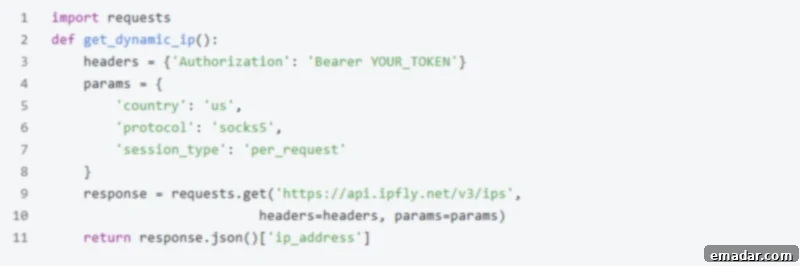
Once you have your token, you can use the IPFLY API to request a new dynamic IP, configure its parameters (e.g., location, type), and manage its lifecycle, all programmatically. This ensures that your applications can adapt quickly to changing IP requirements.
2. Advanced Traffic Masking Configuration
Beyond simply changing IP addresses, effective traffic masquerading involves mimicking real user behavior at a deeper level. This includes synchronizing browser fingerprints, which are unique identifiers based on browser settings, plugins, and configurations. By ensuring that the browser fingerprint aligns with the assigned IP’s characteristics (e.g., time zone, language), you significantly enhance the legitimacy of your requests, making them harder to detect by sophisticated anti-bot systems.
Browser Fingerprint Synchronization Scheme:

IPFLY provides advanced tools and guidelines to ensure your outgoing traffic matches the profile of a genuine user associated with the dynamic IP, encompassing elements like User-Agent strings, screen resolutions, installed fonts, and more. This multi-layered approach to stealth ensures maximum success rates for your operations.
Phase 3: Monitoring and Anti-Attack Confrontation
Maintaining the efficacy of your dynamic IP system requires continuous monitoring and a proactive approach to combating anti-bot measures. This phase focuses on real-time insights and strategic responses to ensure uninterrupted service.
Real-time Monitoring Dashboard Configuration
A comprehensive monitoring dashboard is indispensable for overseeing the health and performance of your IP pool. Key metrics provide immediate insights into potential issues:
- Key Metrics: IP availability rate, request success rate, average response time. These metrics offer a holistic view of your IP infrastructure’s performance.
- Alert Thresholds: Set up alerts for critical conditions, such as success rate falling below 99%, latency exceeding 200ms, or blacklist rate surpassing 0.1%. Timely alerts enable quick intervention and minimize downtime.
For a live demonstration of such a monitoring system, you can explore the IP Health Monitoring Dashboard.
Anti-Scraping Confrontation Playbook
The arms race against anti-bot technologies is constant. IPFLY offers advanced solutions to counter common protection types, ensuring your operations remain effective.
| Protection Type | Cracking Strategy | IPFLY Technical Solution | Detail & Effectiveness |
| TLS Fingerprint Detection (e.g., JA3/JA4) | Dynamic JA3/JA4 Fingerprint Generation | Automatic hourly fingerprint database updates | TLS fingerprints identify clients based on their SSL/TLS handshake. IPFLY dynamically generates and updates these fingerprints every hour, ensuring that each connection appears unique and legitimate, effectively bypassing detection. |
| Behavioral Analysis | Mouse Trajectory + Keystroke Interval Simulation | Human Behavior Model v3.2 | Sophisticated bots are detected by unnatural interaction patterns. IPFLY’s advanced Human Behavior Model v3.2 simulates realistic mouse movements, click patterns, and keystroke intervals, making automated interactions indistinguishable from human ones. |
| IP Reputation Filtering | Real-time Integration with Spamhaus Database | Blacklist refresh frequency 15 seconds/instance | Many websites block IPs with poor reputations (e.g., those associated with spam or malicious activity). IPFLY integrates in real-time with leading IP reputation databases like Spamhaus, refreshing its blacklist every 15 seconds. This ensures that only clean, high-reputation IPs are used, minimizing blocks and maintaining access. |
Join the IPFLY Enterprise Developer Program Today!
Unlock the full potential of dedicated dynamic IP technology for your enterprise. By registering for the IPFLY Enterprise Developer Program, you gain immediate access to exclusive benefits designed to accelerate your development and operational success:
- ✅ Generous API call quota to support rigorous stress testing and large-scale deployments.
- ✅ Dedicated 1-on-1 technical consultant for bespoke architectural design and expert guidance.
Don’t miss out on the opportunity to revolutionize your digital operations with cutting-edge dynamic IP solutions. Act now to secure your competitive advantage in the evolving digital landscape.
Visit our official website to register and begin your journey: http://www.ipfly.net