
The fundamental distinction between datacenter proxies and residential proxies boils down to one simple question: Where do their IP addresses originate?
Datacenter proxies utilize artificial IP addresses generated within cloud servers. While exceptionally fast, their synthetic nature makes them easily identifiable and blockable by sophisticated websites. Residential proxies, conversely, employ genuine IP addresses assigned by legitimate Internet Service Providers (ISPs), allowing them to seamlessly blend in with ordinary, everyday internet users.
Understanding the Core Proxy Differences
Choosing a proxy server is, at its heart, selecting a digital disguise. This decision is paramount, dictating the success or failure of your online endeavors, whether you’re scraping data, conducting market research, managing multiple accounts, or protecting your online anonymity. The origin of an IP address influences everything—speed, cost, and most critically, the inherent risk of detection and blockage.
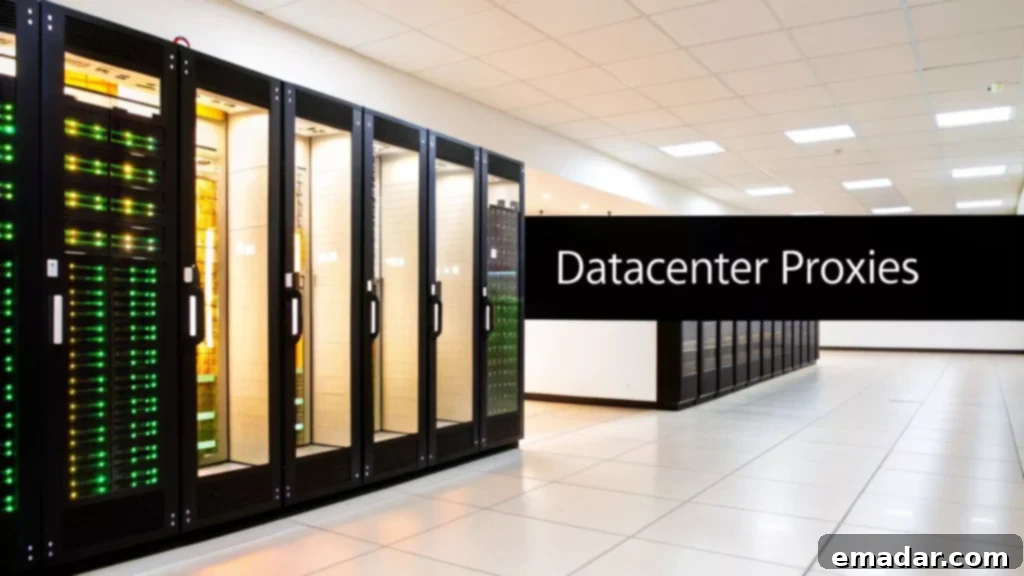
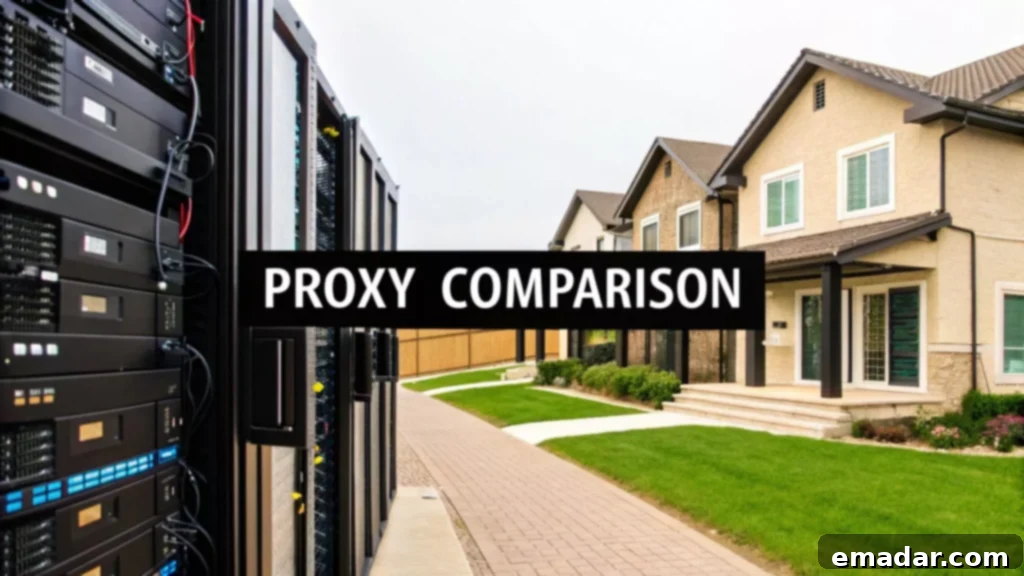
Consider this practical analogy: Datacenter proxies are akin to a fleet of identical, commercially registered delivery trucks. They are incredibly fast and numerous, but they stand out glaringly in a quiet residential neighborhood. Residential proxies, on the other hand, are like a diverse collection of private cars—they blend in perfectly because they look exactly like they belong there. One accomplishes tasks through brute force and sheer volume, while the other achieves its objectives through stealth and authenticity.
Datacenter vs. Residential Proxies at a Glance
To provide a clearer picture for your decision-making, here’s a concise overview of the primary distinctions between these two proxy types. This table breaks down the essential elements, but we will delve deeper into what these differences truly mean for your projects.
| Feature | Datacenter Proxies | Residential Proxies |
|---|---|---|
| IP Source | Generated in cloud data centers | Derived from real Internet Service Providers (ISPs) |
| Anonymity Level | Lower; easily identifiable as proxies | High; appear indistinguishable from real users |
| Typical Speed | Extremely fast with very low latency | Slower; dependent on genuine home internet connections |
| Pricing Model | Lower cost, often billed per IP | Higher cost, typically billed per GB of data |
| Detection Risk | High risk of being blocked or flagged | Extremely low risk of being blocked |
As you can discern, the trade-offs are significant. Your ultimate decision should always align with the specific tasks you need to accomplish and the level of risk you are willing to undertake.
Implications for Cost and Use Cases
The inherent difference in IP origin creates a ripple effect on performance, pricing, and appropriate usage scenarios. Each type serves distinct purposes, and understanding these pros and cons is paramount for strategic deployment.
Cost alone highlights the gravity of the choice. Datacenter proxies are remarkably inexpensive, making them ideal for large-scale, brute-force tasks. Some dedicated IPs can cost as little as $1 per IP per month. They offer raw speed and bandwidth, perfect for tasks like load testing your own website or scraping public forums with minimal security measures.
However, residential proxies command a higher price point, typically ranging from $1 to $15 per GB, due to their unparalleled stealth capabilities. This makes them the preferred choice for high-stakes tasks such as scraping pricing data from e-commerce websites or verifying advertisements without detection. For more insights into how cost and performance intertwine, resources like PacketStream.io offer excellent perspectives.
Actionable Insight: It’s not about which proxy is “better,” but which is the right tool for the job. High-volume, low-sensitivity tasks are a perfect fit for datacenter proxies. But for any sensitive operation where getting blocked isn’t an option, residential proxies are indispensable.
Comparing Performance and Connection Reliability
When you’re choosing between datacenter and residential proxies, the distinction isn’t just technical; it directly impacts the success or failure of your projects. The core trade-off is simple: are you chasing raw speed, or unwavering connection stability? Your answer will point you toward the correct proxy type for your needs.
Datacenter proxies possess one defining characteristic: blistering speed. Because their IPs originate from powerful servers with massive bandwidth, they exhibit extremely low latency. This makes them the go-to choice for tasks requiring millions of requests to be processed in minimal time, such as rapid data acquisition or bulk content downloads.
However, this speed comes at a significant cost. The artificial nature of these IPs makes them conspicuous, meaning websites can more easily detect and block them, rendering their speed advantage useless when encountering robust anti-bot measures.
The Speed Advantage of Datacenter Proxies
Imagine you need to monitor price changes across thousands of competitor product pages multiple times a day. The sheer volume of requests makes speed a non-negotiable requirement. Datacenter proxies are thus perfectly suited for initial reconnaissance on less secure websites or for tasks where being occasionally blocked is a minor inconvenience rather than a critical failure.
- Example: A market research firm needs to scrape headlines from 500 different news websites daily. These sites do not employ advanced bot protection. Using datacenter proxies, they can complete the entire task within an hour, maximizing efficiency.
- SEO Monitoring: Running large-scale keyword ranking checks or website audits demands lightning-fast responses from search engines, a task perfectly suited for these proxies.
- Low Latency Requirements: For any application where every millisecond counts, such as testing new server loads or rapid content delivery network (CDN) validation, datacenter proxies deliver the required performance.
While their speed is undeniable, understanding the limitations of datacenter proxies is crucial when you face heavily protected targets. Their efficiency wanes significantly when faced with robust anti-bot systems.
Consistent Reliability with Residential Proxies
This is where residential proxies revolutionize the game. Because they leverage real IP addresses assigned by ISPs to actual homes, their traffic is virtually indistinguishable from that of an average internet user. This inherent legitimacy grants them unparalleled connection reliability and a significantly higher success rate, especially against sophisticated defenses.
Performance figures speak volumes. While datacenter proxies can boast astounding bandwidth, ranging from 100 to 1000 Mbps, and latencies as low as 10 milliseconds, their success rate on protected websites can plummet to a mere 20-40% due to detection.
Residential proxies, on the other hand, consistently maintain an impressive 85-95% success rate on those exact same websites. This makes them the only reliable choice for sensitive tasks, even if their average latency is higher, typically ranging from 150-300 milliseconds.
Example: Datacenter proxies are like a race car—unbeatable on a straight, open track but useless on complex terrain. Residential proxies are like a dependable all-terrain vehicle (ATV). It might not be the fastest, but it will get you to your destination, no matter how challenging the road.
This distinction is critical for any task where a single failed request could jeopardize an entire project. Think about attempting to purchase limited-edition sneakers online or verifying an advertisement in a specific city—the success of every connection is paramount. In such scenarios, residential proxies are not just an option; they are the only viable solution.
Analyzing True Cost and Return on Investment
Comparing only the sticker price of datacenter and residential proxies is a common, yet critical, mistake. The true financial picture only emerges when you understand their distinct pricing models and, more importantly, the hidden costs of failure. A proxy that appears cheaper on paper can easily end up costing you significantly more if it can’t reliably get the job done.
There’s an inherent difference in their pricing structures. Datacenter proxies are almost exclusively sold per IP—you might pay a fixed monthly fee for a list of 100 IPs that you use. Residential proxies, conversely, are typically billed based on the GB of data consumed. This distinction alone highlights the intended use cases for each proxy type.
Calculating Total Cost of Ownership
The number on the invoice is only one part of the equation. The true cost includes the financial impact of blocked IPs, failed requests, and the time your team wastes troubleshooting. Even worse, basing business decisions on flawed data generated by a failing proxy setup can incur enormous hidden costs, potentially leading to project failure and lost revenue.
Let’s break this down with a couple of real-world scenarios to illustrate the point.
Scenario 1: SEO Company
An SEO company needs to check 50,000 keyword rankings daily across various search engines and locations. These targets have relatively low security measures.
- Datacenter Proxies: They acquire 1,000 datacenter IPs for approximately $500 per month. The speed is incredibly fast, allowing them to complete tasks efficiently. A small percentage of failures doesn’t significantly impact their workflow, making the low cost a huge advantage. The ROI is high because the operational cost is negligible compared to the value of the ranking data.
- Residential Proxies: Using residential proxies here would be a financial disaster. The sheer volume of data would lead to thousands of dollars in bills without providing any practical benefit over the datacenter alternative. It would be entirely overkill, diminishing their profit margins significantly.
Scenario 2: E-commerce Brand
A retail brand is scraping pricing information from five major competitors, all of whom have sophisticated bot detection systems. If they are blocked, the data is useless.
- Datacenter Proxies: They attempt to use 500 datacenter IPs for $250 per month. The outcome? A staggering 90% failure rate. Their IPs are flagged and blocked almost instantly. The data is worthless, and they’ve simply wasted money and valuable time, potentially missing out on critical market insights.
- Residential Proxies: They switch to a residential plan, spending $400 per month for 50GB of data. Their success rate immediately jumps to 98%. Now, they possess accurate, real-time intelligence essential for competitive pricing strategies, leading to increased sales and market share.
Actionable Insight: In the e-commerce scenario, the “cheaper” datacenter proxies resulted in a negative ROI. The residential proxies, despite a higher sticker price, delivered immense returns by enabling the brand to make strategic pricing decisions that led to thousands in additional revenue. Always calculate the cost per successful request, not just the upfront price.
Ultimately, you must base your decision on value, not just price. Consistently ask yourself: What is the true cost of failure for my specific project? Only then will you truly know which proxy type is the correct investment.
Choosing Proxies for Real-World Scenarios
Now, let’s move from theory to the real world. This is where the datacenter vs. residential proxy debate truly matters. The correct choice invariably hinges on your project’s objectives, the security level of your targets, and your tolerance for potential failures. A one-size-fits-all approach simply doesn’t work in the complex landscape of online data acquisition and anonymity.
We’ll walk through several common situations to illustrate how this decision plays out in practice, helping you navigate your options effectively.

When Datacenter Proxies Get the Job Done
Imagine your task involves large-scale web scraping of public data, such as archiving news articles from hundreds of different websites with only basic security in place. In this scenario, your priorities are sheer speed and volume. A few failed requests here and there aren’t a major setback; you can simply retry them, or the overall dataset isn’t critically compromised by minor omissions.
This is a quintessential case for datacenter proxies.
Their raw speed allows you to send millions of requests in a short period, and their low cost per IP makes it highly affordable to maintain a massive rotation pool. Since the target websites aren’t actively trying to block you, the higher detection risk is an entirely acceptable trade-off. They deliver efficiency and cost-effectiveness where stealth is not a primary concern.
When Residential Proxies Are a Must
Now, let’s shift to a more sensitive operation: scraping product prices and inventory levels from major e-commerce giants like Amazon or Nike. These behemoths invest heavily in advanced bot detection systems designed to sniff out and block non-human traffic. Even one of your IPs being flagged could jeopardize your entire operation, leading to a complete data blackout.
For such critical tasks, residential proxies are indispensable.
- Objective: You require accurate, real-time pricing data to remain competitive in a cutthroat market.
- Obstacle: Target websites employ sophisticated fingerprinting and IP reputation checks, blacklisting datacenter IPs upon detection.
- Viable Solution: Residential proxies channel your requests through devices belonging to real users, making your traffic appear entirely human. Your success rate will skyrocket, and the data you collect will be authentic and reliable, providing true competitive intelligence.
Yes, the cost per gigabyte is higher, but it’s easily justifiable. The value of clean, accurate data far outweighs the expense. Attempting to use datacenter proxies here would simply be throwing money away on blocked IPs and incomplete information. This is a core lesson in successful data scraping; choosing the right tool is half the battle.
Example: Don’t just look at the price tag. The real metric is the cost per successful request. A cheap proxy with a 90% failure rate is far more expensive than a premium proxy that consistently delivers results.
Another perfect example is ad verification. A digital marketing agency needs to confirm that their client’s advertisements are displaying correctly in specific cities around the globe. To do this, they must view the website exactly as a local user would.
Datacenter proxies fall short here because their locations are fixed to server farms, not actual neighborhoods. Residential proxies, however, provide genuine IPs from the exact geographical locations you need. This is the only way to accurately verify ad placement and prevent ad spend from being wasted on incorrect targeting or display issues.
To clarify further, here’s a quick guide to help you match tasks with the appropriate proxy type.
Which Proxy for Which Task
| Task | Recommended Proxy Type | Why It’s Best (Actionable Insight) |
|---|---|---|
| Large-Scale Public Data Scraping | Datacenter Proxies | Speed and low cost are priorities. Target security is low, so higher detection risk is manageable. |
| E-commerce Website Price Monitoring | Residential Proxies | Essential for bypassing advanced bot detection on sites like Amazon. Appears as genuine user traffic. |
| Managing Multiple Social Media Accounts | Residential Proxies | Prevents IP-based bans and flagging. Each account can have a unique, legitimate-looking IP address. |
| Ad Verification & Geo-targeting Tests | Residential Proxies | Provides real IPs from specific cities and countries, allowing you to see content exactly like a local user. |
| General Market Research | Datacenter Proxies | Suitable for gathering general data from various sources where IP block detection isn’t a major concern. |
| SEO Monitoring & Keyword Tracking | Residential or Datacenter | Depends on the target. For Google, residential is safer. For less strict search engines, datacenter can work. |
Ultimately, every situation demands a clear-eyed assessment of what you aim to achieve and the obstacles that stand in your way. Making an informed choice from the outset can save you immense hassle, time, and money down the line.
Navigating Anonymity and Detection Risk
When discussing datacenter proxies versus residential proxies, the most crucial differentiator lies in how each handles anonymity and detection. A proxy’s ability to remain incognito directly influences the success or failure of your projects, especially when engaging with websites fortified by high-security measures. The IP address source is not just a detail; it’s everything.
Datacenter proxies are born in cloud servers, meaning their IP addresses are commercially registered to a company. For any modern security system, identifying these proxies using public databases is trivial. To exacerbate the problem, these proxies are often sold in sequential blocks. This means a website can implement a simple rule to blacklist an entire subnet, instantly wiping out hundreds or even thousands of your IPs in one swift action.
The Residential Anonymity Advantage
This is where residential proxies truly shine. They utilize real IP addresses assigned by Internet Service Providers (ISPs) to actual homes and businesses. From the perspective of the target website, traffic originating from a residential IP appears identical to a regular person browsing the internet. This inherent legitimacy is their secret weapon against detection.
- Authentic IP Reputation: Residential IPs boast a clean history of normal user activity, making them trustworthy by default. They haven’t been associated with widespread malicious activity.
- Dispersed and Undetectable Blocks: Since these IPs are sourced from a vast and diverse pool of real users, they don’t follow predictable patterns or come in sequential blocks. This makes it virtually impossible for websites to block them in bulk, ensuring persistent access.
This innate stealth makes them the only truly viable option for any task where getting blocked is simply not an option. You can further explore how residential proxies can help you remain undetected in sensitive projects, providing a layer of security that datacenter alternatives simply cannot match.
Market Trends and Ethical Sourcing
The market is undergoing significant shifts as anti-bot technologies become increasingly intelligent. In 2023, the global datacenter proxy market was valued at approximately $1.8 billion, but it is feeling the heat from the explosive growth of residential proxies. More users are gravitating towards residential IPs due to their unparalleled ability to bypass blocks, even if it means paying a premium.
This trend reveals a clear bifurcation in proxy usage: datacenter proxies are relegated to high-volume, low-risk work, while residential proxies are reserved for high-stakes operations requiring complete stealth and guaranteed access. You can find more insights into the evolving proxy market on DataHorizzon Research.
Actionable Insight: When selecting a provider, always inquire about their ethical sourcing practices. Ethically sourced residential proxies are acquired only with the full, informed consent of the IP address owners. This not only ensures the effectiveness of your operations but also guarantees compliance and long-term sustainability. Trustworthy providers are always transparent about how they build their proxy networks, safeguarding both your project and their users’ privacy.
Making the Final Decision
So, how do you ultimately choose between datacenter proxies and residential proxies? There is no single “best” option—the correct choice depends entirely on the specific needs of your project, your budget, and the obstacles you anticipate encountering. This is not merely a technical selection; it’s a strategic decision that directly impacts the success or failure of your online initiatives.
To navigate this effectively, you need a straightforward framework to guide your thinking and ensure you make the most informed choice possible.
Practical Decision Checklist
Before you commit to a provider, quickly answer these questions. Your responses will directly point you toward the proxy type best suited for your requirements.
- How secure are your targets? If you’re targeting major e-commerce websites or social media platforms, their bot detection systems will spot datacenter IPs a mile away. For these highly secure targets, residential proxies are absolutely essential. However, if you’re simply gathering public data from sites with minimal protection, datacenter proxies will be more than sufficient and cost-effective.
- What is your budget compared to the project’s value? If you’re undertaking a high-stakes operation where acquiring accurate data is crucial to your revenue (e.g., competitive price monitoring), then the higher cost of residential proxies is a wise investment that yields significant ROI. Conversely, for large-scale but lower-value tasks, the affordability of datacenter proxies makes them a justifiable choice.
- Can your task handle some failed requests? For bulk data collection where a small percentage of failures won’t derail your workflow, datacenter proxies work perfectly. But for tasks like managing critical accounts or verifying ad placements, every single connection must count. In these cases, the 95%+ success rate of residential proxies becomes invaluable, ensuring data integrity and operational continuity.
Final Takeaway: Your decision should be based on the cost per successful request, not just the sticker price. A cheap datacenter proxy that fails half the time will ultimately be far more expensive in the long run than a residential proxy that delivers reliable results from the outset, saving you time, frustration, and potential revenue loss.
By honestly answering these questions, you can move beyond simple feature lists and select the proxy tool that will truly get the job done efficiently and effectively. Choose the tool that truly aligns with the value and challenges of your specific tasks, ensuring optimal performance and maximum ROI.
Frequently Asked Questions
When weighing datacenter proxies against residential proxies, certain questions inevitably arise. Clarifying these from the outset can save you considerable hassle and expense.
Are Residential Proxies Always Better?
Absolutely not. The “best” proxy is the one that’s right for your specific job. For any task demanding high anonymity and a low blocking rate—such as scraping prices from heavily defended competitor e-commerce sites—residential proxies reign supreme. They appear as regular users, making them incredibly difficult for websites to detect and block, ensuring consistent access to critical data.
However, if your goal is to tackle less secure websites with raw speed and volume, datacenter proxies are often the smarter financial choice. For instance, if you’re archiving public data from thousands of news websites, datacenter proxies are faster, cheaper, and provide a higher return on investment, where the occasional block is a minor inconvenience.
Can I Use Datacenter Proxies for Social Media Automation?
You can try, but it’s a significant gamble. Major social media platforms invest millions in detection systems that can easily differentiate traffic originating from commercial servers versus genuine home network connections. They are designed to identify and flag suspicious patterns, protecting their user base.
Some very light activity on a single account might slip through, but any serious automation—like bulk account creation, managing an entire roster of profiles, or rapid-fire posting—will almost certainly lead to your IPs being flagged and your accounts being shut down. For social media management, residential proxies are the only truly reliable and sustainable option for long-term operations.
Actionable Insight: A blocked proxy isn’t just an annoyance; it can bring your entire operation to a grinding halt. You know your proxies are blocked when you encounter endless CAPTCHAs, persistent connection timeouts, or HTTP error codes such as 403 Forbidden and 429 Too Many Requests. If your error logs are filled with these codes, your proxy IPs have most likely been blacklisted and are no longer effective.
A sudden drop in your success rate is another clear indicator that your proxy IPs have been “burnt.” This forces you to scramble for replacements, wasting valuable time and data, and ultimately driving up your operational costs. Investing in the right proxy from the start minimizes these disruptions.