
In the vast and dynamic digital landscape, the ability to collect information efficiently is a powerful asset. Web scraping, the automated extraction of data from websites, stands out as a crucial skill for businesses, researchers, and developers alike. From tracking competitor prices and monitoring news feeds to analyzing social media trends and gathering market intelligence, web scraping unlocks unparalleled opportunities for data-driven insights. However, the path to advanced web scraping is not always smooth, and one of the most significant hurdles aspiring data miners face is the challenge of IP blocking.
Websites employ sophisticated anti-scraping mechanisms to protect their data, manage server load, and prevent malicious activities. When your scraping bot sends too many requests from a single IP address, or exhibits behavior inconsistent with that of a human user, these defenses kick in. The result? Your IP address gets flagged and blocked, bringing your data collection efforts to a grinding halt. This is precisely where the strategic use of proxy IPs becomes not just an advantage, but an absolute necessity for any serious web scraper.
Why Is a Proxy IP Indispensable for Web Scraping?
Modern websites are increasingly adept at detecting and thwarting automated data extraction. As your web scraper interacts with a target site, a suite of anti-scraping strategies can be deployed against it:
- IP Address Blocking: The most common defense. If too many requests originate from one IP in a short period, the website’s server will block that IP, preventing further access.
- Request Interception: Servers might simply drop or ignore requests deemed suspicious, making your scraper run indefinitely without returning data.
- CAPTCHA Challenges and Human Verification: To differentiate between bots and humans, websites often present CAPTCHAs, reCAPTCHAs, or other interactive verification tests that automated scripts struggle to solve.
- Rate Limiting: Even without a full block, sites can severely limit the number of requests you can make within a certain timeframe, drastically slowing down your scraping process.
- Returning Fake or Misleading Data: Some advanced systems might even feed your bot fabricated data to mislead your collection efforts without immediately revealing that you’ve been detected.
Attempting to scrape with a single, identifiable IP address from your personal network is a recipe for instant detection and blacklisting. This is why a robust solution is required: a proxy IP pool. By routing your scraping traffic through a network of diverse IP addresses, you can simulate requests coming from multiple unique users across different locations. This approach allows you to bypass stringent anti-scraping measures, maintain anonymity, and significantly boost the efficiency and success rate of your data collection operations.

Demystifying Proxy IP Mechanics: How They Work
The fundamental principle behind a proxy IP is elegantly simple yet incredibly effective. Instead of your web scraper connecting directly to the target website, it first sends its requests to an intermediate server – the proxy server. This proxy server then forwards your request to the target website using its own IP address. When the target website responds, it sends the data back to the proxy server, which then relays it to your scraper. The target website, therefore, only sees the IP address of the proxy server, not your machine’s true IP address.
This redirection offers several critical advantages for web scraping:
- Enhanced Anonymity: Your real IP address remains concealed, protecting your identity and location from the target website.
- Rapid IP Switching: By rotating through a pool of proxies, your scraper can appear as a different user with each request or after a set interval. This mimicry makes it much harder for websites to track and block you.
- Increased Concurrency: A large pool of proxy IPs enables you to send a higher volume of requests simultaneously without triggering rate limits, dramatically speeding up your data collection process.
- Bypassing Geo-Restrictions: Proxies located in different geographical regions allow you to access content that might be restricted to specific countries, opening up global data collection possibilities.
- Avoiding Source IP Blockage: Even if a proxy IP gets blocked, your main IP remains safe, allowing you to simply switch to another proxy and continue scraping without interruption.
Integrating proxy functionality into your scraping script is typically straightforward. Most modern web scraping frameworks and HTTP client libraries offer simple configurations to set proxy parameters, often just requiring a URL or an IP address and port combination. This ease of implementation makes proxy integration accessible even for beginners, providing a powerful tool for overcoming common scraping challenges.
Exploring Proxy IP Types: Finding Your Best Match
Not all proxy IPs are created equal. Different types of proxies offer varying levels of anonymity, speed, reliability, and cost, making the choice crucial for the success of your scraping project. Understanding their distinctions will help you select the most suitable solution:
| Proxy Type | Description | Key Advantages | Ideal Use Cases |
| Datacenter Proxies | IPs provided by data centers, not real home networks. | High speed, generally more affordable, readily available in large quantities. | High-volume, general-purpose data collection from less protected sites, website structure analysis, SEO audits. |
| Residential Proxies | IPs associated with real homes and mobile devices, provided by Internet Service Providers (ISPs). | Extremely high anonymity, very difficult to detect as proxies, excellent for bypassing advanced anti-bot systems. | Scraping highly protected websites (e.g., e-commerce, social media platforms, travel sites), maintaining accounts, accessing geo-restricted content. |
| Dynamic (Rotating) Proxies | IPs that automatically change at set intervals (e.g., per request, every few minutes) from a large pool. | Automated IP rotation, massive IP resource pools, highly effective for large-scale, continuous scraping without manual IP management. | Comprehensive data collection, frequent data updates, situations requiring a constant flow of fresh IPs to avoid detection. |
| Static Residential Proxies (ISP Proxies) | Residential IPs that remain constant over time, provided by ISPs but hosted in data centers. | High anonymity like residential proxies but with the stability and speed of datacenter IPs; allows for consistent sessions. | Long-term scraping projects, managing multiple accounts where IP stickiness is crucial (e.g., social media account warming, e-commerce seller accounts), maintaining login sessions. |
While datacenter proxies offer speed and affordability for basic scraping tasks, their origin from commercial data centers makes them easier for sophisticated anti-bot systems to identify and block. This often leads to frustrating and time-consuming efforts for developers who opt for cheaper, less stable solutions.
For demanding scraping scenarios involving websites with robust anti-bot measures, residential proxies emerge as the gold standard. Because these IPs belong to actual users and devices, they appear legitimate to target websites, drastically reducing the chances of detection and blocking. Dynamic rotating residential proxies are particularly powerful for large-scale operations, as they constantly provide a fresh IP address, minimizing the risk of any single IP being blacklisted.
In many real-world scraping projects, developers have learned the hard way that prioritizing stability, anonymity, and compliance is paramount. This has led to a growing preference for high-quality proxy service providers like IPFLY. IPFLY, for instance, distinguishes itself by offering a robust infrastructure with self-built servers and intelligent filtering mechanisms. This commitment to quality ensures a high degree of IP purity and exceptional speed, making it an ideal choice for successfully collecting data from notoriously challenging and sensitive websites such as TikTok, Instagram, YouTube, Amazon, and Booking.com.
Choosing the right proxy type depends heavily on your specific project requirements, the target website’s defenses, and your budget. For beginners, starting with a reliable residential proxy service can save countless hours of troubleshooting and ensure a smoother learning curve in the complex world of web scraping.
Practical Setup: Integrating Proxies with Python (Conceptual Overview)
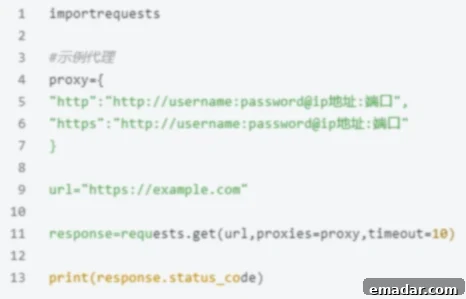
While the actual code implementation will vary slightly depending on the programming language and libraries you use, the core concept of setting up a proxy remains consistent. In Python, for example, popular libraries like requests and frameworks like Scrapy provide straightforward ways to configure proxies.
Typically, you would define a dictionary containing the proxy server’s address and port for both HTTP and HTTPS protocols. If your proxy service requires authentication (which premium services like IPFLY often do for security), you’ll also include your username and password within the proxy URL. This dictionary is then passed as an argument to your request method.
For users leveraging a professional service like IPFLY, the setup process is often even more streamlined. IPFLY typically provides authenticated proxy accounts where the username, password, and port are pre-configured. This eliminates the need for complex manual settings, allowing you to integrate their high-quality proxies seamlessly into your existing scraping scripts with minimal modifications. Their services are designed for easy plug-and-play, ensuring that you can focus more on data processing and less on proxy management.
Advanced Strategies & Common Pitfalls: A Scraper’s Survival Guide
Even with the best proxies, beginners can still encounter roadblocks if they overlook fundamental best practices. Here are five common mistakes new scrapers often make and how to avoid them:
- Neglecting IP Rotation for Popular Websites: Sending continuous requests from a single IP to a high-traffic or heavily protected site will almost instantly lead to an IP ban. This is akin to one person repeatedly knocking on a door; eventually, they’ll be ignored or asked to leave.
- Relying on Free Proxies: While tempting, free proxies are notoriously unreliable, slow, and often already blacklisted. Furthermore, they pose significant security risks, as they can be compromised or used to intercept your data. You get what you pay for, and with free proxies, that often means zero data and compromised security.
- Excessive Request Frequency: Bombarding a website with too many requests in a short period indicates bot behavior. Even with IP rotation, an overly aggressive frequency can still trigger rate limiting or more sophisticated behavioral analytics, leading to blocks or IP pool exhaustion.
- Ignoring User-Agent Headers: Every web browser sends a User-Agent string to identify itself (e.g., Chrome on Windows, Safari on Mac). If your scraper doesn’t send a User-Agent, or sends a generic one, it immediately signals that it’s an automated program, not a human user, making it an easy target for detection.
- Lacking Timeout and Error Handling: Without proper timeouts, your script can get stuck waiting indefinitely for a response from a slow server or a blocked request. Similarly, without robust error handling and retry mechanisms, any minor network glitch or temporary block can crash your entire scraping operation.
✅ To ensure the stability and success of your web scraping projects, adopt these correct practices:
- Utilize High-Anonymity Proxy IPs: Invest in premium residential proxies, like those offered by IPFLY, which provide the highest level of anonymity and are much harder for anti-bot systems to detect.
- Implement Smart IP Rotation and Retry Mechanisms: Automatically rotate your proxy IPs (e.g., after every few requests, or upon encountering a block) and set up intelligent retry logic for failed requests to maximize success rates.
- Mimic Real Browser Behavior: Always set a realistic User-Agent header (and other relevant headers like Referer and Accept-Language) to make your requests appear as if they are coming from a legitimate web browser.
- Control Concurrency and Request Frequency: Introduce random delays between requests and manage the number of concurrent requests to simulate human browsing patterns and avoid triggering rate limits.
- Implement Robust Error Handling and Timeouts: Configure timeouts for all HTTP requests and include comprehensive error handling (e.g.,
try-exceptblocks) to gracefully manage network issues, HTTP errors, and proxy failures, allowing your scraper to recover and continue. - Respect
robots.txt: Always check and adhere to the website’srobots.txtfile. This file outlines which parts of the site can be scraped. Ethical scraping practices are crucial for maintaining a healthy relationship with target websites and avoiding legal issues.
Conclusion: The Cornerstone of Successful Web Scraping
For anyone embarking on the journey of web scraping, mastering the art of using IP proxies is not merely an optional add-on; it is the foundational first step towards achieving reliable and scalable data collection. Proxies are your shield against IP bans, your key to bypassing geo-restrictions, and your pathway to significantly boosting both the efficiency and the quality of your extracted data.
Whether your goal is to gather e-commerce intelligence, perform in-depth social media analysis, monitor pricing fluctuations, or execute targeted localized data grabs, one principle remains constant:
“The journey of successful data collection truly begins with stable, secure, and highly anonymous proxy IPs.”
Don’t wait for your scraping projects to fail, or worse, for your accounts to be permanently banned, before realizing the critical importance of a robust proxy strategy. Take proactive steps now. Explore professional proxy services like IPFLY to construct your own resilient and efficient web scraping IP pool. Investing in quality proxies from the outset will save you invaluable time, effort, and potential headaches in the long run.
IPFLY Proxy Advantages:
- Global Coverage: Access to a vast network of nodes in over 190 countries, offering a diverse selection of static and dynamic residential IPs.
- High Purity & Anonymity: Superior IP cleanliness and anonymity, essential for maintaining cross-border accounts and navigating sensitive platforms.
- Blazing Fast & Stable Connections: Enjoy near-instantaneous connection speeds and unwavering stability, minimizing disconnections and maximizing uptime.
- Comprehensive Protocol Support: Full compatibility with HTTP, HTTPS, and SOCKS5 protocols, ensuring flexibility across various scraping needs.
- Universal Platform Compatibility: Seamless integration with all major platforms, including fingerprint browsers, system-wide settings, and popular automation tools, providing a versatile solution for any scraping setup.
👉 Claim your special offer and unlock premium IP services today!