
In today’s digital landscape, platform security is constantly evolving. As a result, IP reputation (IP purity) has become a critical factor for maintaining business continuity, protecting accounts, and achieving high connection success rates.
From a technical perspective, IP reputation is no longer a simple networking setting. It functions as a long-term scoring system used by global platforms to assess the credibility of a digital identity.
This scoring directly affects whether a corporate account triggers additional security checks, is flagged for high-risk monitoring, or faces immediate access restrictions.
In this comprehensive guide, we examine how automated risk-management models are structured. We explain what IP reputation means, how it works, and how it influences everyday business operations.
- What is IP reputation? (A dynamic risk-ranking system)
IP reputation is a trust score generated by platforms and automated risk systems. These systems analyze an IP address’s history, network type, and current context to produce a composite rating. The score measures how closely the IP’s behavior matches patterns typical of genuine human users.
The core of IP purity: dynamic risk grading
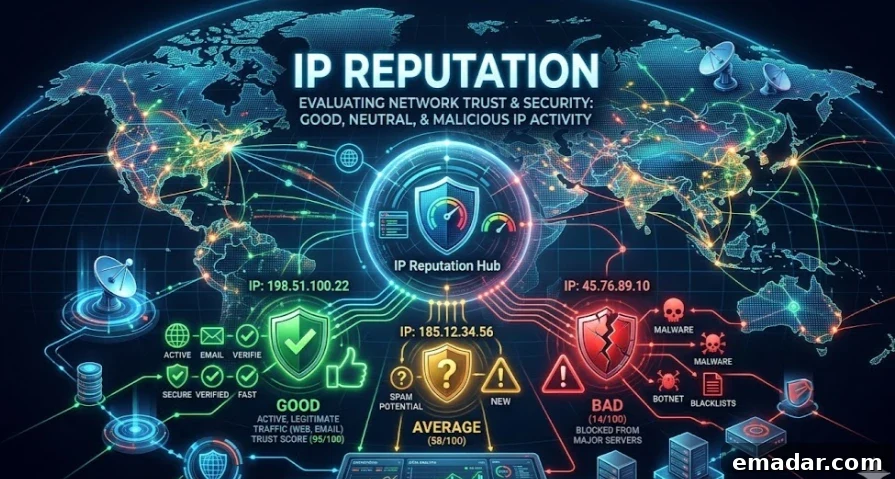
Modern security systems do not simply label an IP as “safe” or “dangerous.” Instead, an IP’s standing fluctuates within a dynamic, data-driven risk tiering. Platforms commonly classify connections into three levels:
- Low risk (high trust): The network has been verified and your team and tools receive immediate access.
- Medium risk (suspicious): The platform detects minor anomalies and may require additional verification such as CAPTCHAs or SMS codes.
- High risk (threat detected): The system flags the network as dangerous and restricts access to protect the platform.
Because the scoring is dynamic, the same IP can receive different trust ratings across platforms, over time, or depending on the activity performed.
Key dimensions of IP reputation
IP trust scores are built from multiple contextual variables rather than a single attribute. Security systems evaluate:
- Network ownership (ASN type): Who owns the IP infrastructure?
- Historical activity logs: What actions have been performed from this IP in the past?
- Usage frequency and concurrency: How many simultaneous connections are active at once?
- IP sharing and recycling patterns: Is the IP shared by unrelated networks?
- Blacklist and threat database status: Is the IP listed on public or private security blacklists?
- Behavioral models: Does current traffic appear natural or automated?
- Why do brand-new proxies often fail on day one?
Many organizations encounter the frustrating issue of buying fresh proxy IPs only to face verification challenges or access blocks the first time they use them on global platforms.
This is usually unrelated to account credentials. Instead, the IP often carries historical risk attributes before you ever connect.
IPs are not “blank slates” — they have histories
IP addresses are reusable infrastructure. Before an IP is assigned to your organization, it may have been used in many different internet scenarios, including:
- Automated market research activities
- Bulk account registrations
- Suspicious advertising traffic
- High-frequency API requests
- Poorly managed bot testing
Security systems record these past behaviors and associate them with the IP, lowering its trust score for subsequent users.
Shared proxy environments accelerate risk
In low-quality shared proxy pools, many users connect through the same IP. This causes issues:
- It distorts platform behavior models.
- It prevents the system from building a stable user identity.
- It leads to the accumulation of high-risk behavior signals.
Even if your team follows compliance strictly, other users’ violations on the same shared node can drag your trust rating into a high-risk zone.
- Network architecture comparison: ISP residential vs. datacenter IPs
Different network types start with very different baseline trust levels in automated security frameworks. These differences arise from how the underlying infrastructure is built.
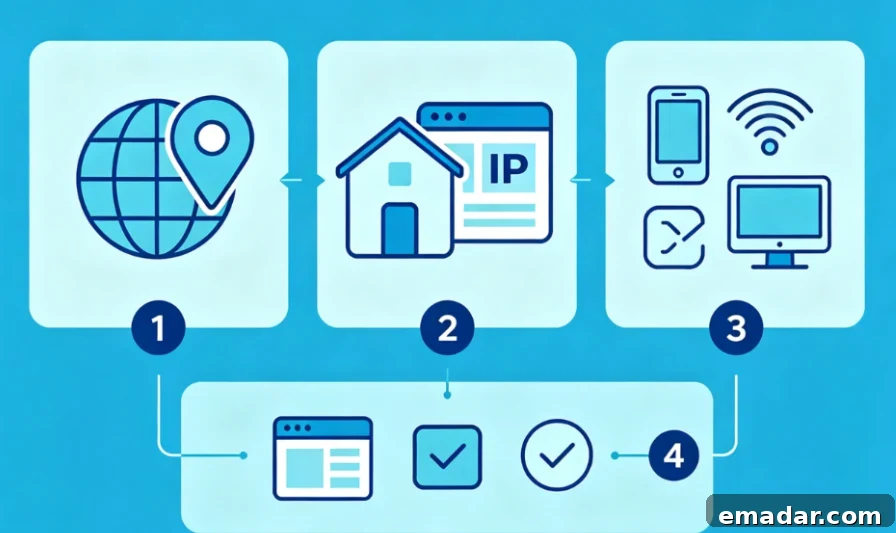
Dedicated ISP residential proxies — high-trust environments
ISP residential IPs come directly from local internet service providers and connect to real home lines. Their traffic patterns appear natural to platforms, they provide strong long-term connection stability, and security models can verify them at low operational cost.
- Platforms see their traffic as organic.
- They deliver excellent long-term stability.
- Security models can validate them efficiently.
For these reasons, dedicated ISP proxies typically fall into the low-risk category across most global platforms. Services focused on long-term stability invest in this kind of infrastructure.
Standard residential proxies — trust depends on control
Standard residential proxies use real residential IP ranges, but their trust varies widely based on management. If the provider shares proxies in a chaotic environment, mixes sessions, or permits anomalous traffic, the reputation drops rapidly to the level of low-quality networks.
Datacenter IPs — high performance with inherent limitations
Datacenter IPs originate from cloud hosting networks and server farms. They offer huge bandwidth and very fast speeds, making them ideal for heavy data-processing tasks. However:
- Their traffic is easily recognized as server-originated rather than residential.
- They start with low trust scores in identity-sensitive systems.
Thus, datacenter networks are suitable for backend high-load tasks but are not designed for long-term account management.
- How global platforms detect anomalous IP signals
Modern security models on platforms like TikTok, Meta, and Google no longer rely solely on IP addresses. They use advanced multi-signal identity verification techniques.
IP is the “front door,” not the whole house
Security systems correlate your IP with your complete digital footprint. They consider:
- IP’s structured network class (ASN verification)
- Consistency between current login location and history
- Match to hardware device fingerprints
- Session token continuity
- Whether navigation paths look like natural human behavior
Trigger factors: “multi-signal stacking”
An IP is rarely restricted for a single minor issue. Instead, security systems raise alarms when multiple negative signals occur together, such as:
- IP hopping across regions too quickly
- Device fingerprint mismatches with prior sessions
- Mechanistic, unnatural browsing paths
- Frequent connection drops and reconnections (session continuity breaks)
When these signals accumulate, the platform marks the connection as “unverified” and limits access.
- The mechanics of IP pollution
IP pollution is a slow, destructive cycle. When an IP is consistently used for abnormal or intense automation, its trust score deteriorates over time.
Pollution is risk accumulation
Networks become polluted by clear operational mistakes:
- Running high-frequency, unoptimized automation
- Allowing multiple users to share a single network node
- Suffering abuse or security incidents
- Remaining on blacklists for extended periods
Each event adds risk weight to the platform’s permanent records for that IP portfolio.
Risk trails have time-weighted lag
Even if you stop all aggressive automation and use a polluted IP perfectly, reputation does not reset instantly. Reputation systems use a time-weighted model, and negative records influence trust scores for weeks or months. Networks therefore experience a lag before being reclassified as trustworthy.
- Why high-purity network identities are becoming scarce
High-purity network identity resources are experiencing a structural shortage, driven by three major industry shifts:
- Limited ISP assets: High-quality consumer broadband lines cannot scale instantly. Regional ISPs operate fixed physical infrastructure under regulatory constraints.
- Expanded blacklist coverage: Risk systems are smarter, retain records longer, and share threat data across platforms more quickly, shrinking the pool of unmarked public IPs.
- Filtering of low-quality assets: Low-quality proxy pools, often used for high-frequency tasks, are increasingly filtered out by platform security models.
Consequently, premium and secure network infrastructure has become a valuable corporate asset.
- Why shared proxies undermine identity isolation
Using low-quality shared proxies is the fastest way to break identity isolation and create account linkage problems.
Behavioral overlap destroys isolation
When multiple independent business tasks run from the exact same shared IP, platforms observe chaotic signals:
- Different accounts originating from the same source
- Fragmented and contradictory geographic and time data
- Broken or unstable session mapping
In risk models, a clean network identity maps to a stable user profile. Once shared proxies break the 1:1 relationship, the system raises the risk level for every account connected through that node.
- Rules for evaluating high-purity network infrastructure
To protect digital assets and maximize operational ROI, technical teams should use four clear criteria when assessing proxy infrastructure:
- Verify authentic ISP origin: Ensure the IP corresponds to a genuine home broadband contract, not cloud servers.
- Audit historical threat logs: Compare the network identity against global private and public blacklists to confirm no accumulated risk.
- Test session persistence: Confirm the network can maintain stable dedicated connections over time without frequent IP rotation.
- Ensure dedicated isolation: Verify the IP is exclusively assigned to your business to avoid pollution from other users.
- Why IP reputation is becoming a core business capability
As automated risk platforms evolve, proxy networks are no longer temporary tools; they are the foundational identity layer for digital networks.
That structural shift is clear in high-value use cases:
- Cross-border e-commerce account management
- Global social media marketing operations
- Localized ad verification systems
- Enterprise data collection and RAG (retrieval-augmented generation) automation
Uptime and security in these scenarios depend entirely on your network identity’s trust rating. Leading organizations are moving away from buying random bulk proxies and investing in stable, long-term identity infrastructure instead.
IP reputation is a long-evolving credit system that determines your organization’s freedom across global networks. As platforms shift toward identity- and behavior-based risk models, your choice of network infrastructure will decide operational success.
This is where top global providers create enterprise value: by building clean, dedicated, globally distributed static residential ISP infrastructure that keeps your network identity consistent, stable, and trustworthy over time. From 2026 onward, competition will focus less on who has the most cheap links and more on who provides the purest network identity infrastructure. Build your digital assets on a solid foundation.