
The proxy industry has evolved significantly in recent years.
Where once the focus was primarily on hiding IP addresses, businesses soon demanded more reliable residential proxies and cleaner IP resources. Today, with the rapid growth of AI automation, large-scale data systems, and global online services, datacenter proxies are regaining attention.
High-quality datacenter proxies are no longer seen simply as “cheap proxies.” They are becoming essential components of modern internet infrastructure. For many technical teams, datacenter proxies remain the preferred solution for speed, stability, and large-scale automation. As a result, more organizations are adopting mixed proxy strategies that combine residential and datacenter IPs, and providers continue to expand and invest in datacenter networks worldwide.
What Is a Datacenter Proxy?
A datacenter proxy is an IP address hosted on servers in cloud or dedicated datacenter environments. Unlike residential proxies, these IPs are not assigned to home internet users. Instead, they originate from cloud servers, hosting providers, enterprise server networks, or dedicated datacenter infrastructure.
Put simply: residential proxies resemble individual home users, while datacenter proxies act like high-performance network machines. This difference makes datacenter proxies generally faster, more stable, lower latency, better suited for automation, easier to scale, and more affordable for large projects.
Because of these attributes, datacenter proxies remain widely used for a variety of tasks, including:
- SEO monitoring
- AI data collection
- Web crawling
- API requests
- Ad verification
- Large-scale automation
- Global testing
- Content monitoring
- Real-time analytics
Industry reports consistently note that datacenter proxies are a cost-effective choice for high-volume workloads where speed and throughput are crucial.

Why Datacenter Proxies Matter More in the AI Era
Predictions that residential proxies would replace datacenter solutions never fully materialized. In fact, AI workloads have increased demand for datacenter-grade infrastructure. AI systems operate very differently from human users: they may send thousands of requests per minute, run continuously, collect data across many countries, monitor sites in real time, and process large datasets without interruption.
These behaviors create a strong need for stable networks, fast response times, large bandwidth, high concurrency, and lower operating costs — areas where datacenter proxies excel. Recent analyses of AI infrastructure indicate growing global demand for datacenter resources driven by the scale and performance requirements of AI workloads.
Datacenter Proxy vs Residential Proxy
Comparing residential and datacenter proxies is one of the most common questions in the industry. The answer is straightforward: neither is universally better; each solves different problems.
Residential Proxies
Residential proxies route traffic through IPs assigned to real internet users, making them more trusted for tasks that require strong identity signals. They are preferred for:
- Social media management
- Local content testing
- Geo-specific browsing
- Ad verification
- Accessing sensitive websites
Because traffic appears more human, residential proxies often yield higher success rates on websites with advanced anti-bot defenses.
Datacenter Proxies
Datacenter proxies prioritize performance and are well suited for high-speed automation, large-scale scraping, API systems, SEO tracking, data analysis, and AI workflows. Compared with residential proxies, they typically offer faster responses, lower latency, better scalability, and a lower cost per request. For many engineering teams, datacenter infrastructure remains the backbone of automated data operations.
Why Low-Quality Datacenter Proxies Often Fail
Not all datacenter proxies perform equally. Failures are often tied to low-quality networks rather than the datacenter model itself. Common issues include shared or abused IPs, blacklisted IP ranges, problematic ASN histories, overused server blocks, weak rotation mechanisms, and poor infrastructure management. These shortcomings can cause captchas, connection blocks, unstable requests, and lower overall success rates.
Because of these variables, two providers selling “datacenter proxies” can produce very different results. Infrastructure quality and proactive IP management are critical.
What Makes a Good Datacenter Proxy?
Professional teams evaluate several key factors when choosing datacenter proxy services.
IP Reputation
IP reputation is essential. IPs with histories of abuse or blacklistings are likely to be distrusted by target sites. Strong providers monitor IP health, ASN reputation, abuse reports, blocklist status, and traffic quality to maintain long-term reliability.
Network Stability
Speed alone does not guarantee success. Businesses need consistent, stable connections — especially for AI systems, automation tools, long-running scripts, and continuous monitoring. High-quality datacenter proxy solutions deliver high uptime, stable routing, low packet loss, robust bandwidth, and consistent request performance.
Global Coverage
Global services require access across many regions for search monitoring, localization checks, multi-region analytics, and global testing. A broad worldwide network gives teams flexibility and reduces geographic blind spots, which is why providers are expanding their global footprints.
Why Many Companies Use Hybrid Proxy Systems
Hybrid proxy architectures are a major trend. Organizations combine residential, datacenter, and sometimes ISP proxies to tailor solutions for different tasks. In typical setups, datacenter proxies handle speed, high request volumes, and automation layers, while residential proxies provide identity trust, region realism, and access to sensitive targets. This hybrid approach balances cost, stability, performance, and success rates and is increasingly seen as the future of proxy infrastructure.
Real Business Problems Datacenter Proxies Help Solve
Datacenter proxies support a variety of critical business functions beyond simple browsing.
SEO Monitoring
SEO teams depend on stable, large-scale request volumes to track search rankings, SERP changes, regional results, and competitor visibility. Datacenter proxies reduce costs and increase efficiency for these repetitive tasks.
AI Data Collection
AI initiatives require extensive datasets from public web content, news, market information, and structured site data. Datacenter proxies enable teams to gather that data at scale.
API Automation
APIs often impose rate limits, geographic restrictions, and request caps. Distributing requests across multiple datacenter IPs helps organizations stay within limits while maintaining throughput.
Global Content Testing
Streaming platforms, SaaS services, and websites display region-specific content. Datacenter proxies offer the global coverage and speed needed to test and validate these variations efficiently.
How IPFLY Builds Modern Datacenter Proxy Infrastructure
Businesses today expect more than basic IP access; they need infrastructure designed for long-running automation and stable operations. IPFLY focuses on building scalable networks that support these demands, offering datacenter, residential, and static residential proxies. Their platform supports a large number of IP resources across many countries and relies on dedicated server systems and large-scale IP management to enhance stability, connection quality, IP cleanliness, and global routing performance.
For teams running automation and AI workflows, durable infrastructure is often more valuable than marginal speed gains. Stable routing and clean IP pools contribute directly to higher success rates and lower operational friction.
The Future of Datacenter Proxies
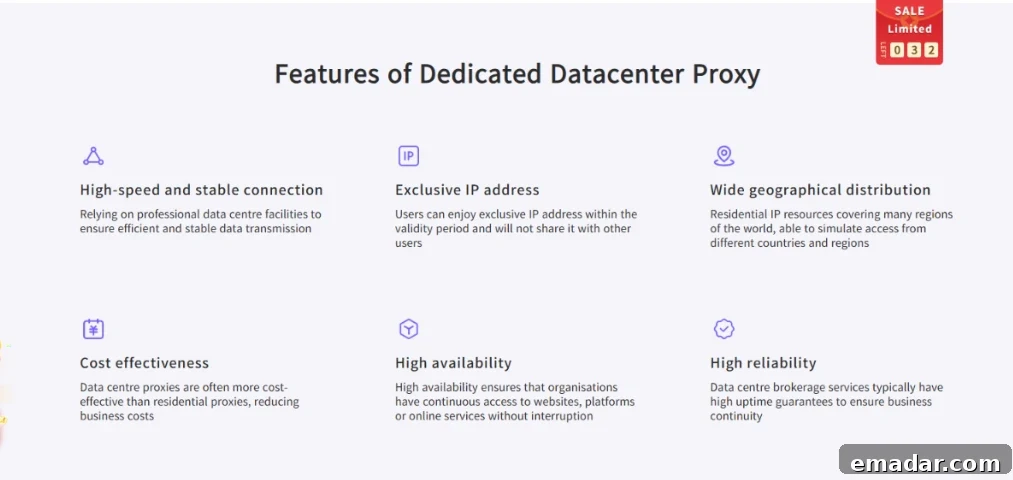
Datacenter proxies are far from obsolete; in many contexts they are gaining importance. AI systems, automation tools, and global data operations demand scalable, stable network infrastructure. Datacenter proxies deliver stable connections, high concurrency, lower costs, fast routing, and reliable uptime — attributes that align with these needs.
Looking forward, proxy infrastructure will likely adopt layered approaches: residential proxies for trust, datacenter proxies for scale, and ISP proxies for balance. The most successful providers will compete on infrastructure quality: cleaner IP resources, smarter routing, more stable networks, and higher request success rates rather than simply offering larger IP pools.
Final Thoughts
Datacenter proxies are often misunderstood. While some consider them outdated, modern internet systems show a different reality: fast, stable network infrastructure is essential for AI automation, global analytics, and large-scale data systems. High-quality datacenter proxies are therefore increasingly valuable. The decisive factor now is infrastructure quality — the cleanliness of IP resources, routing intelligence, and operational stability — all of which become more crucial as automation grows across industries.