
The digital landscape is evolving at an unprecedented pace. As we move further into 2026, the reliance on advanced AI and sophisticated security protocols to govern online interactions is becoming the norm. For any business aiming to conduct market research, manage international e-commerce accounts, or maintain a competitive edge, connection integrity is no longer just an advantage—it’s a necessity. Navigating this complex environment requires tools that align with natural user behavior, bypassing automated flags and restrictions. This is precisely where a residential proxy IP emerges as your most critical digital asset. It grants you the same level of trust and authenticity as an everyday home internet user. This comprehensive guide will explore the mechanics behind residential proxies, their vital business applications, and why a premium provider like IPFLY is the definitive choice for ensuring your operations remain stable, secure, and successful.
Core Definition: What is a Residential Proxy IP?
While the term residential proxy IP might sound technically complex, its core concept is remarkably straightforward. Understanding it is the first step toward leveraging its power for your business.
1. The Fundamental Logic: Real ISPs and Authentic Devices
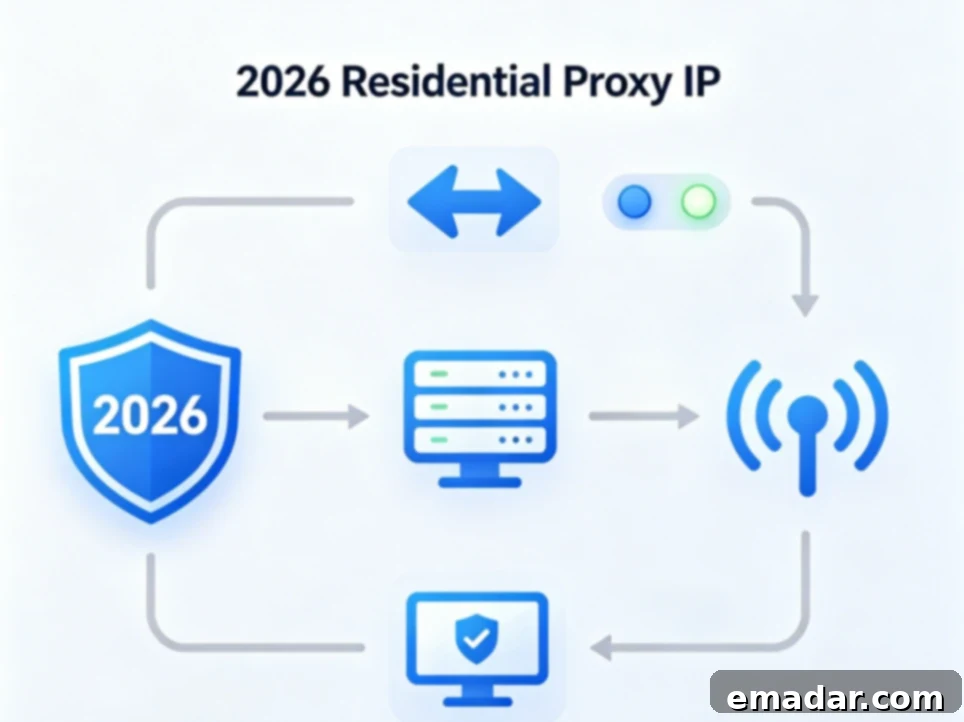
Every time you connect to the internet from home, your Internet Service Provider (ISP)—such as Comcast, Verizon, or BT—assigns your device a unique IP address. This address acts as your digital passport, identifying your connection’s origin. A residential proxy IP is simply an IP address that has been legitimately assigned by an ISP to a real, physical residential device, like a home computer or smartphone. It is sourced from an authentic consumer network, not from a server farm or a corporate data center. Because it is tied to a genuine household and a reputable ISP, websites and online services view traffic from a residential IP as a legitimate connection from a regular user, affording it the highest level of trust.
2. Residential Proxy IP vs. Data Center Proxy: The Critical Difference
Why is the source of your IP address so important? The answer lies in trust and reputation. Websites employ sophisticated algorithms to distinguish between authentic human users and automated bots.
- Trust and Reputation Scores: Connections originating from residential IPs are inherently trusted. They represent the browsing patterns of real people. In contrast, data center IPs are generated in bulk by cloud service providers and are commonly used for high-volume automated tasks. As a result, they are frequently flagged, scrutinized, and often blocked by security systems.
- Security and Risk Isolation: When you use a data center proxy, you are often sharing a subnet with thousands of other users. If one user engages in malicious activity, the entire block of IPs can be blacklisted, causing service interruptions for everyone else. A residential proxy IP provides a professional shield, ensuring your activities are completely isolated. Your reputation is your own, protected from the “bad neighbor” effect common with data center proxies.
Types and Technical Features of Residential Proxy IPs
Residential proxies are not a one-size-fits-all solution. The right type depends entirely on your business objectives, whether you need to gather vast amounts of data anonymously or maintain a consistent digital identity over time.
1. Rotating Residential Proxies
For large-scale data acquisition tasks, rotating residential proxies are the industry standard. This type of proxy automatically changes your IP address at regular intervals—either with every new connection request or after a specific period (e.g., every 10 minutes). This dynamic rotation is the perfect tool for Market Research Automation, web scraping, and price comparison. By distributing your requests across thousands of different “digital locations,” you mimic the behavior of many individual users, allowing your data collection tools to operate smoothly and without interruption or detection.
2. Static Residential IPs (ISP Proxies)
In many business scenarios, consistency is key. A static residential IP, often referred to as an ISP proxy, provides you with a single, dedicated residential IP address that does not change. This is indispensable for tasks that require a stable and persistent digital identity. For example, a successful cross-border e-commerce proxy strategy for managing a specific Amazon or eBay seller account relies on a static IP. Because your login location remains the same, the platform recognizes you as a consistent, trustworthy user, significantly reducing the risk of account verification checks or suspensions.
Why Your Business Needs a Residential Proxy IP in 2026
In today’s hyper-competitive global market, accessing accurate, localized information and maintaining secure digital assets is paramount. Here is how residential proxies empower critical business operations.
1. Cross-Border E-Commerce: Safeguarding Your Digital Storefronts
Managing multiple e-commerce stores, especially across different countries, requires impeccable environmental isolation. Using a cross-border e-commerce proxy provides a unique and clean residential proxy IP for each store. This practice ensures that each of your digital assets is managed through a dedicated, independent identity. It prevents platforms from linking your accounts, which is the most effective way to protect your long-term business investments from being jeopardized by a single account’s issue.
2. Global SEO Monitoring: Achieving Pinpoint Accuracy in Every Market
Search engine results are heavily influenced by the user’s geographical location. To truly understand your brand’s visibility and keyword rankings in a foreign market, you must see what local customers see. By using a residential proxy IP from a specific city like London, Tokyo, or Sydney, you can perform searches as if you were physically there. This enables high-precision Market Research Automation for SEO analysis, providing unbiased data free from personalization and geographic filters.
3. Ad Verification: Ensuring Brand Safety and Marketing ROI
Companies invest heavily in online advertising, and they need to ensure their ads are being displayed correctly to the intended audience. An ISP proxy service is used to verify ad placements from the perspective of a real consumer in a target demographic. This process helps combat ad fraud, confirms that ads are appearing on brand-safe websites, and guarantees that marketing budgets are spent effectively, reaching real people through a secure and verified connection.
How to Evaluate the Quality of a Residential Proxy IP Provider
Not all proxy services are created equal. When selecting a residential proxy IP provider, applying a set of professional standards is crucial to ensure performance, reliability, and security. Here are five essential criteria to guide your decision.
1. IP Pool Size and Global Coverage
A vast and diverse IP pool is the foundation of a high-quality proxy service. A provider with millions of ethically sourced IPs across hundreds of countries ensures that you can always access a fresh, high-reputation address in your target location. This scale is vital for large-scale business tasks, as it minimizes the chances of using a flagged or overused IP, making your residential proxy IP usage safer and more effective.
2. Performance: Speed, Uptime, and Concurrency
Your business operations move fast, and your proxy infrastructure must keep up. Evaluate providers based on three performance metrics: speed (low latency and high bandwidth), uptime (look for a 99.9% guarantee), and concurrency. Concurrency refers to the ability to run many simultaneous connections without performance degradation. For intensive market research or data scraping, a high concurrency limit is non-negotiable.
3. IP Purity and Reputation Management
A top-tier provider actively manages the health of its IP pool. This involves regularly auditing their network to remove low-quality or blacklisted addresses. This commitment to IP purity ensures that you are not assigned a resource that has been previously flagged for abuse by major platforms, protecting the integrity of your own operations.
4. Subnet Diversity: Building Resilience Against Blocks
Professional residential proxy IP providers source their addresses from a wide variety of different subnets (blocks of related IPs). This diversity is a critical defense mechanism. If a website’s security system flags one IP address and decides to block its entire subnet, your operations will remain unaffected because your other connections are routed through completely different network ranges.
5. Ethical Sourcing and Legal Compliance
Trustworthy providers are transparent about how they source their IPs, ensuring that every address comes from a real user who has given explicit consent. A professional ISP proxy provider always operates in full compliance with international data privacy laws like GDPR and CCPA, prioritizing legal integrity and user privacy above all else.
The IPFLY Expert Solution: Redefining Performance and Stability
At IPFLY, we understand the demands of modern digital business. We provide a robust and ethically-grounded foundation for your global growth and security.
1. Unrivaled Global Coverage in 190+ Countries
Our expansive network gives you access to millions of premium residential IPs worldwide. This allows you to establish a genuine local presence in virtually any market, unlocking geo-restricted data and opportunities with ease.
2. Advanced Identity Protection Technology
IPFLY goes beyond simply masking your IP. Our proprietary Identity Protection technology ensures that your entire connection signature—including browser fingerprints and network parameters—is consistent and appears natural. This holistic approach ensures that your business tools operate with maximum stability and minimal risk of detection.
3. Enterprise-Grade API and Scalability
Our infrastructure is built for professionals who demand efficiency and control. Our powerful API allows for seamless integration into your custom applications, enabling effortless Market Research Automation at any scale. Meanwhile, our intuitive dashboard simplifies the management of your cross-border e-commerce proxy portfolio, consolidating all your needs in one centralized platform.
Frequently Asked Questions (FAQ)
1. Is Using a Residential Proxy IP Legal?
Yes, absolutely. When sourced from an ethical provider like IPFLY, residential proxy services are fully legal and compliant with international data standards. Our IPs are obtained with full user consent and are used by businesses worldwide for legitimate purposes like market research, brand protection, and ad verification.
2. Why Do Residential Proxies Offer a Higher Return on Investment (ROI)?
While residential proxies represent a greater initial investment than data center alternatives, they deliver a significantly higher success rate. A single blocked request, a suspended e-commerce account, or a compromised data set can cost a business thousands. A residential proxy IP minimizes these risks, reducing the cost of failed operations and protecting valuable digital assets, which results in a vastly superior long-term ROI.
3. How Do I Configure an ISP Proxy in My Business Tools?
Configuration is simple. Most professional software, from SEO tools to automation scripts and web browsers, has a dedicated “proxy settings” section. You simply enter the credentials provided by IPFLY (host, port, username, and password) to instantly route your application’s traffic through our secure, high-trust network.
As we navigate 2026, a residential proxy IP is no longer a niche tool but a standard requirement for any serious global business. Whether you are scaling your Market Research Automation, securing your cross-border e-commerce proxy strategy, or protecting your brand’s integrity online, you need a partner you can implicitly trust. By choosing IPFLY, you are investing in the stability, performance, and advanced Identity Protection required to not just compete, but to win in a dynamic global marketplace.