
Static IP Address: Your Fixed Digital Identity in the Online World
In the vast landscape of the internet, an IP address acts as your device’s unique “digital identity.” Every time we connect online, log into an application, or visit a website, this “digital ID” facilitates authentication and data transfer. Among various types of IP addresses, the static IP stands out as a unique and invaluable asset. Unlike dynamic IPs, which randomly change with each new connection, a static IP remains constant and enduring. This seemingly simple “fixed” attribute unlocks solutions to numerous core challenges in both everyday use and specialized professional scenarios.
Many individuals harbor misconceptions about static IP addresses, often viewing them as exclusive to “tech professionals” or confusing them with dynamic IPs. In reality, static IPs are seamlessly integrated into our daily routines and a wide array of professional applications. Whether it’s for personal remote work, managing international e-commerce accounts, or simply setting up a personal website, a static IP plays an indispensable role. This article aims to demystify the core value and practical applications of static IPs using clear, straightforward language, ensuring everyone can grasp their significance.
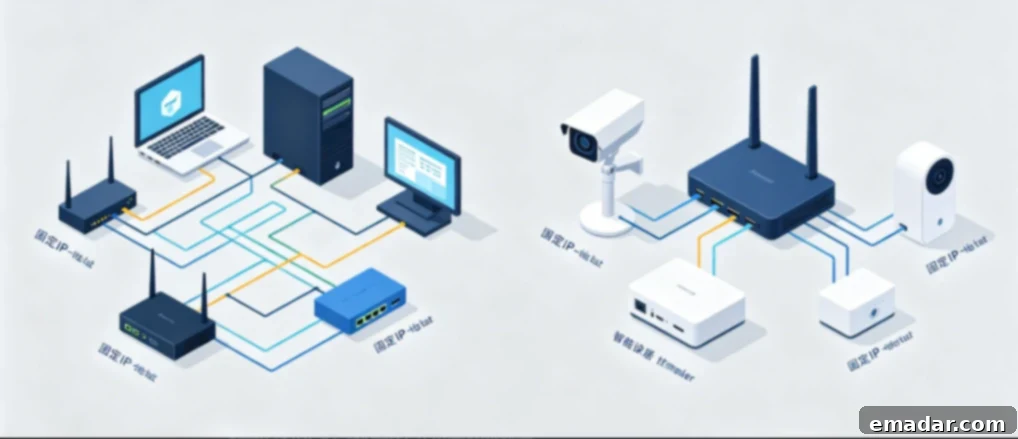
Understanding Static IP Addresses: A Simple Explanation for Everyone
A Static IP Address, in its simplest form, is a “fixed network address” manually assigned to your device by your Internet Service Provider (ISP) or a specialized proxy service provider. Once assigned, this IP address remains unchanged unless manually altered, regardless of whether your device restarts or reconnects to the internet. Think of it as your device having a permanent “street address” in the digital world.
In contrast, most of us regularly use dynamic IP addresses. These are temporarily and randomly assigned by a DHCP server. Your dynamic IP automatically changes each time you connect to the internet, restart your router, or even after a lease period expires. It’s akin to living in a “temporary rental,” where your address changes frequently. While this offers convenience and simplicity, its stability is inherently low.
To illustrate with a more tangible example: your home’s landline phone number, once assigned, never changes. Anyone can reach you consistently at that number – this embodies the logic of a “static IP.” Conversely, your mobile data IP address often changes as you move between cell towers or restart your phone. Others cannot reliably find your device via a fixed IP, which is the defining characteristic of a “dynamic IP.”
Static IP vs. Dynamic IP: A Clear Comparison
Many users ponder whether to opt for a static or dynamic IP. The choice fundamentally depends on your specific needs. Dynamic IPs are perfectly suitable for routine daily internet usage, whereas static IPs are essential for scenarios demanding high stability, consistent accessibility, and enhanced control. The core distinctions between the two are summarized below for quick understanding:
| Comparison Aspect | Static IP | Dynamic IP |
|---|---|---|
| Assignment Method | Manually assigned, remains fixed (unless manually changed) | Automatically assigned, changes randomly after lease expiry or disconnection |
| Stability | Extremely high, long-term fixed, no IP fluctuations | Very low, frequent IP changes, poor stability |
| Key Advantages | Reliable access, anti-association, easy management, ideal for long-term operations | Plug-and-play, low cost, basic privacy protection |
| Key Disadvantages | Slightly more complex setup, may incur additional costs in some scenarios | Unsuitable for stable access requirements, prone to triggering risk control systems |
| Suitable Scenarios | Cross-border account management, remote access, website hosting, live streaming | Casual browsing, video streaming, general office work, mobile device internet use |
The Undeniable Advantages of Static IP: Unrivaled in Specific Scenarios
The fundamental value of a static IP address stems from its “fixed and unchanging” nature. This characteristic provides it with significant, often irreplaceable, advantages over dynamic IPs in numerous applications. Here are the four primary benefits:
Unparalleled Stability to Prevent IP-Related Issues
This is arguably the most crucial advantage of a static IP. Whether you are logging into accounts, accessing websites, or transferring critical data, a static IP will not change due to internet disconnections or device restarts. This consistency prevents common problems like account login anomalies, data transfer interruptions, or failed remote access attempts, which are frequently triggered by IP changes. It is particularly well-suited for situations requiring a continuous and stable internet connection over extended periods.
Robust Anti-Association for Enhanced Account Security
For users managing multiple online accounts, such as cross-border e-commerce sellers or social media marketers, a static IP is vital for preventing account association. By binding each account to a unique, dedicated static IP, you provide each account with its own “independent network identity.” This strategy prevents platforms from detecting multiple accounts sharing the same IP address (or frequently changing IPs), which can flag them as suspicious and lead to account suspensions or bans. This is a critical safeguard against platform risk control mechanisms.
Seamless Remote Access for Convenience and Efficiency
If you frequently need to access devices at home (like a NAS storage, security camera) or your office computer from a remote location, a static IP is the optimal choice. Because your IP address is fixed, you can effortlessly connect to your target device from anywhere in the world using that consistent IP. This eliminates the need for complex Dynamic DNS (DDNS) services, offering a level of stability and ease of use far superior to dynamic IPs. Professionals, freelancers, and anyone requiring regular remote connectivity will find this feature invaluable.
Increased Trust and Suitability for High-Requirement Scenarios
Static IP addresses garner greater trust in many high-stakes environments. For instance, when hosting a personal website or setting up an enterprise email server, a fixed IP allows search engines and mail servers to more consistently identify your site, improving email deliverability and reducing the chances of being marked as spam. Furthermore, payment gateways like PayPal and Stripe often view login environments with static IPs as more credible, thereby minimizing the risk of payment verification failures or account freezes. This perceived reliability significantly enhances your digital footprint.
Common Use Cases for Static IP: Practical Scenarios for Everyone
Many perceive static IPs as an advanced or distant technology, but they are already deeply integrated into our daily lives and various professional fields. Utilizing a static IP in the following scenarios can significantly enhance your experience and mitigate potential risks:
Cross-border Account Management (Most Common Use)
Whether you operate e-commerce stores on platforms like Amazon and eBay, or manage overseas social media accounts on Facebook and TikTok, multi-account operations demand strict separation. Binding each account to a unique static IP is crucial to completely prevent account association and significantly reduce the risk of bans. Moreover, the regional consistency of a static IP can align with the registered region of your store or account, further boosting platform trust and preventing risk control triggers caused by IP geo-hopping.
Personal Remote Work and Device Access
Individuals who frequently need to connect remotely to their company computers, home NAS storage, or surveillance equipment will benefit immensely from a static IP. It enables “always-on, stable access,” eliminating the need to repeatedly search for new IP addresses and preventing interruptions during remote connections. This is particularly ideal for freelancers, remote employees, and anyone requiring reliable access to their digital resources.
Personal Website or Small Server Hosting
If you plan to build a personal blog or a small website, a static IP is an essential prerequisite. A fixed IP ensures that users can consistently access your website via a stable domain name (which is mapped to your static IP). This prevents frustrating situations where your site is “accessible today but not tomorrow.” Furthermore, a static IP can improve your website’s SEO ranking, making it easier for search engines to crawl and index your content.
Live Streaming and Always-Online Businesses
For individuals involved in cross-border live streaming or gaming streams, a static IP guarantees a fixed streaming address, preventing disruptions and viewer loss due to IP changes. For businesses requiring 24/7 online operations (such as ERP system integration or customer service platforms), a static IP ensures continuous service availability, avoiding system disconnections caused by fluctuating IP addresses.
Programming and Developer Scenarios
Programmers and developers often require a stable environment for software testing and API debugging. A static IP ensures this stability, preventing failed API calls or skewed test data due to IP changes. It also facilitates easy port forwarding and firewall rule configuration, significantly boosting development efficiency and streamlining the debugging process.
Essential Tips for New Users: Common Static IP Misconceptions
Misconception 1: Static IPs are Inherently “Superior” to Dynamic IPs
Neither IP type is inherently superior; they simply cater to different scenarios. For everyday browsing and video streaming, a dynamic IP is perfectly adequate. There’s no need to pursue a static IP unnecessarily if your usage doesn’t demand it.
Misconception 2: Static IPs Require Advanced Technical Expertise to Use
Many professional service providers, such as IPFLY, offer static IP solutions that are plug-and-play. They eliminate the need for complex manual configuration, making them accessible and easy to use even for beginners.
Misconception 3: All Static IPs Guarantee Anti-Association Protection
Only “clean and exclusive” static IPs, such as native residential static IPs, truly offer anti-association benefits. Shared static IPs or IPs that have been “tainted” (flagged or used for malicious activities by others) can actually increase your account risk rather than mitigate it.
Misconception 4: Static IPs Require No Maintenance
While static IPs are stable, regular checks for IP availability are still necessary. This helps prevent your IP from being compromised or flagged by platforms. Promptly replacing an IP if any abnormalities are detected is crucial to ensure ongoing security and effectiveness.
The core value of a static IP lies in its “stability” and “fixed nature.” It is not merely a tool for specialists but a practical solution that addresses various real-world pain points for ordinary individuals, cross-border professionals, and content creators. Whether it’s to prevent account association, ensure stable remote access, host a personal website, or facilitate smooth live streaming, a static IP plays an irreplaceable role.
When selecting a static IP, avoid blindly opting for the most expensive option. The key is to match the IP resource to your specific usage scenario, prioritizing cleanliness, stability, and suitability for your needs. This approach will allow you to truly harness its value and avoid common pitfalls.
Register for an official IPFLY account now to access clean, native static IPs covering over 190 countries and regions worldwide. Enjoy plug-and-play convenience, stable, low-latency connections, and 24/7 full Chinese technical support. Register today to unlock a comprehensive static IP experience, mitigate account risks, and boost your operational efficiency!