
Why IP Quality is the Ultimate Ceiling for Business Stability
In the dynamic arenas of cross-border e-commerce, social media management, and robust data scraping, platform risk control mechanisms have undergone a significant evolution. No longer limited to simplistic single-action recognition, these advanced systems now employ sophisticated multi-dimensional “user identity modeling” to assess authenticity and mitigate potential threats.
Today’s leading platforms meticulously evaluate user profiles across several critical dimensions for comprehensive risk assessment:
- IP Source Type: Distinguishing between Internet Service Provider (ISP) assigned IPs and those originating from data centers. ISP IPs are typically associated with genuine residential users, while data center IPs often signal automated or non-human activity.
- Network Behavior Trajectory: Analyzing the user’s online pathways, access frequency, and interaction patterns. Consistent and natural browsing behavior is crucial for building trust.
- Device and Environment Fingerprints: Scrutinizing unique identifiers from devices (e.g., browser type, operating system, plugins, screen resolution) and the overall connection environment to detect inconsistencies or suspicious patterns.
- Behavioral Continuity and Stability: Observing the consistency of actions over time, including IP address stability, login patterns, and the absence of erratic shifts in online activity.
These intricate factors collectively forge a “network identity portrait.” Should this digital persona exhibit a significant deviation from what is perceived as genuine user behavior, it can swiftly trigger a cascade of protective measures, including verification requests, throttling of access, or even outright account suspension or banning. Consequently, IP quality has transcended its former role as a mere ancillary factor; it is now a fundamental variable that directly dictates the sustainability and operational ceiling of any online business endeavor.
The Evolution of Network Identity Recognition Mechanisms
Historically, risk control primarily relied on straightforward rule-based judgments, such as setting limits on request frequency. However, modern systems have vastly evolved, universally adopting advanced behavioral modeling and anomaly detection mechanisms to identify and flag suspicious activities with greater precision:
- Establishing Long-Term User Behavior Baselines: Platforms meticulously build profiles of typical user activities over extended periods, creating a baseline of what constitutes normal behavior for a specific account or user.
- Identifying Anomalous Deviations: Any significant or sudden departure from these established baselines, such as frequent and rapid IP address switching, access from geographically disparate locations within a short timeframe, or unusual spikes in activity, is immediately flagged as a potential anomaly.
- Integrating with IP Reputation Databases: Systems cross-reference IP addresses against extensive databases that track historical usage, blacklists, and previous flags associated with malicious or suspicious activities. This integration assigns a real-time risk score to each IP.
Under this sophisticated detection paradigm, non-residential IPs (like those from data centers) or shared proxy IPs are far more susceptible to being identified and categorized as “non-natural traffic sources.” Their inherent characteristics often clash with the behavioral models of genuine users, leading to heightened scrutiny and potential restrictions.
Underlying Causes of Common Failure Scenarios
In the practical application of online business operations, several recurrent problems commonly hinder success and stability:
- New Account Registration Triggering Multiple Verifications: Freshly created accounts are often immediately subjected to burdensome CAPTCHAs, phone verifications, or email confirmations, significantly delaying setup and user onboarding.
- Login Attempts Being Flagged as Anomalous Access: Users find their legitimate login attempts blocked or challenged because the system perceives the access as unusual or originating from an untrustworthy source.
- Unstable Data Request Success Rates: Automated data collection tasks or API calls experience inconsistent success, with frequent blocks, timeouts, or outright rejections, undermining the reliability of data acquisition efforts.
The fundamental cause underlying these pervasive issues invariably points to one core deficiency: insufficient IP trustworthiness. Specifically, these problems often stem from:
- Usage of Data Center IPs: These IPs are inherently easy for sophisticated platform detection systems to identify and flag due to their distinct network characteristics and association with hosting providers rather than individual residences.
- Reliance on Shared Proxies: When an IP is shared among multiple users, the historical behavior and actions of others become uncontrollable. Prior misuse or suspicious activities by other users on the same shared IP can irrevocably tarnish its reputation, leading to guilt-by-association for all subsequent users.
- IP Behavior Patterns Deviating from Real Users: The automated or bulk activities conducted through certain IPs do not mimic the organic, human-like browsing and interaction patterns that platforms expect from genuine users, triggering flags for bot-like behavior.
All these issues converge on a singular, critical conclusion: the lack of trust associated with the IP address itself is the primary impediment to stable and reliable online operations.

The Indispensable Value of Static Residential IPs
Static Residential IPs, also known as ISP Proxies, offer a groundbreaking solution by synergistically combining “real ISP registration” with “stable IP assignment.” This potent combination delivers a unique set of capabilities essential for robust online operations:
- Establishing Long-Term, Stable Network Identities: By providing an IP address that remains constant and is genuinely registered with an Internet Service Provider, static residential proxies enable the creation of persistent and credible online identities, crucial for sustained platform trust.
- Mitigating Risk Signals from Behavioral Fluctuations: The inherent stability of these IPs drastically reduces the occurrence of erratic IP changes or sudden geographic shifts, thereby minimizing the generation of suspicious risk signals that often trigger platform defenses.
- Enhancing Platform Trust and Account Survival Rates: With a consistent and trustworthy IP profile, accounts are less likely to be flagged, leading to significantly higher levels of platform trust, reduced verification hurdles, and a markedly improved longevity and survival rate for online accounts.
Consequently, Static Residential IPs are rapidly emerging as the preferred and indispensable infrastructure for any business seeking long-term sustainability and reliability in their online ventures.
Static Residential IPs: Technical Definition and Core Characteristics
The Technical Structure of ISP Proxies
Static Residential IPs are fundamentally a specialized category of ISP proxies (Internet Service Provider Proxies). Their core technical architecture is meticulously designed to merge authenticity with performance:
- IP Address Registered with a Real Internet Service Provider (ISP): Unlike data center IPs, these addresses are genuinely allocated by legitimate ISPs and are indistinguishable from the IPs assigned to typical home users. This provides an unparalleled layer of authenticity.
- Network Exit Deployed on High-Performance Server Nodes: While the IP address itself is residential, the actual routing and infrastructure are often hosted on robust, high-speed server nodes. This ensures enterprise-grade connectivity and uptime.
This hybrid structure masterfully achieves a dual advantage:
- Authenticity: They possess the inherent characteristics and trust attributes of a genuine residential network connection, making them extremely difficult for platforms to differentiate from real home users.
- Stability: They offer the robust, consistent, and high-speed connection capabilities typically associated with data center infrastructure, providing reliability that traditional residential connections might lack.
Fundamental Differences Between Static and Dynamic IPs
The critical distinction between static and dynamic residential IPs does not lie in whether the IP “changes” or not, but rather in the profound implications for “identity stability” and consistency over time. While dynamic IPs rotate frequently, static IPs remain constant for extended periods.
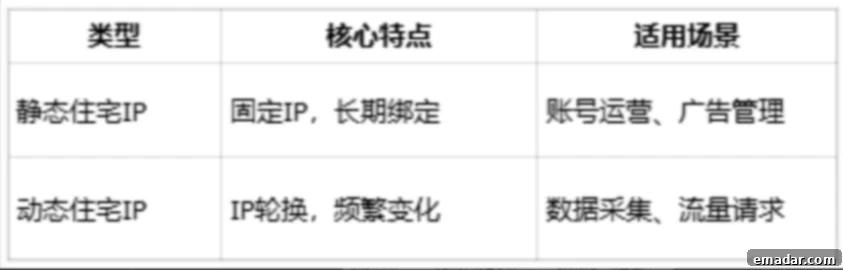
Static residential IPs are uniquely suited for business scenarios that demand continuous identity consistency and long-term association with a stable online presence. This makes them invaluable for tasks where frequent IP changes would trigger suspicion or disrupt ongoing operations, such as managing social media accounts, e-commerce storefronts, or dedicated data scraping projects that require sustained access to specific targets.
Four Core Conditions for Stable Business Operations
To ensure long-term, stable, and unimpeded online business operations, the underlying network environment must rigorously satisfy four fundamental conditions. These pillars collectively form the foundation for trusted and resilient digital presence:
IP Reputation
The trustworthiness and historical standing of an IP address are paramount. A strong IP reputation requires the IP to possess:
- Genuine ISP Origin: The IP must be genuinely registered to a legitimate Internet Service Provider, signifying its connection to a real residential user and not a commercial data center.
- Clean History with No Abnormal Records: The IP should have a pristine history, free from any past associations with spam, malicious activities, botnets, or blacklisting that could flag it as suspicious.
- Non-Shared / Exclusive Use: Ideally, the IP should not be concurrently shared among multiple users, preventing contamination from others’ potentially negative online behaviors.
Behavioral Consistency
Platforms continuously monitor user behavior for patterns and anomalies. Maintaining behavioral consistency is crucial and encompasses:
- Stable Login IP: Consistently logging in from the same IP address or a small, predictable set of IPs helps build a trustworthy user profile and reduces suspicion.
- Consistent Operation Paths: User interactions and navigation paths should be logical and consistent, mimicking human behavior rather than exhibiting erratic or automated movements.
- Absence of Abnormal Jumps: Avoiding sudden, inexplicable changes in geographic location or rapid shifts in behavior that could indicate account compromise or bot activity.
Environmental Isolation
To prevent cross-contamination and account linking, especially when managing multiple accounts, robust environmental isolation is indispensable. This means ensuring:
- Dedicated IP Per Account: Each distinct online account should ideally be associated with its own unique and dedicated IP address, preventing platforms from identifying connections between accounts based on shared network identifiers.
- Browser Environment Isolation: Utilizing separate, unique browser profiles (fingerprints, cookies, local storage) for each account to prevent platforms from linking accounts through device-level identifiers.
- No Cross-Contamination: Strict measures to ensure that activities on one account do not inadvertently impact or link to another, safeguarding against mass suspensions.
Scalability
For growing businesses, the network infrastructure must be capable of expanding seamlessly to meet increasing demands. Scalability ensures the ability to support:
- Parallel Multi-Account Management: The capacity to operate numerous online accounts simultaneously without performance degradation or increased risk.
- Large-Scale IP Resource Deployment: Access to a vast pool of IP addresses that can be provisioned and managed efficiently as business needs grow.
- Long-Term Business Operations: The infrastructure must be reliable and robust enough to support continuous, sustained operations over extended periods without interruption.
IPFLY Static Residential IP: Core Functionality Deep Dive
IPFLY’s Static Residential IP service is meticulously engineered with a suite of core features, each designed to directly address and optimize the four fundamental conditions for stable business operations outlined above.
Exclusive Static IP Mechanism (Ensuring IP Trustworthiness)
Shared IPs inherently carry significant risks that can undermine your online identity:
- Cumulative Behavioral Records: When multiple users share an IP, their diverse activities, both legitimate and suspicious, collectively build a complex and often negative behavioral record for that IP.
- Propagation of Risk Tags: If one user on a shared IP is flagged for suspicious activity, that risk tag can unfortunately propagate to all other users of the same IP, leading to unwarranted scrutiny.
- Uncontrollable Historical Contamination: You have no control over the past actions of other users, meaning an IP could come with pre-existing negative history, impacting your operations from the outset.
IPFLY emphatically addresses these challenges by providing exclusive static IP resources, ensuring unparalleled IP trustworthiness:
- Single-User Exclusive IP Allocation: Each static IP is dedicated solely to one user, ensuring that its reputation is entirely your own and free from external influence.
- Prevention of Cross-User Behavioral Interference: By eliminating sharing, IPFLY guarantees that your online activities are not affected by the actions or flags associated with other users.
- Significant Enhancement of IP Reputation Score: A dedicated, consistently used, and cleanly managed IP naturally builds a strong, positive reputation over time, leading to higher platform trust.
Fixed IP Long-Term Binding (Guaranteeing Behavioral Continuity)
Frequent and unpredictable IP switching can be highly detrimental to establishing a stable online identity:
- Triggering Login Verifications: Platforms often interpret rapid IP changes as suspicious login attempts, prompting additional verification steps like OTPs or security questions.
- Marking as Abnormal Behavior: Constant IP shifts break the pattern of consistent user behavior, leading systems to flag the activity as anomalous or potentially automated.
- Decreased Account Weight/Trust Score: Accounts associated with fluctuating IPs may see their internal trust scores diminish, leading to reduced visibility, higher scrutiny, or even limited functionality.
IPFLY counteracts these issues by offering robust support for:
- Long-Term IP Binding: Users can bind a static IP to their accounts or tasks for extended periods, providing a consistent and recognizable online presence.
- Sustained Stable Connections: The stable nature of static IPs ensures continuous and uninterrupted connectivity, preventing connection drops that could be mistaken for abnormal activity.
This commitment to stability ensures that user behavior consistently aligns with a “continuity model,” fostering trust and reliability with online platforms.
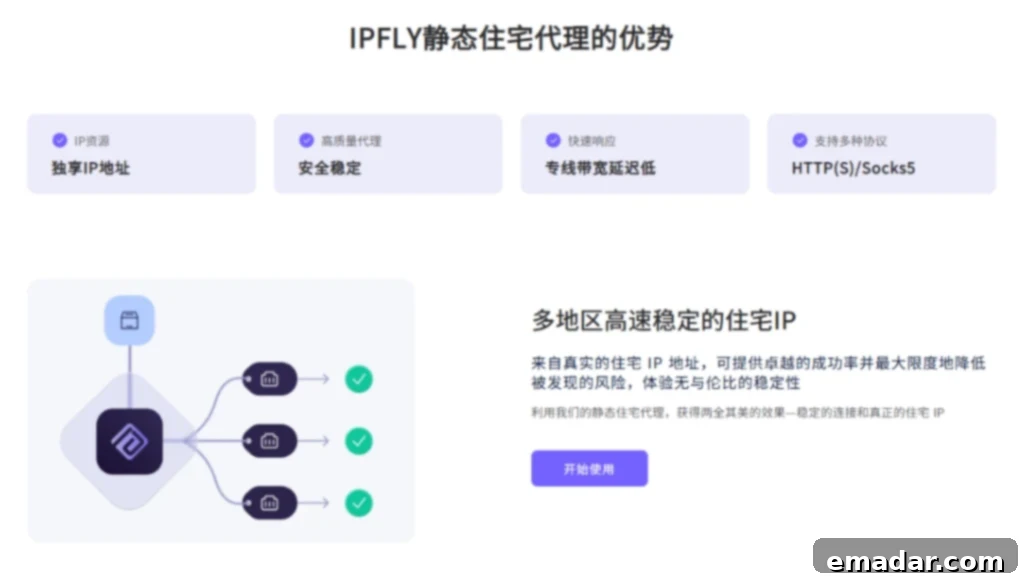
Genuine ISP Network Attributes (Ensuring High Anonymity)
Data center IPs, while offering performance, often exhibit characteristics that make them easily identifiable and thus less anonymous:
- Recognizable IP Ranges: Data center IPs typically belong to specific, well-known IP blocks registered to cloud providers or hosting companies, which are easily detected by sophisticated filtering systems.
- Non-Natural Access Patterns: The sheer volume and speed of requests often originating from data center IPs rarely mimic organic human browsing, immediately raising red flags.
ISP proxies provided by IPFLY achieve superior anonymity and trustworthiness through:
- Utilizing Real Operator IP Segments: By drawing IPs from genuine Internet Service Provider ranges, IPFLY’s proxies appear identical to regular home internet connections.
- Mimicking Home Network Traffic: The inherent nature of these IPs allows for traffic patterns that closely resemble those of a typical household, significantly enhancing their perceived authenticity.
This approach results in a much higher degree of anonymity and a stronger perceived trustworthiness from the perspective of online platforms.
Environment Isolation Support (Anti-Association Mechanism)
Account association, where multiple accounts are linked and potentially banned together, is a significant threat to multi-account operations. It commonly stems from:
- IP Re-use: Multiple accounts being accessed from the same IP address.
- Repeated Fingerprints: Accounts sharing identical device or browser fingerprints.
- Behavioral Consistency: Identical or highly similar usage patterns across different accounts.
IPFLY provides crucial support for environmental isolation, effectively an anti-association mechanism, particularly when integrated with professional anti-detect browsers like AdsPower. This integration enables:
- One-to-One IP and Environment Correspondence: Each online account can be assigned its unique static IP address, coupled with a distinct, isolated browser environment.
- Independent Multi-Account Operation: This setup allows for the simultaneous and independent operation of numerous accounts, each appearing as a separate, unique user.
- Reduced Risk of Batch Bannings: By meticulously isolating each account’s digital footprint, the risk of platforms detecting and linking multiple accounts, leading to mass suspensions, is drastically minimized.
Global Geolocation Capabilities (Ensuring Business Authenticity)
Geographical consistency and accuracy are often paramount for the success and authenticity of various online business scenarios:
- Advertising Campaign Verification: Ensuring that ads are displayed and viewed in their intended target regions for accurate performance analysis.
- E-commerce Price Monitoring: Accessing local versions of e-commerce sites to monitor pricing strategies, product availability, and competitive intelligence specific to different regions.
- Local Search Engine Rankings: Verifying how search results appear for users in specific geographic locations to optimize local SEO strategies.
IPFLY empowers users with comprehensive global geolocation capabilities by providing:
- Diverse IP Resources Across Multiple Countries and Cities: Access to a wide array of static residential IPs spanning various global locations.
- Precise Geographical Location Matching: The ability to select IPs that accurately match specific countries, regions, or even cities, ensuring hyper-localized access.
This precision guarantees that data collection, content verification, and localized marketing efforts yield genuinely authentic and reliable results, reflecting the true user experience in target regions.
High Stability Connection and Low Latency (Ensuring Behavioral Stability)
Fluctuating network connections can generate anomalous signals and disrupt critical online operations:
- Request Interruptions: Inconsistent connections lead to dropped requests, forcing retries and increasing the likelihood of being flagged as automated or unreliable traffic.
- Login Failures: Unstable connectivity can cause intermittent login failures, frustrating users and potentially leading platforms to interpret it as suspicious activity.
- Abnormal Behavioral Records: Frequent disconnections and reconnections create a fragmented user journey, which can be misconstrued as erratic behavior by monitoring systems.
IPFLY mitigates these risks through its high-performance network architecture, delivering:
- High-Availability Connections: Robust infrastructure designed for maximum uptime and minimal service interruptions, ensuring consistent access.
- Low-Latency Response: Optimized network routing and powerful servers guarantee swift data transmission and minimal delays, providing a smooth and responsive user experience.
- Long-Term Stable Operation: The architecture is built for sustained, reliable performance over extended periods, making it ideal for continuous, mission-critical tasks.
Multi-Protocol Support (Ensuring System Compatibility)
To ensure broad compatibility with diverse applications and tools, IPFLY supports mainstream proxy protocols, offering flexibility for various operational needs:
- HTTP / HTTPS: The standard protocols for web browsing and secure web communication, making them compatible with virtually all web browsers and most web-based applications.
- SOCKS5: A more versatile and lower-level protocol that can proxy any type of traffic (not just HTTP/S), including email, FTP, and peer-to-peer connections, offering greater anonymity.
This comprehensive protocol support fulfills a wide range of operational requirements, including:
- Standard Browser Access: Seamless integration with any web browser for manual or automated browsing.
- Automated Scripting: Compatibility with custom scripts and bots developed in various programming languages for automated tasks.
- Data Collection Systems: Enabling robust and reliable data acquisition for complex scraping tools and market intelligence platforms.
Large-Scale Resource Support (Ensuring Business Expansion Capabilities)
As businesses grow and scale, the demand for reliable IP resources inevitably increases. This necessitates support for:
- Multi-Account Management: Efficiently managing a growing portfolio of online accounts.
- High-Concurrency Requests: Handling a large volume of simultaneous data requests or user interactions.
- Global Business Layout: Expanding operations into new geographic markets, requiring localized IP access.
IPFLY, leveraging its expansive global IP resource pool, is uniquely positioned to support these evolving needs:
- Large-Scale Deployment: Capable of deploying and managing thousands of static residential IPs concurrently.
- Flexible Expansion: Resources can be quickly scaled up or down to adapt to fluctuating business demands.
- Long-Term Operation: Designed to sustain large-scale and complex operations over extended periods, providing a stable foundation for growth.
Typical Business Scenario Analysis
Static Residential IPs are critical in various online business operations, offering tangible solutions to common challenges.
Cross-Border E-commerce Operations
Problem:
- Multiple store accounts being linked by platforms, leading to potential bans.
- Inconsistent login environments triggering security alerts and verification processes.
Solution:
- Binding each distinct e-commerce store with its own dedicated, unique IP address.
- Maintaining a fixed and isolated login environment for each store, often with an anti-detect browser.
Result:
- Significantly reduces the risk of account association and subsequent mass bans.
- Elevates the overall stability and longevity of individual store accounts, ensuring uninterrupted sales and operations.
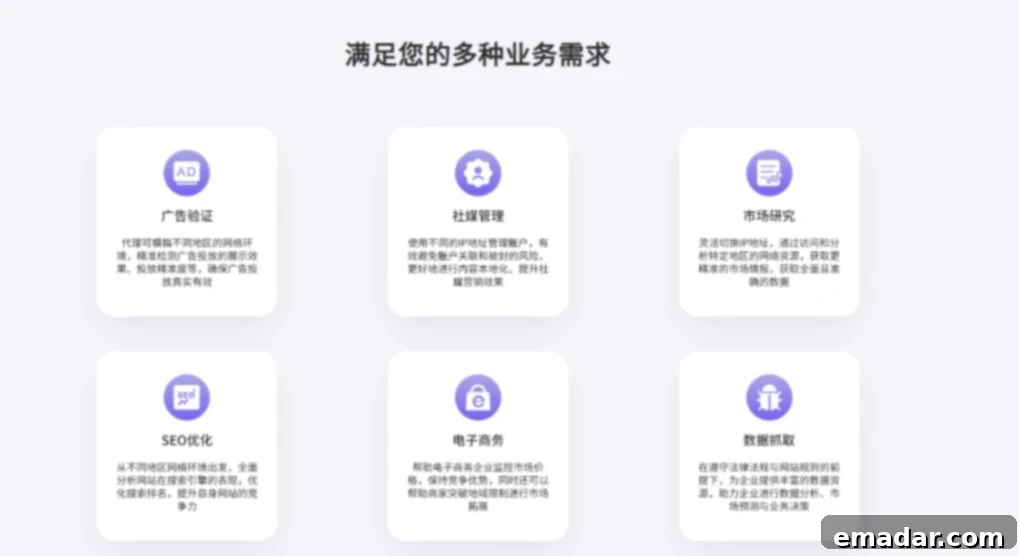
Social Media Account Matrix Management
Problem:
- Multiple social media accounts sharing the same IP address, making them easily detectable as linked.
- Consistent behavioral patterns across multiple accounts originating from the same source.
Solution:
- Assigning a dedicated, unique IP to each social media account, coupled with isolated browser environments.
Result:
- Drastically lowers the account ban rate by masking inter-account connections.
- Extends the survival cycle and operational effectiveness of each individual social media account within the matrix.
Ad Campaign Testing and Verification
Problem:
- Advertisement display and targeting are often geographically influenced, leading to inaccurate verification results.
- Inability to obtain precise data on how ads appear to users in specific regions.
Solution:
- Utilizing local static residential IPs that precisely match the target geographical locations of the ad campaigns.
Result:
- Gains authentic user-perspective data on ad visibility, pricing, and placement, ensuring accurate campaign monitoring.
Data Collection and Market Research
Problem:
- Requests being rate-limited, blocked, or challenged by target websites due to suspicious IP activity.
- Inconsistent and unreliable data acquisition, leading to incomplete or flawed market intelligence.
Solution:
- Employing high-reputation static residential IPs that blend seamlessly with regular user traffic.
Result:
- Significantly boosts the success rate of data requests and API calls.
- Ensures more stable, complete, and reliable data acquisition for critical market research and analysis.
Comparative Analysis: The Appropriate Boundaries for Static Residential IPs
Understanding the unique advantages and limitations of static residential IPs requires a clear comparison with other proxy types, delineating their optimal use cases and risk profiles.
Compared to Dynamic Residential IPs
- Static Residential IPs: Primarily suited for scenarios demanding long-term identity binding, account stability, and consistent online presence, where IP changes are detrimental to trust.
- Dynamic Residential IPs: More appropriate for high-frequency, short-lived requests where IP rotation is beneficial for avoiding rate limits, such as large-scale, anonymous data scraping that doesn’t require maintaining a specific identity.
Compared to Data Center IPs
- Data Center IPs: Offer lower costs and higher speeds but are inherently easier for sophisticated platforms to identify and flag due to their distinct network characteristics and commercial origins. They are best for tasks where anonymity is less critical.
- Static Residential IPs: Provide significantly higher trustworthiness and anonymity by appearing as genuine home users, making them ideal for sensitive operations where blending in is paramount, despite potentially higher costs.
Compared to Free Proxies
Free proxies, while seemingly attractive, pose severe risks and are generally unsuitable for any professional or sensitive operational environment:
- High Contamination Rate: They are frequently abused and therefore often blacklisted or associated with malicious activities, making them highly unreliable.
- Unstable Connections: Free proxies are typically poorly maintained, leading to frequent disconnections, slow speeds, and unreliable performance.
- Significant Security Risks: Many free proxy services are fronts for data harvesting or malware distribution, jeopardizing user privacy and security.
Given these inherent drawbacks, free proxies are unequivocally not recommended for any production environment or critical business operations.
Evaluation Standards for Static Residential IP Service Providers
When selecting a Static Residential IP service provider, it is crucial to focus on several key criteria to ensure you invest in a reliable and effective solution. These standards reflect the core requirements for high-quality, stable, and trustworthy IP services:
- Does the Provider Offer Exclusive IP Resources? Ensuring dedicated, non-shared IPs is fundamental for maintaining a clean IP reputation and preventing contamination from other users.
- Are IPs Sourced from Real ISPs? Verification that IPs originate from legitimate Internet Service Providers is critical for ensuring they possess genuine residential network attributes and are not easily detected as proxies.
- Does it Support Long-Term Stable Use? The service must be designed for sustained, uninterrupted operation, providing consistent connectivity for long-running tasks and maintaining account stability over time.
- Is There Global Node Coverage? A broad geographical footprint is essential for businesses requiring localized access, enabling accurate geo-targeting and market research in various regions worldwide.
- Does it Feature a High-Availability Network Architecture? The underlying network infrastructure must be robust, reliable, and optimized for minimal downtime and low latency, ensuring consistent performance and preventing connection disruptions.
IPFLY stands out in the market by demonstrating comprehensive capabilities across all these critical dimensions, making it a leading choice for businesses seeking high-quality static residential proxy solutions.
Conclusion: Proxy IPs Evolving from Tools to Indispensable Infrastructure
As online platform risk control mechanisms continue to advance and become increasingly sophisticated, the role of IP addresses has fundamentally shifted:
- IPs are no longer merely simple access tools: They have become a crucial element of a user’s digital identity, actively contributing to how platforms perceive and trust an account.
- They are now a core component of online identity: The quality, consistency, and history of an IP address significantly influence an account’s reputation, access privileges, and longevity.
Static Residential IPs, by consistently delivering:
- High-credibility identities: Mimicking genuine residential users for unparalleled trust.
- A foundation for stable behavior: Providing consistent and predictable network access that aligns with natural user patterns.
- Scalable resource capabilities: Offering the flexibility to grow and manage extensive online operations.
have firmly established themselves as critical, indispensable infrastructure for successful cross-border e-commerce, social media management, data scraping, and other data-intensive online businesses.
IPFLY, through its systematic and thoughtfully designed product offerings, achieves an optimal balance between stability, anonymity, and scalability. This makes it an ideal and robust solution for businesses engaged in long-term and large-scale operational scenarios that demand reliability and trust.
FAQ: Frequently Asked Questions About Static Residential IPs
Will a static residential IP completely prevent bans?
No, it will not completely prevent bans. Any online activity carries inherent risks, and platform policies are constantly evolving. However, utilizing high-quality static residential IPs can significantly lower the probability of triggering security alerts, reducing the overall risk of bans or restrictions by presenting a more trustworthy and consistent online identity.
Why do fixed IPs help improve security?
Fixed IPs enhance security by allowing platforms to establish a stable and consistent behavioral model for your online identity. When your IP address remains constant, your login patterns, geographic location, and general online activities appear predictable and organic, making it less likely for algorithms to flag your behavior as abnormal, suspicious, or bot-like. This consistency builds trust and reduces the chances of triggering verification checks or security measures.
What is the difference between an ISP proxy and a regular residential proxy?
An ISP proxy is a type of residential proxy that specifically uses IP addresses officially registered with Internet Service Providers (ISPs), similar to how a home user would get their IP. These IPs offer superior stability, higher speeds, and are generally more trustworthy as they are not reliant on individual home users’ uptime. Regular residential proxies, on the other hand, typically route traffic through real residential users’ devices, which can offer more diversity but might come with lower stability and potentially slower speeds depending on the network of the residential device.
Is it recommended to use one IP for each account?
Yes, it is strongly recommended to use one unique IP address for each online account you manage. This strategy is crucial for mitigating the risk of account association. By isolating each account with its dedicated IP, you prevent platforms from linking your accounts based on shared network identifiers, significantly reducing the risk of a single flagged account leading to a mass ban of all your associated accounts.
For which businesses are static residential IPs suitable?
Static residential IPs are ideally suited for businesses that require high trust, stability, and consistent online identities. This includes, but is not limited to, cross-border e-commerce operations (managing multiple stores), social media account management (building and maintaining social media matrices), advertising verification and testing (ensuring localized ad accuracy), long-term data collection, market research, and any other scenario where stable, authentic, and geographically targeted online presence is critical for success.