
The Indispensable Role of High-Quality IP Addresses in Sustaining Enterprise Operations
In the dynamic realms of cross-border e-commerce, social media management, and market research, online platforms have moved beyond merely evaluating user behavior. They now delve deeper, scrutinizing the very identity behind every interaction.
Modern platform systems leverage a sophisticated array of signals to construct a comprehensive understanding of each user:
- IP Source: Determining whether the IP address originates from a legitimate Internet Service Provider (ISP) or a less reputable data center.
- Behavioral Patterns: Analyzing the frequency, consistency, and navigational paths of interactions over time.
- Device and Browser Environment: Assessing the uniqueness and consistency of the user’s device, operating system, and browser fingerprint.
- Connection Consistency: Monitoring the stability and continuity of the connection from a specific IP address over extended periods.
Collectively, these signals converge to forge a detailed network identity profile. If this profile deviates from the characteristics of a genuine, organic user, it can trigger alarms within the platform’s advanced risk control mechanisms, potentially leading to reduced user trust scores or even restricted access.
The Evolution of Platform Risk Control Systems
Gone are the days when online platforms relied on rudimentary, rule-based systems to identify suspicious activity. Today, the landscape is defined by highly sophisticated frameworks designed for proactive threat detection and user authentication:
- Behavioral Analytics Models: These systems establish baselines for typical user behavior and are adept at detecting anomalies that might indicate bot activity, account hijacking, or other fraudulent actions.
- Traffic Evaluation Systems: Continuously monitor and analyze incoming traffic for patterns indicative of malicious intent, such as rapid requests, unusual login attempts, or large-scale data harvesting.
- IP Reputation Scoring: An intricate system that assigns a trust score to each IP address based on its historical activity, association with known spam/malware, and classification (e.g., residential, data center, mobile).
These advanced systems are engineered to:
- Establish Long-Term Behavioral Benchmarks: Learning and adapting to individual user patterns to differentiate between legitimate activity and suspicious deviations.
- Detect Aberrant Changes: Identifying sudden shifts in behavior, location, or device that could signify a compromised account or an attempt to bypass security measures.
- Utilize Extensive Datasets for IP Reputation Assessment: Drawing upon vast global databases to instantly evaluate the trustworthiness and legitimacy of an IP address, considering its history across various online services.
In this rigorously monitored environment, the legitimacy and integrity of your network connection become paramount for uninterrupted and successful digital operations.
Understanding the Root Causes of Early Account Instability
Businesses operating multiple accounts across platforms often encounter frustrating hurdles, especially during the initial stages of operation. Common issues include:
- Persistent Verification Challenges: Repeated requests for identity verification upon first login or subsequent access attempts.
- Frequent Access Restrictions: Accounts being temporarily locked, suspended, or flagged for unusual activity without apparent cause.
- Inconsistent Request Success Rates: A fluctuating ability to perform routine actions, such as posting content, making transactions, or accessing specific features.
The underlying cause for a significant majority of these early instabilities often boils down to one critical factor: a low IP reputation score.
For instance:
- Data Center IP Addresses: These are typically identified as belonging to commercial server farms, not individual home users. Platforms often categorize traffic from such IPs as non-user traffic, immediately lowering their trust score.
- Shared Proxy IPs: These addresses are used by numerous users simultaneously, leading to a mixed and often questionable history of activities. One user’s illicit actions can negatively impact the reputation of the entire shared IP, inadvertently affecting all other users.
Such low-reputation IPs can erode platform trust from the very first interaction, making it exponentially harder to establish and maintain stable accounts.
Why Static Residential Proxies Are an Essential Tool in Today’s Digital Landscape
Modern platforms, in their quest to ensure genuine user experiences and combat fraud, impose stringent requirements for network connections:
- Stable Identity: A consistent digital presence that doesn’t frequently change its core identifying attributes.
- Authentic Network Source: IP addresses that genuinely originate from residential ISPs, mimicking real human users.
- Consistent Behavioral Patterns: Predictable and logical online actions that align with organic user activity.
This is precisely where static residential proxies, also known as ISP proxies, emerge as an indispensable solution. They are engineered to provide:
- Fixed IP Addresses Over Time: Unlike dynamic proxies that rotate IPs, static residential proxies maintain a consistent IP, fostering a stable digital identity.
- ISP-Based Network Legitimacy: These IPs are registered with legitimate Internet Service Providers, giving them the appearance of genuine residential users.
- Stable Behavioral Signals: The consistent IP allows for the development of predictable and trustworthy online behavior patterns over time.
By leveraging static residential proxies, businesses can significantly enhance their alignment with platform trust evaluation systems, thereby ensuring greater account stability and operational longevity.
What Exactly Are Static Residential Proxies?
To fully grasp their value, it’s crucial to understand the unique architecture and characteristics of static residential proxies.
ISP Proxy Architecture: Fusing Real Identity with Stable Infrastructure
Static residential proxies, often referred to as ISP proxies, represent a hybrid solution that ingeniously combines the best aspects of both residential and data center proxies. They are characterized by:
- IP Addresses Registered with Real Internet Service Providers: These are legitimate residential IPs that have been acquired from ISPs and hosted on powerful servers. This means the IP address is perceived by websites as originating from a typical home internet connection.
- Hosted on High-Performance Infrastructure: Unlike true residential proxies that might rely on end-user devices, ISP proxies are hosted in data centers. This infrastructure provides server-grade reliability, speed, and uptime.
This unique combination yields two profound advantages:
- Authenticity: The traffic originating from these proxies convincingly presents itself as activity from a real, genuine user, significantly reducing the likelihood of detection or flagging by platform risk systems.
- Stability: Leveraging data center infrastructure ensures unparalleled performance, consistent uptime, and a level of reliability that matches server-grade quality, essential for continuous and demanding operations.
Static vs. Dynamic Proxies: The Cornerstone of Identity Consistency
The fundamental distinction between static and dynamic proxies lies in the persistence of identity. This choice is critical and depends heavily on your operational objectives.
- Dynamic Proxies: These proxies are designed to frequently rotate IP addresses, sometimes with every request or after a short interval. This rapid rotation is ideal for maintaining anonymity or for large-scale data scraping where individual IP reputation is less critical than avoiding temporary bans due to high request volumes from a single IP.
- Static Proxies: In stark contrast, static proxies maintain a fixed, unchanging IP address for extended periods, effectively establishing a consistent and stable digital identity.
While dynamic proxies are perfectly suited for tasks requiring anonymity and massive data acquisition across various IPs, static proxies excel in scenarios demanding continuity and a verifiable online presence. They are highly suitable for:
- Account Management: Operating multiple social media accounts, e-commerce storefronts, or advertising accounts without triggering suspicious activity flags.
- Long-Term Campaigns: Running sustained marketing efforts, brand monitoring, or SEO tracking that benefits from consistent IP addresses.
- Consistent Workflows: Any operation where maintaining a steady, predictable online presence is crucial to avoid disruptions and build trust with platforms.
A stable IP address, therefore, plays a pivotal role in helping platforms build a predictable and trustworthy behavioral profile for your account, reducing the risk of false positives from their risk control systems.
Four Foundational Requirements for Stable Digital Operations
Achieving and maintaining stable operations across various digital platforms hinges on adhering to several critical requirements concerning your network identity.
-
IP Reputation (Trust Level)
The trustworthiness of your IP address is a primary determinant of your success. A high-quality IP should inherently possess these characteristics:
- Originates from a Legitimate Internet Service Provider: IPs registered with real ISPs are inherently perceived as more legitimate than those from data centers, which are often associated with automated traffic.
- Maintains a Clean Credit History: An IP address with no prior history of spamming, fraudulent activity, or being blacklisted is crucial for establishing trust.
- Assigned to a Single User or Entity: Dedicated IPs ensure that the actions of one user do not negatively impact the reputation of another, fostering a pristine and controlled environment.
-
Behavioral Consistency
Platforms extensively analyze user behavior to detect anomalies. They demand:
- Customary Login Locations: Consistent access from expected geographical regions builds a reliable user profile.
- Predictable Activity Patterns: Engaging with the platform in a manner that aligns with typical human interaction, avoiding erratic or automated-looking behavior.
- Avoidance of Abrupt Environmental Changes: Sudden shifts in IP address, device fingerprint, or browser configurations can trigger security alerts, indicating potential account compromise.

-
Environmental Isolation
To prevent unwanted associations and minimize risk, each digital entity should operate within its own silo:
- Dedicated IP Address per Account: Assigning a unique IP address to each account is fundamental to prevent platforms from linking multiple accounts to a single source, which is a common trigger for bans.
- Isolated Browser Environment: Utilizing anti-detect browsers or virtual environments for each account ensures that cookies, browser fingerprints, and other identifying data remain distinct and do not cross-contaminate.
-
Scalability
As businesses grow, their operational demands on proxy infrastructure will inevitably increase. The chosen system must support:
- Management of Multiple Accounts: The ability to easily provision and manage a growing number of proxy connections for various accounts.
- Long-Term Workflows: Ensuring that the proxy service can sustain continuous operations without degradation in performance or reliability.
- Adapting to Expanding Operational Needs: The flexibility to scale IP resources up or down dynamically to match evolving business requirements.
IPFLY Static Residential Proxy Features: A Deep Dive
IPFLY’s static residential proxy solution is meticulously designed with a suite of features, each specifically engineered to address critical infrastructure challenges and optimize your digital operations.
Dedicated Static IP Addresses (Enhancing IP Reputation)
Operating in shared IP environments inherently introduces significant risks. The historical usage patterns of shared IPs can be highly diverse, often encompassing activities that negatively impact their reputation. This unpredictability makes it nearly impossible to maintain a consistently high trust score with platforms.
IPFLY circumvents these issues by providing:
- Exclusive IP Address Allocation: Each IP address is dedicated solely to your use, ensuring its history is clean and controlled.
- Non-Shareable Resources: Your assigned IP remains exclusively yours, guaranteeing that no other user’s actions can compromise its reputation.
The Result: A significantly elevated IP reputation score, fostering stable and reliable trust assessments from online platforms, crucial for long-term account health.
Long-Term Fixed IPs (Ensuring Behavioral Consistency)
Frequent changes in IP addresses are a red flag for many platform risk control systems. Such instability can:
- Trigger Verification Processes: Leading to repeated CAPTCHA challenges, SMS verifications, or even temporary account suspensions.
- Disrupt Behavioral Continuity: Making it difficult for platforms to build a consistent behavioral profile, increasing suspicion of bot activity.
IPFLY’s infrastructure is built to support:
- Long-Term IP Binding: Your assigned IP remains static for the duration of your service, allowing for consistent identity presentation.
- Persistent Session Stability: Maintaining a stable connection ensures uninterrupted workflows and a seamless user experience.
The Result: Consistent behavioral patterns that align perfectly with platform expectations, thereby minimizing disruptions and enhancing account longevity.
Authentic ISP-Provided IP Addresses (Enhancing Network Legitimacy)
IP addresses originating from data centers are often segregated and treated with a higher degree of suspicion by online platforms, as they are commonly associated with automated systems and bots.
IPFLY differentiates itself by offering ISP-based IP addresses that:
- Belong to Genuine Network Service Providers: These IPs are indistinguishable from those used by typical home internet users, making your traffic appear organic and legitimate.
- Reflect Natural User Traffic Patterns: The inherent nature of ISP IPs means they blend seamlessly with real user activity, bypassing many automated detection systems.
The Result: A much stronger alignment with platform trust models, significantly reducing the likelihood of being flagged or blocked based on IP type alone.
Environmental Isolation Support (Mitigating Account Linking Risks)
Account linking is a critical concern for multi-account operators. It occurs when platforms identify commonalities that suggest multiple accounts are controlled by the same entity, leading to potential bans or restrictions. This risk is amplified when:
- Multiple Accounts Share Infrastructure: Such as the same IP address, device fingerprint, or browser environment.
- Behavioral Patterns Overlap: Similar login times, posting habits, or interaction sequences across different accounts.
IPFLY addresses this by facilitating robust environmental isolation. It seamlessly integrates with advanced anti-detect browser tools like AdsPower, ensuring:
- One IP Address per Account: A strict one-to-one mapping between each account and a dedicated IP.
- Isolated Operating Environments: Each account operates within its own unique browser profile, complete with distinct cookies, local storage, and fingerprints.
The Result: A dramatic reduction in cross-account risk exposure, allowing you to manage multiple profiles with confidence and stability.
Global Geo-Targeting (Ensuring Data Accuracy)
Geographical location profoundly impacts the digital content and data users encounter. Factors like a user’s IP location influence:
- Advertising Display Results: The specific ads served to a user, their pricing, and their relevance.
- Localized Pricing Data: Product prices that vary by region, crucial for competitive analysis.
- Search Engine Rankings: SEO results that are tailored to the user’s geographical context.
IPFLY provides granular control over location, offering:
- Country and City-Level IP Selection: The ability to choose IP addresses from specific countries and even particular cities worldwide.
The Result: Access to accurate local data and the ability to establish reliable testing environments that truly reflect the user experience in target regions.
Stable Connectivity and Low Latency (Supporting Natural Behavior)
Unstable or high-latency connections can severely hamper digital operations, leading to:
- Session Interruptions: Frequent disconnections that disrupt ongoing tasks and require repeated logins.
- Inconsistent Requests: Delayed responses or dropped requests that can make automated tasks unreliable and inefficient.
IPFLY’s robust infrastructure is specifically designed to ensure:
- High Availability: Minimizing downtime and ensuring your proxies are always accessible.
- Low Latency: Providing swift response times for quick and seamless interactions.
The Result: Smooth, predictable, and uninterrupted operations, allowing your digital activities to flow naturally and efficiently, mimicking genuine user behavior.
Multi-Protocol Support (Ensuring System Compatibility)
To maximize compatibility across a diverse range of applications and tools, IPFLY offers support for multiple industry-standard protocols. The supported protocols include:
- HTTP / HTTPS: The standard protocols for web browsing and secure data transmission, compatible with virtually all web-based applications.
- SOCKS5: A more versatile proxy protocol that can handle any type of traffic, including non-web applications, supporting a broader range of use cases.
This comprehensive protocol support ensures seamless integration with a wide array of systems and tools, including:
- Web Browsers: For manual browsing, account management, and content verification.
- Automation Tools: For scripting complex tasks, data collection, and multi-account management.
- Data Systems: For direct integration into data pipelines and analytics platforms.
Scalable IP Resources (Supporting Business Growth)
As your business expands and its digital footprint grows, so too will your demand for reliable IP resources. This often means:
- The Need for More Accounts: Requiring additional dedicated IPs to maintain isolation and stability.
- Increased IP Resource Requirements: Scaling up your proxy infrastructure to handle a larger volume of operations.
IPFLY is built to accommodate this growth, offering:
- A Vast Global IP Pool: Access to a large and continuously updated inventory of high-quality static residential IPs from diverse locations.
- Flexible Scaling Capabilities: The ability to easily add or remove IP addresses as your operational needs evolve, ensuring you always have the right resources at hand.
The Result: A sustainable foundation for long-term growth, allowing your operations to expand seamlessly without being bottlenecked by IP availability or quality.
Real-World Business Applications of Static Residential Proxies
Static residential proxies are not just theoretical tools; they offer tangible solutions to real challenges faced by businesses operating in the digital landscape.
Cross-Border E-commerce
Challenge: E-commerce businesses managing multiple storefronts across different platforms or regions often face the risk of account association and subsequent bans due to shared IP addresses or detected patterns. This can lead to lost revenue and operational disruptions.
Solution: By assigning a dedicated static residential IP address to each e-commerce store or account, businesses can create a unique and isolated digital footprint for each entity. This mimics distinct human operators.
Result: Significantly improved account stability, drastically reduced risk of account linking, and the ability to operate multiple e-commerce ventures smoothly and securely, enhancing localization and market access.
Social Media Operations
Challenge: Businesses and marketers managing numerous social media accounts for brand promotion, community engagement, or influencer marketing often encounter suspensions or shadow bans when these accounts operate from shared or flagged infrastructure.
Solution: Implementing an isolated environment with a dedicated static residential IP address for each social media account ensures that platform algorithms perceive each profile as belonging to a distinct, genuine user. This includes using anti-detect browsers for full isolation.
Result: A more stable and extended account lifecycle, enabling effective multi-account management, consistent content posting, and robust audience engagement without the constant threat of platform restrictions.
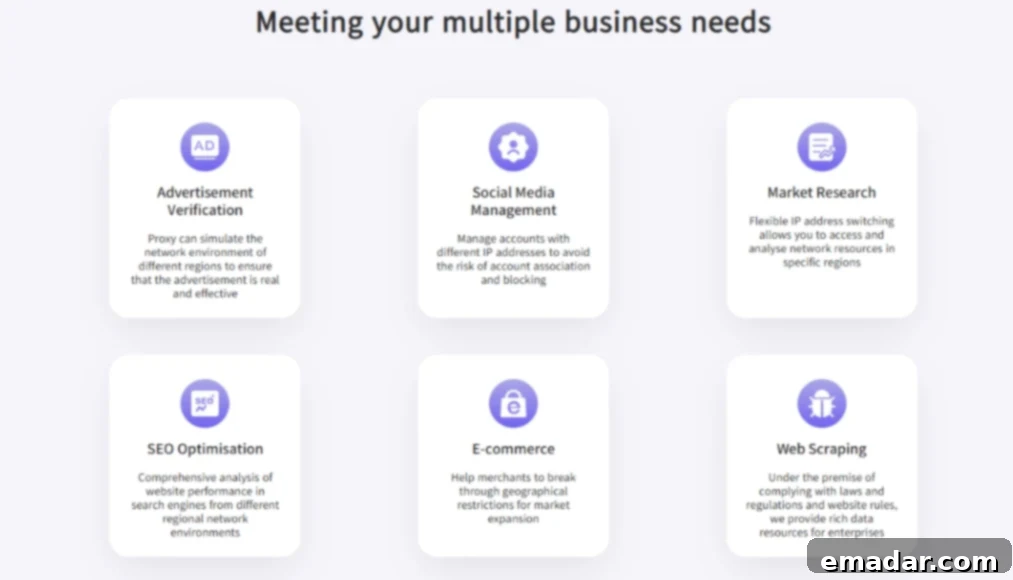
Ad Verification
Challenge: Advertisements often vary significantly based on the user’s geographical location. Verifying that ads are correctly displayed, appear on appropriate websites, and are visible to the target audience in specific regions is crucial for campaign effectiveness and budget allocation.
Solution: Utilizing static residential proxies with precise geo-targeting capabilities allows advertisers to simulate users from specific locations. This enables them to view and verify advertisements as they would appear to the local audience.
Result: Accurate representation of client-side ad content, ensuring compliance, competitive intelligence, and efficient optimization of advertising campaigns by verifying regional ad delivery.
Market Research & Data Collection
Challenge: Conducting comprehensive market research and collecting data from various online sources can be hindered by inconsistent access, IP blocks, and geo-restrictions imposed by websites trying to prevent automated scraping.
Solution: Employing stable and reputable static residential IP addresses ensures reliable and consistent access to target websites. Their legitimate nature helps bypass many anti-bot measures, allowing for uninterrupted data collection.
Result: A robust and repeatable data acquisition workflow, enabling businesses to gather accurate and timely market intelligence, monitor competitor activities, and inform strategic decisions without facing persistent access issues.
When to Deploy Static Residential Proxies: A Comparative Guide
Understanding the nuances between different proxy types is crucial for selecting the right tool for your specific operational needs.
Compared to Dynamic Residential Proxies
- Static Residential Proxies: These are best suited for tasks requiring identity persistence, such as long-term account management, maintaining stable social media profiles, or any scenario where a consistent online fingerprint is vital to build trust and avoid detection. They offer predictability and continuity.
- Dynamic Residential Proxies: These excel when large-scale IP rotation is necessary, for instance, during extensive web scraping, price comparison, or ad verification across a vast number of URLs where individual IP longevity is less important than avoiding temporary blocks by frequently changing IPs.
Compared to Data Center Proxies
- Data Center Proxies: Offer a cost-effective solution with high speeds, making them suitable for less sensitive tasks like general browsing, content delivery, or basic SEO monitoring where the IP’s origin isn’t heavily scrutinized. However, their lower perceived legitimacy makes them more prone to being detected and blocked by sophisticated platforms.
- Static Residential Proxies: While generally a higher investment, they provide significantly enhanced legitimacy due to their ISP-backed origin. This makes them the preferred choice for critical operations like managing high-value accounts, e-commerce storefronts, or any activity where appearing as a genuine user is paramount to avoid restrictions.
Compared to Unverified Proxy Sources
Utilizing proxies from unverified or free sources poses substantial risks. These sources typically lack:
- Stability: Connections are often unreliable, leading to frequent disconnections and operational downtime.
- Security: There’s a high risk of compromised data, malware, or exposure to malicious actors due to a lack of encryption and vetting.
- Predictable Performance: Speeds can be erratic and slow, making efficient operations impossible.
Such sources are emphatically not suitable for any production environment or critical business operation due to their inherent unreliability and security vulnerabilities.
How to Evaluate a Reliable Proxy Provider
Choosing the right static residential proxy provider is a critical decision that directly impacts the stability and success of your digital operations. Key criteria for evaluation include:
- Dedicated IP Address Allocation: Ensure the provider offers truly dedicated IPs that are exclusively yours, preventing shared usage and maintaining a clean reputation history.
- Authentic ISP-Based Resources: Verify that the IPs originate from legitimate Internet Service Providers, guaranteeing they mimic real user traffic and are perceived as highly legitimate by target platforms.
- Long-Term Stability: A reputable provider should guarantee consistent uptime and a fixed IP address for the duration of your service, essential for behavioral consistency and avoiding flags.
- Global Coverage: Look for a provider with a vast and diverse pool of IPs across numerous countries and cities, enabling precise geo-targeting for localized operations and market research.
- High-Performance Infrastructure: The underlying network should be robust, offering low latency and high bandwidth to support smooth, efficient, and uninterrupted operations, regardless of demand.
IPFLY rigorously adheres to and exceeds these essential standards, positioning itself as a premier choice for businesses seeking reliable and high-quality static residential proxies.
Compliance and Responsible Use
At IPFLY, our services are meticulously designed and intended for legitimate, ethical, and compliant business applications. We advocate for responsible proxy usage that respects platform terms of service and legal frameworks. Our services are ideal for:
- Cross-Border E-commerce Operations: Enabling stable management of international storefronts and localized marketing.
- Advertising Verification and Localization Testing: Ensuring ad campaigns display correctly and perform optimally in specific geographic markets.
- Market Research and Data Collection: Gathering public data for competitive analysis and market insights in a reliable and consistent manner.
- Multi-Account Management in Compliance with Platform Policies: Utilizing proxies to manage distinct accounts where platform terms permit, ensuring each account maintains a unique and legitimate online identity.
Conversely, IPFLY unequivocally does not support or condone activities that violate ethical standards or legal regulations. This includes, but is not limited to:
- Engaging in Activities that Breach Platform Terms of Service: Any use that contradicts the acceptable use policies of target websites or services.
- Unauthorized Access to Restricted Systems: Attempting to gain entry to networks or data without explicit permission.
- Fraudulent or Abusive Behavior: Any illicit activity, spamming, or actions designed to exploit or harm individuals or systems.
Users are solely responsible for ensuring their use of IPFLY services aligns with all applicable laws and platform regulations.
Conclusion: The Future of Digital Operations Hinges on IP Quality
The landscape of digital operations has undergone a profound transformation. Proxy services are no longer mere tools for anonymity; they have evolved into fundamental infrastructure components critical for sustained business success in a hyper-monitored online environment.
Static residential proxies, in particular, provide an unparalleled advantage by delivering:
- Trusted Network Identity: Ensuring your online presence is perceived as legitimate and authentic by sophisticated platform risk control systems.
- Consistent Behavioral Signals: Allowing you to build a predictable and trustworthy profile that minimizes disruptions and enhances account longevity.
- Scalable Operational Support: Providing the flexible and robust infrastructure needed to grow your business without compromising on stability or security.
IPFLY is engineered to embody these core principles, making it the ideal partner for businesses engaged in long-term, large-scale digital operations seeking stability, reliability, and competitive advantage. Invest in high-quality IP addresses today to secure the future of your digital ventures.
Frequently Asked Questions (FAQ)
Are static residential proxies completely risk-free?
While no online activity is entirely devoid of risk, static residential proxies significantly minimize the likelihood of detection and enhance compatibility with platform trust systems. They provide a high level of legitimacy, but responsible usage adhering to platform terms of service is always recommended to achieve the best results.
Why is a fixed IP address considered more reliable?
A fixed IP address is deemed more reliable because it enables the maintenance of consistent behavioral patterns over time. Platforms value consistency as it helps them build a reliable profile for a user, reducing suspicion of bot activity or account compromise. Frequent IP changes, on the other hand, can trigger security checks and erode trust.
What is the distinction between ISP proxies and home residential proxies?
ISP proxies (static residential proxies) are IP addresses acquired from ISPs but hosted in data centers, offering superior stability, speed, and uptime due to professional infrastructure. True home residential proxies directly use end-users’ home internet connections, which can be less stable but offer maximum authenticity, albeit with fluctuating performance. ISP proxies combine the authenticity of residential IPs with the reliability of data center hosting.
Should each account utilize an independent IP address?
Yes, absolutely. Assigning a dedicated IP address to each individual account is a crucial best practice. This approach significantly enhances environmental isolation, preventing platforms from linking multiple accounts through common IP usage and drastically lowering the risk of mass bans or restrictions due to account association.
What are the optimal use cases for static proxies?
Static proxies are best suited for operations that demand identity persistence, stability, and a high level of trust. This includes long-term account management for social media or e-commerce, sustained marketing campaigns, SEO monitoring, brand protection, and any workflow where consistent access and predictable behavior are paramount for success and avoiding detection.