
Deep Dive: Decoding and Resolving the “nocaptcha user response code” Error
Encountering the message, “Your nocaptcha user response code is missing or invalid,” can be as frustrating as trying to open a secure door with a key that simply won’t turn. For professionals and businesses navigating the digital landscape, especially those involved in secure online tasks, data collection, or automation, this reCAPTCHA error represents a significant hurdle. It signifies that Google’s advanced security system, reCAPTCHA, failed to receive a valid authentication token from your environment. Without this critical verification, websites understandably restrict access to safeguard their integrity against automated threats and spam.
Understanding this error goes beyond a simple technical glitch; it delves into the intricate dance between your browser, the website, and Google’s sophisticated anti-bot mechanisms. This comprehensive guide will explore the root causes of this common reCAPTCHA issue, offer immediate practical solutions, and uncover the deeper network and IP reputation factors that often underpin persistent problems, providing a robust pathway to uninterrupted online operations.
1. How the reCAPTCHA Mechanism Functions as a Digital Gatekeeper
Google reCAPTCHA acts as an invisible yet powerful digital gatekeeper for countless websites worldwide. Its primary role is to differentiate between legitimate human users and malicious automated bots. When you interact with a reCAPTCHA challenge (whether it’s clicking an “I’m not a robot” checkbox or solving a visual puzzle), a unique, encrypted “response code” or token is generated. This code serves as a digital certificate of authenticity. Your browser then sends this certificate to the website’s server. The server, in turn, validates this token with Google’s reCAPTCHA service. If this intricate chain of communication—from your browser, through the website, to Google’s validation servers—is interrupted, delayed, or compromised, the dreaded “Your nocaptcha user response code is missing or invalid” alert promptly appears, blocking your access.
This multi-layered verification process is essential for maintaining the security and functionality of websites, preventing spam submissions, brute-force attacks, and unauthorized access to sensitive accounts or data. However, for legitimate users, ensuring a smooth reCAPTCHA experience requires a stable and trustworthy digital environment.
2. Deconstructing the Error: What Constitutes a “Missing or Invalid” Code?
The error message itself provides two distinct clues: the code is either “missing” or “invalid.” Understanding the distinction is crucial for effective troubleshooting:
- Missing Code: This scenario typically implies that the reCAPTCHA authentication field remained entirely empty during the data transmission process. It’s as if the system was expecting a response but received nothing at all. Common triggers for a missing code include:
- Failed Widget Load: The reCAPTCHA widget itself failed to load or render properly on the webpage, often due to network instability, browser-side blocking (e.g., by extensions), or JavaScript execution errors.
- User Inaction: The user didn’t interact with the reCAPTCHA challenge at all, or the interaction wasn’t registered by the system before the form was submitted.
- Network Timeouts: A severe delay in network communication prevented the generated token from being sent within the expected timeframe.
- Invalid Code: In this case, a digital certificate was indeed generated and transmitted, but it was deemed unacceptable by Google’s servers. This can happen if the token is:
- Expired: The verification process took too long, and the generated token’s validity window (typically a few minutes) elapsed before it could be successfully validated.
- Corrupted or Manipulated: Although rare for legitimate users, the token might have been altered or damaged during transmission, or Google’s system detected signs of attempted manipulation.
- Suspicious Behavior: Google’s reCAPTCHA system, especially reCAPTCHA v3, assigns a “score” to user interactions. If your digital environment or behavior seems inconsistent with standard human activity (e.g., highly unusual navigation patterns, rapid form submissions, or an IP address associated with suspicious activity), the generated token might be intentionally invalidated, even if technically correct.
- API Misconfiguration: For website owners, incorrect reCAPTCHA site keys or secret keys can lead to tokens always being invalid.
3. Common Business Scenarios Impacted by reCAPTCHA Failures
This reCAPTCHA error isn’t merely an inconvenience; it can severely disrupt critical business operations. We frequently observe this during sensitive tasks such as a LinkedIn Registration, setting up secure market research tools, bulk account creation, or submitting time-sensitive forms.
For example, imagine you are managing a large-scale LinkedIn Registration process for a new team or for market analysis. If your internet connection experiences even a momentary drop or high latency, the verification token generated by reCAPTCHA might expire before it successfully reaches the server. The LinkedIn platform, expecting a fresh, valid code, will return: “Your nocaptcha user response code is missing or invalid.” Similarly, businesses relying on web scraping or automated form submissions often face this issue when their underlying network infrastructure or automation scripts don’t properly handle reCAPTCHA’s dynamic nature, leading to persistent roadblocks and delays in data acquisition.
Five Practical Steps to Immediately Resolve “Your nocaptcha user response code is missing or invalid”
Before exploring more advanced solutions, it’s wise to address the most common, localized causes. Most instances of this reCAPTCHA error stem from minor local configuration issues within your browser or network environment. Here’s how to resolve them efficiently and get back to your tasks.
1. Hard Refresh and Cache Management
Your web browser is designed to store temporary files (cache) and site data (cookies) to speed up loading times. However, outdated or corrupted cached data can interfere with the proper functioning of modern web elements like reCAPTCHA. A “Hard Refresh” forces your browser to bypass its cache and re-download all website resources, establishing a clean connection.
- Action: Press
Ctrl + F5(on Windows or Linux) orCmd + Shift + R(on Mac). Alternatively, you can tryCtrl + Shift + Ron Windows/Linux or `Cmd + Option + R` on Mac, depending on your browser. For Chrome/Firefox, you can also open developer tools (F12) and right-click the refresh button to see “Hard Refresh” or “Empty Cache and Hard Reload” options. - Why it works: This action ensures that your next attempt, whether for a LinkedIn Registration or any other form submission, starts with a brand-new reCAPTCHA widget and a fresh verification token, free from the interference of stale data.
2. Auditing and Disabling Browser Extensions
Browser extensions, while often helpful, can sometimes unintentionally interfere with the JavaScript and iframe elements that reCAPTCHA relies upon. Privacy tools, ad blockers, script blockers, or even custom scripts designed for other purposes can prevent the reCAPTCHA widget from loading correctly or communicating with Google’s servers.
- The Solution: Temporarily disable non-essential browser extensions. Access your browser’s extension management page (e.g., `chrome://extensions` for Chrome, `about:addons` for Firefox). Disable all extensions and try submitting the form again. If the issue is resolved, re-enable your extensions one by one to identify the culprit. This diagnostic step is crucial for troubleshooting the “Your nocaptcha user response code is missing or invalid” error, as it isolates potential conflicts originating from your browser’s add-ons.
3. Ensuring JavaScript Compliance and Browser Updates
Google reCAPTCHA relies heavily on JavaScript for its dynamic functionality, including rendering the challenge, detecting user behavior, and generating the response token. An outdated browser or a browser with JavaScript disabled can directly cause the reCAPTCHA widget to fail.
Action: Ensure your web browser is updated to its latest version. Modern browsers come with up-to-date JavaScript engines that support Google’s advanced security protocols. Check your browser settings to confirm that JavaScript is enabled. If you’re using an older operating system or browser, consider upgrading to a newer, fully supported version to prevent script execution failures and compatibility issues that lead to reCAPTCHA problems.
4. Network Infrastructure Reset
Temporary glitches within your local network infrastructure, such as your router or modem, can lead to packet loss, slow connections, or DNS resolution conflicts. These issues can disrupt the critical communication pathway between your browser, the website, and Google’s reCAPTCHA servers, resulting in a “missing or invalid” code.
Action: Perform a power cycle of your router and modem. Unplug both devices from their power sources, wait for about 30-60 seconds, then plug them back in, starting with the modem, then the router. Allow them to fully reboot and re-establish an internet connection before trying to access the website again. This simple reset can refresh your local network connection, clear any temporary DNS conflicts, and improve overall network stability, often resolving the “Your nocaptcha user response code is missing or invalid” error caused by transient network issues.
5. Utilizing Incognito Mode for Environment Testing
Private browsing modes (Incognito in Chrome, Private Window in Firefox/Safari) offer a pristine browsing environment. They typically operate without loaded extensions and do not use existing cookies or cached data from your main browser profile. This makes them an excellent diagnostic tool.
Action: Open an Incognito or Private window and attempt to complete the task (e.g., LinkedIn Registration). If your operation proceeds without error in this mode, it strongly indicates that the issue lies within your primary browser profile’s stored data (cookies, cache) or one of your active extensions. This pinpoints your troubleshooting efforts, allowing you to systematically clear specific browser data or manage extensions in your main profile rather than guessing.
Beyond Local Fixes: Why Your Network IP Can Be the Real Reason for ReCAPTCHA Errors
While local browser and network troubleshooting can resolve many instances of the “missing or invalid nocaptcha user response code” error, for professionals managing business automation, large-scale data collection, or multiple accounts, the root cause may be deeper within the technical integration or, more fundamentally, your network environment and IP reputation.
1. API Integration: Verify Site Key and Secret Key Consistency
For websites and applications that integrate reCAPTCHA, accurate API key configuration is paramount. reCAPTCHA requires a pair of keys: a “Site Key” (public, used on the frontend to display the widget) and a “Secret Key” (private, used on the backend to verify the token with Google).
Action for Developers/Integrators: Double-check that your integration keys are perfectly matched within your API calls and website configuration. Using a Site Key without its correctly paired Secret Key on the backend will trigger the “Your nocaptcha user response code is missing or invalid” error every single time a form is submitted, as Google’s verification servers will reject the unmatched keys as invalid. Ensure there are no typos, leading or trailing spaces, or environmental mismatches between your development, staging, and production environments.
2. Optimizing Callbacks for Asynchronous Environments
Modern web development often utilizes asynchronous JavaScript and XML (AJAX) to load content dynamically, improving user experience. reCAPTCHA also loads asynchronously. A common integration mistake is attempting to send form data before the reCAPTCHA widget has fully initialized and generated its token.
Action for Developers/Integrators: On dynamic websites, ensure that the reCAPTCHA widget is fully initialized and the response token is successfully obtained *before* your form data is sent to the server. This is typically achieved by using a dedicated “callback” function within your JavaScript. Google’s reCAPTCHA API provides `grecaptcha.render()` with an `onload` callback, or a `data-callback` attribute on the reCAPTCHA div. This ensures that your form submission logic only executes once the verification code has been successfully attached to your outgoing request, preventing the error caused by a premature submission.
The Unseen Factor: Your Network Environment and IP Reputation
Expert View: In many sophisticated scenarios, your code might be impeccable, and your local environment flawless, yet you continuously face the “nocaptcha user response code is missing or invalid” error. This often points to a fundamental issue: your network identity lacks the necessary “Trust Score.” If your IP address is flagged as high-risk, suspicious, or associated with automated activity, Google’s reCAPTCHA system may intentionally refuse to validate your response code, irrespective of user interaction.
Google’s reCAPTCHA system is incredibly intelligent, constantly evaluating the context of each verification attempt. A critical component of this evaluation is the reputation of the IP address from which the request originates.
1. Why Shared Data Center IPs Often Fail reCAPTCHA Checks
Data center IP addresses are commonly used by servers, VPNs, proxy services, and, unfortunately, by bad actors deploying bots and spam. When you connect to the internet through a shared data center IP, you often fall victim to “guilt by association.” If other users on the same subnet or the IP range have exhibited non-compliant behavior (e.g., sending spam, performing credential stuffing, or abusing online services), Google’s reCAPTCHA system will assign a lower trust score to that entire IP range. This leads to significantly stricter verification hurdles, frequent reCAPTCHA challenges, or outright invalidation of response codes, resulting in the frustrating “Your nocaptcha user response code is missing or invalid” loop for legitimate users.
2. ASN Purity: The Foundation of Trust in reCAPTCHA Success Rates
The Role of Autonomous System Numbers (ASN): An ASN is a unique number that identifies a network on the internet. Google, like other advanced security systems, heavily prioritizes traffic from certain ASNs over others. Specifically, Google assigns a much higher trust score to requests originating from Residential ASNs – those associated with major home Internet Service Providers (ISPs) like Comcast, AT&T, Verizon, or BT. These ASNs are indicative of authentic human users engaging in typical browsing behavior.
Conversely, connections from “Server Farm” or Commercial ASNs (those typically used by data centers, cloud providers, and corporate networks) are viewed with significantly higher scrutiny by reCAPTCHA, especially during sensitive tasks like LinkedIn Registration, account creation, or bulk data submission. Such IPs are more likely to be associated with automated tools, bots, or professional web scraping operations, leading to increased reCAPTCHA challenges and a higher probability of the response code being deemed “invalid.” Achieving “ASN purity” by using residential IPs is thus a crucial factor in reCAPTCHA success.
3. Understanding and Mitigating IP Fraud Scores
Every IP address carries a dynamic “reputation” or “Fraud Score.” This score is a composite of various factors, including the IP’s history of abuse, its presence on blacklists, its association with VPNs or proxies, its geographical consistency, and its traffic patterns. If your current connection has a high “Fraud Score,” Google’s reCAPTCHA system can be exceptionally aggressive in its countermeasures. This can manifest as an endless loop of difficult visual puzzles, an immediate “Score 0.0” on reCAPTCHA v3, or the intentional invalidation of a valid response code, leading directly to the “Your nocaptcha user response code is missing or invalid” error.
To overcome this, particularly for professional use cases that require consistent access and high trust, you need to transition to a high-reputation network environment. This means utilizing IP addresses that are clean, untainted, and perceived by Google as originating from genuine human users.
Advanced Infrastructure: Solving “Your nocaptcha user response code is missing or invalid” with IPFLY
For businesses and professionals who consistently encounter reCAPTCHA challenges despite implementing local fixes, the solution lies in a robust, high-trust IP infrastructure. This is where advanced proxy solutions become indispensable, offering the “digital identity” needed to navigate stringent security checks.
1. The Necessity of Native Residential Proxies
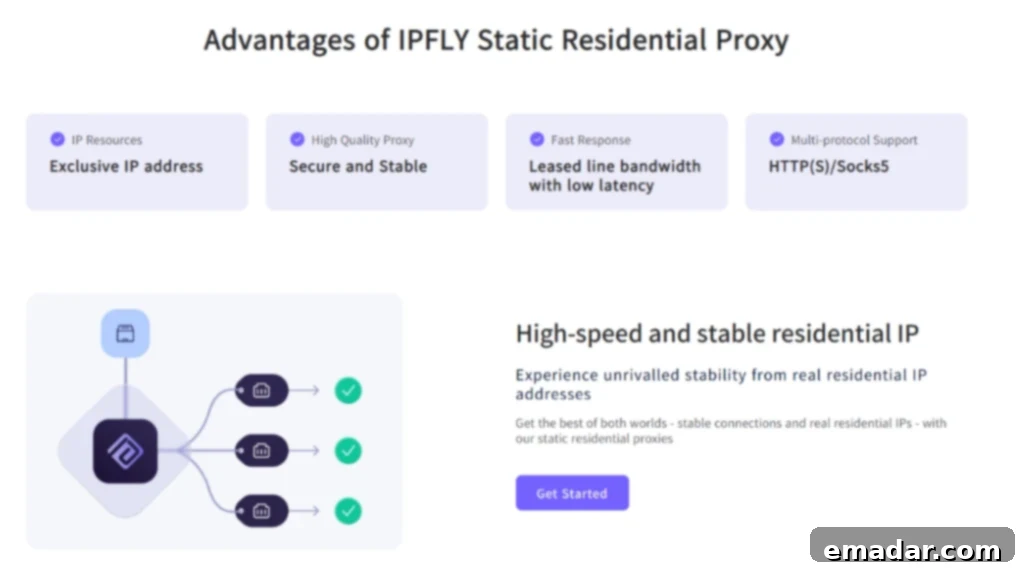
A Native Residential Proxy provides an IP address that is genuinely assigned by a real Internet Service Provider (ISP) to a residential household. Unlike data center IPs, these IPs mimic the online footprint of everyday users. This is the highest standard for identity protection and ensures that your traffic is treated with maximum trust by Google’s security systems, including reCAPTCHA. By routing your connection through such an IP, you effectively bypass the “guilt by association” problem and gain access with a clean, high-reputation identity, significantly reducing the likelihood of encountering the “missing or invalid code” error.
2. Maintaining Session Consistency with Static ISP Proxies
Why Consistency Matters for reCAPTCHA
For sensitive operations or tasks that require prolonged interaction, such as extensive LinkedIn Registration processes or complex data submissions, session consistency is paramount. If your IP address changes mid-session, particularly during or immediately after a reCAPTCHA challenge, the platform may interpret this as suspicious behavior and automatically reject your verification code for security reasons. This leads directly to the “invalid code” error.
Utilizing a Static ISP IP ensures that your “digital footprint” remains stable and unchanged throughout your entire session. This provides the crucial stability needed for successful authentication and consistent interaction with websites, preventing reCAPTCHA failures caused by fluctuating network identities. Static Residential Proxies offer a persistent, high-trust IP that is ideal for maintaining continuous, reliable access.
3. Environmental Isolation with Professional Tools
For multi-account management or scaled operations, simply having a good IP isn’t enough. It’s crucial to combine high-quality IPs from providers like IPFLY with robust environmental isolation tools. Platforms like MostLogin allow you to create distinct, isolated browser profiles, each with its own unique browser fingerprint, cookies, local storage, and, critically, a dedicated IP address.
This approach ensures that each business account operates within its own clean, unique digital environment, preventing any cross-account interference, cookie contamination, or shared IP flags that could trigger reCAPTCHA errors. By isolating each operation, you significantly enhance your success rates and protect against detection, making “missing or invalid” codes a thing of the past for professional-grade tasks.
Conclusion: Building a Trusted Network Foundation for Uninterrupted Operations
The “Your nocaptcha user response code is missing or invalid” error, while seemingly a minor nuisance, can be a significant roadblock for individuals and businesses alike. Resolving this issue effectively is about more than just a quick fix; it’s about understanding the intricate layers of modern web security and building a professional, trusted network foundation.
By systematically addressing local browser issues, ensuring correct API integrations, and, most importantly, leveraging the power of high-reputation residential IP infrastructure provided by IPFLY, you can ensure your business operations remain uninterrupted, secure, and highly efficient. Investing in a reliable IP solution is not just about bypassing reCAPTCHA; it’s about establishing a foundation of digital trust that is essential for success in today’s demanding online environment.